Key Takeaway
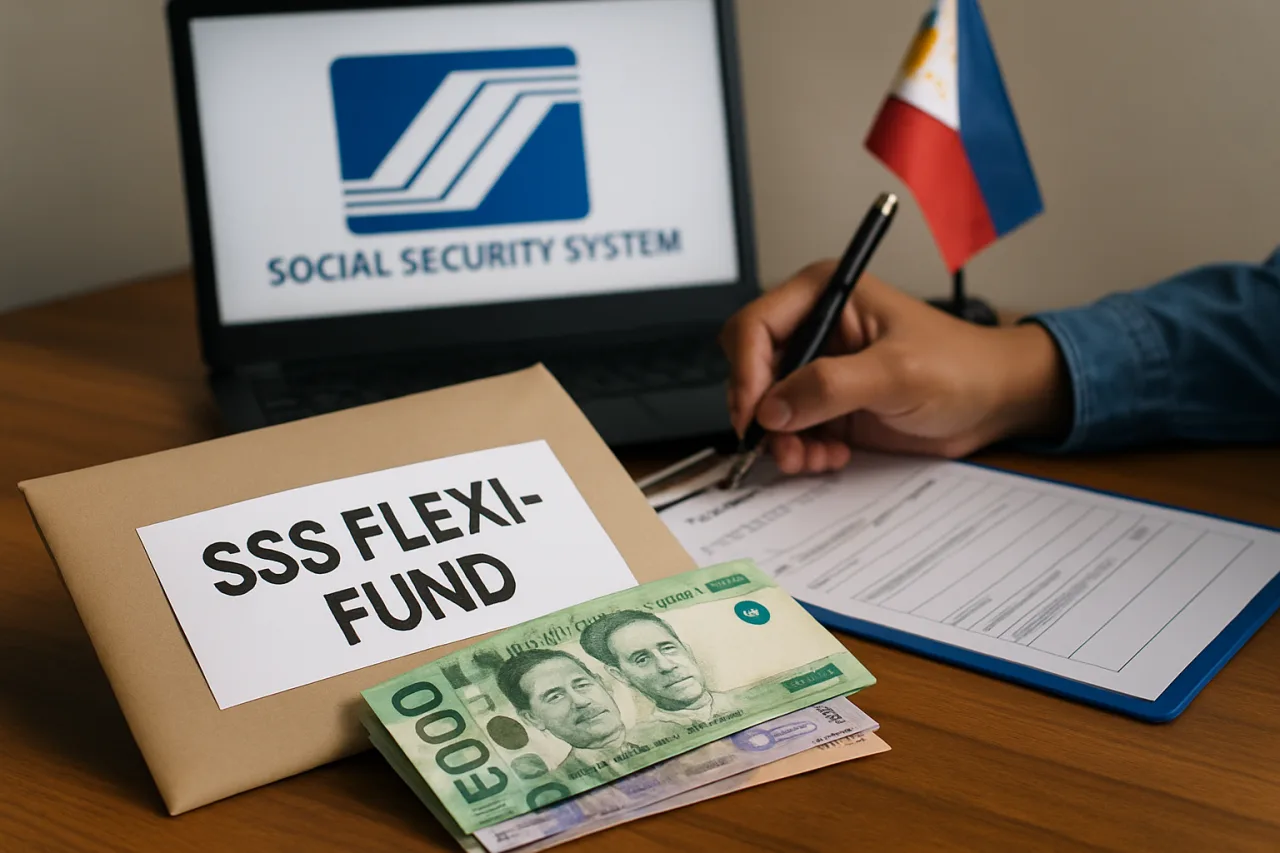
The SSS Flexi-Fund is the OFW’s most overlooked government savings tool. It pays the higher of SSS short-term placement rates or the 91-day Treasury bill rate, every peso of it tax-exempt, with a minimum contribution of ₱200 and no maintaining balance. The gate: your latest regular SSS contribution must sit at the maximum salary credit of ₱20,000 — which for land-based OFWs means paying ₱3,000 a month into regular SSS before a single peso reaches this fund. This guide covers who qualifies, exactly how the rate works, the 1% management fee nobody markets, how withdrawals pay out, and a side-by-side against Pag-IBIG MP2 for the same monthly money.
Table of Contents
What the SSS Flexi-Fund actually is
The Social Security System created the SSS Flexi-Fund as a voluntary, tax-exempt pension-savings supplement exclusively for OFW members. Think of it as a second pocket inside your SSS membership: after you pay the maximum monthly mandatory contribution, every peso above that ceiling spills into this second pocket and earns interest at a rate tied to government short-term yields. The SSS invests the pooled money in fixed-income government securities, which makes earnings guaranteed rather than market-dependent — no equity swings, no principal-loss risk, no negative years.
Two design choices separate the SSS Flexi-Fund from nearly every other savings product sold to Filipinos. First, the interest rate formula is mandated: the average rate of SSS short-term peso placements or 91-day Treasury bills, whichever is higher, repriced quarterly. Second, earnings are exempt from the 20% final withholding tax that takes a bite out of every bank deposit yield. On ₱100,000 the tax difference alone is worth roughly ₱600-700 a year against a comparable taxable deposit at the same headline rate.
Who qualifies: the ₱20,000 MSC gate
The qualification rule is the part most guides bury: to enroll in the SSS Flexi-Fund, your latest regular SSS contribution must be based on the maximum Monthly Salary Credit — currently ₱20,000. For a land-based OFW that means declaring a ₱20,000-or-higher MSC and paying the corresponding 15% contribution: ₱3,000 a month at that rung of the table. Sea-based members get there through employer-side deductions when their salary schedule reaches the maximum band.
Membership continues even after your overseas employment ends, with one condition: supplemental contributions continue only while regular SSS contributions stay at the maximum. The opportunity to add money ceases completely once you file a final claim — total disability, retirement, or death benefits — under the regular program. Age caps admission at 60, and enrollment requires proof you were recruited locally by a foreign employer, earn income abroad, or reside permanently in a foreign country.
How the interest rate actually works
Every SSS Flexi-Fund peso earns the higher of two benchmarks: the average rate of SSS short-term peso placements, or the prevailing 91-day Treasury bill rate. The figure is repriced quarterly, so your yield follows the rate cycle rather than freezing at enrollment. When the BSP policy rate falls, the 91-day T-bill falls and the SSS Flexi-Fund yield follows — but the same mechanism lifts your yield when rates rise, and the floor never drops below the higher of the two benchmarks.
The honest comparison: bank time deposits post similar headline rates but hand 20% of the interest to the taxman, while SSS Flexi-Fund earnings are exempt. The fund also charges a fixed annual management fee of 1% of your accumulated balance — contributions plus earnings — deducted monthly from the account. That fee is the real cost of the guarantee, and the honest way to price it: net of the fee, the fund still beats a taxed time deposit of equal headline rate by roughly the tax differential minus half a point.
How to enroll: the exact steps
Enrollment needs two documents filed together: the Flexi-Fund Enrollment Form for OFW Members, and proof of maximum-MSC contribution status. Download the form from the SSS website, then submit it to any SSS branch, service office, or foreign representative office — or by email to the SSS OFW relations desk with scanned copies. Members already abroad attach validated proof of payment of their latest maximum contribution; members still in the Philippines add the OEC or e-receipt issued before deployment.
Your SSS Flexi-Fund membership takes effect the day the first supplemental contribution posts. From there payment is radically flexible: any amount from ₱200 up, monthly or quarterly or annually or on an intermittent schedule, whatever the deployment allows. No initial deposit, no maintaining balance, no ceiling on supplemental amounts. Channels mirror regular SSS payment rails: My.SSS reference numbers, the SSS Mobile App, GCash and Maya accredited collection, plus overseas representative offices.
Withdrawals and claims
Early withdrawal is allowed anytime, full or partial, through the dedicated claim form (SS Form DDR-2) filed at any branch or foreign office. Two consequences follow: the withdrawal forfeits earnings not yet credited to the fund, and you may re-enroll afterward by resuming regular contributions at the maximum. Final SSS Flexi-Fund benefits pay as a lump sum in the same circumstances that trigger regular final claims — retirement, total disability, or death — computed from accumulated contributions plus all accumulated earnings to date.
Retirement payout carries a choice: take the whole SSS Flexi-Fund balance in one payment or receive it in installments. Members who reach regular retirement age while money remains in the fund are paid alongside their pension. The principal never expires and the fund never forfeits — the only things you ever lose are uncredited earnings on money you pulled early.
SSS Flexi-Fund versus Pag-IBIG MP2: the honest math
Both are government-backed, both pay tax-free dividends, both accept contributions from abroad. The differences decide placement. MP2 has paid around 7% — 7.12% declared for 2025 — while the SSS Flexi-Fund tracks shorter government paper and generally runs lower. MP2 locks money for five years; the SSS Flexi-Fund withdraws anytime with forfeited-earnings as the only cost. MP2 builds Pag-IBIG housing-loan eligibility; the SSS Flexi-Fund never touches the SSS pension formula.
A practical split for an OFW remitting ₱40,000 in savings capacity every month: keep ₱3,000 flowing to regular SSS at maximum MSC, route the emergency buffer into the SSS Flexi-Fund because withdrawals stay penalty-free, and commit the long-term tranche to MP2 where the five-year lock earns the fatter dividend. The programs are complements — the SSS Flexi-Fund is the liquidity layer, MP2 is the compounding layer.
The failure mode: lapsing
The trap is never enrollment — it is lapsing while busy overseas. Miss the maximum-MSC requirement and your supplemental peso quietly stops qualifying for SSS Flexi-Fund crediting; let the regular record lapse and the whole channel shuts until contributions resume. The fix is boring and effective: prepay twelve months of regular contributions whenever cash allows, confirm each posting in My.SSS, and only then route the surplus up top — the same discipline that keeps remittance costs under control.
The money math: what a yearly contribution schedule produces
Numbers make the product concrete. Suppose an OFW contributes ₱2,000 monthly into the fund for a full year — ₱24,000 of principal — and the credited rate runs near the middle of the recent T-bill range, call it around 5.5%. Interest accrues on the running balance, quarterly repricing adjusting the rate as the year moves. After the 1% management fee on the average accumulated balance — roughly ₱120-160 over the year for this schedule — the net position still lands ahead of any taxed bank product at the same headline rate, and the gap widens as the balance compounds across years.
Raise the schedule to ₱5,000 monthly and the same arithmetic multiplies: five years of that habit, with quarterly repricing averaging above 5%, builds a fund approaching ₱350,000 before any final claim.
The withdrawal clock matters as much as the deposit habit. Money pulled before earnings credit forfeits those uncredited earnings — so the practical rhythm that works for OFW cash flow is a quarterly contribution aligned with contract pay cycles, then a review every December when the year’s postings are visible in My.SSS.
Members who treat the fund as a parking lot for occasional surplus lose less to the fee than members who churn in and out, because the 1% charge applies to the accumulated balance regardless of how briefly new money stays.
Paying from abroad: the channel list that actually works
The enrollment paperwork is the easy half; paying sustainably from a jobsite is where OFW members stumble. The reliable rails from abroad, in rough order of convenience: the SSS Mobile App with a locally issued card or wallet link; GCash and Maya, both accredited collection partners that accept reference-number payments for a small convenience fee; PNB, Asia United Bank, and other overseas-fluent partner banks with online payments against the reference number;
Ventaja and other OFW-specialist remittance products sold at deployment hubs; and finally the SSS foreign representative offices themselves, which accept over-the-counter payment in several Gulf, Asian, and European posts. Every rail requires the reference number generated in My.SSS first — pay without it and the posting floats, sometimes for weeks, and a floating posting breaks the maximum-MSC continuity the fund depends on.
Sea-based members should let the manning agency route the regular contribution while self-directing the supplemental peso, because the regular schedule runs through the employer’s books while the fund remains personal. Land-based members juggling contract renewals should set a quarterly reminder to regenerate the reference number — the document carries validity windows, and an expired reference number is the most common reason an overseas payment never posts.
Declaring the right MSC: the walkthrough
Because eligibility hangs on the maximum salary credit, the declaration step deserves its own checklist. Inside My.SSS, the OFW member edits the monthly earnings declaration and selects the salary bracket — the table runs to ₱35,000, but the fund gate sits at ₱20,000, so any bracket at or above that rung qualifies. The contribution then computes at 15% of the chosen bracket: ₱3,000 at exactly 20,000, up to ₱5,250 at the 35,000 ceiling. Paying above the gate does nothing extra for fund eligibility — it does buy a bigger regular pension and more salary-loan headroom, which is worth more than the fund supplement for members deciding where the marginal peso goes.
Members over 55 face a restriction worth knowing before they declare: MSC increases are limited — once per year, one bracket at a time — regardless of proof of income. The exception applies when switching membership type into OFW status for the first time, which allows an unlimited jump straight to the maximum. Plan the declaration before the final contract year rather than discovering the restriction at the enrollment window.
Five mistakes that cost OFW members real money
First, enrolling before the maximum-MSC contribution has actually posted — the application fails or sits pending while the member assumes coverage. Second, treating the fund like a savings account and withdrawing before quarterly earnings credit, paying the re-deposit penalty in forfeited yield. Third, ignoring the management fee’s compounding: large idle balances lose more to the 1% charge than small active ones, which argues for contribution sizing tied to actual saving capacity rather than maximalist parking. Fourth, letting the regular SSS record lapse after returning home — the fund channel dies with it, and reviving both takes months of postings.
Fifth, never comparing the fund’s net yield against current time-deposit promos; the guarantee has value, but a promo paying two points higher net of tax beats it for money you could lock.
Where the fund sits in an OFW’s full stack
Zoom out and the fund is one layer in a four-layer architecture. Layer one: the emergency buffer, three to six months of family expenses, held liquid in a Philippine digital bank for same-day access. Layer two: the fund itself — government-guaranteed, tax-free, penalty-free liquidity for medium-term goals like a homecoming budget or a sibling’s tuition cycle. Layer three: MP2 for the five-year compounding horizon and housing-loan eligibility. Layer four: market instruments — index funds, REITs, blue-chip pesos — for the decade-plus horizon where guaranteed yields stop keeping pace with asset growth.
Members who skip straight to layer four with their entire surplus end up selling positions at bad moments; members who never leave layers one and two end up decades behind. The fund’s proper role is the second layer, and its penalty-free withdrawal design is exactly what that role demands.
Primary program rules referenced for this guide: the SSS Flexi-Fund Program official page and the SSS OFW member coverage rules published on sss.gov.ph — contribution gates, rates, and fee mechanics quoted there.
How to cite this page
Cite as: Worldngayon, “SSS Flexi-Fund for OFWs: Rates, Rules and How to Enroll,” 2026. All mechanics — the ₱20,000 MSC gate, ₱200 minimum, tax-exempt status, quarterly repricing, and 1% management fee — follow the SSS’s official Flexi-Fund Program rules; verify current rates at sss.gov.ph before transacting.