The Seed Phrase Verification Scam: How the Honeypot Trap Drains Curious Wallets
Key Takeaway
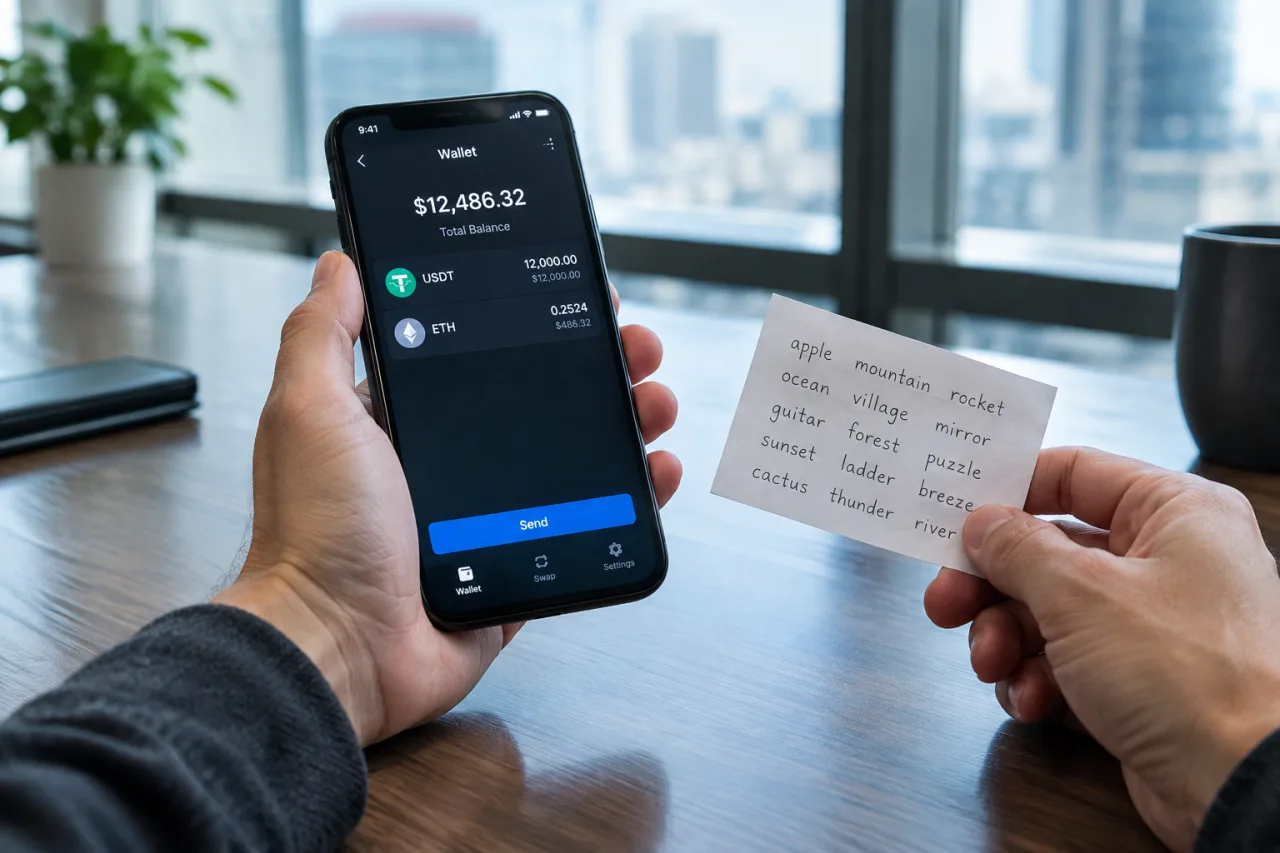
🎣 The seed phrase verification scam plants a “found” wallet online: a seed phrase posted in a YouTube comment or forum thread with a visible balance — importing it works, the balance shows, and moving any coin requires a small “gas top-up” that flows straight to the scammer who posted it.
🕸️ The honeypot is automated: whoever seeded the phrase watches the wallet around the clock — the moment your funded gas arrives, the scripted sweeper drains it faster than you can type; the visible USDT balance is often a fake token contract that only LOOKS valuable.
🚪 The drainer’s cousin needs your approval too: fake “verify your seed phrase” sites that ask you to enter the words run a different play — the words go straight to an attacker-controlled bot, per Group-IB’s drainer research, and the wallet empties the moment it’s imported anywhere.
🧾 The golden rule covers every variant: never import a seed phrase you did not generate yourself, never type an existing seed phrase into any website, and never send gas to “unlock” or “activate” a wallet you found — three rules that survive every version of the trap.
🔐 Your real defense is generation discipline: seeds born on trusted hardware or apps, stored offline, never photographed or typed into browsers — the generation and storage rules our hardware-wallet and wallet-malware guides install.
Table of Contents
“Seed phrase verification” is the scam name dressed as a service: a person finds a seed phrase online — or is handed one — and looks for a way to run a seed phrase verification check whether the wallet holds anything. The search runs straight into infrastructure built for exactly that behavior: verification sites that capture typed seeds, honeypot wallets that pay out “activation fees” to their planters, and fake token balances that mimic value on a ledger you don’t fully read yet. The trap is older than every campaign still running, and the seed phrase verification infrastructure updates its paint but never its mechanism — Group-IB’s drainer research documents sites that collected seed phrases straight into attacker Telegram bots, and the honeypot variant has run for years — the seed phrase verification psychology never ages: free crypto, visible balance, one small step. This guide dissects every variant of the seed phrase online scam, shows the mechanics that make the visible balance worthless, and installs the three golden rules plus the generation discipline that make your real wallet immune forever.
How the Seed Phrase Verification Scam’s Honeypot Works: the Anatomy of the Bait
The Seed Phrase Verification Site Variant: When the Scam Comes to You
The verification-site version inverts the flow — instead of offering a seed, it asks for yours: “Seed checkers,” “balance verifiers,” and wallet-recovery portals invite the user to paste a seed phrase “offline and safe,” and the phrase transmits straight to operator infrastructure: Group-IB’s wallet-drainer research documented sites that routed submitted seeds directly into attacker-controlled Telegram bots, emptying the victim’s real wallet the moment anyone imported it. The packaging varies — drainer kits resurface across campaigns for years after takedowns, the same scripts laundering through new domains. The red flag is structural and permanent: there is NO legitimate reason any website, app, support agent, or “verification tool” ever needs your seed phrase typed or pasted. Seed phrases verify nothing about a website; they ARE the wallet. Any request is the theft itself in the present tense, which makes it the rare scam where the correct response is free, instant, and always the same: close the tab. The seed phrase verification industry ships new skins — AI-themed checkers, exchange-branded ‘support tools,’ recovery dashboards with professional login pages — and every skin shares the one tell that never changes: the form field that accepts words it has no legitimate business ever requesting.
The Fake Team Member Variant and the Sweep Automation
Seed-phrase scams also arrive targeted: fake “team members” or “support staff” from exchanges, wallets, or project Discords DM promising help with a stuck transaction and asking for the seed “to restore access” — the impersonation lane our platform-scam guides track on every messaging app. The seed phrase verification request from a ‘support agent’ double-impersonates: it borrows the platform’s brand AND the support desk’s authority at once, which is why the channel check (no real exchange support everDMs first, no real wallet asks for words) pairs with the domain check — the fake-brand variant rides lookalike handles and freshly registered support domains the fake-website checklist catches on sight. The automation behind successful honeypots is the part victims underestimate: drainer infrastructure watches, sweeps, and relaunches — a drainer can outlive its own shutdown, with code resurfacing in new campaigns more than a year later. Speed asymmetry finishes the picture: the scammer’s bot sweeps a funded honeypot in seconds, while the curious victim is still reading the token contract. The math the victim should internalize: a honeypot that LOOKS like $5,000 costs the planter nothing and pays whenever anyone sends gas — while the victim’s “activation fee” is real money moving to a real-controlled address, one-way, unrefunded.
The Three Golden Rules and Generation Discipline
Every variant above falls to three imperatives that never change. First: never import a seed phrase you didn’t generate yourself — “never import a seed phrase you found publicly, under any framing” — the imported wallet belongs to whoever published the words the moment you fund it. Second: never type or paste an existing seed phrase into any website, form, app prompt, or support chat — verification of a wallet’s balance happens in your own wallet app or a block explorer, using the PUBLIC address, never the seed.
Third: never send coin to “unlock,” “activate,” or “sync” a wallet you found or were given — wallet software doesn’t work that way, and the request maps one-to-one onto the sweep automation. Generation discipline completes the defense: seeds created on trusted hardware wallets or vetted apps, written to paper or metal, stored offline, never photographed, never cloud-synced, never typed into browsers — the full storage protocol sits in the hardware-wallet guide (with the Electrum updates lane covering the software-wallet edge), and the wallet-malware guide covers the drainer-side threats that target the wallets you DO own.
The Drainer Economics: Why the Bait Pays at Scale
Seed phrase verification scams persist because the economics are brutally favorable to the scammer. Production cost: near zero — a fake token contract, an automated watcher, a message template. Operating cost: the watching bots run unattended around the clock. Hit rate: the planter needs one curious importer among thousands of readers to fund the honeypot and pay the sweep — and the sweep takes everything that arrives, instantly, forever. Group-IB’s drainer documentation adds the compounding layer: captured seeds from checker sites feed attacker-controlled wallets immediately, drainer kits survive takedowns and resurface under new domains, and the same infrastructure serves campaign after campaign. The victim’s calculus runs the other way: the visible balance looks like found money, the gas fee looks trivially small relative to a fortune, and the loss lands before the doubt finishes loading. Naming the economics out loud is the antidote — the bait’s entire business model collapses the moment the reader understands that the balance is the advertisement and the gas fee is the sale.
Frequently Asked Questions
What Is a Seed Phrase Verification Scam?
Any scheme where “checking” a seed phrase leads to loss: sites that capture pasted seeds for attacker wallets, honeypot wallets seeded online with fake balances that cost gas to move, and fake support staff who request seeds “to restore access.” The unifying rule: your seed phrase IS your wallet — anything asking for it isn’t verification, it’s the theft itself, and no legitimate service on earth requires typing one.
Why Does a Found Seed Phrase Show a Huge Balance I Can’t Move?
The bait is engineered: fake token contracts mimic USDT or other assets, flashing balances that were never real, or the wallet watches for your gas deposit and sweeps instantly. A visible balance in a wallet you didn’t generate is not spendable by you — the seed phrase verification psychology lives entirely in that one false assumption — the planter controls the wallet faster than you do, has automation watching it, and designed the visible number to trigger exactly the “activation fee” that pays them.
Are Seed Checkers or Balance Verification Websites Safe?
No site needs your seed phrase — the honest tools check PUBLIC addresses on block explorers, which reveal balances without any secret. Seed-phrase “checkers” exist to capture seeds; Group-IB’s drainer research documented them feeding attacker Telegram bots directly, with kits resurfacing for years. Verification of your own wallet happens in your wallet app or a block explorer with your public address — never by typing the seed anywhere.
What Should I Do If I Already Imported a Found Seed Phrase?
What should I do if I already imported a found seed phrase
Assume the wallet is attacker-monitored and send nothing further — including gas. If you typed a seed you use elsewhere into a checker site, treat that wallet as compromised immediately: generate a fresh seed on trusted hardware or a vetted app, move surviving funds to new addresses, and rotate the email and exchange accounts behind it. The seed cannot be un-leaked; the surviving funds can still be saved, and the earlier the migration, the less the sweep collects.
Assume the wallet is attacker-monitored and stop all interaction: send nothing to it (gas included), don’t try to “rescue” the balance — the sweep beats you by automation. If you typed a seed you USE elsewhere into a site, treat that wallet as compromised immediately: create a fresh wallet, move surviving funds to new addresses generated from a new seed, and rotate the email and exchange accounts behind it. The seed can’t be un-leaked; the funds still can be saved.
How Do I Store a Seed Phrase Safely?
Generate it on trusted hardware or a vetted app, write it to paper or engraved metal, store copies offline in separate secured locations, and never photograph it, type it into any browser or cloud note, or share it with any support channel. The storage discipline plus the never-import rule gives your wallet exactly one key holder: you — which makes every honeypot, drainer, and verification site irrelevant to your funds by construction.
Financial Disclaimer
This article provides general security guidance and does not constitute legal or financial advice. Scam tactics, tooling, and platform behavior change over time; verify against official wallet-provider documentation and law-enforcement guidance before acting. The author and publisher disclaim any liability for actions taken based on this information.
External sources linked in this article, in order of first mention. Spotted an error or a broken link? Tell us.
Cite this pagePublished Nov 1, 2026
APA 7
Agron, E. (2026, November 1). The Seed Phrase Verification Scam: How the Honeypot Trap Drains Curious Wallets. WorldNgayon. https://worldngayon.com/seed-phrase-verification-scam/
MLA 9
Agron, Edmon. “The Seed Phrase Verification Scam: How the Honeypot Trap Drains Curious Wallets.” WorldNgayon, 1 Nov. 2026, worldngayon.com/seed-phrase-verification-scam/.
Chicago
Agron, Edmon. “The Seed Phrase Verification Scam: How the Honeypot Trap Drains Curious Wallets.” WorldNgayon, November 1, 2026. https://worldngayon.com/seed-phrase-verification-scam/.
Harvard
Agron, E. (2026) ‘The Seed Phrase Verification Scam: How the Honeypot Trap Drains Curious Wallets’, WorldNgayon, 1 November. Available at: https://worldngayon.com/seed-phrase-verification-scam/.
IEEE
E. Agron, “The Seed Phrase Verification Scam: How the Honeypot Trap Drains Curious Wallets,” WorldNgayon, Nov. 1, 2026. [Online]. Available: https://worldngayon.com/seed-phrase-verification-scam/
BibTeX
@online{agron2026seedphrase,
  author       = {Agron, Edmon},
  title        = {{The Seed Phrase Verification Scam: How the Honeypot Trap Drains Curious Wallets}},
  year         = {2026},
  date         = {2026-11-01},
  organization = {WorldNgayon},
  url          = {https://worldngayon.com/seed-phrase-verification-scam/},
  urldate      = {}
}
RIS
TY  - ELEC
AU  - Agron, Edmon
TI  - The Seed Phrase Verification Scam: How the Honeypot Trap Drains Curious Wallets
T2  - WorldNgayon
PY  - 2026
DA  - 2026/11/01/
UR  - https://worldngayon.com/seed-phrase-verification-scam/
Y2  -
ER  -
Cite the version you read; the page may be updated. Zotero and Mendeley can also import this page directly.