Table of Contents
Key Takeaway
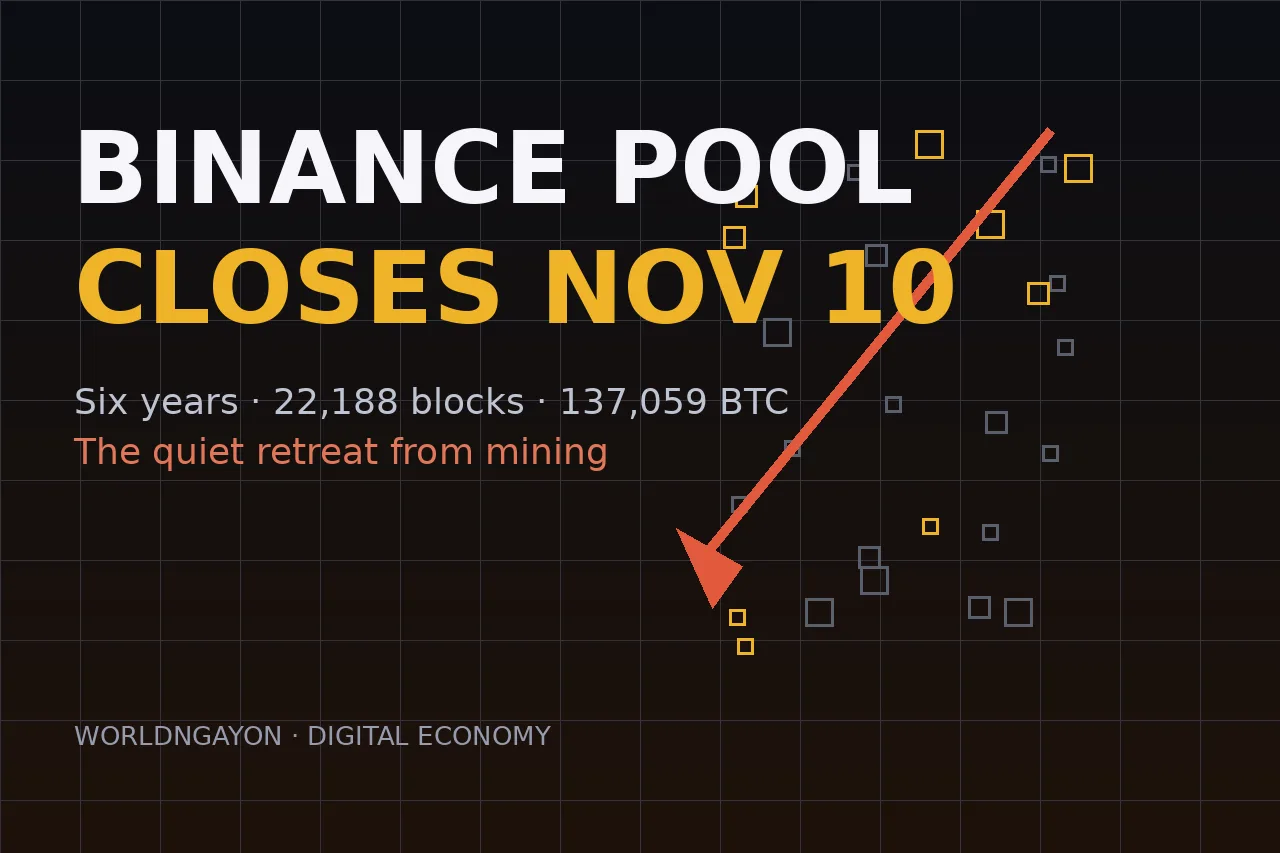
- Binance will shut down its mining pool and all related services — Pool Savings, Cloud Mining, Transaction Accelerator, mining APIs and hashrate alerts — at 07:00 UTC on November 10, 2026, ending a six-year run.
- Since launching in April 2020, Binance Pool mined 22,188 Bitcoin blocks and collected 137,059 BTC in rewards; today it contributes about 19.7 EH/s, roughly 1.1% of network hashrate.
- No reason was given beyond an “ongoing review of products and services” — but the closure fits a clear pattern: Binance is sunsetting infrastructure products while pushing into tokenized stocks, US equities trading and regulated finance.
The Announcement: What Closes and When
The notice went out this week, and the timetable for the mining pool shutdown is precise. At 07:00 UTC on November 10, the mining pool begins disconnecting miners, disabling its Stratum URLs and mining endpoints. Hashrate and shares submitted after that moment will no longer be accepted, processed or credited. The shutdown covers the full family: the mining pool itself, Pool Savings, Cloud Mining products, the Transaction Accelerator, Telegram hashrate alerts, email notifications and the pool API.
Miners have homework before the mining pool cutoff. Machines must be repointed to another pool before November 10 or their work simply stops counting. Pool Savings users must unsubscribe or redeem positions before the service ends. Anyone expecting a final payout has until 23:59 UTC on November 10 to complete identity verification. Pool pages stay viewable for historical records until 07:00 UTC on November 24, after which they disappear permanently. Eligible rewards, balances and refunds process afterward, subject to account status and compliance checks.
Six Years on the Scoreboard
The mining pool record is worth stating plainly before it is erased from the live web. Binance Pool launched in April 2020, when pool choice was a loyalty statement for retail miners. Over six years it mined 22,188 blocks and accumulated 137,059 BTC in rewards — an haul worth billions at any recent price. mining pool scoreboard detail: at its contribution today, roughly 19.7 exahash per second finds about three blocks a day; over the past month it produced 47 of 4,425 blocks, about 1.1% of the network.
Those numbers describe a mid-tier mining pool, not a giant. Foundry USA, Antpool, F2Pool and ViaBTC each out-earn it by multiples, and the 2026 network is dominated by professionally run operations with direct hardware relationships. Binance’s share of hashrate was always a retail convenience feature — miners who already kept coins on the exchange pointed their rigs at the house pool.
Why Now: the Quiet Retreat Has a Pattern
Binance’s official line on the mining pool closure is a product review, and it has not tied the closure to Stratum version debates, hashprice or any regulator. But the surrounding moves sketch the strategy. In June, the exchange opened zero-commission trading in more than 7,000 US stocks and ETFs for customers outside the United States, with fractional purchases from $5 — co-CEO Richard Teng framing it as finance, not crypto infrastructure. A tokenized-equity feature, bStocks, is previewed to mint share-backed tokens on the BNB blockchain.
The NFT marketplace followed the same logic when it closed on July 3, with users pushed to the self-custody wallet. Changpeng Zhao used the phrase “smooth sunsetting of old products” back in 2023; mining services are the latest and largest such sunset. None of the closed products — the mining pool included — carry strategic weight in a portfolio whose growth lines are equities, tokenization and regulated custody — the crypto-bank wall falling across 2026 rewards exactly that pivot.
Compliance arithmetic likely does silent work too. Cloud mining contracts — customers buying future mining output upfront — skirt securities and commodities questions in several jurisdictions, and Binance has lived under multi-year compliance monitoring since its 2023 US settlement. A product line with thin margins, legal exposure and no growth story is the easiest thing on the list to delete.
Where the mining pool hashrate goes next
Hashrate is fluid; loyalty is not, at industrial scale. When Binance Pool’s endpoints go dark on November 10, roughly 19.7 exahash per second of customer hardware will be repointed somewhere within hours — the reconfiguration takes minutes per rig, and miners who miss the cutoff lose only post-cutoff shares. The real question is where the work lands: Foundry USA and Antpool already clear a third of the network between them, and a mid-tier exit like this one concentrates block-finding power further toward the giants.
That concentration is the quiet story inside the story. Bitcoin’s security model assumes distributed hashpower, but economics keep rewarding consolidation — cheaper power contracts, better hardware financing, closer relationships with chip makers. Each pool exit nudges the distribution curve. Regulators and researchers track the effective concentration metric, and every retreat like Binance’s makes the next halving’s map a little more vertical than the last one.
For retail miners — the segment Binance Pool actually served — the migration is a chore with a deadline. Hashrate-market aggregators list the live pool shares; the practical checklist is short: pick a pool, read its payout scheme (FPPS vs PPLNS still matters for small operators), update the Stratum URL, verify accepted hashrate on the new dashboard, then redeem any Binance Pool Savings balances before the November 10 sweep. Anyone holding Cloud Mining contracts has the harder task: those are future-output purchases, not hardware, so the closure terms govern — eligible balances and refunds process after shutdown, subject to account status and compliance checks.
The reference reading for this shutdown: crypto.news’s closure timeline and Bitcoin.com’s six-year retrospective both carry the full service list and dates, while CoinMarketCap’s academy brief adds the hashrate math for readers who want the numbers without the narrative.
The Fee Arithmetic Behind the Decision
Mining pools charge small percentage fees on block rewards — typically between one and four percent — and the business only works at volume. A pool’s costs are real regardless of size: Stratum infrastructure, engineers on call, payout processing, compliance review for every customer account.
The Sector Backdrop: Miners Are Leaving Mining
Binance Pool’s roughly 1.1% network share meant those fixed costs spread over thin volume, and the halvings cut the reward base twice since 2024. Add the post-settlement compliance overhead that shadows every Binance product line, and the pool was likely producing accounting losses dressed up as a “product ecosystem.” The honest description is that exchanges ran pools as user glue — a reason to keep hashrate, and the coins it earned, on-platform. Glue is not a growth business, and this management team is ruthless about deleting those lines.
Binance’s exit lands during an industry-wide identity crisis. Bitcoin mining revenue per terahash has cycled through punishing lows after successive halvings, and operators are converting what they own — power, land, cooling — into AI and high-performance-computing contracts. CleanSpark sold 702 BTC in September and folded its mining updates into a data-center buildout funded by a $2.276 billion notes raise. Hyperscale Data switched off its Michigan miners outright to make room for an AI customer.
The Philippine and OFW Retail Angle
Mining pool consolidation is already underway. SBI Crypto Pool and Poolin have stepped aside as margins compress, and smaller pools fade without coverage; roughly 127 entities still contribute hashrate to Bitcoin. The mining pool business rewards scale and vertical integration, and an exchange-run mid-tier pool carries costs without strategic return. On that scoreboard, the decision is arithmetic, not sentiment — a point Satoshi watchers make with a shrug, since Nakamoto also moved on.
The Rail: What Users Actually Do
Readers on this beat will ask the practical question: does this touch Filipino users? Directly, only a small slice — Filipino retail miners pointing ASICs at Binance Pool, and users of Cloud Mining contracts bought through the exchange.
Filipino traders, stablecoin users and corridor customers are untouched; the mining products are industrial plumbing with a tiny local footprint, unlike the hashrate geography shifts that move markets. The indirect lesson is the one worth keeping: exchange-attached services can retire with weeks of notice, so any household relying on an exchange-attached feature — auto-invest, staking, savings products — should hold an exit plan that does not assume the feature outlives the product review cycle. Diversification across two exchanges and one self-custody wallet remains the cheapest insurance in crypto.
The deeper lesson mirrors what this desk tracks across the beat: platforms are repositioning from crypto-infrastructure companies into financial institutions, and the product lines that defined crypto’s retail era are being retired in favor of regulated, margin-bearing finance. Tokenized equities, custody, settlement — those are the 2027 product stacks being assembled in public. Mining pools, NFT marketplaces and cloud contracts belong to the 2021 retail stack, and no amount of nostalgia changes the margin math. Readers who track which products survive each review cycle are effectively watching a live map of what the exchanges intend to be when the current reinvention finishes.
The Tape: What to Watch
- The mining pool cutoff itself: any extension would signal pressure from miners with stranded positions.
- Hashrate migration flows — whether Binance’s 19.7 EH/s lands on Foundry and Antpool, concentrating the network further, or scatters to mid-tier pools.
- The bStocks launch: the tokenized-equity product is where Binance’s growth capital is going, and its rollout will tell the market what the 2027 exchange looks like.
- More pool exits: SBI and Poolin already stepped back; watch whether one more major operator exits before the next halving, and what the geography of hashrate looks like if it does.
For miners, the mining pool migration is minutes, not weeks: update the Stratum URL in rig configuration to another pool and work continues; only balances accrued before November 10 pay out. For Cloud Mining customers the calculus is harder — contract holders should review termination and refund terms in the closure notice, because future-output purchases are the product being retired.
Will Binance ever run a mining pool again?
Retail users of the Transaction Accelerator lose a convenience for pushing stuck Bitcoin transactions through congested blocks; alternatives exist among third-party accelerators, and fee markets have been friendlier lately. Filipino and OFW retail users of stablecoin settlement services are untouched — the closure is industrial, not payments-side — but it is a reminder that exchange-attached services can retire with weeks of notice. Keep critical rails diversified rather than single-exchange — the cheapest hedge in crypto remains a second exchange account and one self-custody wallet that never depends on a single company’s product roadmap.
Do I need to move my miners off Binance Pool?
The mining pool era of crypto exchanges is closing, one product line at a time. Exchanges are becoming financial institutions that offer trading, custody and tokenized securities — and leaving the industrial base layer to specialists. Bitcoin’s hashrate will not miss Binance; its retail miners will need one deadline circled in red. The mining pool chapter of exchange history closes quietly — exactly the way infrastructure exits are supposed to go.
What happens to my Cloud Mining contract?
Nothing in the announcement suggests a return path. The company framed the closure as part of an ongoing product review and is reallocating toward equities, tokenized stocks and regulated offerings. Historical precedent — the NFT marketplace closure — shows Binance does not resurrect sunset product lines; it migrates users to still-live alternatives and moves on.
Why is Binance shutting down a profitable service?
Yes — before 07:00 UTC on November 10, 2026. Repoint your rig’s Stratum URL to another pool; shares submitted after the cutoff are not credited. Final payouts require identity verification by 23:59 UTC the same day. Pool pages remain viewable until November 24 for records.
Does this affect Bitcoin’s network security?
The product is retired. Review the closure notice for termination and refund terms — eligible balances and refunds process after shutdown, subject to account status and compliance checks. Cloud mining positions do not transfer automatically to any other service.
Is the Transaction Accelerator shutting down too?
Binance Pool was mid-tier (about 1.1% of network hashrate) in a business that rewards scale, and cloud-mining contracts carry securities-law exposure in several jurisdictions. Binance is reallocating toward equities trading, tokenized stocks and regulated products — higher growth, higher margin, fewer compliance headaches.