Table of Contents
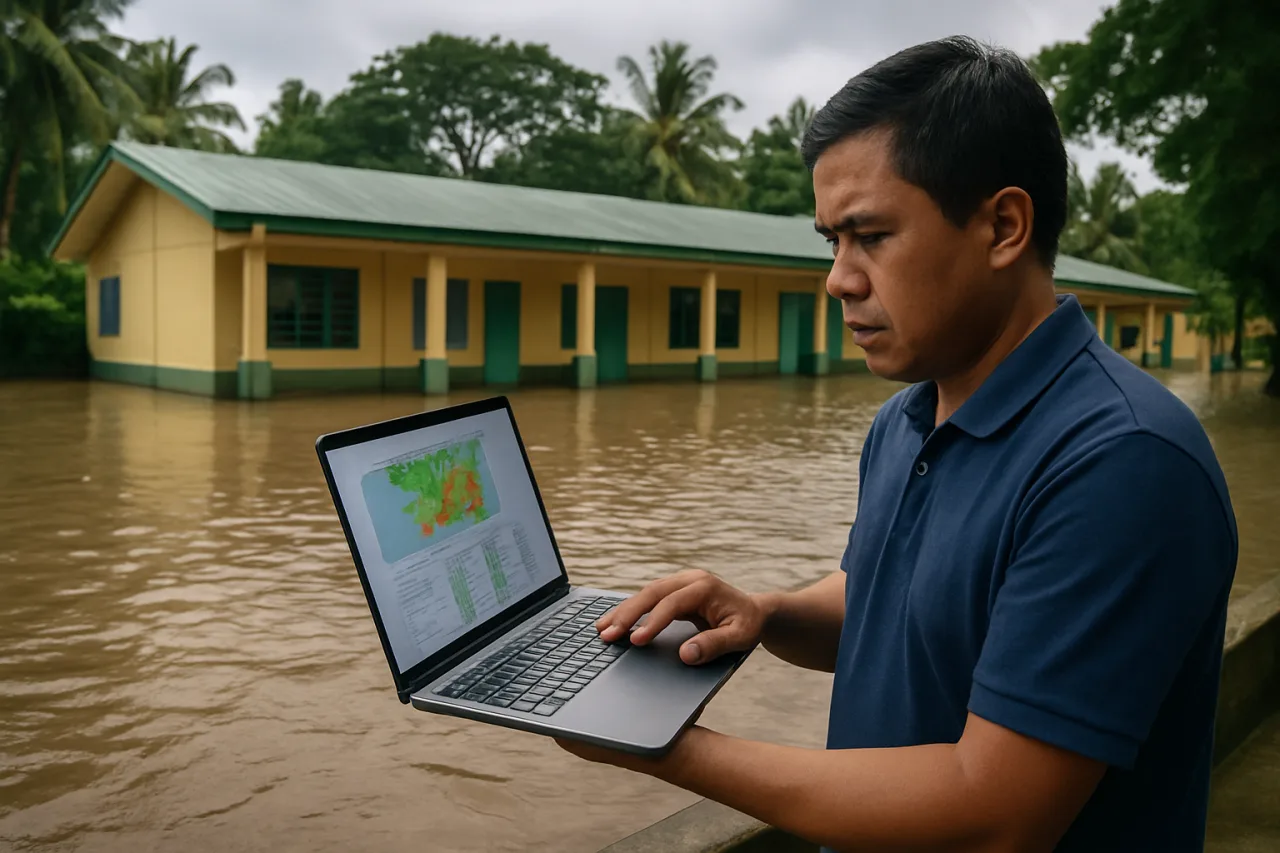
Project LIGTAS is the Philippine government’s answer to a number that should embarrass everyone: Filipino schools lose an average of 40 to 50 instructional days every year to natural hazards, according to EDCOM II — more than two full months of learning washed out by floods, typhoons, and heat, year after year, in one of the most disaster-exposed countries on Earth. On August 26, 2026, Education Secretary Sonny Angara led the nationwide launch of the platform built to break that cycle: LIGTAS+, the Learning Institution Geohazard Tracking and Assessment for Safety, an AI-enabled multi-hazard analytics platform that fuses satellite imagery, geospatial analytics, and school-level risk data into real-time intelligence for every public school in the archipelago. In a demonstration that should matter to far more people than education officials, the system cut official situation-report preparation from hours to about five minutes. This is the analysis of what LIGTAS+ actually does, why it matters beyond the classroom, and what its five-minute promise says about AI’s real role in Philippine public service.
Key Takeaway
- 🛰️ What launched: DepEd’s Project LIGTAS+ went nationwide on August 26, 2026 — an AI-enabled platform fusing satellite imagery, geospatial analytics, and school-level risk data into real-time hazard intelligence.
- ⏱️ The proof: in a launch demonstration, official disaster situation reports dropped from hours to about five minutes.
- 📉 The problem it attacks: Filipino schools lose 40-50 instructional days a year to natural hazards, per EDCOM II — up to a quarter of the school calendar.
- ✅ What families should expect: more surgical class suspensions, earlier and more specific warnings, and less paperwork for teachers during emergencies.
What Project LIGTAS Actually Is — and Why It Exists
Strip the acronym and Project LIGTAS — the “+” marks its extended scope — is a data infrastructure play. The platform, developed by DepEd’s own Disaster Risk Reduction and Management Service, integrates four layers: artificial intelligence for pattern detection and forecasting, satellite imagery including SAR (synthetic aperture radar) flood intelligence, geospatial analytics that map hazards down to individual school coordinates, and the ground truth that only school-level risk profiles can provide. The output is an interactive multi-hazard map where an education leader can see not just that a storm is coming, but which specific campuses sit in its flood path, how severe the risk ranks, and what response each school should execute before conditions deteriorate.
The problem it attacks is genuinely Filipino in scale. The Philippines absorbs roughly twenty typhoons a year on top of earthquakes, volcanic activity, and the monsoon flooding that regularly submerges entire regions. DepEd’s own response machinery has historically depended on fragmented hazard updates — a rainfall bulletin here, a local government suspension order there, a principal’s judgment call at dawn. Angara’s framing at the launch cut to the gap: it is not enough to know that there is a hazard; authorities need to know where it is, who will be affected, how great the risk is, and what to do before a hazard becomes a crisis. Project LIGTAS exists to convert that sentence from rhetoric into dashboard.
The platform’s real-time layer tracks rainfall, extreme heat, wind speeds, and temperature spikes, alerting officials before conditions cross thresholds that force closures. That is a quiet revolution in a system where suspension decisions have traditionally arrived as reactive announcements — sometimes hours after parents have already made risky commutes, sometimes days before any actual threat materializes, in the sweeping province-wide cancellations that cost learning days even when the sun comes out by noon. The PAGASA feeds that underpin the hazard data are the same forecasts Filipinos check every typhoon season; Project LIGTAS fuses them with the one thing those forecasts lack — which specific buildings and children sit in the path.
The Five-Minute Situation Report: Why That Number Matters
Amid the launch coverage, one demonstration number deserves more attention than it received: LIGTAS+ reduced the preparation of official situation reports from hours to around five minutes. In disaster response, the situation report — the sitrep — is the document that tells national and regional officials what is happening, where, and what has been done. Preparing one traditionally means phone calls to division offices, manual consolidation of school reports, and hours of formatting while conditions on the ground keep changing. During a fast-moving typhoon, a four-hour-old sitrep is not intelligence; it is history.
Compressing that cycle to five minutes changes the decision timeline fundamentally. A regional director can see which schools are exposed before the peak of the storm, pre-position resources, issue targeted guidance, and — critically — document everything automatically for the after-action review. The same compression applies upward: national leadership gets a live national picture instead of a morning summary. For a department managing some 47,000 public schools across 7,600 islands, the difference between hours and minutes is not convenience — it is the difference between managing a crisis and narrating one.
There is also a labor-honesty dimension that Filipino professionals in any large organization will recognize. The people who used to spend their nights consolidating sitreps are the same overworked administrative staff the system depends on during emergencies. Automating the document assembly does not just speed up decisions; it frees the humans to make the judgment calls that software cannot — when to pre-emptively move students, which schools need which resources first. The AI does the aggregation; humans keep the judgment. That division, more than any dashboard graphic, is what mature government AI adoption looks like.
The Education Emergency Behind the Platform
The instructional-days number deserves its own examination, because it explains the urgency behind Project LIGTAS. EDCOM II — the Second Congressional Commission on Education, whose landmark findings have driven the current reform wave — found that Filipino schools lose an average of 40 to 50 instructional days annually to natural hazards and class suspensions. Against a school calendar of roughly 200 days, that is up to a quarter of the academic year disrupted, concentrated perversely in the communities least equipped to absorb the loss: rural, flood-prone, under-resourced districts where connectivity and make-up classes are scarcest. The learning-loss literature is unambiguous about what interrupted instruction compounds into — weaker literacy outcomes, higher dropout risk, and widening gaps between students whose schools close often and those whose schools rarely do.
This is why the platform belongs in a broader story about Philippine competitiveness rather than in the “public service convenience” folder where government tech launches usually die. Every instructional day recovered through precise, localized suspension decisions is a day of human capital formation that the economy’s call centers, factories, and burgeoning AI hubs will eventually inherit — or not. The BusinessMirror’s May coverage of the earlier LIGTAS+ rollout phase noted the platform’s role in identifying geohazard exposure for future school construction, which points at the longer game: risk data feeding into where buildings go, how they are engineered, and which communities get resilience investments first. The Philippines’ AI-readiness debate, which we examined in our UNESCAP analysis of the country’s affordability gaps, keeps returning to this exact pattern — the country’s constraint is not ambition but implementation infrastructure, and here is a working piece of it.
AI Disaster Preparedness: What Other Agencies Should Copy From Project LIGTAS
DepEd’s platform arrives as several government AI initiatives are moving in parallel — the DICT‘s own modernization pushes, LGU-level smart-city experiments, and the budget discussions Angara has been waging to fund school safety properly. The lesson worth extracting from Project LIGTAS is architectural, and three features stand out as replicable across agencies.
First, it fuses existing data instead of demanding new collection. Satellite SAR, weather feeds, and school profiles already existed in silos; the innovation is the integration layer that turns them into decisions. Any agency sitting on fragmented data — the DOH with epidemiological surveillance, the DPWH with road and bridge conditions, the DSWD with social welfare registries — has the raw material for the same play. Second, it optimizes for the actual decision, not the technology showcase: the five-minute sitrep targets the exact document that real officials wait for, rather than a generic “AI dashboard.” Third, it was built in-house by DepEd’s DRRMS rather than procured as a black box, which matters enormously for sustainability, data sovereignty, and the government’s ability to iterate without renegotiating a vendor contract. The contrast with stalled mega-projects elsewhere in government is instructive — working software built by the agency that needs it is quietly becoming the most radical idea in Philippine public-sector IT.
The caveats deserve equal billing. An AI platform is only as good as its connectivity, and many of the schools most exposed to hazards are also the ones with the weakest internet and power reliability — the same infrastructure tax the UNESCAP report documented. Data quality is a second constraint: school-level risk profiles require accurate school-level data, and administrative datasets in any large bureaucracy carry legacy errors. And there is the adoption question that kills most government platforms: whether division superintendents and principals actually use the system, or whether it becomes another compliance dashboard checked only when supervisors ask. DepEd’s budget request for a dedicated school-safety line in 2027 suggests the department understands that hardware and platforms without operating budgets are stage props. DepEd maintains its own disaster-preparedness resources on the official DepEd portal, the reference point schools will use alongside the platform itself.
What Parents and Teachers Should Actually Expect
For the families who experience disasters as canceled classes and flooded classrooms, the platform’s promise translates into three practical changes over time. Suspension decisions should get more surgical: hyperlocal hazard data makes it possible to close the exposed schools and keep the safe ones open, ending the era of whole-province shutdowns for weather that never arrives — though the judgment to act on precise data still belongs to humans. Parents should expect earlier, more specific warnings from schools, because the same real-time feeds that alert officials can inform family decisions about pickups, evacuations, and work absences. And teachers should see less admin burden during emergencies — the automated sitrep is hours of paperwork returned to the classroom.
The deeper takeaway for Filipino professionals watching how their government adopts AI: Project LIGTAS is the template worth studying precisely because it is unglamorous. No chatbot, no digital-avatar press conference — just satellite data, school coordinates, and the oldest public-sector problem there is: getting the right information to the person who must decide, before the water rises. If LIGTAS+ delivers even part of what its launch demonstrated, the 40 school days now drowning every year become the metric to watch — not because AI saves them all, but because a country that can see its hazards in real time finally has the option of refusing to lose them. Our coverage of AI deployment questions in Philippine institutions makes the companion argument: the technology works; the governance and follow-through decide whether it matters.
Frequently Asked Questions
What is Project LIGTAS+ of DepEd?
Project LIGTAS+ (Learning Institution Geohazard Tracking and Assessment for Safety) is DepEd’s AI-enabled multi-hazard analytics and risk management platform, launched nationwide on August 26, 2026. It integrates AI, satellite imagery, geospatial analytics, and school-level risk data to give education leaders real-time, actionable hazard intelligence.
How does the LIGTAS+ platform work?
The platform fuses satellite imagery — including SAR-based flood intelligence — with weather feeds and school-level risk profiles on an interactive multi-hazard map. It tracks rainfall, extreme heat, wind speeds, and temperature spikes in real time, and generates school-specific risk assessments that support suspension and response decisions.
How much class time do Filipino schools lose to disasters?
DepEd cited EDCOM II data showing schools lose an average of 40 to 50 instructional days per year to natural hazards and class suspensions — up to a quarter of the school calendar, concentrated in flood- and typhoon-prone communities.
How much faster is LIGTAS+ than the manual process?
In a demonstration at the launch, the platform reduced official situation-report preparation from hours to about five minutes, compressing the emergency-response cycle so officials can act during a fast-moving hazard rather than after it.
Does Project LIGTAS+ decide class suspensions automatically?
No. The platform provides data and risk assessments; suspension decisions remain with education officials and local authorities. The AI narrows uncertainty about where hazards are and who is exposed — the judgment calls stay human.
What are the platform’s limitations?
Its value depends on internet and power reliability at the schools most exposed to hazards, on the accuracy of school-level risk data, and on sustained funding — DepEd is seeking a dedicated school-safety budget line for 2027. It is decision support, not a replacement for local judgment and on-the-ground verification.
Financial Disclaimer
This article is provided for general information and educational purposes only. It does not constitute financial, investment, or professional advice. Platform capabilities described reflect government statements and media coverage at the time of writing and may evolve. For official information on school safety and class suspensions, refer to the Department of Education and your local government’s official channels.