Table of Contents
Key Takeaway
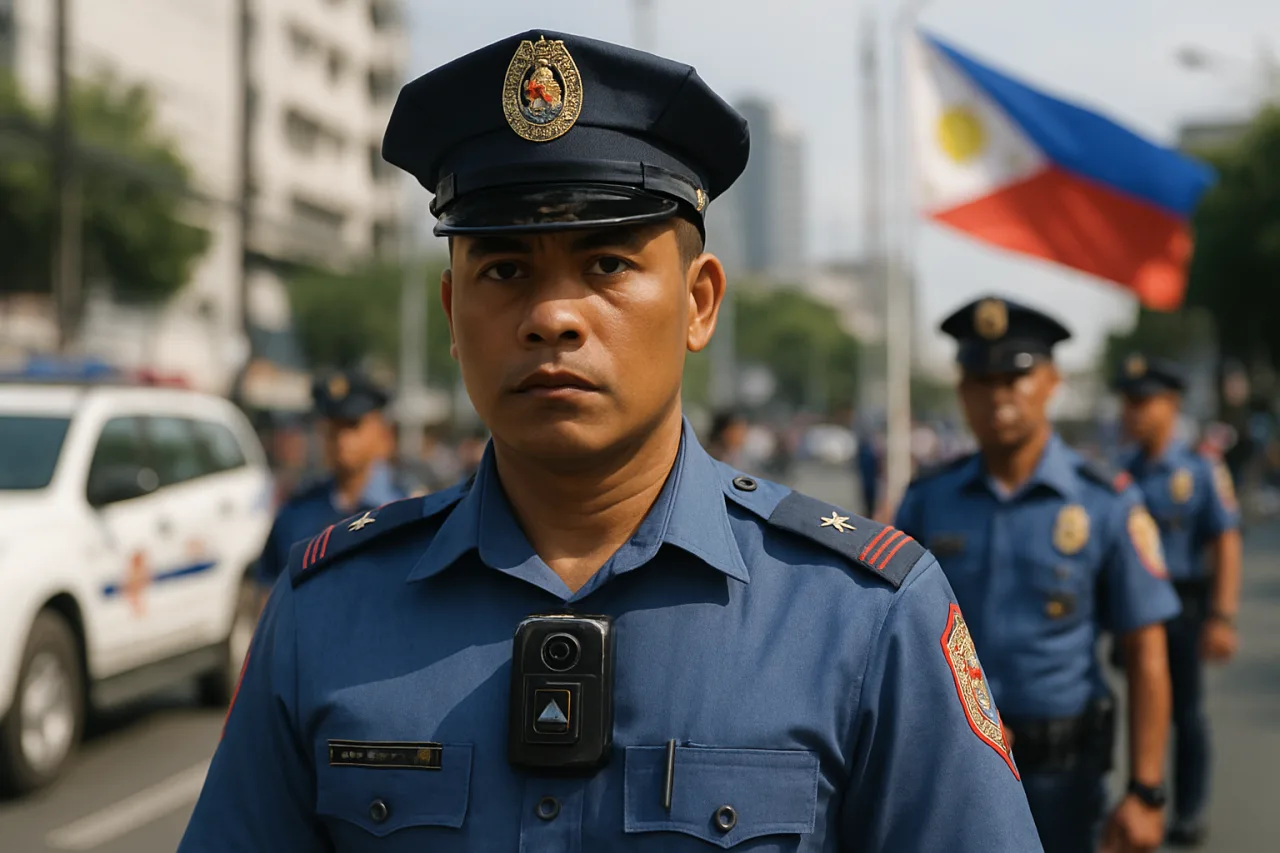
- 🎥 The buy: The PNP is purchasing up to 20,000 PNP AI body cameras Philippines-wide, Interior Secretary Jonvic Remulla told the House appropriations committee on August 27 — a tenfold jump from the roughly 2,000 units now serving a 230,000-strong police force.
- 🤖 What “AI-enabled” means: PNP chief Gen. Jose Melencio Nartatez Jr. said the new AI body cameras Philippines will get carry superior lenses and image quality built for AI processing — with usage guidelines to be crafted alongside privacy agencies.
- ⚖️ The legal anchor: A 2021 Supreme Court issuance already requires body-worn cameras during the implementation of search and arrest warrants — this procurement scales that requirement to everyday operations.
- 🔍 The open question: Whether facial recognition — the capability that turns 20,000 PNP AI body cameras from recording devices into identification networks and real-time analytics will be switched on — the feature that has triggered privacy battles in the US and UK — remains undecided, and the Data Privacy Act applies.
- 📌 What to watch: The 2027 budget process and the joint guidelines the PNP promised; both will define what these cameras may and may not do.
The Philippine National Police is preparing its biggest surveillance technology upgrade in years: up to 20,000 AI body cameras Philippines-wide, enough to outfit one in every eleven police officer — a deployment scale that makes the PNP AI body cameras program the largest police-technology purchase in Philippine historys, under a procurement disclosed by Interior and Local Government Secretary Jonvic Remulla at the House appropriations committee hearing on the department’s 2027 budget on August 27, 2026. The announcement lands at the intersection of two powerful currents — a Supreme Court mandate that has been waiting for hardware to catch up since 2021, and a global debate over what police cameras equipped with artificial intelligence should be allowed to see, remember, and match. For Filipino citizens, commuters, activists and even the police officers themselves, the rollout will define how the line between public security and state surveillance gets drawn in practice.
The scale matters as much as the technology. The PNP today fields roughly 2,000 body-worn cameras for a police force of more than 230,000 — a ratio that has confined cameras to high-profile operations like warrant service, drug busts and demolition evictions. Twenty thousand units change the arithmetic entirely: patrol stops, checkpoints, barangay-level operations and the daily encounters between police and citizens become recordable as a matter of course. And unlike the 2019-era units, these cameras are explicitly built for AI processing — which is precisely why the announcement has drawn both praise for transparency promises and immediate questions about facial recognition.
What the PNP AI Body Cameras Program Is Buying — and What the PNP Chief Promised
PNP chief Gen. Jose Melencio Nartatez Jr. addressed the procurement directly on Friday, August 28, framing the AI body cameras Philippines program as an evidence and accountability tool first. “The AI-enabled body cameras will enhance the PNP’s capability to document police operations with clearer and more reliable footage,” Nartatez said in a statement carried by the Philippine Daily Inquirer. “This will help preserve evidence, support investigations, and promote greater accountability among our personnel.” He added that the new units are “expected to have superior lenses and image quality that will make them more suitable for AI processing” — a detail that matters more than it sounds, because AI features like license-plate reading, object detection and face matching are only as good as the footage they analyze.
Nartatez also committed to coordination: the rollout of the cameras, he said, will be coordinated with the agencies concerned to craft guidelines on the use of the AI features, in compliance with privacy and evidence-handling requirements. “We assure the public that these body cameras will be used to strengthen transparency and accountability in police operations,” he said, extending the promise to officers themselves: the technology, he argued, will “protect not only the public but also our police officers by providing an objective record of what transpired during police encounters and operations.”
The money line runs through the 2027 national budget. Remulla disclosed the procurement during the House appropriations committee hearing on the DILG’s proposed spending, and the PNP’s wider modernization request — a proposed ₱242.5-billion budget, up 7 percent from the previous year per the Philippine News Agency — is the vehicle. Earlier reporting put the PNP’s ambition at 34,000 body cameras for police units nationwide, with annual augmentations after the initial purchase. The 20,000-unit first tranche is the down payment on that target.
Why Now: The 2021 Supreme Court Mandate
The rollout is not happening in a legal vacuum. A 2021 Supreme Court issuance requires law enforcement officers to use at least one body-worn camera and one alternative recording device when implementing search and arrest warrants — a rule born from the drug-war era, when the absence of independent footage made contested operations impossible to adjudicate. The problem since then has been simple arithmetic: 2,000 cameras cannot cover 230,000 officers, so the mandate has lived mostly on paper, honored at warrant implementations and headline operations and ignored everywhere else.
The AI body cameras Philippines procurement is the hardware catch-up. With the AI body cameras Philippines program at 20,000 PNP AI body cameras units, warrant service becomes fully covered with room to spare for routine patrol work — and the “alternative recording device” requirement becomes trivially satisfiable. The procurement also lands amid a broader legislative push to institutionalize Philippine cyber governance: the House has passed a critical information infrastructure cybersecurity bill, and measures like HB 9605 creating a national cybersecurity council remain pending in the Senate. We explained what HB 9605 would create here; body-camera governance will be one more file on that institutional plate.
The Privacy Question the PNP AI Body Cameras Haven’t Answered Yet
Here is the part that deserves more attention than the procurement number itself: what the AI in “AI-enabled” will actually do. Globally, police body cameras have drifted from passive recorders toward active sensors. Axon, the largest US supplier, has tested facial recognition on body-worn cameras; a report by the R Street Institute documented rising concerns over bias and oversight as departments integrate real-time video analytics, warning that “the line between public security and state surveillance lies not in technology, but in the policies that govern it.” In New Orleans, officers ran facial recognition across a private network of more than 200 cameras in violation of city policy — the kind of capability creep that happens when hardware arrives before rules do.
The Philippines has its own legal scaffolding for this: the Data Privacy Act, enforced by the National Privacy Commission, applies in full to biometric processing by government agencies — and the NPC has shown willingness to act, tracking hundreds of data breach notifications in recent years. Our coverage of the NPC’s incident reports shows the commission already struggles with enforcement capacity against private-sector leaks; adding a 20,000-camera biometric pipeline to its oversight load is a serious ask. Nartatez’s commitment to craft guidelines “with the agencies concerned” is the right shape of promise — but the guidelines for the AI body cameras Philippines rollout do not yet exist, and their content (whether facial recognition is permitted, how long footage is retained, who can search it, whether real-time matching is ever allowed) will determine whether this program is remembered as an accountability tool or as the largest biometric surveillance expansion in Philippine history.
The technology’s dual-use nature is worth stating plainly. The same computer vision that automates evidence tagging can, with a settings change, sweep faces into watchlists. AI-generated fakes are already a documented problem in Philippine scam culture — deepfake-driven fraud has surged across the country — and the fear inverts for state systems: footage that can be trusted is powerful, but footage whose AI annotations can be wrong, biased or tampered with becomes its own evidence problem. The PNP’s image-quality argument (“more suitable for AI processing”) is a virtue for evidence preservation and a risk vector for everything else.
What PNP AI Body Cameras Mean for Filipinos on the Street
For the ordinary citizen, the practical effects of the AI body cameras Philippines rollout arrive before the policy debates conclude. If you are stopped at a checkpoint, recorded during an operation, or witness an incident, the presumption shifts: an objective video record exists, and requesting access to footage that concerns you is a right exercisable under the Data Privacy Act and evidence rules — the same framework that made body-cam footage decisive in past contested operations. For police officers, the calculus runs both ways: the camera protects against false accusations, and it documents misconduct with equal fidelity. Departments that deployed at scale in other countries report complaint reductions in both directions — fewer bogus complaints against officers, fewer unrecorded incidents against citizens.
For businesses and LGUs, three practical notes. First, establishments near fixed checkpoints or patrol-heavy zones will increasingly appear in police footage; the privacy rules governing incidental recording of third parties remain governed by the DPA’s legitimate-interest framework. Second, procurement is money: a 20,000-unit program with storage, licenses and AI processing fees is a multi-billion-peso lifecycle cost, and the budget hearings are where unit economics (per-camera cost, cloud storage terms, vendor lock-in) deserve scrutiny. Third, for BPOs and security-services firms watching the AI body cameras Philippines debate, the same technology stack is arriving in the private market — AI-enabled CCTV with analytics is now procurable at Philippine SME price points, which makes the public-policy debate a preview of the private-sector norm.
Overseas Filipino workers have a stake in this rollout that is easy to miss. Every year, millions of balikbayans pass through NAIA and Clark, where police visibility is highest — and where disputes over alleged violations, “laglag-bala”-style incidents and baggage disputes have historically collapsed into one word against another. The AI body cameras Philippines program, if its footage-access rules are written in good faith, gives the returning OFW something concrete: a verifiable record when an encounter at immigration, customs or a checkpoint goes wrong. That is why the guideline-drafting process is not an internal police matter — it is a consumer protection issue for every Filipino who lands at NAIA Terminal 1 after a 14-hour flight.
Rollout Timeline and What to Watch
The sequence to watch for the AI body cameras Philippines program runs through four checkpoints. One: the 2027 budget — the House appropriations hearings continue this month, and the body-camera line item’s final size will be set in the General Appropriations Act. Two: the joint guidelines — Nartatez has committed to crafting them with privacy and justice agencies before full deployment; their text is the single most consequential document of this program. Three: the first delivery tranche — Remulla indicated purchases are already in process, meaning hardware could begin arriving within quarters, not years, with annual augmentation toward the 34,000 target. Four: the NPC’s posture — whether the commission issues specific guidance on body-worn biometric processing, as its counterparts have in other jurisdictions, will signal how hard the privacy guardrails will bite.
The honest bottom line: 20,000 AI body cameras can make Philippine policing measurably more accountable, and they can make it measurably more surveilled, and the difference is not in the cameras — it is in the paperwork being drafted right now. Citizens got a real promise this week: an objective record of police encounters, at scale, for the first time. Whether that record serves the public or quietly becomes something else is the story of the next twelve months, and this coverage will track it.
Frequently Asked Questions About AI Body Cameras Philippines
How many AI body cameras Philippines is the PNP buying?
Up to 20,000 units, according to Interior Secretary Jonvic Remulla’s disclosure at the House appropriations committee hearing on August 27, 2026. That is roughly ten times the PNP’s current inventory of about 2,000 body-worn cameras for a force of more than 230,000 officers, with earlier statements indicating a longer-term target of 34,000 units and annual augmentations.
What can the AI in police body cameras do?
Officially, the PNP has emphasized documentation quality — PNP chief Gen. Nartatez said the new units have superior lenses and image quality “more suitable for AI processing,” which enables features like object detection, transcription and footage indexing. Whether facial recognition or real-time matching will be enabled has not been decided; the PNP says usage guidelines will be crafted with concerned agencies before deployment.
Are police required to use body cameras in the Philippines?
Yes, in specific circumstances. A 2021 Supreme Court issuance requires law enforcement officers to use at least one body-worn camera and one alternative recording device when implementing search and arrest warrants. The new procurement extends camera coverage far beyond that legal minimum toward routine police operations.
Does the Data Privacy Act apply to police body cameras?
Yes. The Data Privacy Act of 2012 governs the processing of personal data — including biometric data — by government agencies, with the National Privacy Commission as enforcer. Footage containing identifiable individuals is personal data; retention, access and any biometric processing must comply with the DPA’s lawful-processing requirements.
Can the police use facial recognition on body camera footage?
There is no public Philippine guideline permitting or prohibiting it yet — that is precisely what the promised joint guidelines must settle. Internationally, the feature is controversial: the US has seen cities restrict it after unauthorized use, and privacy groups warn about bias and mission creep. Filipino citizens can weigh in during the guideline-drafting process and through the NPC.
Can I request body camera footage of an incident involving me?
As a data subject under the Data Privacy Act, you can request access to personal data processed about you, including footage, subject to law-enforcement exemptions and ongoing-investigation carve-outs. For footage in criminal proceedings, your lawyer can move for its production as evidence — one of the accountability benefits the PNP itself cites
The Watcher’s Field Guide: What the PNP AI Body Cameras Do on the Street
Walk through an ordinary enforcement week and the PNP AI body cameras change the texture of every encounter. A checkpoint stop: the PNP AI body camera boots when the officer leaves the vehicle, announces its presence aloud, and timestamps identity checks — the 2021 Supreme Court rule made continuous recording the constitutionality price, so a checkpoint without recording is itself the red flag. A barangay anti-drug operation: the camera’s automatic activation removes the "he said, they said" zone that produced the war’s worst documents — the recording is now the primary evidence, and its absence becomes the first question any competent lawyer asks. A warrant service: live-streaming to the station supervisor creates a second pair of eyes that cannot be influenced by the officers inside the room. For the street-level Filipino, the practical rule set: assume recording is happening at any uniformed encounter; state clearly when you invoke rights (the camera audio does not interpret silence); and if an encounter produces evidence without a recording, the deficiency is discoverable — demand the device log in any case involving uniformed personnel. The 20,000-camera scale makes this ordinary rather than exceptional: by the full rollout, most urban encounters will have a device present, which is precisely why knowing the rules beats fearing the lens.
What happens when a PNP AI body camera "fails" during an operation?
The honest answer: the burden shifts. Under the transparency rules, a missing or malfunctioning recording becomes a discoverable fact — defense counsel can demand maintenance logs, and courts have treated unexplained gaps as grounds to discount officer testimony. The PNP’s accountability framework treats chronic failure patterns as supervisory issues, so repeated "camera problems" on one unit draw scrutiny. For citizens, the PNP AI body cameras’ device log is now part of the record: request it early, in writing, and it becomes leverage rather than rumor.
The procurement math explains the scale-up: 20,000 devices across patrol commands means roughly one unit per shift team in priority urban stations, and maintenance cycles — battery swaps, storage hygiene, firmware — become the hidden cost center that decides whether the PNP AI body cameras capture evidence or collect dust. The honest readiness check for oversight bodies is boring and checkable: charging-dock uptime percentages, monthly device-log audits, and the training-hours ledger per precinct. Where those three numbers get published, the program behaves; where they vanish, the cameras become costumes. The 2026 rollout deserves the same receipt-tracking discipline this site applies to any ₱-billion procurement — and the same default skepticism until the logs prove otherwise.
One more operational note for readers encountering the devices: the visible indicator lights on the PNP AI body cameras matter legally — a recording device without a visible active indicator operates in a gray zone the Supreme Court decision never sanctioned. If you ever need to challenge an encounter, the indicator state, the device model, and the timestamp alignment between camera and station log are the three technical facts a lawyer asks for first. Ordinary citizens don’t need to memorize hardware specs; they need to remember that the recording is the record, and the record is their shield when the system works and their evidence when it doesn’t.
.
Financial Disclaimer
General information only — not financial, legal, or professional advice. Program details, procurement figures, and timelines reflect public disclosures and reporting as of October 2026 and yield to official PNP, DBM, and oversight documents. Encounters with law enforcement raise rights-sensitive questions; consult a licensed attorney for personal legal matters.