Table of Contents
Key Takeaway
- Pay by bank moves money straight from a customer’s bank account to a business over instant rails — no card, no card fees, no expiry dates on stored credentials.
- New PYMNTS Intelligence data (October 2026, with Trustly) shows 32 percent of digital-bank users’ bill payments could shift to pay by bank if discounts and buyer protection were offered — versus 22 percent of the overall market.
- The United Kingdom just opened the commercial era: since June 2, 2026, businesses can collect recurring payments over open banking under one shared scheme, after the ecosystem passed one billion payments.
- The gap between openness and adoption is named in the data: only 12.2 percent of customers see pay by bank as a debit substitute today, but 72 percent would with rewards, buyer protection — or both — added.
- For Filipino readers the parallel is direct: the Philippines already runs two instant rails (InstaPay and PesoNet) plus QR Ph — the question is not capability but incentives, fraud responsibility, and what the card networks charge instead.
What pay by bank actually is
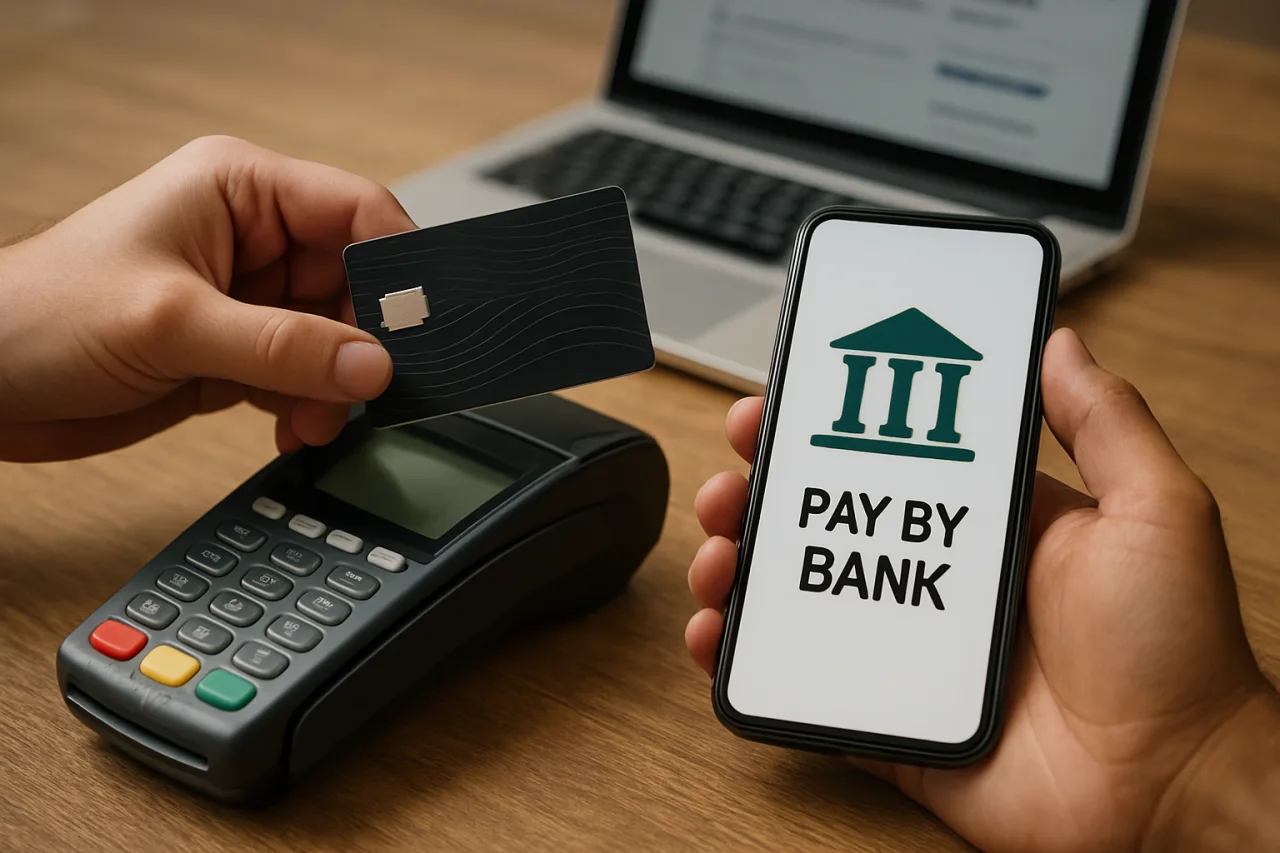
The definition is simpler than fintech jargon makes it. Pay by bank — the industry also says account-to-account, or A2A — is a payment where money moves directly from the payer’s bank account to the recipient, over instant payment rails, without a card network sitting in the middle. At an online checkout, the customer picks their bank, gets bounced to their own banking app with the amount and payee pre-filled, approves with the face scan or passcode they already use daily, and the merchant sees confirmation within seconds.
No 16-digit number changes hands; nothing to steal, nothing to expire, and no interchange fee priced into the sale. The United Kingdom built its version on open banking rules (the nine largest banks were required to open access in 2018), the euro area made instant transfers a legal standard with the Instant Payments Regulation, and the United States runs two instant rails — RTP and FedNow — used mostly for business flows while the open-banking rule that would unlock consumer pay by bank sits blocked in federal court.
Then there is the Philippines — which quietly runs one of the world’s most-used instant-payment ecosystems. The BSP’s InstaPay and PesoNet rails plus QR Ph made account-to-account transfers a daily habit for tens of millions of e-wallet and bank users. A jeepney-side QR payment IS A2A economics with a different brand name — and our digital-bank rate comparison shows how fast deposit behavior shifts when payment UX improves. That is why the US and UK data below should be read as a forecast of the argument that will land here next: the rails exist; what decides everything is who pays what, and who protects whom.
The October 2026 data: 32 percent is one incentive away
PYMNTS Intelligence’s “Pay by Bank Deep Dive” (with Trustly; US Census-balanced survey of 2,071 adults, published October 2026) quantified the switch pool. Among digital-bank users — customers already comfortable moving money in apps: 35.4 percent of their account-to-account transactions could shift to pay by bank with discounts and buyer protection on the table. For bill payments specifically: 32 percent of digital-bank users and 22 percent of the overall population. Add the incentive question and the picture sharpens: 43.1 percent of digital-bank users name immediate cash benefits as the top motivator, 16.9 percent buyer protection, and — the stubborn line — 25.4 percent say no listed incentive would move them at all.
The adoption gap tells the strategic story. Today, only 12.2 percent of all bank customers view pay by bank as a debit substitute. With rewards, buyer protection, or both: 72 percent either already see it that way or would. That’s the entire business case compressed into two numbers — the rails work, the awareness works, and the one missing piece is the incentive layer the card networks already run (rewards on interchange funded by merchant fees).
The card-free rail has no interchange to fund those discounts — so the incentive question becomes: who bridges the gap during the transition? That structural tension is why the 32 percent number is a forecast, not a current event — and why the UK just moved first at the system level.
The UK made recurring legal: June 2, 2026
The UK’s Payments Initiative — an industry company backed by 31 banks and fintechs — launched the first commercial scheme for recurring pay by bank on June 2, 2026. Recurring pay by bank (the industry’s variable recurring payments, VRPs) works like this: a customer approves a business once in their banking app, setting limits per payment or per month; the business then collects repeat payments within those limits with no per-transaction approvals; each payment settles in real time and the customer can view or kill the mandate from their banking app anytime.
First wave businesses: payments to government, utilities, charities, and financial services — the sectors whose bills everybody already pays monthly. The launch followed the ecosystem’s one-billionth open banking payment (June 2026’s volumes: 40.16 million in one month, of which 7.73 million were recurring; recurring share grew from 15.67 percent in October 2025 to about 19 percent by June 2026, +6.7 percent month over month).
The comparison table that decides adoption: versus Direct Debit — no days-later failure discovery, real-time confirmation, no advance-notice renegotiation dance for changing amounts. Versus card-on-file — no expiring card numbers, no network fee per transaction, no dispute-chargeback ambiguity for the merchant. For businesses, real-time failure information lets a collections call happen the same day; for families, the mandate’s hard limits are visible in your own banking app, not buried in a merchant portal. The FCA has already said it wants competing commercial schemes — the UKPI rulebook is a first mover, not a monopoly.
Why banks and merchants see the same numbers differently
Pull the stake threads apart before the forecast. For merchants and billers: interchange elimination plus instant settlement plus no card-number breach surface — the math has been compelling since checkout A/B tests started publishing. For banks: account-to-account payments simultaneously cannibalize debit economics and threatens interchange-dependent rewards programs — but the same banks run the apps pay by bank requires, and the account-holder authentication is an asset no third-party wallet can replicate. For consumers: the trade is card rewards for zero card fraud risk and real-time visibility — and the survey says most would trade when the incentives are bridged — and the fee-stakes context echoes the way remittance-cost lines (tracked in our World Investment Watch) reprice household budgets.
And the fraud responsibility line is drawn the same way in every jurisdiction so far: authorization happened in the customer’s banking app with strong customer authentication — the dispute framework is fundamentally different from card chargeback rules, and consumer education about irreversible instant transfers is the gap every regulator’s roadmap names but nobody’s launch marketing solved.
The timing wrinkle worth naming: pay by bank’s growth lands in the middle of a fraud-supervision cycle. Every market moving first — the UK with its scheme rulebook, the EU with instant-payment law — is simultaneously hardening fraud data sharing between banks (the European scheme infrastructure now includes formal fraud-information arrangements among payment providers), because faster rails mean less time to stop a payment in flight.
Instant and irreversible cuts both ways: merchants love the certainty, and scam victims lose the reversal window that card disputes imperfectly provided. The surveys say buyers understand the trade — buyer protection was the second-most-demanded incentive — which means the winning implementations will compete on protection, not just speed. Any rollout plan for the Philippines should write that on page one.
That fraud-trade matters more in PH-corridor contexts than the average OECD market: instant irreversibility plus a scam ecosystem that weaponizes urgency is the exact combination the PSE Watch and scam-economy coverage tracks. A Philippine rollout of the same idea would need the identical buyer-protection layer the survey demands — the tech is ready, the consumer-protection rules are the frontier.
What has to change here (the PH roadmap for the same argument)
Map it plainly. The rails: exist (InstaPay, PesoNet, QR Ph), now with BSP-mandated fee caps; the habits: exist (tens of millions use e-wallets and QR daily for transfers and bill pay); the missing pieces: (1) the checkout-integration equivalent — a standard, cross-bank “pay this bill from my bank/e-wallet” merchant layer at PH-online-store scale, not just P2P transfers; (2) the incentive layer — who funds the discount that draws the first 32 percent;
And three more pieces decide the rest. (3) the fraud-responsibility rule — whose loss is an authorized-but-scammed transfer, the question Philippine banks and regulators have been circling in scam-economy hearings; and (4) the recurring piece — a QR Ph or InstaPay mandate equivalent for tuition, utilities, and family support: OFW families sending tuition monthly IS the recurring-payment use case of this trend — the corridor context is in the $39.6 billion remittance shift analysis, and the family-payments automation story is the most concrete version of the benefit.
None of these need new rails; each needs a rulebook or an integration standard — which is exactly how the UK process ran before June 2026.
What to watch next
Dated triggers: UKPI Wave 2 — the expansion of eligible sectors expected beyond government, utilities, charities and financial services (watch the Payments Initiative’s rulebook updates and the FCA’s long-term open banking framework consultation promised by end-2026). Competing UK schemes the FCA said it wants — watch for the second commercial scheme launch. US Section 1033 litigation and reconsideration — the blocked rule’s fate decides whether consumer pay by bank finally has a US legal floor. And the Philippine side: any BSP or Payments Council move toward recurring-institution mandates on InstaPay/QR Ph, or fee-cap changes. Whichever market names its buyer-protection rule first wins the scam-weary customer — and the PH has the strongest motivation to be that market.
General information notice
This analysis is for general information only and is not financial, investment or legal advice. Product and scheme references are for context, not endorsement. Payment products carry different protections; verify current terms with your own bank or provider. Do your own research before financial decisions.
FAQ
What does pay by bank mean?
Paying a business directly from your bank account over instant payment rails — the customer approves in their banking app, money moves account-to-account in seconds, and no card or card network is involved. The industry also calls it account-to-account (A2A) payment.
Is pay by bank safe?
Authentication happens in your own banking app with the same biometrics you use to log in — a scammer needs your app, your device, and your approval. But approved transfers are typically instant and irreversible: unlike card disputes, a completed transfer is hard to claw back, which is why the buyer-protection incentives in the data matter so much.
Why would a business prefer pay by bank over cards?
No card network fees on the sale, real-time settlement and confirmation, no expiring card credentials, and no card-number data breach surface. The tradeoff for the merchant: a different dispute framework and the need to make the incentive bridge during customer transition.
What changed in the UK in June 2026?
The first commercial scheme for recurring pay by bank went live on June 2, 2026, under a shared rulebook from the UK Payments Initiative: one approval in the banking app lets a business collect repeat payments within customer-set limits, real-time, in sectors like utilities, government, charity and financial services — a Direct Debit and card-on-file alternative with real-time confirmation.
Will pay by bank replace cards?
Not overnight — rewards-earning card habits and credit-float preferences keep cards dominant at checkout. The realistic case, supported by the 2026 survey data, is a 22–32 percent shift pool in bill pay and A2A categories once incentives and buyer protection arrive; cards keep rewards categories while pay by bank takes the recurring, fee-sensitive volume.
Does the Philippines have pay by bank?
The Philippine rails exist (InstaPay, PesoNet, QR Ph) and daily A2A habits are strong, but the full merchant-checkout and recurring-mandate infrastructure the UK just switched on is not yet unified at market scale. Watch for BSP/Payments Council moves toward recurring mandates and standardized merchant layers.