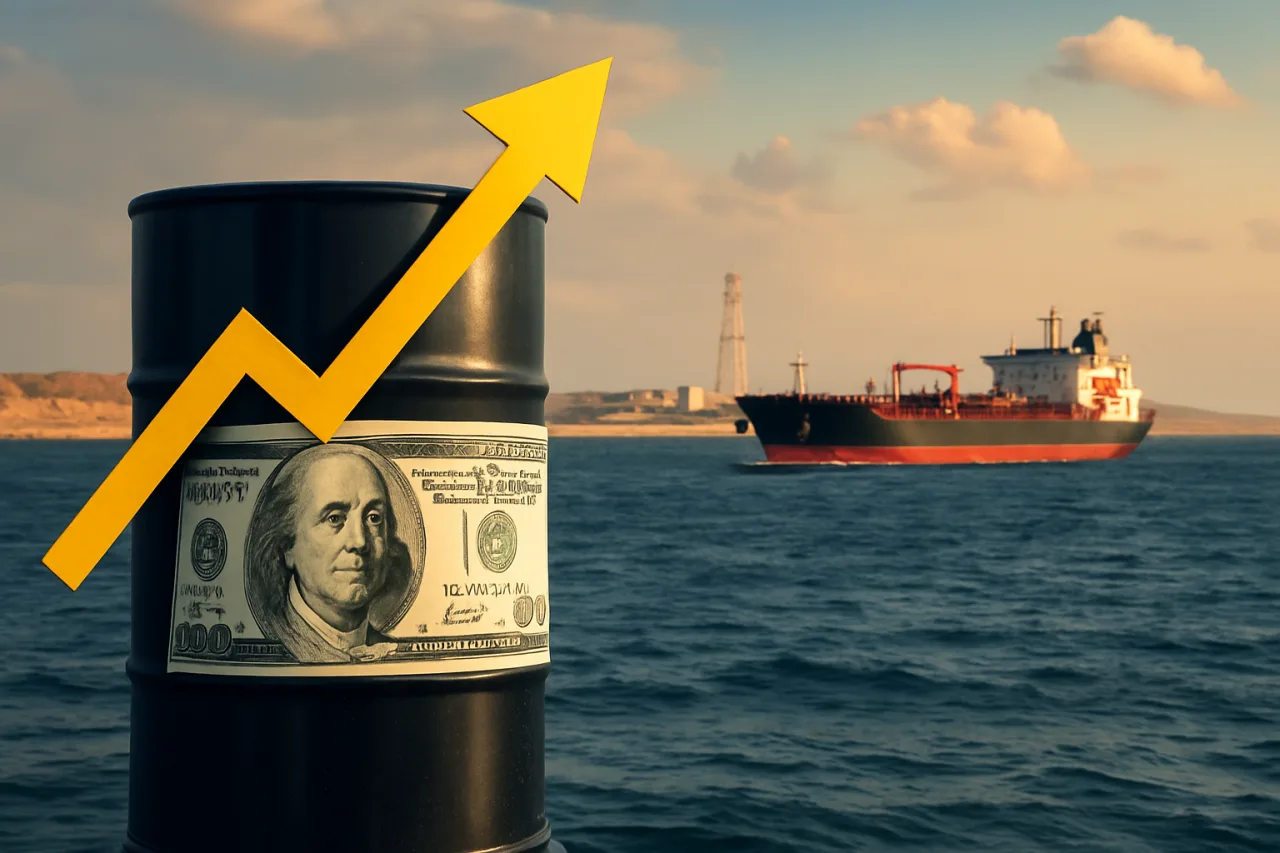
WIW #014 — the Triple-Shock Oil Tape
Table of Contents
Oil price spike Thursday delivered the year’s cleanest supply-shock tape: Brent settled $104.28 (+4%) and WTI $91.49 (+3.6%) as Iran ramped attacks on tankers transiting the Strait of Hormuz and Hurricane Isaias shut roughly 500,000 barrels per day — about 25% of US Gulf of Mexico offshore production — while EIA draws (-3.2M bbl to 424.1M) confirmed a market already tightening. World Investment Watch #014 reads the three shocks, the Brent-WTI gap that prices them differently, the second-round inflation question that reaches every household and central bank, and the playbook for an oil shock week that arrives while the world’s central banks are still leaning hawkish.
Key Takeaway
- 🛢️ One session, three shocks: Brent $104.28 (+4.0%) / WTI $91.49 (+3.6%) settled Thursday in the sharpest oil price spike since the June 2025 exchange, as Hormuz tanker attacks escalated, Hurricane Isaias shut ~500K bpd (~25%) of US Gulf offshore output, and EIA draws (-3.2M bbl) affirmed the tightness — Brent holding above $100 into Friday’s trade (intraday ~$102.9, WTI ~$90.4 Friday-morning prints).
- 📦 The Hormuz math has a subtlety: transits fell to 9.5M bpd (-30% vs pre-war normal) but pipeline workarounds kept TOTAL Middle East crude flows near prewar 16.4M bpd — the market is pricing chokepoint risk, not lost barrels. That gap between the fear and the flows is the tape’s most important nuance.
- ⛽ The Brent-WTI gap: the $15+ premium of Brent over WTI ($104.28 vs $91.49; ~$104.9 vs ~$91.94 Friday) is the market’s own pricing of geography — Brent carries the Hormuz risk premium that WTI is structurally spared by the Atlantic hurricane’s US-production shock.
- 🏦 The second-round question: $100+ crude feeding September’s accelerating inflation (PH 7.20%) forces the hawkish central-bank lean (BSP 5.00%, the Fed’s 3.75-4.00%) to stay hawkish longer — with the October 23 BSP Monetary Board meeting now hostage partly to an oil chart.
The Thursday Oil Price Spike: What Moved and Why
The receipts, from primary-adjacent market desks with concordant prints (CNBC’s session wrap on the settles; OGJ and EnergyNow on the intraday path; OilPrice.com on the Friday hold):
- Settles (Thursday October 8): Brent +4.0% to $104.28; WTI +3.6% to $91.49.
- Intraday extremes: Brent printed above $105 (+5% at the highs) before easing; WTI ~$92.62 (+4.92% from Wednesday’s $88.28 official settlement).
- Holds (Friday morning, Oct 9): Brent ~$102.9 (-1.30% from Thursday’s close but above $100 — and ABOVE the week’s opening level); WTI ~$90.4. The hold above $100 after a +4% day is itself information: the market is not treating Thursday as a one-day spike — the Friday print says the premium is staying bid.
- The echo: the last time this series saw a comparable oil price spike day, the lens was World Investment Watch #002‘s 18% oil surge and a Fed in hiking mode — the structural rhyme with today’s tape is the reason the hawkish-oil connection is series doctrine, not speculation.
The Three Shocks Behind the Oil Price Spike: Hormuz 9.5M, Isaias 25%, and the 2025 Echo
- Shock 1 — Hormuz attacks (the chokepoint premium): transits fell to 9.5M bpd during the week ended Tuesday — about 30% below pre-war normal (Kpler data via CNBC). The nuance that separates this from the 2024-25 episodes: TOTAL Middle East crude flows (crude + pipeline workarounds) stood near prewar levels at 16.4M bpd. The market isn’t pricing LOST barrels — it’s pricing the RISK that the workaround architecture fails, plus freight/insurance premia on every voyage through the Gulf.
- Shock 2 — Hurricane Isaias (the Atlantic supply shock): operators shut ~500K bpd ≈ 25% of US Gulf of Mexico offshore production as the storm churned toward Alabama/Mississippi/Florida panhandle. Shell suspended Mars, Olympus, Ursa, Vito, Appomattox; Chevron initiated shutdowns at four operated platforms. The Atlantic-basin supply shock lands on the WTI side of the ledger — and still moved both benchmarks because inventories were already drawing (-3.2M bbl to 424.1M; distillates 12% below the 5-year seasonal average).
- Shock 3 — the 2025 echo (the structural rhyme): the June 2025 Israel-Iran exchange ended with zero barrels actually lost — the spike evaporated. Whether October 2026’s escalation resolves the same way or the tanker-attack regime hardens into a durable chokepoint crisis IS the question that prices Brent from here; the series holds no forecast, only the framework.
A contract-roll honesty note, because this series prices nothing on distorted comparisons: WTI trades the November 2026 contract and Brent the December 2026 contract — both current prints are compared against Wednesday’s settlement of the SAME contracts (verified per EnergyNow’s roll check), so the +4%/+3.6% readings carry no material roll distortion. The Brent-WTI gap math above uses corresponding-contract pairs throughout.
The Brent-WTI Gap: Reading the $15 Signal
The Friday-morning math: Brent ~$102.9-104.9 vs WTI ~$90.4-91.94 — a premium of $12.4-15.3. The series has tracked this differential as a risk thermometer since #004’s Hormuz reopening watch:
- What the gap prices: Brent is the seaborne international benchmark — every Hormuz transit, every tanker-attack headline, every freight and war-risk premium lands IN Brent. WTI prices continental US supply: the Isaias shock hits WTI’s own geography, yet the differential widened because Brent’s risk premium grew faster than WTI’s supply-loss premium.
- What the gap did in past episodes: at #004’s watch the premium LEAKED as Hormuz reopened — the differential is the market’s running referendum on chokepoint risk. A widening gap = the market re-armoring; a collapsing gap = de-escalation priced in real-time, no headlines required.
- The nuance: the Atlantic hurricane adds a WTI-side premium (US offshore output shut); if Isaias passes with swift restarts, WTI’s premium unwinds fast — but Brent’s chokepoint premium doesn’t. Watch the gap, not just the level: it’s the cleanest de-escalation gauge on the board.
The Second-Round Question: What $100+ Oil Does to Fed and BSP Math
- The transmission: an oil price spike feeds every CPI basket; $100+ crude raises the import bill for every net importer — the Philippines directly (diesel-linked transport and power), and indirectly through the global manufacturing chain. September’s 7.20% print accelerated INTO this oil move; the October print will price it.
- The BSP lens: policy at 5.00% post-hike, the board meeting October 23 — an accelerating-inflation print plus $104 Brent constrains dovish room exactly when growth needs it. The Monetary Board decision record is the standing receipt line for the board’s stance.
- The Fed lens: at 3.75%-4.00% after September’s hike, the hiking wave that began with Oil’s 18% surge-era tightening (WIW #002) meets its second oil shock in a year — the July trough (-4.06% for the index month) showed what the combo does to cyclical assets.
- The OFW transmission, direct: Philippine pump prices are diesel-linked; $104 Brent lands at the pump in weeks. The oil-price peso-squeeze ledger documented the household transmission the last time crude ran — the same machinery re-arms at $100+.
The Investor Playbook: Three Moves for an Oil Shock Week
- Move 1 — date the risk, don’t average into it: the June 2025 precedent (zero barrels lost, the oil price spike evaporated) argues against averaging up into geopolitical premia; the hardened-regime counter-scenario argues against complacency. The disciplined move is written branches: if the Brent-WTI gap collapses = de-escalation, treat the spike as noise; if the gap holds/widens with the attack regime persisting, treat $100+ as the new regime and re-underwrite energy-exposed budgets (household fuel, transport-heavy businesses, airline margins).
- Move 2 — separate the benchmarks: energy exposure isn’t one trade — Brent-side exposure carries the geopolitical premium; WTI-side carries the Atlantic supply shock. Position size should match which premium you are actually underwriting.
- Move 3 — the central-bank calendar is the clock: October 23 (BSP Monetary Board) and the Fed’s next meeting are the dates the second-round inflation question gets answered. Pre-write both branches — hawkish-hold vs hold-here — and pre-commit the portfolio response.
The OFW Money Angle: Fuel, Remittances, and the Peso Lens
- The pump math: diesel-linked pump prices follow an oil price spike with a lag measured in weeks — a $4-5/barrel spike (roughly ₱1.50-2.00/liter equivalent at the pump after taxes and passthrough) lands mid-late October. Households should budget the October fuel line at the bumped rate, not September’s.
- The remittance lens: a hawkish BSP + high oil inflation window is historically a stronger-peso window (rate differentials attract flows) — but the growth drag of $100+ oil on a net importer cuts the other way. The honest line: the peso lens stays two-sided; the reliable move is the standing conversion discipline (convert at need, staggered, not lump timing) rather than anniversary-driven FX speculation.
- The transport-business lens: for readers running transport or delivery side-hustles (tricycle, delivery apps, logistics), the marginal rider math tightens as fuel eats the fare — the tricycle-ledger piece carries the per-liter mechanics; re-run your breakeven at ₱2 extra per liter before raising rates.
- The ber-months angle: October-December spending (tuition top-ups, holiday logistics) meets the fuel bump — the practical move is pulling October’s discretionary fuel-heavy spending forward where it’s genuinely needed, and pushing what can wait past the spike window.
The Watch: Five Receipts for Next Week
- Brent-WTI differential: the de-escalation gauge — collapse = spike treated as noise; hold/widen = regime question. The series’ standing thermometer.
- Hormuz transit prints: the 9.5M bpd level is the shock’s floor; recovery toward pre-war ~13.5M bpd transit levels = chokepoint flows normalizing.
- Isaias damage + restart pace: 500K bpd shut; restart pace decides how fast the WTI-side premium unwinds; platform-by-platform restarts per operator statements.
- October 23 BSP board: the second-round question’s known decision point (MB No. 11 on the calendar) — inflation print + oil chart = the board’s bind.
- The echo test: if the June 2025 echo holds (zero lost barrels, the oil price spike evaporates), expect the premium to leak back within weeks — the tape’s own de-escalation confirmation, series-tracked since #004.
Frequently Asked Questions
The falsification line, written before the next print so this episode can be judged honestly: if Hormuz transits recover toward 13M+ bpd AND the Brent-WTI gap compresses under $8 within three weeks, the spike belongs in the noise column with June 2025 — the series will say so. If either receipt fails, the regime-shift read stands and the peso-side watch items graduate from monitoring to portfolio action.
Why did oil prices spike to $104 on October 8, 2026?
The October 8 oil price spike landed three shocks in one session: Iran ramped attacks on tankers transiting the Strait of Hormuz (transits -30% vs pre-war normal at 9.5M bpd), Hurricane Isaias shut ~500,000 bpd — about 25% of US Gulf offshore production — and EIA data showed commercial crude inventories drawing 3.2M bbl to 424.1M. Brent settled +4% at $104.28; WTI +3.6% at $91.49.
What is the Brent-WTI spread telling us now?
The differential (roughly $12-15) is the market’s running referendum on chokepoint risk: Brent carries the Hormuz war-risk premium directly, while WTI prices continental US supply. The series tracked this gauge since #004’s reopening watch — a widening gap means the market re-armoring against chokepoint risk; a collapsing gap means de-escalation is being priced in real time. Watch the gap, not just the level.
Will high oil prices increase Philippine inflation?
The transmission is direct: fuel and transport sit in every CPI basket, and the Philippines imports its crude. September’s 7.20% print accelerated INTO this spike; October’s inflation data will carry the pump-price passthrough. The BSP (next board meeting October 23) reads the same oil chart — an oil shock inside an accelerating-inflation window constrains any dovish turn.
How does a $104 Brent price reach an OFW household budget?
Through the pump: diesel-linked prices pass through in weeks — a $4-5/barrel spike is roughly ₱1.50-2.00 per liter at the pump after taxes. Budget October-December fuel spending at the bumped rate, stagger transport-heavy errands, and re-run side-hustle breakevens (transport/delivery work) at the higher fuel line before adjusting prices.
Is this oil spike like June 2025?
The setup rhymes (chokepoint attacks, +4-5% crude sessions), but the resolution question is open: June 2025’s exchange ended with zero barrels actually lost and the spike evaporated. This October episode prices the possibility that the tanker-attack regime hardens rather than resolves. The Brent-WTI gap and the transit prints are the receipts that will tell you which story the market is living in.
Financial Disclaimer
This article is market intelligence for informational purposes only and is not financial, investment, or trading advice. Prices, flows, and figures are from cited third-party trackers with their own methodologies and may differ by source or timestamp. Do your own research and consult a registered advisor before making investment decisions.