Key Takeaway
- 💬 OpenAI launched Sponsored Agents on September 16, 2026: brand-funded AI units that open a labeled, direct conversation inside ChatGPT — the ad doesn’t link out, it does the task with you.
- 🛋️ The pilot runs in the United States with Wayfair and Angi as launch advertisers; Newegg, Best Buy, Lowe’s, and VistaPrint are named as early ChatGPT advertisers.
- 📅 This is the second ad step in one week: ChatGPT’s standard ads (Amazon DSP/Adform buying) went live September 10, and Sponsored Agents followed September 16.
- 🧭 Users keep control: the agent only takes over after you tap the labeled unit, and you can spell out the task or exit anytime — but the commercial turn inside ChatGPT is now structural, not experimental.
- 🇵🇭 For Filipino sellers and freelancers: AI-chat channels are becoming a real acquisition surface — but only for brands with an agent strategy. The organic lane is still free.
Table of Contents
For twenty years, internet advertising has been a redirect: an ad catches your eye, you click, you leave. On September 16, 2026, OpenAI deleted that step. Its new Sponsored Agents format lets a brand take over the chat itself — a labeled advertiser-run agent appears in the conversation, answers your follow-ups in the same thread, and hands you to the business’s site only when you are ready to buy. The ad is no longer a billboard; it is an employee.
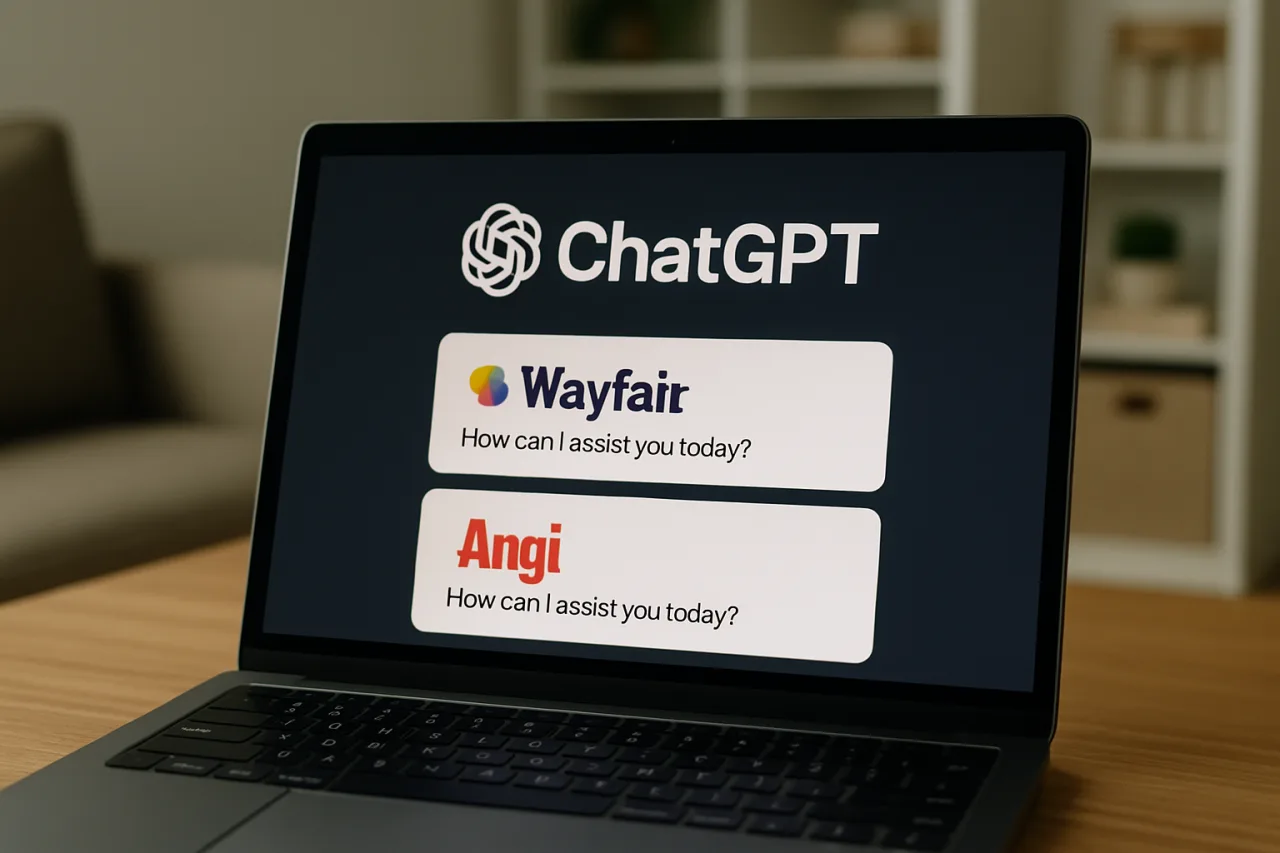
The first employers of this technology are Wayfair, the furniture giant, and Angi, the home-services marketplace — both confirmed by OpenAI’s announcement and Angi’s own launch post. In ChatGPT conversations about home services, an Angi-branded agent can now collect project details from a homeowner and route them into Angi’s service-request flow, matching them with local contractors. Wayfair participates “at limited scale,” per OpenAI, in what the company calls testing with select advertisers in the US.
How a Sponsored Agent Actually Behaves
The mechanic matters because it rewrites decades of advertising behavior. A standard ChatGPT ad — the format OpenAI switched on September 10, bought through Amazon DSP and Adform — shows a text or image unit beneath a chat response. Tap a Sponsored Agent, and instead of a landing page you get a labeled conversation: the agent introduces itself as the brand’s, asks about your project, proposes options, and can complete a real action such as a booking or purchase request before handoff. Users, OpenAI says, can “spell out” what they want — the unit behaves like a specialist, not a banner.
Three design details deserve attention. First, labeling is mandatory — the agent is identified as advertiser-run, which is the FTC’s baseline expectation for native advertising. Second, the interaction is opt-in per tap: the agent engages only after you choose it, which keeps the organic chat separate from the commercial one. Third, the agent’s handoff is a conversion event — the brand’s systems receive a lead or a sale, not a click. That is the business model: OpenAI is selling completed intent, not attention.
The September Timeline: Two Ad Formats in Seven Days
September 10: ChatGPT ads (display units, Amazon DSP/Adform, HubSpot as first CRM partner, a Shopify App Store connector for US merchants). September 16: Sponsored Agents with Wayfair and Angi. The sequence shows OpenAI building the full ad stack — impression layer first, action layer second — the same ladder Google and Meta climbed. The AI-native difference is that every ad slot can now hold a worker, not a message. Early reports also indicate OpenAI is preparing ads that resolve directly to agents at DevDay on September 29.
What This Asks of Users
The honest costs are three. Data: a branded agent conversation is a commercial interaction — expect it to inform ad targeting even when the chat feels personal. Trust: the agent is competent and helpful because it was built to convert you; its advice serves the brand’s category, not the whole market — a home-services agent from Angi will not recommend Angi’s competitor even when the competitor is better for you. Blurring: the line between assistant and salesperson gets fuzzy precisely where users have learned to relax — inside a chat. None of this is hidden; it is all labeled. But knowing the mechanic and feeling the difference are two different skills, and this format asks users to learn the second one.
The Regulation Question: Who Checks the Agent?
The US Federal Trade Commission’s native-advertising rules require that paid endorsements be identifiable — labeling is not a courtesy, it is the compliance floor. A conversation, however, is a subtler medium than a banner: an agent that answers “is this waterproof?” builds more trust in three replies than a display ad builds in three exposures, and trust is exactly the thing regulators watch when formats evolve. Expect the following pressure points as the pilot matures: whether the agent must disclose when it cannot fulfill something (say, a competitor’s lower price), whether conversation data feeds ad targeting without a separate consent layer, and whether OpenAI’s ad-ranking documentation becomes auditable the way search ad auctions eventually did. The company’s September posture — inviting third-party evaluators — will be read as a governance signal here too: if OpenAI wants external evaluation of model safety, its advertising behavior will be evaluated with the same logic, just by different auditors. Filipino BPO firms servicing US ad-tech compliance teams should expect agent-channel review work to land in their queues within the year.
The E-Commerce Layer: What Angi’s Agent Reveals
Look closely at Angi’s design choice: the agent does not sell anything directly — it qualifies you. It collects project details, then hands you into the service-request flow where real matching happens. That is a lead-gen agent, not a checkout agent, and it is the natural first design for trust-sensitive categories. Wayfair’s limited-scale test likely points toward product-level agents: “show me a sofa under ₱-equivalent that fits a small condo” — inventory, dimensions, delivery date, in-conversation. For Philippine marketplaces (Shopee, Lazada, TikTok Shop sellers), the transferable lesson is that agent-ready product data — structured specs, honest stock, accurate pricing — is becoming the shelf-space of the AI-commerce era. The brands that win in these pilots are the ones whose catalogs an agent can faithfully represent without a human cleaning up after it.
What It Means for Filipino Sellers and Freelancers
Three practical reads. First, the organic lane is still open. ChatGPT’s organic answers remain untied to the ad slots, and products that earn their way into recommendations by being genuinely referenced — reviews, comparisons, guides — still win the default answer. That is the opportunity this site’s own coverage of practical AI workflows rides on: content that AI systems cite is the free tier of the new stack. Second, agents as a service. Building conversational agents for brands — the exact skill this site’s small-business agent coverage teaches — is the talent this ad format consumes at scale. Every Wayfair needs an agent builder; the skills are learnable remotely, and the Philippines has the service-industry muscle memory for exactly this kind of managed-conversation work. Third, competition discipline. When your market’s discovery shifts from Google search to AI chat, your product data, pricing accuracy, and response speed matter more than your keyword rankings. The sellers who treat agent channels as storefronts — maintained, staffed, measured — will take share from those who wait.
One honest caveat: the pilot is US-only, and OpenAI’s ad behavior will evolve under regulatory scrutiny — the same scrutiny that has followed its safety-coordination turn this month. Nothing here is a guide to advertise inside ChatGPT yet; it is a map of where the surface is heading, read early.
The Ad Turn in Context: Assistant, Marketplace, Media
Step back and the strategic picture is legible: ChatGPT has spent 2026 becoming three products at once — an assistant (Chat, Work, Codex modes), a marketplace (plugins, app connectors), and now a media business (ads + sponsored agents). Each layer feeds the next: the assistant generates attention, the marketplace embeds tools, the media layer monetizes intent. OpenAI’s September ad turn simply completed the loop. Whether Sponsored Agents become the default discovery surface or a niche format depends on one variable OpenAI does not fully control: whether users accept a salesperson inside their assistant. The first week’s evidence — a pilot, limited scale, two brands — suggests the company is walking the line deliberately. The rest of the industry will follow whatever survives that test.
UPDATE OCT 10, 2026: the ad stack this piece examined has since completed its build-out — the visual image-generation format, the measurement-partner bench, and Wall Street’s rewritten covenants on AI compute financing are covered in AI World This Week #013.
Frequently Asked Questions (FAQ)
- Q: What are Sponsored Agents in ChatGPT?
- Brand-funded AI units OpenAI launched September 16, 2026 that open a labeled, direct conversation with an advertiser’s own agent inside ChatGPT — able to complete a real action like a booking or purchase, not just show a link.
- Q: Which brands are in the pilot?
- Wayfair and Angi are the launch advertisers; OpenAI says testing is limited to select US advertisers. Newegg, Best Buy, Lowe’s, and VistaPrint are named as early advertisers on the standard ChatGPT ad format that launched September 10.
- Q: How is a Sponsored Agent different from regular ChatGPT ads?
- Regular ads are display units beneath a response. A Sponsored Agent is a labeled conversation that can perform the task — the difference between a billboard and a salesperson who talks to you in the same chat.
- Q: Can I turn off ads in ChatGPT?
- Ad visibility varies by plan and region; the pilot is US-only so far. The labeled units are opt-in per tap — you choose whether to engage the brand’s agent.
- Q: What should Filipino online sellers do about this?
- Nothing yet on the ad side — the pilot is US-only — but two moves are already smart: keep your product data accurate wherever AI systems read it, and start learning agent-building skills, because conversational commerce is the direction of travel.