Table of Contents
Key Takeaway
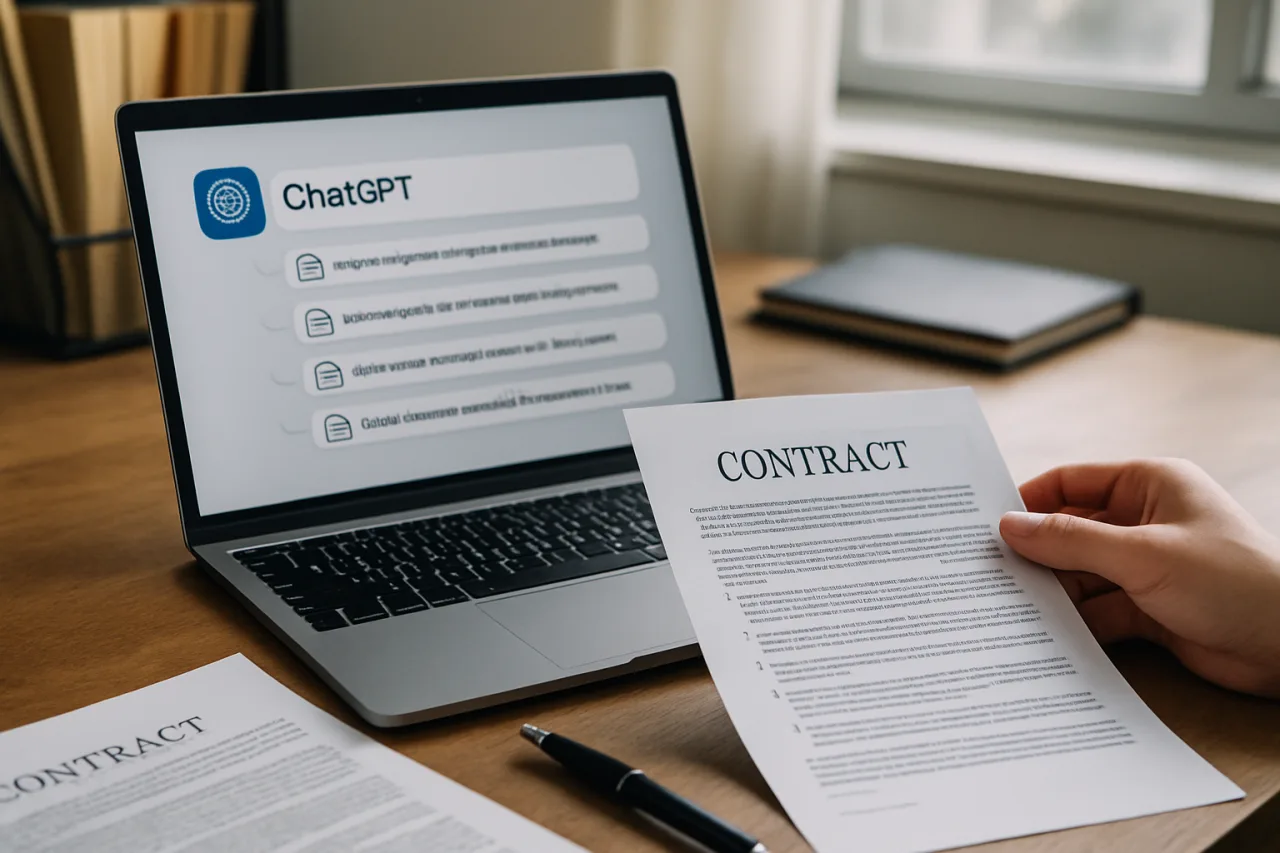
- 📜 Contract documents meet their match in Prompt of the Day #004 — five copy-paste prompts that turn free ChatGPT into a contract decoder — the reading layer for rental contracts, employment offers, loan agreements, and insurance policies.
- 🔍 The decoder prompt flags obligations, fees, exit clauses, and one-sided terms — then translates each into plain language with a risk grade.
- 📎 The form-walker prompt turns any government form into a checklist: what each field wants, which document satisfies it, and what trips rejections.
- 💬 The negotiation-prep prompt drafts your clarifying questions and revision requests before the signing meeting — politely and specifically.
- 🇵🇭 Filipino/global scenarios run through every prompt: Philippine rental contracts, OFW employment offers, BIR/SSS forms, and telco fine print all work as inputs.
Why Contract Documents Are the Highest-Leverage Prompt Target
The documents that shape a Filipino household’s year — rental contracts, job offers, loan agreements, insurance policies, telco plans — share one property: they are written to be enforceable, not readable. The Prompt of the Day #004 episode targets that gap with a contract documents decoder with prompts that make any large-language model do the reading: extract the obligations, surface the money clauses, grade the risks, and translate the legalese into sentences a busy person can act on.
Unlike the #001 budgeting pack or the #002 store prompts, these contract documents prompts work on paperwork you did not write — which is where most families actually get hurt.
The privacy rule comes first because document prompts touch sensitive data. Paste clauses, not identities: redact names, account numbers, addresses, and ID numbers before anything goes into a chatbot. The prompts below are built to work with the redacted text — and the habit costs nothing.
The 5 Copy-Paste Contract Documents Prompts
All five run on free ChatGPT or Gemini — the contract documents pack. Copy the whole block, paste your document text (or a photo transcription) at the marked line.
Prompt 1 — The Decoder (use on any contract or agreement)
You are a contract decoder for ordinary people. I will paste the text of a contract with personal details redacted.

Do the following, in this order:
1. Summarize what this document is, in 2 sentences, in plain language.
2. List every obligation on MY side (what I must do, pay, or maintain).
3. List every obligation on THEIR side.
4. Flag every money clause: amounts, dates, penalties, escalations, auto-renewals.
5. Flag exit clauses: how I end this agreement, notice periods, and what it costs.
6. Flag anything unusual, one-sided, or that a Filipino consumer law might question.
7. End with a risk grade (LOW / MEDIUM / HIGH) and the 3 questions I should ask before signing.

Do not summarize away details. Quote exact clause numbers when you flag something.

--- DOCUMENT TEXT ---
[PASTE REDACTED DOCUMENT TEXT HERE]
Prompt 2 — The Form Walker (use on any government or application form)
You are a form-walking assistant. I will paste the text of a government or application form.

1. List every field I must fill, grouped by section.
2. For each field, state in plain language what it wants and which common document satisfies it (e.g., "valid ID — passport or UMID accepted").
3. Flag the 3 fields most often filled wrong, and how to fill them correctly.
4. Note any field that needs a supporting attachment, and which office issues it.
5. End with a one-page checklist I can print: documents, photocopies, and fees.

--- FORM TEXT ---
[PASTE FORM TEXT HERE]
Prompt 3 — The Fine-Print Finder (use on insurance, telco plans, loan terms)
You are a fine-print auditor. Read the pasted terms below.

Find and list:
1. Every fee that can increase after I sign (with the trigger).
2. Every condition that can cancel my service or claim.
3. Every auto-renewal or lock-in clause, with dates and escape options.
4. Every clause that limits my right to complain or take legal action.
5. Every vague term ("reasonable", "at our discretion") and what it could mean in practice.

Be specific: quote each clause verbatim, then translate it to plain language.

--- TERMS TEXT ---
[PASTE REDACTED TERMS HERE]
Prompt 4 — The Comparison Prompt (use on two versions of any agreement)
You are a contract comparison assistant. I will paste TWO versions of an agreement (VERSION A = older/first draft, VERSION B = newer).

1. List every difference that changes money, time, risk, or rights.
2. For each difference, state which version is better for ME and why, in one sentence.
3. Flag any new clause in Version B that did not exist in Version A.
4. End with the 3 things I should negotiate before signing Version B.

--- VERSION A ---
[PASTE FIRST TEXT]

--- VERSION B ---
[PASTE SECOND REDACTED DOCUMENT TEXT HERE]
Prompt 5 — The Negotiation-Prep Prompt (use before the signing meeting)
You are a negotiation prep assistant. I pasted a decoded contract summary below.

1. Draft 5 polite but specific clarifying questions I should ask before signing, ordered by importance.
2. Draft 2 polite revision requests for the most one-sided clauses, worded so a landlord/HR/manager can accept without losing face.
3. Draft one fallback position for each: what I accept if they refuse.
4. Remind me of anything I must verify independently (registration, receipts, IDs).

--- DECODED SUMMARY FROM PROMPT 1 ---
[PASTE PROMPT 1 OUTPUT HERE]
Worked Example: the Rental Contract in Pasig
Input: a 1-year residential lease, ₱18,000/month, Pasig — personal details redacted. The tenant pasted the full contract documents text into Prompt 1. The output, abridged:
- Obligations (tenant): rent due on the 5th; 2 months’ advance + 1 month deposit; maintain fixtures; no subletting; 60-day notice to vacate.
- Obligations (landlord): structural repairs; return deposit within 30 days of move-out inspection.
- Flags: a 5% annual escalation buried in section 7 (legal under RA 9653‘s rules for residential units but rarely mentioned verbally); a clause making the tenant pay for “repairs deemed necessary by the owner” — unbounded; deposit return “after inspection” with no deadline on the inspection itself.
- Risk grade: MEDIUM — signable after 3 questions: cap the escalation, define “deemed necessary,” set a 7-day post-inspection deposit-return deadline.
The tenant ran Prompt 5 on that output, walked into the signing with three questions drafted, and got the repair-clause cap written in before signing. That is the whole point of contract decoder prompts: not legal advice — reading support that converts uncertainty into questions worth asking.
Customization: Making the Prompts Yours
- Add your jurisdiction line: append “Note: this is in the Philippines; cite the relevant consumer or rental law sections by name when relevant.” — the same trick works for any country.
- Add your role: prepend “I am the tenant / the employee / the borrower” so the decoder assigns obligations from your side of the table.
- Chain the prompts: Prompt 1’s output is Prompt 5’s input; for renewals, run Prompt 4 first, then 1 on the newer version only.
- Set the reading level: add “Explain at a level a busy tricycle driver would understand — short sentences, no legal jargon.”
Pitfalls, Privacy Rules, and the Send Button
Three rules keep this safe. First, redact before pasting — names, numbers, addresses, signatures: none of it helps the model, all of it helps a leak. Second, the AI reads, it does not decide: a risk grade is a reading aid, not legal advice; a lawyer still signs off on anything that carries real money or legal consequences, and for Philippine disputes the barangay mediation step often costs less than any litigation.
Third, verify against the source: government requirements change — the form-walker’s contract documents checklist is a draft, and the agency’s official page is the final word. The prompts put the reading in front of you; the send button — and the signature — stay in your hand.
This is Prompt of the Day #004. Catch up on the series: #001 the family budget analyst, #002 the store’s order machine, and #003 the interview coach — each with its full copy-paste pack. Tomorrow’s episode: the job-hunt prompts. For the government-services angle, see our eGovAI explainer.
Frequently Asked Questions
What are contract decoder prompts?
Copy-paste contract documents prompts that turn a free AI chatbot into a document-reading assistant: they extract obligations, flag money clauses and exit terms, translate legalese into plain language, and grade risk — before you sign anything.
Is it safe to paste my contract into ChatGPT?
Safe to the degree you redact first: remove names, account numbers, addresses, and ID numbers before pasting. The clause text is what the model needs; the personal identifiers are what a leak would harm.
Can the AI give legal advice on my contract?
No — and the prompts above are built to respect that line. They surface what the document says and grade the reading risk; a licensed lawyer makes the legal call. For Philippine tenancy disputes, barangay mediation is often the first, cheapest step.
Which AI should I use for the contract decoder prompts?
Free ChatGPT or Gemini both handle document text well; the decoder works anywhere you can paste a few pages of contract documents text. What matters is the prompt structure — role, numbered outputs, quote-the-clause instruction — not the brand.
Do these prompts work for OFW employment contracts?
The decoder pattern works on any agreement text, including OFW contract documents — and it is especially worth running on the fee, replacement, and termination clauses. For the verification layer, cross-check everything against DMW’s official contract standards; the AI reads, the regulator’s rules decide.
What is Prompt of the Day?
WorldNgayon’s daily copy-paste prompt series: one practical use case per day with the exact prompt, a worked example, and customization notes — text-in/text-out only, so every episode is usable tonight without any setup.