Table of Contents
Key Takeaway
- 🤝 The verified plan: OpenAI intends to buy AI chips from Alphabet’s Google as part of its AI buildout — per Bloomberg’s reporting and CNBC’s confirmation of The Information’s story; final terms are not yet known.
- 🔄 The reversal: OpenAI — a longtime Nvidia customer — is adding Google’s TPUs, the custom chips Google has built for a decade, in an era where buyers are hedging across multiple chip suppliers.
- 📦 The playbook shift: Google+Oracle announced a blockbuster distribution deal Tuesday — Oracle Cloud will offer Google’s TPUs to its customers starting next year, Google turning to partners to scale an AI chip business it once kept in-house (CNBC).
- ⚠️ The Nvidia read: analysts frame both moves as warnings for Nvidia’s near-monopoly: “Google’s TPU business is about to explode” as the multichip era spreads — the phrase Business Insider used for the second warning in a week.
- 📈 What the market saw: “google stock” spiked to 200,000+ searches on the US trend board (up 700%), one day before Alphabet’s Q3 report — the announcement that OpenAI plans to buy AI chips from Google and the earnings clock landed in the same window.
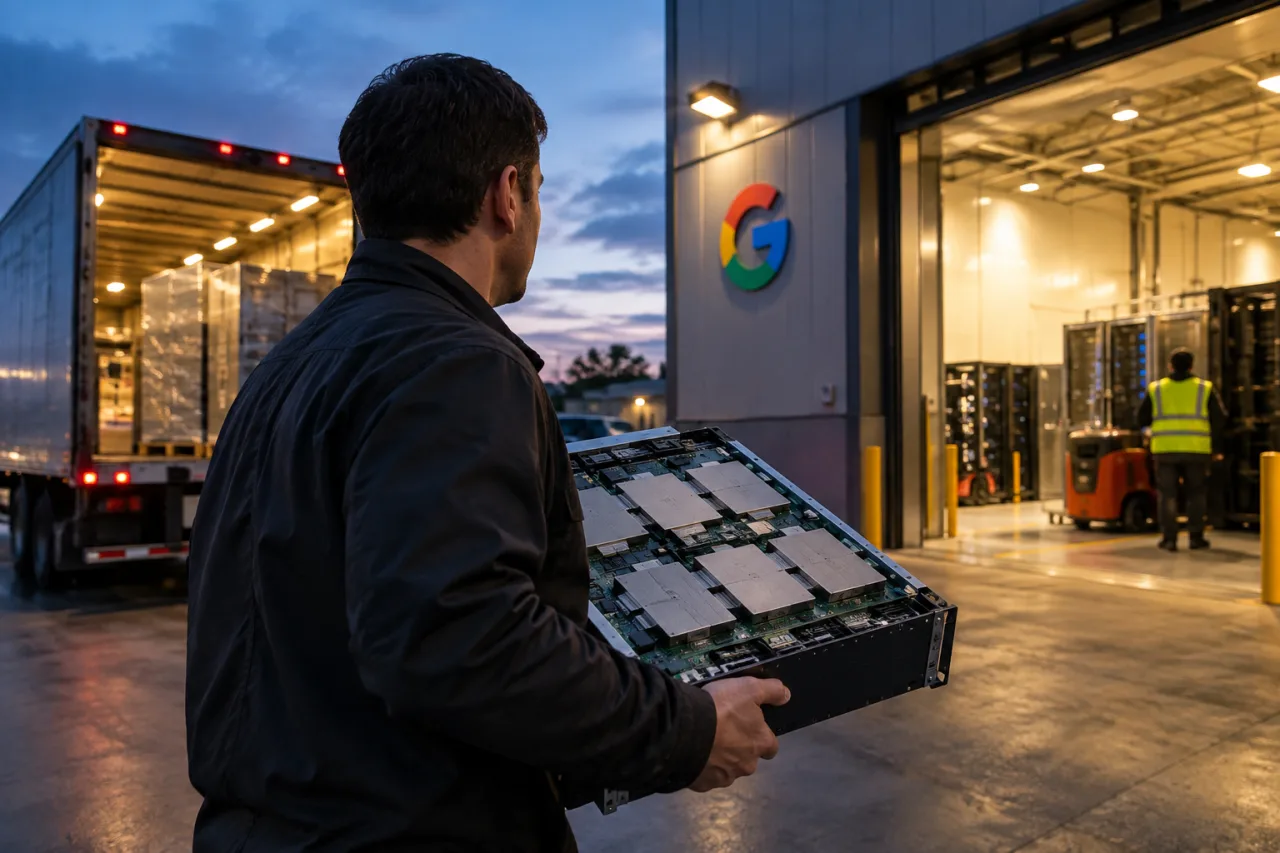
AI chips from Google are coming to OpenAI’s data centers. That sentence — inconceivable through most of the AI era — is now the plan of record: Bloomberg reported Wednesday, and CNBC confirmed, that OpenAI intends to buy chips from Google as part of its AI infrastructure buildout, with final terms still unknown (Reuters; The Information). The buyer is the ChatGPT maker whose computing buildout has defined the AI economy; the seller custom-built its Tensor Processing Units for exactly that market over a decade; The shift in AI chips supply did not arrive a day early by accident — and the announcement’s clock matters as much as its content. Wrapped around it is the second half of the shift: a Google–Oracle distribution deal that turns Google’s chip business from an internal advantage into a merchant product. This piece assembles the verified story — what is confirmed, what is not, why the rivalry reversed, and what it does to the AI supply chain everyone from OFW freelancers to sovereign-scale buyers depends on.
The verification spine of this piece: three independent outlets carry the OpenAI plan (Bloomberg, The Information, CNBC with named confirmation), the Google-Oracle product deal carries Alphabet’s own announcement record, and the earnings context carries Alphabet’s filed quarterly history through Q2 2026. Everything else on the wire tonight — the term sheets, the volumes, the exclusivity questions — is context until signed.
Why OpenAI Buying AI Chips From Google Matters
OpenAI’s computing story has been a single-supplier story. Its models ran on Nvidia GPUs; its buildout announcements priced Nvidia hardware through Microsoft Azure and, later, its own compute deals. According to Bloomberg — reporting a person familiar with the matter, because the discussions are private — that changes: OpenAI intends to buy Google’s chips as part of the broader AI buildout. Two things make the shift structural rather than incidental. First, supply: the AI economy’s binding constraint has repeatedly been GPU availability, and a second major supplier changes negotiating positions across the board. Second, architecture: Google’s TPUs are purpose-built for the training-and-inference workloads these AI companies run — the chips Google describes as custom silicon it has been developing since the deep-learning era. For OpenAI the move is diversification; for the market it is evidence that the largest AI buyer alive is willing to run its core infrastructure on a rival’s silicon (The Information broke the report; Reuters carried it within hours).
The Google–Oracle Deal: Google’s Cloud Playbook Shifts
The day before its earnings, Alphabet announced that Oracle Cloud will offer Google’s TPUs to Oracle customers starting next year — CNBC’s summary is the cleanest on record: Google is “altering its cloud playbook, turning to partners to sell more AI chips” as it tries to bolster competition with Nvidia in the AI chip market. The strategic logic is a decade in the making: Google built TPUs for its own services, rented them implicitly through its cloud, and watched hyperscaler rivals monetize chips as products. Selling through Oracle’s enterprise customer base — while OpenAI itself plans to buy — converts the TPU program from infrastructure into an AI chip business with merchant reach. Analysts quoted in Business Insider’s framing predict the “TPU takeoff” is near: more companies hedge with multichip strategies, providing openings for Google and the field beyond Nvidia. The verification note a source-led analysis owes you: Google’s deal is confirmed and dated (Tuesday’s announcement); the OpenAI purchase is reported and confirmed by CNBC but terms unknown — the distinction between the two states is the difference between a signed card and an intended plan, and this piece keeps them labeled apart throughout.
Nvidia in the Multichip Era: What the Two AI Chips Warnings Add Up To
Nvidia’s chip monopoly — the single most profitable supply position in the AI economy — now faces the pattern every monopoly fears: the biggest buyers building second sources. The week’s sequence tells the story: Google+Oracle’s distribution deal (announced), OpenAI’s plan (reported, confirmed), and analyst read-throughs that the TPU business “is about to explode” as hedging spreads (Business Insider). The honest counterweight, stated with equal weight: Nvidia’s installed base, software ecosystem and next-generation roadmap remain the industry’s default, and multichip strategies — TPU for some workloads, GPU for others — add demand for the category rather than simply subtracting it from one winner; some analyst framing treats Google’s growth as an expansion of the custom-chip market Nvidia itself serves through its own cloud partnerships. The invalidation lens both directions: if hyperscalers’ own silicon (Google, Amazon, Microsoft-class in-house programs) keeps converting large workloads, Nvidia’s pricing power erodes at the margin; if the AI buildout grows faster than any single supplier can feed, everyone sells into scarcity and the “warning” narrative inverts again. In our view, the week’s real fact is simpler than either extreme: the largest AI buyer alive just told the market it will not bet its entire stack on one chip family — and that decision is now public procurement policy, not rumor.
What Google Stock Is Pricing Tonight
The spike’s context: “google stock” hit 200,000+ US searches (up about 700%) on the trend board — the biggest financial spike of the day — as three clocks aligned: the Oracle chip deal, the OpenAI plan, and Alphabet’s Q3 report after tonight’s close. The fundamentals on file: Q2 2026 showed revenue up 24% to $119.8 billion, Google Cloud up 82% to $24.8 billion, and EPS of $9.11 — a 294% jump that included roughly $99 billion in largely unrealized gains from Alphabet’s stakes in SpaceX and Anthropic, the number that caused the headline profit splash (Yahoo Finance/Motley Fool’s earnings preview carries the breakdown). Alphabet has closed higher the day after seven of its last 16 reports — the historical base rate for tonight. The desk’s frame for readers: the chip news is a strategy story; the earnings are a delivery story; the stock’s move tomorrow will price how well the two connect. For the market-structure context around AI buyers financing their suppliers, the desk’s AI capex explainer and the neocloud guide carry the infrastructure economics; the Anthropic stakes sitting inside Alphabet’s paper gains are documented in the ANT risk-factors analysis.
The OFW-and-builder lens, stated plainly: the shift in AI chips is not only a Silicon Valley negotiation — it is the upstream event behind every price a remote worker pays. Compute costs flow into API pricing, which flows into the tools freelancers and small agencies build on; a supply side that hedges across chip families is a supply side whose prices move less violently in shortages, and whose capacity keeps expanding into regions the AI economy has underserved. The buyer-side lesson from OpenAI’s plan is the same lesson any business owner can scale down: single-source dependencies look cheap until the constraint hits, and the moment to build the second source is while the first still works. Whether the plan becomes a signed contract matters for the chip market; that the biggest AI buyer alive thinks in second sources matters for everyone building on it.
What Would Change This Story: the Invalidation Ledger
- A signed, dated OpenAI–Google contract with disclosed terms would upgrade “reported plan” to “confirmed deal” — and would move the TPU-competition reading from marginal to structural.
- A public walk-back — OpenAI, Google or Oracle clarifying the plan is narrower than reported (pilot volumes, specific workloads) would re-price the “warning to Nvidia” narrative downwards.
- Alphabet’s earnings call tonight: capex guidance, TPU-external-revenue commentary, or cloud-growth numbers that contradict the “chip business scales via partners” thesis.
- Nvidia’s counter-response — new large-scale deals, supply allocations, or pricing moves that re-tighten its position would restore the single-supplier default the news disturbed.
What the Evidence Supports, by Reader Situation
Education desk, not an advisory service — decision inputs, never instructions.
- If you’re tracking the AI supply chain for work: the verified states are Google’s Oracle distribution deal (announced, dated) and OpenAI’s purchase plan (reported, CNBC-confirmed, terms unknown) — treat the first as procurement reality and the second as direction, and re-check for the signed contract before drawing conclusions.
- If you’re positioned in AI-linked investments: the two-sided read stands — custom-chip expansion grows the category while compressing one supplier’s exclusivity; earnings calls tonight (Alphabet) and tomorrow (others) carry the next data points; the historical base rate for Alphabet’s post-earnings direction is 7-of-16 higher, per the desk’s sourced preview — arithmetic, not advice.
- If you build AI products for clients: the multichip era changes procurement language: infrastructure choices are becoming vendor-portfolio questions (TPU/GPU/custom), and freelancers positioning around migration, evaluation or integration work ride exactly the wave the deal announcements describe — see the desk’s AI-capex and neocloud guides for the economics underneath.
FAQ: the OpenAI–Google Chip Story
Will OpenAI really buy AI chips from Google?
The plan is reported and confirmed: Bloomberg reported the intention, The Information broke it, and CNBC confirmed OpenAI is planning to buy Google’s TPUs. Final terms are not yet known — the deal is a plan, not a signed contract on the public record yet.
What are Google TPUs?
Tensor Processing Units — the custom AI chips Google has developed in-house since the deep-learning era, purpose-built for the training and inference workloads AI labs run at scale, historically deployed inside Google’s own cloud before the Oracle distribution deal opened them to external customers.
Why did Google and Oracle make this deal?
To scale the TPU business as a product: Oracle Cloud will offer Google’s TPUs to its enterprise customers starting next year, turning Google’s internal chip advantage into a merchant AI-chip lane aimed squarely at competing with Nvidia in the AI chip market, per CNBC’s deal summary.
What does this mean for Nvidia?
Analyst framing this week treats it as a warning: the largest AI buyers are hedging with multichip strategies and second sources, which compresses Nvidia’s exclusivity at the margin even as the category grows. Nvidia’s installed base and ecosystem remain the industry default — the numbers that matter arrive with tonight’s and tomorrow’s earnings calls.
Why is Google stock spiking in searches?
“Google stock” hit 200,000+ US searches (up ~700%) as the Oracle chip deal, the OpenAI purchase plan, and Alphabet’s Q3 earnings report converged in a single window — attention, not verdict; Alphabet reports after tonight’s close.
What did Google say about its own AI chips business?
Through actions rather than press releases: the Oracle distribution deal converts TPUs from an internal advantage into an external product line, partners carry the sales motion, and the earnings call tonight is the first chance investors get to hear Alibaba-class capex and TPU-external-revenue framing from the company itself — CNBC’s deal coverage frames it as Google “bolstering competition with Nvidia in the AI chip market.”
How does the multichip era change AI chips procurement?
The practical shift is in the contract language: buyers now architect capacity across chip families — GPUs for one class of workload, TPUs for another, in-house or cloud-hosted for a third — and pricing negotiations gain a second lever that did not exist a year ago. For teams procuring AI chips today, the evaluation questions multiply: portability of models across silicon, software maturity of each stack, and the supply commitments each vendor can actually sign. The desk’s capex and neocloud guides carry the cost models underneath those questions.
Financial Disclaimer
This article is for general information and education only. It is not financial, investment, legal or tax advice, and it does not recommend the purchase, sale or holding of any security or asset. Deal terms, guidance and market data change quickly; figures were sourced from the cited reports dated October 27–28, 2026 and must be re-verified before any decision. WorldNgayon does not hold any position in the securities or companies discussed, and no content on this site should be acted upon without independent verification and, where appropriate, advice from a licensed professional.
- bloomberg.com/news/articles/2026-10-28/openai-plans-to-buy-google-s-c… — Bloomberg’s reporting
- cnbc.com/2026/10/28/google-alters-cloud-playbook-turning-to-partners-… — CNBC’s confirmation
- businessinsider.com/google-ai-chip-business-oracle-tpus-nvidia-threat… — Business Insider
- reuters.com/business/openai-plans-buy-googles-ai-chips-information-re… — Reuters
- theinformation.com/articles/openai-longtime-nvidia-customer-plans-buy… — The Information
- cnbc.com/2026/10/27/oracle-openai-chatgpt-codex-google-tpus.html
- finance.yahoo.com/markets/stocks/articles/alphabet-stock-surge-oct-28… — Yahoo Finance
- fool.com/investing/2026/10/26/will-alphabet-stock-surge-after-oct-28 — Motley Fool’s earnings preview
External sources linked in this article, in order of first mention. Spotted an error or a broken link? Tell us.
Cite this pagePublished Oct 29, 2026
Agron, E. (2026, October 29). OpenAI Will Buy AI Chips From Google: the Rivalry Reversal Behind Google’s Stock Spike. WorldNgayon. https://worldngayon.com/openai-google-ai-chips-deal/
Agron, Edmon. “OpenAI Will Buy AI Chips From Google: the Rivalry Reversal Behind Google’s Stock Spike.” WorldNgayon, 29 Oct. 2026, worldngayon.com/openai-google-ai-chips-deal/.
Agron, Edmon. “OpenAI Will Buy AI Chips From Google: the Rivalry Reversal Behind Google’s Stock Spike.” WorldNgayon, October 29, 2026. https://worldngayon.com/openai-google-ai-chips-deal/.
Agron, E. (2026) ‘OpenAI Will Buy AI Chips From Google: the Rivalry Reversal Behind Google’s Stock Spike’, WorldNgayon, 29 October. Available at: https://worldngayon.com/openai-google-ai-chips-deal/.
E. Agron, “OpenAI Will Buy AI Chips From Google: the Rivalry Reversal Behind Google’s Stock Spike,” WorldNgayon, Oct. 29, 2026. [Online]. Available: https://worldngayon.com/openai-google-ai-chips-deal/
@online{agron2026openaigoogle,
  author       = {Agron, Edmon},
  title        = {{OpenAI Will Buy AI Chips From Google: the Rivalry Reversal Behind Google’s Stock Spike}},
  year         = {2026},
  date         = {2026-10-29},
  organization = {WorldNgayon},
  url          = {https://worldngayon.com/openai-google-ai-chips-deal/},
  urldate      = {}
}TY - ELEC AU - Agron, Edmon TI - OpenAI Will Buy AI Chips From Google: the Rivalry Reversal Behind Google’s Stock Spike T2 - WorldNgayon PY - 2026 DA - 2026/10/29/ UR - https://worldngayon.com/openai-google-ai-chips-deal/ Y2 - ER -
Cite the version you read; the page may be updated. Zotero and Mendeley can also import this page directly.