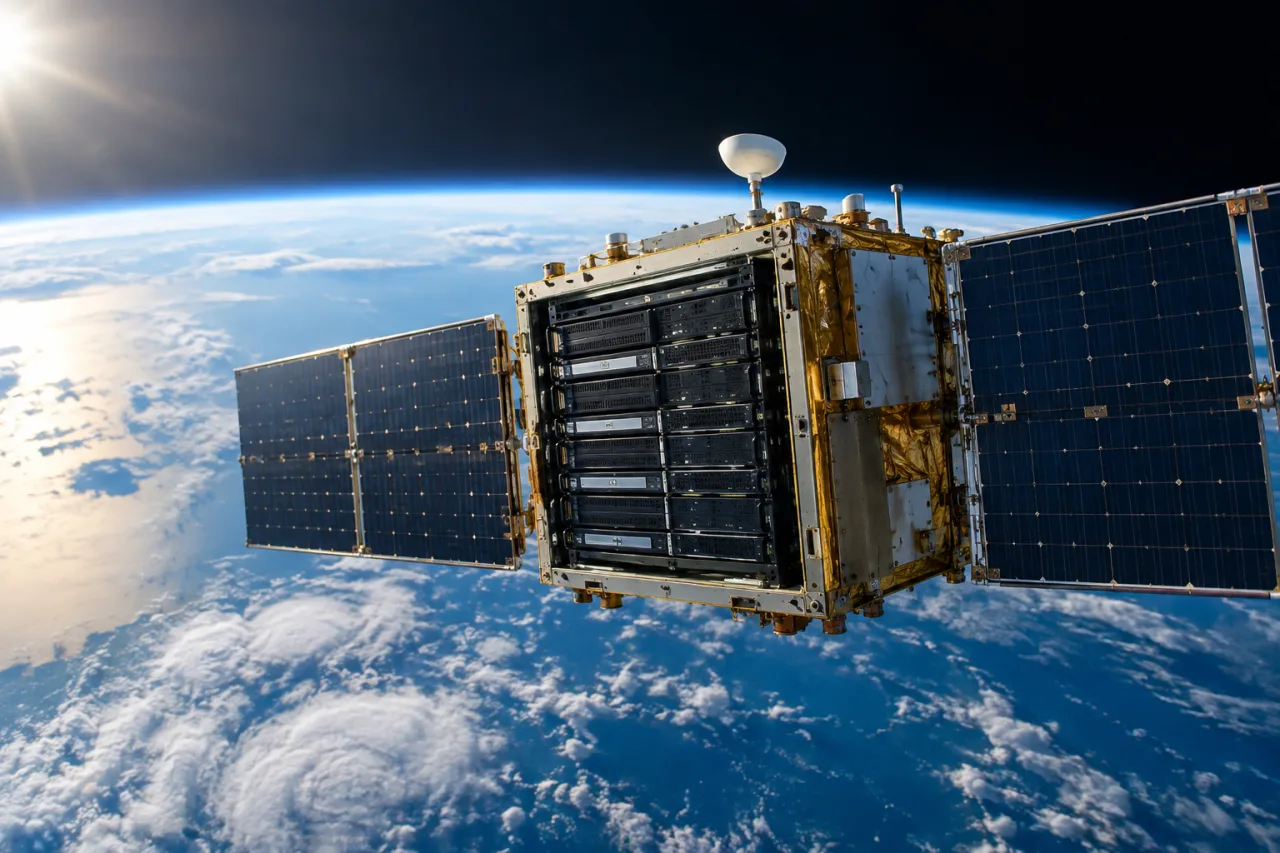
Key Takeaway
- 🛰️ The thesis in one line: put compute where the solar power is unlimited and the cooling is a vacuum — space data centers trade Earth’s grid and permitting problems for launch-cost and radiation problems, and the trade keeps getting cheaper.
- 🚀 The launch-cost collapse is the engine: $18,500/kg in the 1970s-2000 era → $2,720/kg on Falcon 9 today → Google’s Project Suncatcher analysis puts space AI compute at breaking even around $200/kg — Starship’s reusability is the bet that closes the gap.
- 🏗️ The build is real, not paper: Starcloud (YC-backed) flew an H100-class system and trained a large language model in orbit in 2025; SpaceX filed with the FCC for an “orbital data center system” in January 2026.
- 🌡️ The physics column keeps three hard costs: heat leaves only by radiation (no convection), radiation flips bits (Redundant voting like Dragon’s triple-redundant flight computers is the fix), and debris plus ultraviolet aging shorten hardware life (solar arrays fade 0.5-0.8% a year).
- ⚖️ The honest verdict: the uses that make sense today ride proximity to space (Earth observation, telescope co-flying, missile-defense processing); the grid-compute thesis scales in the 2030s if the launch curves hold — priced honestly per Bain’s early-2030s window.
Space data centers sound like science fiction until the three numbers land: unlimited solar power above the atmosphere, free vacuum cooling, and launch costs that fell from $18,500 per kilogram to $2,720 in two decades. That is the whole thesis — move compute to where the grid stops being the constraint — and in 2025-2026 it stopped being paper: an H100-class GPU cluster trained a large language model in orbit, Google organized a TPU-satellite program around it, and SpaceX asked the FCC for permission to build orbital data centers. This piece walks the real build, the physics that fights it, the skeptic case that deserves its own column, and the dated math that says when orbit beats the grid.
Table of Contents
Why this lane matters now: the terrestrial buildout is hitting its physical limits — power interconnects queue for years, cities block sites, cooling water becomes a political fight (all tracked in our grid-problem and backlash pieces). Space data centers are the industry’s cleanest exit from those constraints, and the 2026 announcements turned them from a thought experiment into a filed, funded, flight-tested engineering program.
Why space data centers: the grid problem meets its mirror
The terrestrial AI buildout runs on three constrained inputs, and each has a space-mirror. Power: on Earth, a gigawatt-scale campus queues for grid interconnection and fights local ratepayers; in orbit, a solar array in sun-synchronous orbit sees near-continuous sunlight — Starcloud’s flagship proposal spans solar arrays more than four kilometers long for multi-gigawatt generation. Cooling: Earth facilities fight water politics; orbit offers the ultimate heat sink — radiative rejection to a 3-kelvin sky, no water, though it is less efficient than the convection the ground uses (the physics column below prices this honestly). Land and permitting: the ground’s slowest input; orbit needs no zoning boards — only launch, which is exactly where its own constraint lives.
The third reason is the unsung one — the data is already up there: satellites generate more data than they can downlink. A single high-resolution Earth-observation satellite produces one to two terabytes of imagery a day while radio downlinks during brief ground passes move only tens of gigabytes. Processing in orbit — the research literature calls these platforms Space Data Centers, software-driven multi-tenant service platforms in orbit — removes the downlink deficit instead of paying it. That is why the first real customers of orbital compute will not be chatbots; they will be satellites.
The launch-cost math that decides everything
The collapsed curve: launch costs averaged roughly $18,500/kg from 1970 to 2000 (the Space Shuttle era ran $54,500/kg for large deployments); today’s Falcon 9 flies at about $2,720/kg and Falcon Heavy at about $1,400/kg — a twentyfold fall that made everything downstream possible. Active satellites grew from ~2,500 in 2000 (14 nations) to 11,500+ (91 new spacefaring nations) — the volume effects of exactly that curve.
The threshold Google’s engineers wrote down: Project Suncatcher’s analysis puts space AI compute at competitive parity when launch reaches about $200/kg — an order of magnitude below today’s Falcon 9 pricing. The bridge to that number is full reusability: Starship targets 150-200 metric tons of payload against Falcon 9’s ~23 tons, and Bain’s analysis projects launch costs per unit of compute falling up to 80% by 2035 if the reusable-vehicle curves hold. On the hardware side Bain assumes compute costs comparable per kilowatt on orbit as on Earth — the premium sits in launch plus the orbital infrastructure: solar arrays, radiators, propulsion, avionics.
The scaling check worth memorizing: at current satellite mass estimates, one gigawatt of orbital compute takes roughly 1,000 Falcon 9-class launches per year — far beyond the entire world’s launch cadence. That number is the skeptic’s best fact and the program’s clearest constraint: the thesis does not scale until the per-launch economics change, which is precisely why Starship’s payload numbers, not the satellite designs, are the rate-limiting fact to watch.
The players: Starcloud, Suncatcher and the FCC filing
Starcloud — the builder. Y Combinator-backed, it released the first widely cited gigawatt-class orbital AI data center proposal in September 2024. In 2025 it put an NVIDIA H100-class system in orbit and became the first company to train a large language model in space — and to run a version of Google’s Gemini there. The milestone matters less as a capability claim than as a proof-of-path: radiation-tolerant inference on commercial silicon works; the remaining variables are thermal and economic.
Project Suncatcher — the scale thesis. Google’s program aims to fly TPU-equipped satellite clusters, with the $200/kg break-even analysis attached. Its published posture treats sun-synchronous orbits as the natural habitat — near-continuous sunlight for the solar arrays — and the constellation’s real engineering problem as the one the ground never faces: keeping distributed TPUs synchronized across inter-satellite links.
The regulator’s row: SpaceX filed with the US Federal Communications Commission in January 2026 for an “orbital data center system” — the bureaucratic event that turns a thesis into a program. Whatever the filing’s final architecture, a launch operator asking the regulator for orbital-data-center spectrum is the strongest institutional tell in the record; Bain’s analysis reads the combined field as scaling in the early 2030s, with economics turning favorable by the mid-2030s if the launch curves hold.
The physics column: heat, radiation and debris
Heat — the honest engineering constraint. On Earth, racks dump heat into water and air via convection; in vacuum, only radiation works: every kilowatt of compute needs radiator area pointed at deep space, sized precisely because radiators are the mass the launch must carry. This is why space data centers trade the ground’s water politics for a fixed radiator budget — the heat does not disappear; it pays for itself in mass. The University of Pennsylvania team’s tether-based architecture (presented at AIAA SciTech in January 2026) is one honest response: use gravity-gradient tension and solar-pressure stabilization to hold megawatt-scale structures without heavy attitude-control hardware.
Radiation — the compute-killer with a known fix. Cosmic rays flip bits and degrade silicon; the flight-proven answer is redundancy rather than exotic chips: SpaceX’s Dragon capsule carries 54 processors across six flight computers, running Linux on commercial x86 parts with triple-redundant voting to detect and recover from radiation-induced errors. The same pattern scales to inference racks — commodity silicon, voted — which is why the Starcloud H100 result matters: the fix is architecture, not special hardware.
Weathering and debris — the lifecycle tax. Solar arrays degrade 0.5-0.8% per year from ultraviolet exposure and orbital thermal cycles; on-orbit servicing (repair, refit) is early-stage practice; and large structures are exposed to orbital debris in proportion to their cross-section. The uncomfortable conclusion the literature reaches: today’s space data centers are effectively disposable infrastructure — designed around a hardware generation rather than a retrofit cycle — which prices them like consumables, not buildings.
The skeptic column: why space data centers may make no sense
The skeptic case deserves its full weight, and it has two load-bearing arguments. First, the launch floor: today, placing a 100-megawatt system in orbit costs more than the compute hardware itself — the economics start underwater and hope rides on curves that have surprised in both directions. Second, the thermodynamics tax: radiation-only cooling plus radiator mass means every watt of compute buys less useful work than on Earth, forever; the vacuum is a benefit only after you pay the radiator for it. Add the single-use lifecycle and the maintenance vacuum, and the skeptic’s summary is fair: as a replacement for terrestrial grid compute, orbit is a bet on curves, not a present-day answer.
What the skeptic column concedes: proximity workloads — the next section — clear the bar today, and the grid-compute thesis needs no advocacy while the launch curve keeps falling. The honest position is not “space data centers make no sense”; it is “they make sense exactly where distance from Earth is worth paying for” — a narrower, checkable claim.
What actually makes sense today: proximity workloads
Three workload classes already clear today’s launch economics because they buy proximity, not cheap compute. Earth-observation processing: imagery enhancement, feature extraction, target detection and compression run on the satellites or on adjacent SDC nodes — turning the downlink deficit from a cost into a service. Telescope co-flying: compute satellites sharing a platform with space telescopes process observations where the data originates. Defense and latency: missile-tracking constellations with onboard processing are deploying now — the Pentagon’s proliferated-architecture programs treat orbital inference as a near-term requirement, not a forecast. Each of these prices distance from Earth as a feature; none needs the $200/kg threshold to clear.
The bridge workloads: the research literature’s middle tier — delay-tolerant, compute-heavy jobs offloaded from stressed ground data centers (batch rendering, archival processing, model fine-tuning on already-orbital data) — becomes viable first where the ground constraint (grid, water, siting) bites hardest. Those are the workloads to watch as the real adoption signal; when a hyperscaler admits to offloading a class of jobs to orbit, the thesis has moved from filing papers to operations.
The economics: when orbit beats the grid
The cost stack, honestly: at Falcon 9’s ~$2,720/kg, a 100-MW orbital data center carries roughly 50% more cost per kilowatt than an equivalent terrestrial facility (Bain’s analysis, assuming comparable compute hardware per kilowatt). The terrestrial comparison is not stationary, though: Earth-side campuses face grid interconnect queues, escalating power contracts, water politics and (per our power-pipeline piece) multi-year waits — while the orbital stack’s dominant line item is falling 20-80% on the projected curves. The crossover the analyses converge on: early 2030s for scale deployments, mid-2030s for general economic favorability, with Suncatcher’s $200/kg threshold as the cleanest single-number checkpoint on the path.
What would falsify the thesis: launch cadence stalling (the 1,000-launches-per-gigawatt number staying true through the decade), Starship payload metrics missing, or a terrestrial buildout that solves the grid queue faster than orbit solves launch — the falsification conditions are dated and checkable, which is what separates this from the usual infrastructure hype.
WorldNgayon Insight: the workload decides the altitude
Strip the discourse to its decision and one rule survives: the workload decides the altitude. Compute that must sit next to space-based sensors lives in orbit now, economics already cleared. Compute that competes with the grid on price waits for the launch curve, and the launch curve is a fleet of rockets, not a marketing deck. Every serious player in the record — Starcloud, Google’s Suncatcher, SpaceX’s filing, the defense constellations — sorts the same way, and the public debate keeps misfiling the first group as proof of the second. The reader’s discipline: when a space data center claim lands, ask which workload it names. Proximity? Already real. Grid replacement? Dated, checkable, and honestly priced by Bain’s early-2030s window. The claim that names neither is selling a rocket, not a data center.
What this means for work, money and the Philippines
Budgets and careers: the near-term labor market is terrestrial — orbital programs hire launch integration, radiation-tolerant systems and satellite-networking specialists, a niche that grows with the filings; the mainstream infrastructure jobs remain ground-side (tracked in our AI data-center jobs guide). For Philippine readers: the country’s ground-side story (the 500-MW capacity build, the power-crisis constraints and the $500M G42 entry) is the near-term lane — space data centers are a forecast-layer asset for a country still building its first terrestrial tiers. The practical posture: watch the launch-curve milestones (Starship payload, Suncatcher’s $200/kg checkpoint, Bain’s early-2030s window) the way one watches interest rates — as the pricing input for a decade-later reality, not a this-year purchase decision. The satellite-services angle, though, is nearer than it looks: an economy already running its own space program (Diwata) buys orbital processing capability as a user long before it is ever a builder.
Verdict: price the workload, watch the launch curve
Space data centers, checked: the physics are known and priced (radiators, redundancy, disposability), the economics have one dominant variable (launch cost per kilogram, now $2,720 and headed toward Suncatcher’s $200 threshold if reusability performs), the institutional record is real (an H100-class cluster flew, an LLM trained in orbit, an FCC filing exists), and the near-term money is in proximity workloads — not grid replacement. Price the workload, watch the launch curve, and treat every claim that confuses the two as the tell it is.
Sources on the record: Bain orbital data-center analysis · Wikipedia orbital data centers.
Financial Disclaimer
This article is editorial analysis of publicly reported engineering, market and policy information, not investment or financial advice, and no outcome is promised. Prices, projections and program plans change; verify with the named sources. Technology markets carry substantial risk.
- bain.com/insights/orbital-data-centers-beyond-the-grid — Bain orbital data-center analysis
- en.wikipedia.org/wiki/Orbital_data_centers — Wikipedia orbital data centers
External sources linked in this article, in order of first mention. Spotted an error or a broken link? Tell us.
Cite this pagePublished Oct 28, 2026
Agron, E. (2026, October 28). Space Data Centers Explained: Starcloud, Suncatcher and Why Orbit May Beat the Grid. WorldNgayon. https://worldngayon.com/space-data-centers/
Agron, Edmon. “Space Data Centers Explained: Starcloud, Suncatcher and Why Orbit May Beat the Grid.” WorldNgayon, 28 Oct. 2026, worldngayon.com/space-data-centers/.
Agron, Edmon. “Space Data Centers Explained: Starcloud, Suncatcher and Why Orbit May Beat the Grid.” WorldNgayon, October 28, 2026. https://worldngayon.com/space-data-centers/.
Agron, E. (2026) ‘Space Data Centers Explained: Starcloud, Suncatcher and Why Orbit May Beat the Grid’, WorldNgayon, 28 October. Available at: https://worldngayon.com/space-data-centers/.
E. Agron, “Space Data Centers Explained: Starcloud, Suncatcher and Why Orbit May Beat the Grid,” WorldNgayon, Oct. 28, 2026. [Online]. Available: https://worldngayon.com/space-data-centers/
@online{agron2026spacedata,
  author       = {Agron, Edmon},
  title        = {{Space Data Centers Explained: Starcloud, Suncatcher and Why Orbit May Beat the Grid}},
  year         = {2026},
  date         = {2026-10-28},
  organization = {WorldNgayon},
  url          = {https://worldngayon.com/space-data-centers/},
  urldate      = {}
}TY - ELEC AU - Agron, Edmon TI - Space Data Centers Explained: Starcloud, Suncatcher and Why Orbit May Beat the Grid T2 - WorldNgayon PY - 2026 DA - 2026/10/28/ UR - https://worldngayon.com/space-data-centers/ Y2 - ER -
Cite the version you read; the page may be updated. Zotero and Mendeley can also import this page directly.