Key Takeaway
- 💰 The OpenAI funding question, dated: OpenAI pared its new OpenAI funding round from a reported ~$30 billion target to up to $20 billion (CNBC, reporting the night of November 2, 2026, per CNBC and the Financial Times) — with roughly $11 billion of the pared target secured and the tech rout (Nasdaq −7.8% from the October 6 closing high after a −2.9% Friday, Oct 30) repricing the round in real time.
- 📉 Why venture capital paused: the megafund era crowded out the classic model — OpenAI’s last $122 billion round carried ~$110 billion from Amazon, NVIDIA and SoftBank, leaving ~$12 billion for VCs, private credit and endowments; Anthropic’s $65 billion May-2026 round (Google $10B + Amazon $5B included) drew only 8 of 28 investors from the venture class — the biggest AI rounds have structurally outgrown their traditional check-writers.
- 🏦 Who funds AI now: the stack behind the OpenAI funding round — hyperscalers (strategic, compute-leveraged), sovereign wealth funds, hedge funds and asset managers — the megafund stack; the classic VC firm writes smaller checks later in the stack, and the funding question is really the IPO window’s status quo: OpenAI pursues a 2027 listing partly to get ahead of Anthropic’s imminent one (both tapping the same investor base).
- 🧮 The honest context: the round’s own architecture prices the caution — a $1.25 trillion pre-money valuation (reported October 22) with the valuation EXCLUDING the new money, a retail tranche floated for the follow-on, and the target’s $10 billion cut landing the same week the tape fell; the raise continues the arc — bigger, faster, more compute-justified — while the buyer list narrows.
- 🔭 What the pause means: the financing question is the AI economy’s stress gauge — when OpenAI’s round struggles while Anthropic’s S-1 revision reports $17 billion in quarterly revenue against $895.4 billion in purchase commitments, the gap between commitments and cash is the market’s real debate.
The OpenAI funding question is the AI economy’s live stress gauge — and the OpenAI funding answer, as reported this week, carries both the strain and the structure. OpenAI is seeking to raise up to $20 billion in its new funding round — pared down from a roughly $30 billion target reported earlier (the cut landing October 31 per the FT, amid a tech rout that took the Nasdaq down 2.9% on the prior Friday and 7.8% from its October 6 closing high) — with roughly $11 billion of the pared target secured, per CNBC’s reporting the night of November 2, 2026. The round’s reported terms still price the company at $1.25 trillion pre-money. The deeper story is structural: the biggest AI rounds have outgrown venture capital itself — OpenAI’s last $122 billion round ran ~$110 billion from Amazon, NVIDIA and SoftBank alone. This guide dates the record, prices why the classic funds paused, and maps who funds AI now.
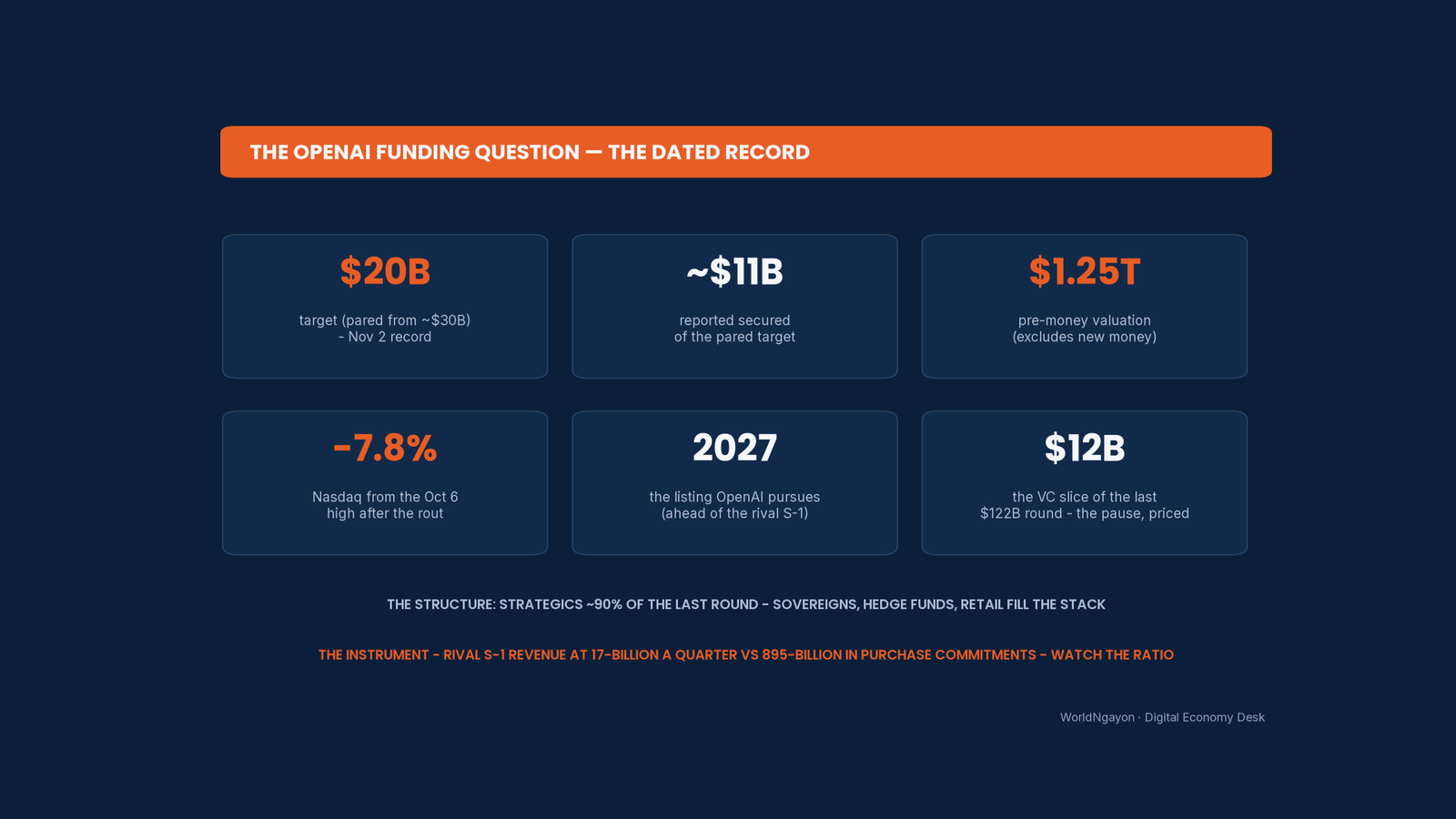
Table of Contents
The OpenAI funding question: the dated record
| Date | Dated event (as reported) |
| October 22, 2026 | CNBC reports OpenAI closing in on a round of up to $30 billion at a $1.25 trillion pre-money valuation (valuation excludes the new money; post-money lands near $1.28 trillion if full) |
| October 30, 2026 | Nasdaq falls 2.9% in the tech rout — down 7.8% from the October 6 all-time closing high; FT reports OpenAI cut the funding target by $10 billion (to $20 billion) amid the selloff |
| October 31, 2026 | Reuters carries the cut: wealthy individuals to be offered a subsequent retail tranche at the $1.25 trillion valuation; the classic VCs (Founders Fund, Coatue, Sequoia, a16z) expected among participants; OpenAI pursuing a 2027 listing, partly ahead of Anthropic’s imminent one |
| November 2, 2026 | CNBC’s reporting night: OpenAI seeking UP TO $20 billion — about $11 billion secured; the round’s strain documented while the tape’s worry deepens |
| November 2026 context | Anthropic’s revised S-1 reports $17 billion in Q3 revenue and $895.4 billion in purchase commitments; the two labs tap the same investor base |
WorldNgayon Analysis: the round’s compression reads straight on the tape: a target cut by a third the same week the market repriced AI spending, a partial close (~$11B of $20B), and a listing pursued partly as the exit valve. The crash-question guide frames the mechanism: megacaps fund from cash flow; the LABS fund on rounds — and the rounds price the market’s confidence in the labs’ burn. The money-trail analyses carry the same structures financing the buildout.
Bottom Line: the record says strain with structure intact — the round shrank, the valuation held, the listing clock runs.
Why venture capital paused: the structural math
The math that pushed the VCs out: the frontier labs’ rounds grew past the venture class’s entire capacity. OpenAI’s last round: $122 billion reported, of which ~$110 billion came from THREE strategic names (Amazon $50B, NVIDIA $30B, SoftBank $30B) — leaving ~$12 billion for everything else (venture funds, private credit, endowments). Anthropic’s February mega-round carried an estimated $10 billion from NVIDIA and $5 billion from Microsoft with the remainder across thirty-seven funds including hedge-fund money; the May 2026 round ($65 billion) drew just 8 of 28 investors from the VC class — the rest hedge funds, asset managers, sovereign wealth funds and strategics. The structure’s verdict: a VC fund that writes $100-500 million checks is a rounding error in a $20-122 billion round — the pause is not caution ABOUT AI; it is arithmetic ABOUT check size.
The caution component, honestly named: the same week’s tape (the Nasdaq rout; the round’s cut; the “only about $11 billion secured” strain) carries real caution too: strategic and sovereign capital is deep but not infinite, the public-market’s route (the IPO) is now the labs’ funding horizon, and the industry’s biggest spenders (the hyperscalers funding from cash flow — the Meta-style $145 billion AI capex class) do not need outside capital — which leaves the labs’ rounds to the narrowest funding stack in the market.
WorldNgayon Analysis: the pause’s honest verdict: venture capital did not lose faith — it lost capacity and relevance, and the labs’ answer (retail tranches, sovereign funds, IPOs) is the structure growing to fill the vacuum. The circular-financing analyses carry why that concentration carries its own fragility.
Bottom Line: the classic fund cannot write a frontier-model check anymore — the pause is the arithmetic, not the mood.
Who funds AI now: the megafund stack
The stack, tiered: 1 — strategics: the hyperscalers and chipmakers who fund from operating cash and take compute commitments in return (the Amazon/NVIDIA/SoftBank class — the last round’s 90%); 2 — sovereign wealth funds: the Gulf and sovereign books (MGX-class) riding the compute era; 3 — hedge funds and asset managers: late-stage exposure at pre-IPO pricing (Jane Street-class participation in the Anthropic round); 4 — the classic VCs: now late-stack participants (Founders Fund, Coatue, Sequoia, a16z in OpenAI’s round per the FT); 5 — retail: the tranche OpenAI floats for the follow-on — the structure’s newest tier, reaching individuals through a private round before any exchange does. The IPO (2027 pursued, Anthropic’s earlier-listed) is the stack’s exit valve.
WorldNgayon Analysis: the stack’s shape carries the concentration conversation this site’s crash coverage runs (the circular-deals ledger): when strategic partners are also suppliers and also the anchor buyers of compute commitments, the financing structure’s independence thins — the funding question and the circularity question are now the same question read from two sides.
Bottom Line: five tiers, and the bottom two are new — AI finance industrialized around the round, not the fund.
The revenue side: Anthropic’s S-1 and the commitments gap
The counterweight, dated: while OpenAI’s round strains, Anthropic’s revised S-1 reporting (this week) put $17 billion of Q3 revenue against $895.4 billion of purchase commitments — the revenue line is growing, and the commitments line is growing faster. The gap is the debate: the market’s bulls read the revenue trajectory (the commitments monetizing into the 2027-class revenue lines); the bears read the timing mismatch (cash out for commitments arrives before the revenue does — the quarter’s compute costs are the round’s real denominator). Both readings describe the same structure; the round’s strain and the S-1’s revenue are the same story’s two halves — the labs are spending at industrial scale against revenue growth at industrial rate (the capex economics guide carries the spend side).
WorldNgayon Analysis: the commitments-gap frame is the cleanest instrument this week left us: track the RATIO (revenue growth rate vs commitments growth rate) rather than the absolutes — the ratio decides whether the funding question resolves into ‘growth financing’ or ‘refinancing’ before the 2027 listings answer it the IPO way.
Bottom Line: $17 billion in a quarter, $895 billion committed — the ratio, not the totals, is the market’s instrument.
What this means for work, money and the Philippines
For investors: the funding question prices the AI economy’s floor: rounds of this size closing at all is the bull case’s plumbing; the strain ($11B of $20B) and the retail tranche are the caution’s plumbing — track the close and the post-IPO window (the watchlist numbers and the crash-series instruments carry the discipline).
For founders and startups: the OpenAI funding pause is a strategy memo: the mega-round era narrows check sizes at the bottom — product-led paths, profitability earlier, and the regional funds’ lane (the solo-tools economy) matter more when the frontier’s funding ignores yours.
For Filipino professionals and OFWs: the jobs layer rides on the funded side: the labs’ hiring (and the compliance and infrastructure roles the buildout carries — the jobs analyses, Gulf and SEA lane) continues through strains because the deployment is contracted; the OFW-lens caution: a financing pause upstream shows up downstream in vendor churn and pricing — the peso lens and the money-trail context carry the watch points for decisions routed through these companies’ platforms.
Verdict: the rounds grew past the funds
The OpenAI funding question, settled as structure rather than sentiment: a round pared from ~$30 billion to up to $20 billion (November 2’s CNBC record, with ~$11 billion secured against the cut’s tape), a $1.25 trillion pre-money price, a retail tranche floated, a 2027 listing pursued ahead of Anthropic’s — and a financing stack where strategics, sovereigns and hedge funds write the checks the venture class can no longer size. The pause is arithmetic, not despair; the S-1’s $17 billion quarter is real revenue growth against $895.4 billion committed; and the ratio between them is the instrument that decides whether the question resolves as growth financing, refinancing or the IPO’s answer. The rounds grew past the funds — the funding question’s second act is the listing window.
Sources on the record: the Reuters funding-target report.
Financial Disclaimer
This article is editorial analysis of publicly reported information, not investment or financial advice, and no outcome is promised. Figures and claims are as reported by the named sources at the stated dates; verify before acting. Markets and policy carry substantial risk.
The OpenAI funding story’s third act deserves its own paragraph: the retail tranche. The follow-on offering floated for wealthy individuals at the $1.25 trillion valuation extends the megafund stack to the individual tier — private-market exposure at private pricing before any exchange lists the company — and it rewrites the funding question’s audience: the round that skipped the classic funds does not have to skip individuals. The OpenAI funding strain and the IPO timeline (a 2027 listing pursued, ahead of the competitor’s) together define the funding horizon; the OpenAI funding round’s close, the tranche’s takeup, and the listing window’s pricing are the dated events the question resolves through. And the honest caution for anyone reading the OpenAI funding story as an investor: report-tier discipline applies — targets, secured amounts and tranche terms all moved inside two weeks; treat every figure at the date and source it carries.
The megafund stack, priced by its tiers: the strategic layer (the hyperscalers and chipmakers funding from operating cash, taking compute commitments as consideration – the last round’s ~90%); the sovereign layer (the Gulf-class sovereign wealth funds riding the compute decade); the hedge-and-asset-manager layer (late-stage exposure at pre-IPO pricing; the Anthropic round’s roster carried hedge-fund participation by name); the venture layer (now a late-stack participant class, writing checks the round tolerates rather than sizes); and the retail layer (the OpenAI funding structure’s newest tier – wealthy individuals reached through a private tranche before any exchange lists the asset). Each tier prices the same asset differently: the strategics in commitments, the sovereigns in decades, the managers in pricing windows, the funds in option value, the individuals in access. The OpenAI funding question’s resolution – the round’s close, the tranche’s takeup, the 2027 listing – reprices all five at once, which is why a ’round’ now moves the market the way a rate decision once did.
The IPO window, the question’s scheduled answer: both labs’ trajectories now run toward the public markets — OpenAI’s 2027 pursuit, the competitor’s earlier listing — and the OpenAI funding question becomes an exchange question: what does a $1.25 trillion-class asset price at on a public exchange, against a retail tranche that has already shown access-based demand inside the private round? The honest read: the megafund stack industrialized the last mile of private AI finance, and the listing converts its pricing into something the market can mark daily — the risk transfers from ‘can the round close’ to ‘can the multiple hold.’ The OpenAI funding arc’s own data — targets cut, amounts secured, tranches floated — is the market’s stress gauge for exactly that question, and each dated event in the tables above repriced it.
More on the record: the megaround-context record · the rounds-past-funds analysis.
- reuters.com/business/openai-cuts-funding-target-by-10-billion-ft-repo… — the Reuters funding-target report
- tech-insider.org/openai-30b-funding-round-1-25t-valuation-ipo-2026 — the megaround-context record
- wheresyoured.at/what-happens-if-openai-dies — the rounds-past-funds analysis
External sources linked in this article, in order of first mention. Spotted an error or a broken link? Tell us.
Cite this pagePublished Nov 4, 2026
Agron, E. (2026, November 4). The OpenAI Funding Question: Why Venture Capital Paused. WorldNgayon. https://worldngayon.com/openai-funding/
Agron, Edmon. “The OpenAI Funding Question: Why Venture Capital Paused.” WorldNgayon, 4 Nov. 2026, worldngayon.com/openai-funding/.
Agron, Edmon. “The OpenAI Funding Question: Why Venture Capital Paused.” WorldNgayon, November 4, 2026. https://worldngayon.com/openai-funding/.
Agron, E. (2026) ‘The OpenAI Funding Question: Why Venture Capital Paused’, WorldNgayon, 4 November. Available at: https://worldngayon.com/openai-funding/.
E. Agron, “The OpenAI Funding Question: Why Venture Capital Paused,” WorldNgayon, Nov. 4, 2026. [Online]. Available: https://worldngayon.com/openai-funding/
@online{agron2026openaifunding,
  author       = {Agron, Edmon},
  title        = {{The OpenAI Funding Question: Why Venture Capital Paused}},
  year         = {2026},
  date         = {2026-11-04},
  organization = {WorldNgayon},
  url          = {https://worldngayon.com/openai-funding/},
  urldate      = {}
}TY - ELEC AU - Agron, Edmon TI - The OpenAI Funding Question: Why Venture Capital Paused T2 - WorldNgayon PY - 2026 DA - 2026/11/04/ UR - https://worldngayon.com/openai-funding/ Y2 - ER -
Cite the version you read; the page may be updated. Zotero and Mendeley can also import this page directly.