The Loan App Is Texting Your Whole Contact List — Harassment Is Illegal, and Here's the Complaint File
Key Takeaway
📞 The loan app is texting your whole contact list — loan app harassment the moment it does: contact harvesting at application time, then shaming texts and calls to family, coworkers, and strangers — Philippine law treats this as illegal collection, and the SEC rules explicitly prohibit contacting anyone who is not a named guarantor or co-maker.
🏛️ The complaint file runs through four desks, not one: SEC (unregistered lenders, unfair collection — the i-Message portal files free), the National Privacy Commission (the contact-list harvest itself is a data-privacy violation — the ₱500 fee), the NTC (the SIM and number layer), and the PNP Anti-Cybercrime Group or NBI for threats and cyberlibel — most serious cases justify filing with more than one.
⚖️ The debt does not excuse the harassment — the rule that changes the whole negotiation: illegal collection methods are wrong regardless of the balance owed; you can stop the harassment while you deal with the loan separately.
📸 The evidence pack decides the case: screenshots with visible numbers and dates, call logs, the app’s agreement and permission screens, the payment records — filed promptly, because harassment evidence is the easiest evidence to lose.
🛡️ The counter-patterns that keep you safe while the case runs: pay only through the channels the agreement documents (and document every payment instruction), never to random personal accounts, never under a threat’s deadline — and the notarization detail (₱100-300) that converts your filing from a tip into an actionable case.
Table of Contents
The loan app is texting your whole contact list (the loan app harassment pattern) because it harvested the numbers when you applied — and Philippine law is on the receiving side of that script: collection harassment of your contacts, threats, and public shaming are illegal regardless of what the loan itself looks like. The complaint file is the response that works, and it runs through four desks — SEC, NPC, NTC, PNP-ACG or NBI — each with its own filing route, most free of charge. This loan app harassment dossier assembles the filing system: what each desk owns, what the evidence pack contains, the notarization step that turns a tip into a case, and the counter-patterns that keep the harassment from reaching anyone else’s phone in your family while the case grinds forward.
The Loan App Harassment Script: What the App Does and Why It’s Illegal
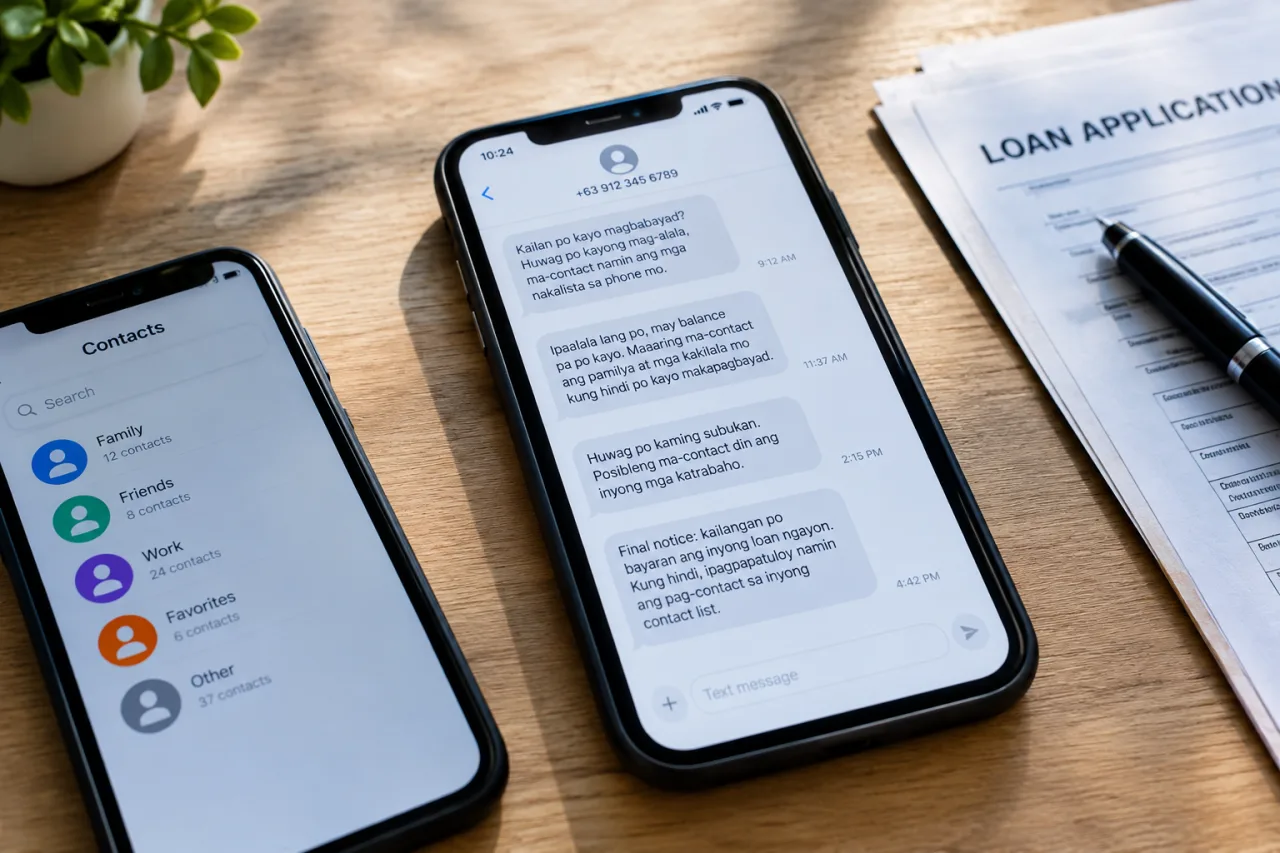
The loan app harassment script runs in waves: a first-wave call or text to your own number (legal if the collection itself is fair), then the turn to your harvested contacts — family, coworkers, the person listed as a reference three years ago, sometimes numbers you barely recognize — with debt-shaming scripts, threats to reveal your debt to your employer, edited screenshots of your account, and the fake-lawyer or fake-NBI roles that the guides document in the same lanes as every impersonation play the texting guides document. Every move after the first wave crosses lines the Philippine rules already drew: the SEC’s collection rules prohibit contacting people in your contact list who are not named guarantors or co-makers; the Data Privacy Act prohibits the harvesting itself and any disclosure of your data beyond the uses you consented to; threats and fake-authority claims belong to the criminal codes the PNP-ACG and NBI enforce. The contact-harassment analysis puts it plainly: naming someone as a reference does not authorize aggressive collection or shaming — and the same desk accepts the complaint whether or not the debt is legitimate, because the harassment is a separate wrong.
The Evidence Pack: What Files Before the First Call to the Desk
The loan app harassment filings succeed on paper, and the pack assembles in one sitting: screenshots of every harassing message with the number and timestamp visible (the raw message screen, not the chat app’s cropped version), the call log entries, the app’s registration screens (the exact app name as your phone shows it and the developer account), the loan agreement and its permission screens (what the app asked to access, including the contacts), the payment records for anything you already paid, and the notes of any call where threats were spoken (date, time, number, script). The filing guide’s rule matches every complaint desk in this series: gather evidence first and report promptly to preserve it — harassment evidence is the easiest evidence to lose, because the number gets recycled tomorrow and the account gets deleted in a week.
The SEC Filing: the Lender’s Own Regulator and the Free Portal
The SEC owns the lending company itself — the desk that ends loan app harassment campaigns at the license level — registration status, unfair collection practices, unrecorded online lending platform operations, and excessive charges beyond the covered-loan caps — and its guidance lists the agency-match table: enforcement runs from cease-and-desist orders through administrative fines reaching up to ₱2 million, with the DOJ referral lane for the criminal-tier cases. The filing portal (the i-Message system) runs free or at very low cost, accepts the evidence pack as assembled, and the escalation guide’s warning matters at filing time: an unverified complaint gets docketed as a tip, not an actionable case — notarization (₱100-300 at any notary) is the step that converts the filing. The honesty rule the escalation guide emphasizes: state the loan, the amount received, and the payments made accurately, because the harassment case strengthens when the debt side is clean — and the desk investigates harassment even when the debt itself is real.
The NPC Filing: the Privacy Case Behind Every Contact Bomb
The NTC and SEC handle the behavior; the National Privacy Commission owns the data harvesting that makes the behavior possible — the phonebook access the app requested at install, the contact disclosure to collectors, the unauthorized processing of everyone’s personal information. The loan app harassment NPC filing documents the data-chain: what the app harvested (the permission screens), where it went (the harassing texts to people who never consented), and the specific processing violations; the filing fee runs ₱500 plus the small legal-research fee (with exemptions available), and the NPC’s own decisions — the takedown orders and penalties it has issued in this exact lane — are the precedent trail the filing rides. Serious harassment cases justify parallel NPC and SEC filings, the guides’ standing advice; the desks don’t conflict, they compound.
The Criminal Layer and the NTC Lane: Threats, Cyberlibel, and the Number Itself
Where the script turns criminal — threats against your safety, impersonation (the fake lawyer, the fake NBI, the fake court), harassment with edited intimate content, or cyberlibel posts — the filing moves to the PNP Anti-Cybercrime Group or the NBI Cybercrime Division, which take the same evidence pack and the same complaints the SEC sees, with jurisdiction over the criminal tier. And the practical layer that no other desk handles: the NTC’s power over the numbers and telecoms themselves — the spam and abuse reports route the worst numbers toward blocking action even while your SEC and NPC cases grind. The triage guide’s table maps which problem goes to which desk — lending misconduct to SEC, data misuse to NPC, threats and fake accounts to PNP/NBI, credit-report disputes to the Credit Information Corporation — and the filing order is yours to choose when several apply, the way every complaint desk this series runs — including the fintech complaint ladder.
The Counter-Patterns: Staying Safe While the Case Runs
The harassment case and the debt continue in parallel, and the counter-patterns keep both survivable. Payments run only through channels the agreement documents — the LabanPH guidance includes the fake-account payment trap: collections that redirect you to personal accounts and channels that change every cycle — so every payment instruction gets documented (account name, number, receipt, confirmation) and payment to the official channel is the only one that counts. Threats of jail are theater (non-payment of debt is civil, not criminal); “we will message your employer” claims die on the same SEC rules; and the balance you still owe is real — the guides’ rule says deal with it separately, through negotiation or the official channels, while the harassment case runs its course. What the whole family learns from one complaint cycle: the app’s leverage was never the debt; it was the harvest — and the harvest is the part Philippine law takes away.
The OFW and Family Layer: Harassment That Travels
Borrower and family rarely share a country: the loan was taken in Manila while the worker earns in Riyadh, and the harassment lands on the phones still in the Philippines — the lola getting the shaming text, the cousin’s employer getting the call. The complaint file works across exactly that distance: the SEC and NPC filings run online from anywhere in the world, the evidence pack uploads from Riyadh the same night the texts arrive, and the power of attorney or written authorization (a family member as the authorized filer) covers the cases where the desks want a locally-signed document. The OFW layer adds one more duty: the briefing call — the family hears the script before the texts arrive (debt-collection harassment is illegal; do not engage, do not pay the redirected accounts, screenshot everything), because the family is the harassment’s actual target surface and the people most likely to pay under pressure are the ones the scripts are written for. The complaint file is a document the OFW builds once and the family files twice; the distances that the loan app exploits are the distances the filing system crosses for free.
Frequently Asked Questions
Can I Complain About Loan App Harassment if I Still Owe Money?
Yes — the harassment is illegal regardless of the debt, which is the rule that makes the whole filing system work for honest borrowers. State the loan accurately in your complaint (amount received, payments made), file the evidence pack, and let the desk weigh the collection conduct and the balance as separate questions — the SEC guidance says exactly this, because the harassment itself is the violation under review.
How Do I File a Complaint With the SEC Against a Loan App?
The i-Message portal accepts the complaint free or at minimal cost: the evidence pack (screenshots, call logs, agreement, payment records), the app’s exact name and developer, and the collection-behavior narrative. The notarization step (₱100-300 at any notary) converts the filing into an actionable case rather than a docketed tip — the step most first-timers skip, and the one that decides whether the case proceeds.
What Does the National Privacy Commission Do for Loan App Victims?
The NPC owns the data harvesting: the phonebook access at application, the contact disclosure to collectors, and the unauthorized processing of your family’s and friends’ personal information. The complaint documents the harvest chain with the app’s permission screens and the harassing messages as evidence; the filing fee runs ₱500 (plus the minor research fee, exemptions available), and the NPC’s takedown orders and penalties are the precedent trail behind every serious filing in this lane.
Is It Legal for a Debt Collector to Contact My Family and Coworkers?
No — the SEC’s collection rules explicitly prohibit contacting people in your contact list who are not named guarantors or co-makers, and naming someone as a reference three years ago never authorized aggressive collection or shaming. The Data Privacy Act adds the harvesting and disclosure layer. Every text they sent to a number you never authorized is a documented violation — that’s what the evidence pack exists to capture.
Can I Go to Jail for Not Paying an Online Loan?
No — non-payment of debt is a civil matter in the Philippines, and the jail threats in the scripts are theater. What IS criminal: the threats made against you, the impersonation of lawyers and police, the shaming posts. That’s the split the complaint system runs on — the balance you owe stays a civil question; the harassment becomes the criminal and administrative case, and those are the desks the filings target.
Financial Disclaimer
This article provides general consumer-protection and legal-information guidance and does not constitute legal or financial advice. Filing fees, portals, and agency rules change over time; verify against the official SEC, NPC, and NTC pages before acting. The author and publisher disclaim any liability for actions taken based on this information.
External sources linked in this article, in order of first mention. Spotted an error or a broken link? Tell us.
Cite this pagePublished Nov 2, 2026
APA 7
Agron, E. (2026, November 2). The Loan App Is Texting Your Whole Contact List — Harassment Is Illegal, and Here’s the Complaint File. WorldNgayon. https://worldngayon.com/loan-app-harassment/
MLA 9
Agron, Edmon. “The Loan App Is Texting Your Whole Contact List — Harassment Is Illegal, and Here’s the Complaint File.” WorldNgayon, 2 Nov. 2026, worldngayon.com/loan-app-harassment/.
Chicago
Agron, Edmon. “The Loan App Is Texting Your Whole Contact List — Harassment Is Illegal, and Here’s the Complaint File.” WorldNgayon, November 2, 2026. https://worldngayon.com/loan-app-harassment/.
Harvard
Agron, E. (2026) ‘The Loan App Is Texting Your Whole Contact List — Harassment Is Illegal, and Here’s the Complaint File’, WorldNgayon, 2 November. Available at: https://worldngayon.com/loan-app-harassment/.
IEEE
E. Agron, “The Loan App Is Texting Your Whole Contact List — Harassment Is Illegal, and Here’s the Complaint File,” WorldNgayon, Nov. 2, 2026. [Online]. Available: https://worldngayon.com/loan-app-harassment/
BibTeX
@online{agron2026loanapp,
  author       = {Agron, Edmon},
  title        = {{The Loan App Is Texting Your Whole Contact List — Harassment Is Illegal, and Here’s the Complaint File}},
  year         = {2026},
  date         = {2026-11-02},
  organization = {WorldNgayon},
  url          = {https://worldngayon.com/loan-app-harassment/},
  urldate      = {}
}
RIS
TY  - ELEC
AU  - Agron, Edmon
TI  - The Loan App Is Texting Your Whole Contact List — Harassment Is Illegal, and Here’s the Complaint File
T2  - WorldNgayon
PY  - 2026
DA  - 2026/11/02/
UR  - https://worldngayon.com/loan-app-harassment/
Y2  -
ER  -
Cite the version you read; the page may be updated. Zotero and Mendeley can also import this page directly.