Table of Contents
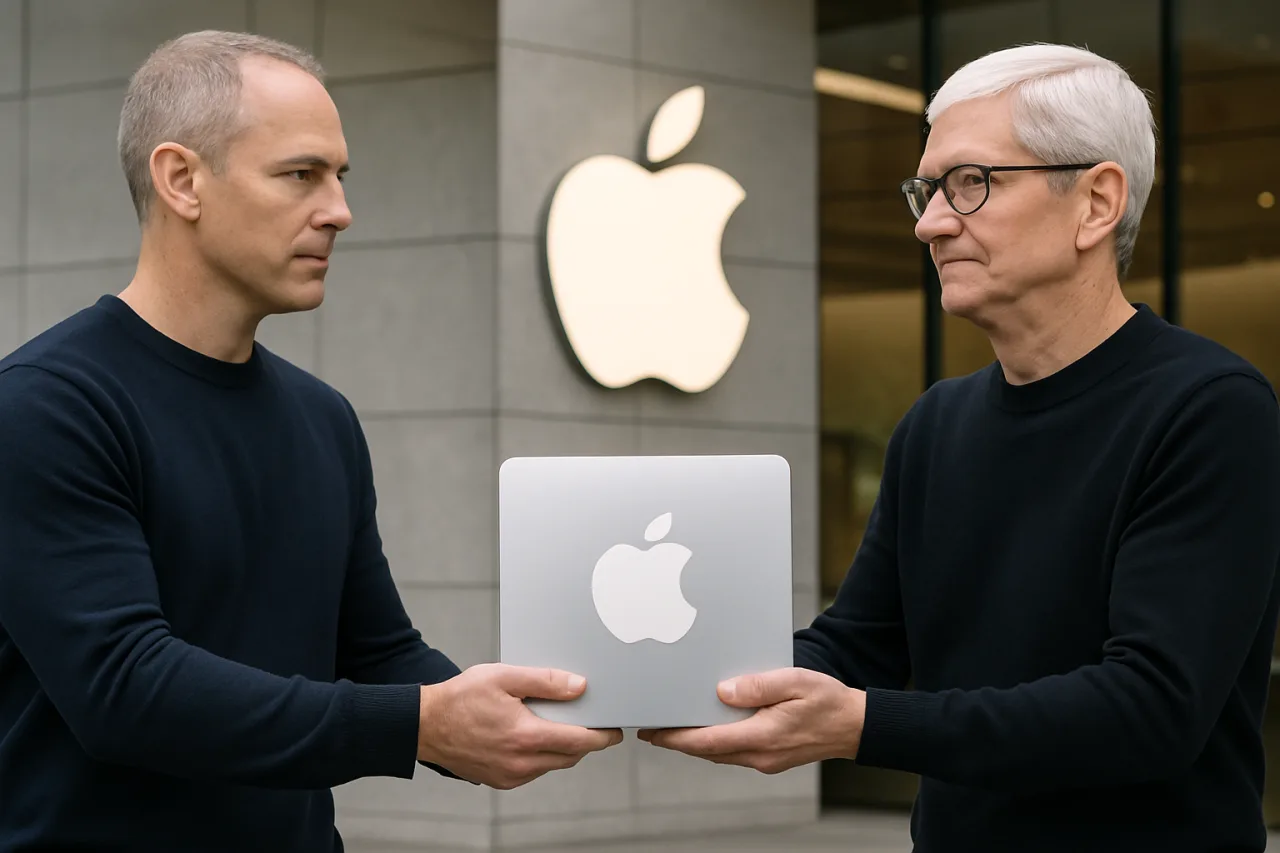
Apple CEO John Ternus formally took command of the world’s most valuable company on September 1, 2026, ending Tim Cook’s 15-year run as chief executive and inheriting a business worth more than $4 trillion, with over 2.5 billion active devices, annual revenue above $416 billion, and an AI strategy that runs on the silicon this 25-year Apple veteran spent his career building. The handover — announced April 20 and approved unanimously by the board — makes Ternus the eighth CEO in Apple’s history and the first whose rise came from the chip lab rather than the executive suite. His first public test arrives just eight days into the job: the September 9 hardware event, where a rebuilt Siri and Apple’s first foldable iPhone are widely reported to headline.
Key Takeaway
- 🔁 The handover is complete: John Ternus became Apple CEO effective September 1, 2026, while Tim Cook moved into a new executive chairman role focused on global policy engagement.
- 🏭 An engineer now runs Apple: Ternus is the first CEO promoted from hardware engineering — the architect of the Apple silicon transition that powers every AI feature the company ships.
- 💰 The inheritance is historic: Cook leaves behind a company that grew from roughly $350 billion to $4 trillion in market value, with revenue nearly quadrupling from $108 billion to more than $416 billion.
- 📅 September 9 is the first test: Ternus’s opening act is Apple’s biggest hardware event of the year, with a rebuilt Siri and a reported foldable iPhone on deck.
- 🇵🇭 Why Filipinos should care: the Philippines is one of the world’s most iPhone-dependent markets, and Apple’s silicon choices decide how AI features reach the devices OFW families buy every year.
Apple CEO Change: The September 1 Handover Explained
The transition was engineered for certainty, not surprise. Apple announced the succession on April 20, 2026, in an official Apple Newsroom press release, giving the company more than four months to manage a handover that Wall Street had long priced in. Cook remained chief executive through the summer, working alongside Ternus on what Apple described as a smooth transition, before formally moving to the executive chairman’s office on September 1. Arthur Levinson, Apple’s non-executive chairman for the past 15 years, became lead independent director on the same date, and Ternus joined the board of directors as he assumed the top job.
The division of labor is unusual and deliberate. Cook, 65, is not retiring — as executive chairman he will assist with certain company matters, most notably engaging with policymakers around the world, a role that grew in importance as Apple committed $600 billion in US investment over five years during an August White House appearance. Ternus, meanwhile, holds full operational command. It is the first CEO transition at Apple since 2011, when Cook himself succeeded Steve Jobs shortly before Jobs’ death.
Wedbush analyst Dan Ives told CNBC the timing still surprised the market: “The view is he was going to stay on maybe for another year.” Cook had publicly shut down retirement speculation as recently as March, telling Good Morning America that he loved the job deeply. The board, evidently, had other plans — and the fact that the announcement came with a fully planned four-month runway suggests the succession was settled far earlier than the public realized.
Who Is John Ternus, Apple’s Eighth CEO?
Ternus is the rare Apple executive whose entire career fits inside one building. He joined the company more than two decades ago, rose through the hardware engineering organization, worked under both Steve Jobs and Tim Cook, and led the Product Design and Hardware Engineering teams as senior vice president before the promotion. Cook’s own description of his successor was pointed: “John Ternus has the mind of an engineer, the soul of an innovator, and the heart to lead with integrity and with honor.”
| Profile | Detail |
|---|---|
| New role | Apple Chief Executive Officer, effective September 1, 2026 |
| Previous role | Senior Vice President, Hardware Engineering |
| Tenure at Apple | Over 25 years; worked under Steve Jobs and Tim Cook |
| Signature work | Apple silicon transition — M-series chips across Mac, iPad and Vision Pro |
| CEO number | Eighth chief executive in Apple’s history |
| First public test | September 9, 2026 hardware event |
The chip credentials matter more than any biography line. Ternus oversaw the era in which Apple moved the Mac away from Intel and built its own M-series processors — the foundation of on-device AI. In August 2026 alone, Apple shipped the Mac Studio with M5 Max and M5 Ultra, unveiled a more powerful Mac mini with the M6 and M5 Pro, and introduced the M6 and M5 Ultra for what the company called a big leap in AI compute. That cadence is the clearest signal of what his Apple will prioritize: the silicon that makes artificial intelligence fast, private and battery-friendly.
What the New Apple CEO Inherits From the Cook Era
Cook leaves a company transformed. When he took over in August 2011, Apple was worth approximately $350 billion and had annual revenue of $108 billion. By the time he handed over the keys, market capitalization had grown more than tenfold to $4 trillion — briefly touching $5 trillion in July 2026 — revenue had nearly quadrupled to more than $416 billion, and the active installed base had expanded past 2.5 billion devices across more than 200 countries and territories.
| Cook-era metric | 2011 | 2026 handover |
|---|---|---|
| Market capitalization | ~$350 billion | $4 trillion (briefly $5T in July 2026) |
| Annual revenue | $108 billion (FY2011) | $416+ billion (FY2025) |
| Active devices | Under 400 million | More than 2.5 billion |
| Services business | Nascent | Over $100 billion — a Fortune 40 equivalent |
| Retail footprint | About 350 stores | More than 500 stores, 200+ countries |
| Headcount | ~50,000 | More than 150,000 |
The categories Cook created — Apple Watch, AirPods, Apple Vision Pro — and the services empire he scaled (iCloud, Apple Pay, Apple Music, Apple TV) give Ternus a portfolio no incoming CEO has ever matched. The challenge is equally clear. Apple’s rivals are spending at speeds the industry has never seen, and the company’s own AI ambitions are judged, fairly or not, to be trailing the cloud-first competition. Ternus’s answer, judging by his decade of work, is that AI belongs on the device — and the device is only as good as its chip. Readers tracking how AI leadership narratives shape markets will recognize the pattern in our earlier coverage of why AI is already reshaping CEO agendas and Bill Gates’ warning about AI-driven upheaval.
September 9: The New Apple CEO’s First Test
Ternus does not get a quiet start. Apple’s September hardware event — scheduled for September 9, eight days after he took office — will showcase the first products designed entirely under his watch as CEO. Two headline expectations dominate the reporting: a rebuilt, more conversational Siri, and Apple’s first foldable iPhone, a device category the company resisted for years while Samsung and Chinese brands normalized it.
For a hardware engineer, the foldable is a fitting debut. Foldable devices are unforgiving tests of mechanical engineering, display integration and battery architecture — precisely the disciplines Ternus ran for years. And the Siri rebuild is where hardware and AI strategy visibly converge: on-device processing, faster neural engines and tighter memory bandwidth are the physical requirements of an assistant that responds in real time without shipping every request to a data center.
The market will be watching two numbers more than any keynote slide: iPhone pre-order data in the weeks after the event, and any guidance that shows AI features driving upgrade cycles rather than merely decorating them. An inherited $4 trillion company buys patience, but not unlimited patience.
Why a Hardware Chief Leads Apple’s AI Era
The choice of Ternus over any software or services executive is Apple’s clearest strategic statement in a decade. While competitors race to rent computing power from cloud giants — a dynamic we examined in our analysis of the Pax Silica silicon alliance — Apple’s model has always been vertical: own the chip, own the operating system, own the experience. On-device AI is the continuation of that philosophy, and it depends entirely on the silicon roadmap Ternus built.
The economics back the logic. Apple Intelligence features run on neural engines inside M-series and A-series chips, which means every AI capability Apple ships lowers its marginal cost relative to rivals paying per-token cloud fees. Privacy, too, becomes a hardware feature: data that never leaves the device cannot be breached from a server farm. In an era when regulators scrutinize where AI computations happen, the chip-first strategy is both a product advantage and a legal shield.
The risks are real. AI at scale still requires data center capacity, and Apple’s cloud footprint is modest relative to Microsoft, Google or Amazon. Ternus must scale hybrid infrastructure without surrendering the privacy positioning that differentiates Apple. How he balances those pressures — silicon moat versus cloud scale — will define his tenure more than any single product launch.
What the Apple CEO Change Means for Filipino Users and Workers
The Philippines sits near the top of global iPhone enthusiasm, and the Apple CEO transition lands here with practical force. OFW families buying iPhone 16 and 17 generations in the coming quarters are buying into Ternus’s hardware roadmap: whatever the September 9 event announces, the resale value, software support span and AI feature set of those devices will be shaped by his decisions.
For the Filipino tech workforce, the signal is employment-shaped. Apple’s continued $600 billion US investment commitment and its chip-first strategy reinforce a global demand pattern for hardware, firmware and silicon talent — fields where Filipino engineers are already present through semiconductor design services and electronics manufacturing partners across Laguna, Cebu and Clark. A CEO who rose from hardware signals to every supplier and every engineering team that the device roadmap, not the marketing calendar, is Apple’s center of gravity.
There is also a broader leadership lesson in the transition itself. Cook spent 15 years proving that an operator — a supply chain master, not a showman — could scale the world’s most valuable company. Ternus now tests the opposite hypothesis: that in the AI era, the builder of the machine should run the company that sells it. Filipino professionals navigating their own AI-era career choices can read the tea leaves: deep technical competence remains the scarcest, most promotable skill in the global market.
What Comes Next Under Apple CEO John Ternus
The watchlist for the next twelve months is short and concrete. First, the September 9 event — execution, reception and pre-order numbers for the foldable iPhone and rebuilt Siri. Second, the AI roadmap: whether Apple Intelligence expands meaningfully beyond its current feature set, and whether Apple’s on-device strategy holds as competitors accelerate cloud agents. Third, organizational signals — whether Ternus elevates more engineers into executive ranks, confirming the silicon-first culture shift. Fourth, the China and tariff landscape, where Cook’s successor as operational CEO inherits a geopolitical file that Cook personally managed for years.
One thing is already certain: the era of asking whether Apple can innovate without Steve Jobs has a new chapter, and this time the person holding the pen is an engineer who has spent 25 years shipping the products. The mountain watches, and so does the market.
Frequently Asked Questions About the Apple CEO Change
Who is the new Apple CEO?
John Ternus, Apple’s former senior vice president of Hardware Engineering, became Apple CEO effective September 1, 2026. He is the eighth chief executive in the company’s history and the first promoted from the hardware engineering organization. He spent more than 25 years at Apple and led the Apple silicon transition across Mac, iPad and Vision Pro.
When did Tim Cook step down as Apple CEO?
Tim Cook’s last day as CEO was August 31, 2026, with the transition effective September 1, 2026. He moved into the role of executive chairman of Apple’s board, where he focuses on company matters including engagement with policymakers worldwide. The succession was announced on April 20, 2026.
Is Tim Cook leaving Apple completely?
No. Cook remains at Apple as executive chairman — an active role that includes global policy engagement, particularly around the company’s $600 billion US investment commitment. Arthur Levinson, previously non-executive chairman, became lead independent director on the same date.
Why did Apple choose a hardware engineer as CEO?
The board’s choice signals Apple’s strategic priority: on-device artificial intelligence depends on custom silicon, and Ternus built that silicon advantage. As the leader of hardware engineering through the M-series chip transition, he represents the company’s core belief that AI performance, privacy and battery life are won in the chip design lab before they are won in software.
What will John Ternus do first as Apple CEO?
His first major public act is the September 9, 2026 hardware event, eight days into his tenure, where Apple is expected to unveil a rebuilt Siri and its first foldable iPhone. The event is the first market test of products planned under his leadership and will set the tone for his product philosophy as CEO.
How big was Apple when Tim Cook handed over?
At the September 1, 2026 handover, Apple’s market capitalization stood at approximately $4 trillion — up from about $350 billion when Cook became CEO in 2011. Annual revenue exceeds $416 billion, the installed base surpasses 2.5 billion active devices, and the services business generates more than $100 billion a year.