Table of Contents
Key Takeaway
- 👔 The claim: Google CEO Sundar Pichai says AI replacing CEOs may be the most realistic scenario of all — leadership roles could be the easiest for AI to take over, not the last.
- The receipts: Sam Altman says he’d consider himself a failure if OpenAI isn’t the first major company run by an AI CEO, and Elon Musk says AI and robots will eventually replace all jobs.
- Why the corner office is exposed: Executive work is dense with the exact tasks AI does best — synthesis, forecasting, reporting, and decision support — while its human strengths are narrower than the title suggests.
- The play: Managers who deliberately build the skills AI cannot price — accountability, trust, negotiation, and crisis leadership — turn this warning into a career moat.
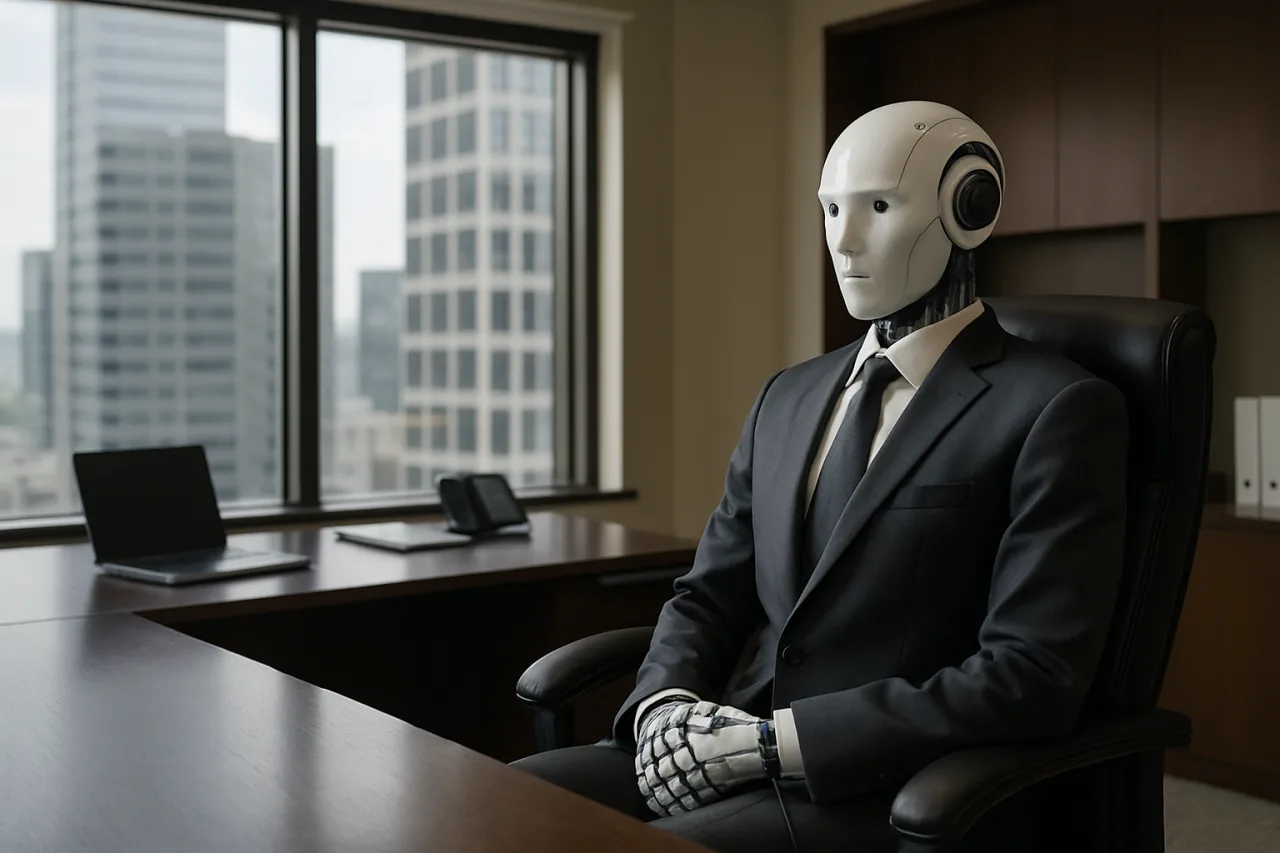
AI replacing CEOs sounds like the punchline to a joke executives tell at retreats — until the CEO of Google is the one telling it. Sundar Pichai, who runs the company whose search box sits between most of the world and information itself, said in a recent interview that CEO roles may be the “easiest” for artificial intelligence to replace, per The Economic Times’s coverage of the conversation. The man whose own corner office overlooks the most valuable AI portfolio on earth believes the technology could one day take his job — and possibly before it takes yours.
The statement matters because of who said it and where the trendline on AI replacing CEOs runs. OpenAI’s Sam Altman, asked about his own obsolescence, told the Conversations with Tyler podcast, as Yahoo Finance quoted the exchange: “Shame on me if OpenAI is not the first big company run by an AI CEO.” Elon Musk has posted that “AI and robots will replace all jobs,” with work becoming optional like “growing your own vegetables.” Three of the most powerful people in technology now publicly agree that the executive suite is not exempt from automation. This article unpacks what Pichai actually said, why the CEO job is more exposed than it looks, what remains defensibly human at the top — and what professionals below the C-suite should do with a warning this specific.
What Pichai Actually Said About AI Replacing CEOs
Pichai’s remarks, as reported by The Economic Times, contain a claim few executives would dare make about their own roles: that the corner office could be among the first to fall. His reasoning is a task-level analysis disguised as modesty. Much of what a CEO “does” — reading dashboards, synthesizing market reports, allocating capital, crafting the narrative for investors — is precisely the pattern-matching and synthesis work where large language models already excel. There is, he cautioned, still work to be done before AI can fully unlock those capabilities, but the direction of travel is unmistakable.
Two clarifiers from the same interview matter for balance. Pichai noted that AI models remain “prone to errors” and that users should not rely on them alone — one reason he argues Google Search retains its grounding advantage. And he expressed confidence that Google can ride out the AI market turbulence because of its “own full stack of technologies.” Translation: the CEO sees the disruption clearly, believes his company is built to survive it, and still thinks his own job description is more automatable than the public assumes. That combination — candor plus composure — is why the comment traveled around the world within hours.
The Altman Bet: A Company Run by an AI CEO
If Pichai’s framing is the analyst’s view, Sam Altman’s is the founder’s wager. On the Conversations with Tyler podcast, the OpenAI chief put a deadline on his own irrelevance: “Shame on me if OpenAI is not the first big company run by an AI CEO.” The line is characteristic Altman — self-implicating, quotable, and strategically brilliant — but it is also a concrete prediction that the top job itself is a solvable software problem. He is, in effect, promising to fire himself and calling it success.
Musk’s version is maximalist: “AI and robots will replace all jobs,” he posted on X, adding that working could become optional — like growing your own vegetables — in a world of automated abundance. Strip the futurism and a pattern emerges across all three statements. The people building these systems believe they will eventually manage, direct, and even govern organizations. Not one of them argues the executive suite is protected. The disagreement is only about the timeline — and Pichai’s “easiest to replace” framing puts management roles earlier in the sequence than almost any prediction currently priced into labor markets.
Why the Corner Office Is More Exposed Than It Looks
The counterintuitive truth in the AI replacing CEOs debate is that seniority can mean exposure. Decompose a typical executive week and the automatable share is startling: status synthesis from reporting layers, variance analysis, scenario modeling, competitor tracking, investor updates, agenda-setting, and first drafts of nearly every strategic document. These are text-and-number tasks with clear success criteria — the exact profile where AI agents are compounding fastest, as our earlier analysis of Pichai’s warning on AI job disruption documented for entry-level roles. The difference at the top is scale, not kind.
Jensen Huang, asked last year whether AI could take his job, answered “absolutely not” — arguing AI remains far from replacing workers at scale and has “no possibility of doing what we do.” The disagreement between Huang and Pichai is the live fault line of 2026: one CEO bets on augmentation preserving leadership; the other bets the leadership layer itself is pattern-matching all the way up. The evidence so far favors neither absolutely — but the tasks decomposition favors Pichai’s reading, because the higher you go, the more your calendar consists of decisions that were already prepared, summarized, and framed by someone (or something) else.
What Stays Human When AI Replacing CEOs Gets Serious
The defensible core of leadership is smaller than the title, but it is not empty. Accountability is the first wall: boards, regulators, and shareholders need a throat to choke, and no legal system on earth accepts “the model decided.” Trust is the second: capital allocation in a crisis, layoffs, mergers, and public apology are acts of human credibility that stakeholders audit emotionally, not logically. Negotiation is the third — the live reading of a counterparty’s hesitation in a closed room, which is game theory performed by nervous systems. And judgment under ambiguity — deciding with incomplete data when the model’s confidence interval spans disaster and triumph — remains the defining human act of command.
That defensive perimeter maps almost perfectly onto Bill Gates’ “Human Reserved” concept, which our analysis of the Gates essay covered this week: certain domains preserved for people not because machines fail there, but because the loss of human presence would be too great. Leadership under scrutiny is the prototype Human Reserved role. The uncomfortable implication for middle managers is sharper, though: if the CEO’s automatable tasks get automated while the defensible core concentrates at the very top, the traditional management pyramid narrows in the middle. Fewer layers, bigger spans, and a premium on the human skills the pyramid used to diffuse.
The Trust Recession Behind the Executive Wagers
Notice the irony holding the AI replacing CEOs story together: the executives predicting AI will run companies are the same ones asking employees to trust AI adoption programs. Our reporting on the AI adoption trust gap found a majority of surveyed Americans now fear AI more than they admire it — and that gap widens when leadership frames automation as destiny rather than choice. Altman cheering for his own replacement reads differently to an employee whose performance review next quarter depends on the same technology. The Zuckerberg Meta AI restructuring saga — Project OT’s collapse — already demonstrated what happens when replacement rhetoric outruns delivery: rebellion, firefighting, retreat.
Pichai’s framing threads this needle more carefully. He speaks of jobs that will be eliminated and others that will “evolve and transition,” and of AI agents that will eventually act on your behalf — scheduling, investing, even medical triage — which he calls “really interesting” territory. The message underneath: the technology is real, the timeline is uncertain, and the leaders modeling calm are also the ones whose jobs the models are coming for. Whether that candor builds trust or burns it is, for now, an open experiment with the world’s workforce as its subject.
Five Defensive Moves for Managers Who Take the Warning Seriously
- Own a P&L, not a process. Automatable management is process stewardship; defensible management is commercial accountability with a name attached to it. Volunteer for revenue or loss responsibility — it is the hardest thing to hand to a model and the easiest thing for a board to verify.
- Build the human network no org chart captures. Cross-company trust, the ally who warns you before the merger leaks, the regulator who takes your call — these networks are invisible to dashboards and therefore invisible to replacement models.
- Become the executive who operates AI. Between the extremes of denial and obsolescence sits the fastest-growing role in every org chart: the leader who deploys, audits, and corrects AI systems. That fluency is this decade’s MBA, and our AI job interview preparation plan shows how to signal it credibly.
- Keep a public record of human judgment. Decisions made against the data — and vindicated — are the portfolio that proves the accountability layer is you. Document them; careers are repriced on evidence, not vibes.
- Watch the governance wave, not just the tool wave. Boards are beginning to ask who is liable when an AI-prepared decision fails. The managers who can answer for model risk in plain language will inherit the roles that survive the squeeze.
What AI Replacing CEOs Means for Filipino Professionals
The AI replacing CEOs debate lands on the Philippine management layer of its largest industries. The BPO sector’s supervisory ranks — team leads, account managers, operations directors — hold exactly the hybrid roles this analysis describes: enough process to be automatable, enough human coordination to be defensible. The professionals who move up the value curve toward client-facing accountability and AI-operations fluency will ride the transition; those who remain pure reporting intermediaries are standing where the squeeze lands first. The same calculus applies in banking, healthcare administration, and the government service layer — anywhere a management title means summarizing upward and delegating downward.
There is also an upside case worth naming. If Altman is even half right, the next decade’s most valuable credential is operational judgment about AI systems — and that credential is country-agnostic. A operations lead in Manila who can demonstrably manage hybrid human-AI teams is competing in the same global market as one in Austin or Dublin, as our coverage of Philippine outsourcing AI readiness has tracked. The corner office may or may not fall to a model. The middle managers who prepare as if Pichai is right will still be standing when the experiment resolves.
Frequently Asked Questions About AI Replacing CEOs
Did Sundar Pichai really say CEOs could be replaced by AI?
Yes — per The Economic Times’ report of his recent interview, Pichai said CEO roles may be the “easiest” for AI to replace, while noting that the technology’s full capabilities have not yet arrived and that models remain prone to errors. He paired the warning with confidence that Google’s full technology stack positions it to weather the transition.
Why would CEOs be easier to replace than other workers?
Because much of executive work is synthesis and decision support — reading dashboards, summarizing reports, forecasting, and preparing choices for others — which are core AI strengths. The human-only core of leadership (accountability, trust-building, negotiation, judgment under ambiguity) is real but narrower than the title implies, so the automatable share of the job is larger at the top than most people assume.
What did Sam Altman say about an AI CEO?
On the Conversations with Tyler podcast, the OpenAI CEO said: “Shame on me if OpenAI is not the first big company run by an AI CEO” — a deliberate self-bet that his own role is a solvable software problem. Elon Musk has gone further, predicting on X that AI and robots will eventually replace all jobs, making work optional.
Which leaders disagree that AI will replace CEOs?
NVIDIA’s Jensen Huang has been the most prominent skeptic, saying “absolutely not” when asked whether AI could do his job, and arguing that as of now AI has “no possibility” of doing what executives and workers do at scale. The Pichai-Huang split is the clearest public disagreement among major-CEO ranks about automation’s direction.
Which management skills are safest from AI?
Accountability (being the person answerable for outcomes), trust and crisis leadership, high-stakes negotiation, cross-organizational influence, and judgment under incomplete information. These are concentrated, relationship-bound, and legally anchored in humans — the profile Gates’ Human Reserved framework envisions preserving.
Should mid-level managers be worried?
Be realistic, not alarmed. The likeliest near-term outcome is pyramid compression: fewer management layers with larger spans, where surviving roles demand demonstrable AI fluency plus the human skills above. Managers who build accountability records and AI-operations fluency now are positioned for the compression; those whose value is pure reporting intermediation are the exposed population.
The Bottom Line
The AI replacing CEOs debate is no longer hypothetical — it is three CEOs describing their own obsolescence with startling calm, each for different reasons. Pichai’s version deserves the most attention because it is the least self-serving: a sitting chief executive explaining why his own task list is more automatable than the market believes. The professionals who profit from that candor will be the ones who treat the executive suite like any other role under automation pressure: audit the tasks, build the defensible core, and run toward the judgment-shaped work that remains.