Key Takeaway
- 🌊 The definition: immersion cooling is the practice of submerging whole servers in a tank of electrically-insulating, heat-absorbing liquid — a dielectric fluid — so every component cools at once without air movement; it is the most radical of the liquid-cooling technologies that AI’s power-hungry racks forced into the mainstream.
- ⚗️ The two systems: single-phase immersion (the fluid stays liquid, pumps through a heat exchanger — about 67% of the market in 2024) and two-phase immersion (the fluid boils off the chips into vapor, condenses back on a coil — able to cool 250-500 kW per tank); both replace fans with physics.
- 🌡️ Why AI made it mainstream: air cooling’s practical rack ceiling sat around 20 kW before heat became unmanageable; AI racks now push past 100 kW — with 300 kW-class designs arriving — and immersion is one of the few architectures that cools that density uniformly.
- ⚖️ The honest scorecard: immersion’s wins (uniform whole-server cooling, no fans, dense footprints) versus its costs (tank infrastructure, fluid selection and lifecycle management, and higher upfront spend than direct-to-chip cold plates) — and the vendor-stated numbers belong in the marketing column until third-party-verified, per this site’s evidence standard.
- 🗺️ The strategic read: immersion is not the default for everyone — direct-to-chip cooling is the hyperscale’s current incumbent — but for maximum-density AI builds, edge sites in hot climates, and the next generation of rack power, immersion is the technology being evaluated in every serious capacity plan.
Table of Contents
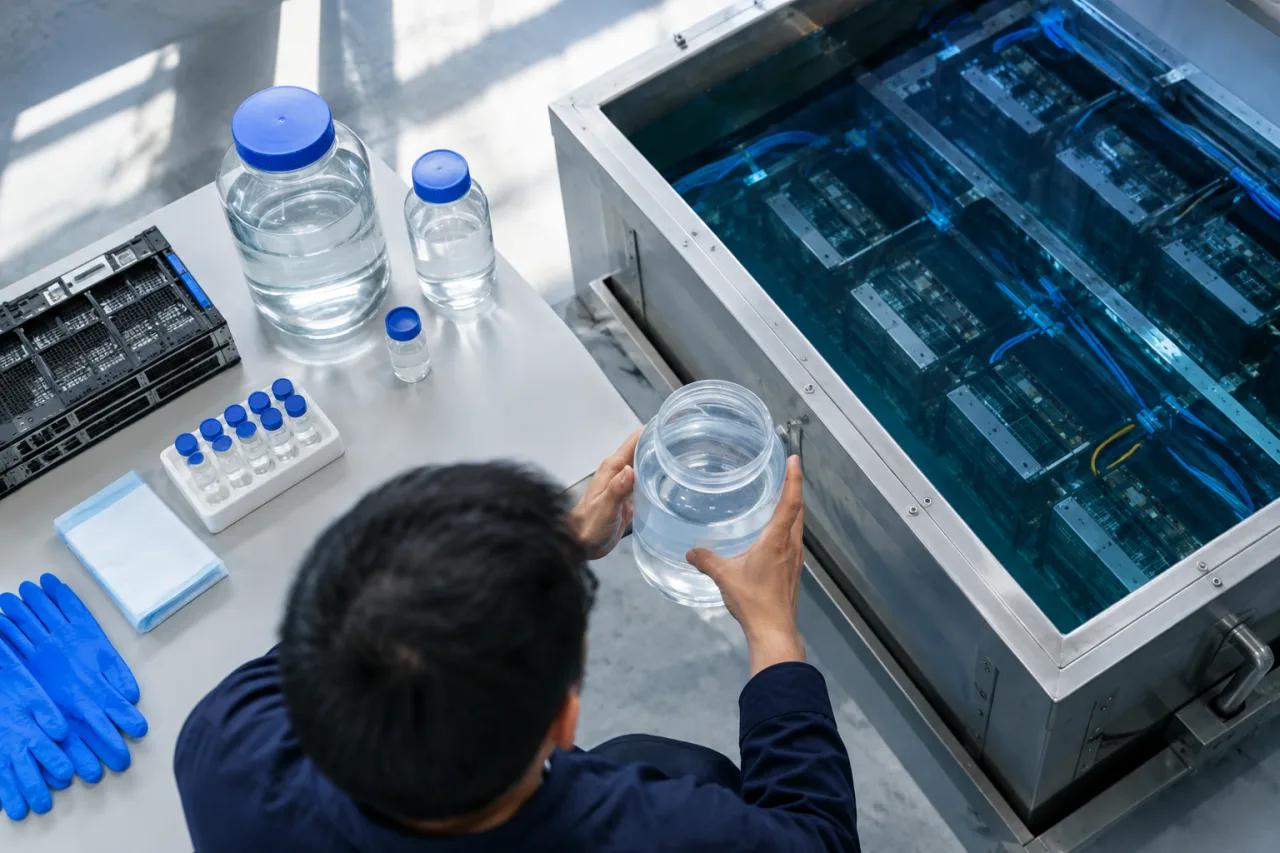
Immersion cooling sounds futuristic and looks industrial-chic: servers lowered into dark tanks of engineered liquid, no fans, no air filters, just boards bathing in fluid that draws their heat away silently. The exotic look is misleading — this is now a mainstream data-center capacity option (about 67% of the immersion market was single-phase systems in 2024), born in cryptocurrency mining farms and promoted by AI’s thermal reality: the racks got too hot for air. This guide explains the technology for readers deciding what to believe — the physics, the two system designs, the fluid chemistry that makes it possible, the honest scorecard of measured benefits versus vendor claims, and where immersion fits against the direct-to-chip cooling now standard in hyperscale AI builds.
What is immersion cooling: the definition
So what is immersion cooling, operationally? immersion cooling manages server heat by submerging electronic components — or entire servers — in a thermally conductive but electrically insulating liquid coolant. Electrically insulating is the load-bearing property: the coolant must not conduct electricity, because it touches live boards; the industry calls such fluids dielectric fluids. Thermally conductive is the promise: the fluid replaces air as the heat-transfer medium, and a working liquid moves heat by orders of magnitude better than air.
The mechanism: heat leaves the chip package, passes through the fluid, and is carried to a heat exchanger — a coil or a plate — where a second loop (water, in most designs) moves it out of the building. No fans, no raised-floor airflow, no hot/cold aisle separation: the entire thermal discipline of the last two decades of data-center design collapses into a tank. That collapse is why immersion cooling reads as radical — it removes, rather than scales up, the airflow infrastructure every traditional facility is built around.
The lineage matters for credibility: immersion did not arrive with AI. Cryptocurrency miners adopted it in the 2010s to squeeze more ASICs into containers without airflow noise or dust; the technology’s industrial maturity — tanks, fluids, service models — was proven in that harsh economics-first market before AI’s 300 kW racks made it strategically necessary. The AI capex pieces this site runs trace the demand side of that transition; this piece covers the thermal side.
Why rack density killed air cooling
The ceiling that AI broke: a rack is the standard vertical unit of data-center capacity, and its power draw determines its thermal design. Air-cooled racks ran comfortably at 5-15 kW for two decades; densities peaked around 20 kW in the largest air-cooled deployments before liquid became unavoidable — and generative AI broke the scale: GPU-accelerated servers now push past 100 kW per rack in the largest hyperscale applications, with 300 kW-class AI racks in current designs. The physics reason air loses is simple: air is a poor heat conductor, and moving it fast requires fan power that itself becomes heat and noise; beyond some density, the airflow math stops closing and every incremental watt of compute costs more to cool than it earns.
The economic reason the industry did not move sooner: air cooling is cheap, flexible and serviceable — every component is a field-replaceable unit a technician can swap in an afternoon. Liquid systems raise the service bar (fluids, tanks, cold plates, CDU pumps) and the failure-mode list, which is why the transition happened not when liquid became technically possible, but when density made air economically impossible — the AI buildout is that inflection, and the water-and-cooling politics piece carries the resource side of the same shift.
Single-phase vs two-phase immersion cooling
Single-phase immersion (the 67% standard): the server sits in a bath of dielectric fluid that stays liquid through the whole cycle; pumps circulate the warmed fluid through heat exchangers, where the heat transfers out. Tank designs are simple, the plumbing is off-the-shelf industrial hardware, and the fluid can be hydrocarbon-based or fluorochemical — single-phase’s simplicity made it the dominant deployment, especially in HPC data centers and the majority of the immersion cooling market measured in 2024.
Two-phase immersion (the high-density option): the fluid is chosen to boil at the operating temperature of the chips; heat absorption happens mostly through the phase change (liquid → vapor), the vapor rises and condenses back to liquid on a condenser coil, and the cycle repeats with no pump at all in some designs. The phase change buys large increases in heat-carrying capacity — two-phase systems have been deployed supporting power densities of up to 250-500 kW per tank — at the cost of more exotic fluids and stricter sealing (the fluid is a working refrigerant, and lost fluid is lost money).
| Property | Single-phase | Two-phase |
| Fluid state | Always liquid, pumped | Boils to vapor, condenses back |
| Power per tank | Up to ~100 kW class | 250-500 kW class |
| Fluid cost/complexity | Lower (hydrocarbon or fluorochemical) | Higher (refrigerant-class fluids, sealing) |
| Market position (2024) | ~67% of immersion deployments | Niche, rising with AI density |
| Best fit | HPC clusters, cost-driven retrofits | Maximum-density AI builds |
The dielectric fluid: the heart of the system
Why not water: the intuitive coolant — water — cannot touch electronics unless deionized, and deionized water’s conductivity returns the instant it picks up any contamination; leakage risks demand dedicated leak-prevention systems. Modern data-center immersion instead uses chemically engineered dielectric fluids selected for a specific property set: inert and non-conductive, low in viscosity (pumping power scales with viscosity), non-toxic, non-corrosive, and with a high flash point for safety around electronics. Engineers balance fluid heat-transfer performance against material compatibility with server components, maintenance practicality, environmental impact, and total lifecycle cost — the fluid decision is the system’s central engineering trade.
The two fluid families: hydrocarbon-based fluids (often synthetic oils, petroleum-derived, cheaper, widely used in single-phase) and fluorochemical fluids (engineered, higher performance, higher cost, and facing their own environmental and regulatory scrutiny). The fluid choice drives the sustainability ledger: petroleum-derived coolants are fossil-based, and if spilled, contaminate soil and water — while the water-based coolant of direct-to-chip systems is non-toxic and biodegradable. That ledger difference is one of the honest cases direct-to-chip advocates hold against immersion, and it belongs in any evaluation below.
The service reality: tanks and fluids invert the data-center maintenance culture. Replacing a failed server means lifting it out of a bath (with drip and handling procedures); fluids age and need testing or replacement across the system’s life; and a tank leak is a different failure class than a fan failure. These are manageable — the crypto industry proved the model survives brutal economics — but they are real, site-level operating changes, which is why immersion adoption tracks operators willing to re-think service workflows, not just hardware specs.
The claim ledger: what the numbers actually say
The stated numbers, honestly categorized: the immersion literature carries dramatic figures — up to 120% more processing capacity and up to 40% energy-efficiency improvement versus air-cooled facilities, cooling-energy reductions of over 60% (with some systems claiming up to 95%), and PUE floors unreachable in air-cooled halls. The evidence discipline this site applies (the same standard as our capex analysis): vendor and market-research claims are marketing-grade until third-party-reproduced. What the measured record supports: immersion reliably removes the airflow-parasitic loads (fans, CRAC units, air movers) whose energy disappears in liquid designs; it enables higher density-per-footprint, which converts into campus-level capacity gains where land is scarce; and it stabilizes component temperatures, which extends hardware lifespan and reduces maintenance cycles — that triad is solid. The dramatic range figures depend on baseline (a poorly-run air facility makes immersion look fantastic) and on workload; a rigorous comparison reports the fluid-side results per configuration, which few vendors publish.
The cost ledger, structured: upfront: tanks, fluids, and (in larger systems) pumps and heat exchangers exceed air-handler costs for equivalent capacity — immersion’s higher upfront cost is the standard first finding. Operating: fluid-pumping overhead is low, air-movement energy disappears, and cooling-energy savings offset the capital premium over time — higher energy efficiency over the system’s life is the honest offset line. Hidden: fluid procurement and disposal, tank servicing, and the organizational retraining of the service team. The buyer’s equation is therefore total-cost-of-ownership over the fleet’s life — not sticker price — and every serious evaluation in this market ends there.
Immersion vs direct-to-chip: the comparison that decides
| Dimension | Immersion | Direct-to-chip (DLC) |
| Servicing | Server lift-out from bath | Cold-plate swap; standard practice |
| Cooling reach | All components uniformly | Targeted at CPU/GPU packages only |
| Fluid economics | Dielectric fluids, lifecycle cost | Water-based (PG25 class), cheap |
| Density support | 300 kW-class racks; uniform | 300 kW+ with mature CDU layer; |
| Sustainability | Petroleum fluid leakage risk | Water-based, biodegradable |
| Hyperscale status | Evaluating for density ceilings | The installed default for AI |
The immersion-cooling comparison’s honest read: the current hyperscale default is direct-to-chip cold plates circulating water-based coolant — the technology that solved the 100 kW rack problem with less service disruption, cheaper fluid, and component-targeted engineering. The immersion case rests on uniformity (every part of the server cools, not just the chip packages), maximum density per tank, and edge deployments where air infrastructure cannot be built at all. The vendor debate is heated — direct-to-chip advocates publish efficiency cases against oil’s pumping overhead; immersion advocates answer with whole-system thermal uniformity — and the reader’s defense is structural: neither camp’s numbers are third-party-reproduced at scale, so the decision runs on service model, fluid lifecycle and site constraints, not on the advertised percentages.
Where immersion cooling wins: the honest use cases
1 — Extreme-density builds: when the compute-per-square-meter is the binding constraint (dense urban retrofits, satellite sites), immersion’s tank model packs the most compute into the least airflow volume — the edge-AI infrastructure pieces carry the deployment shapes where this binds. 2 — Hot-climate sites: cooling towers and air economizers lose efficiency as ambient temperatures rise; immersion’s fluid loop is comparatively indifferent to outdoor air — in tropical or desert locations the gap widens further, one reason operators planning Southeast Asian campuses evaluate liquid designs seriously from day one (the regional analysis below). 3 — Dusty, remote, hostile environments: no airflow means no dust ingress, fewer filters, and sealed operation — the military-industrial and mining heritage of immersion. 4 — The next rack generation: as AI rack designs keep climbing (the path toward 300 kW and beyond), the airflow math closes permanently, and immersion becomes one of very few architectures that holds uniform cooling at those densities — capacity planners keep immersion on the shortlist precisely because the trendline points through its strengths.
WorldNgayon Insight: the tropics change the thermal math
The immersion-cooling debate runs globally, but the thermal economics differ sharply by latitude — and the difference lands squarely on Southeast Asia, the region the SEA data-center buildout analysis tracks (Malaysia’s 42% regional share by 2028 and Singapore’s constrained 19%). In temperate markets, air-side economization gives air cooling cheap months of relief, keeping liquid conversions marginal. In the tropics, ambient air sits hot and humid year-round: chillers work harder, water-side systems strain against humidity, and the thermodynamic discount air cooling enjoys disappears — liquid cooling stops being an optimization and becomes the design default for anything beyond legacy racks. The region’s tropical reality plus its buildout scale makes Southeast Asia one of the environments where immersion and direct-to-chip decisions are being made right now — a local advantage for operators fluent in the fluid-ledger math this piece teaches, from Manila’s data-center corridors to Malaysia’s state-backed campuses.
What this means for work, money and the Philippines
Budgets: for enterprises colloating in the region, the thermal question arrives as rack density in the service menu — understanding immersion versus direct-to-chip is how a buyer reads a data-center quote correctly instead of buying airflow mythology. Careers: the thermal layer is now a hiring specialty — data-center technicians fluent in fluid systems, CDU operations and tank servicing step into a market where those skills are scarce and premium-paying; the transition re-skills the mechanical trades into AI-era infrastructure work. For Filipino professionals and OFWs: the regional buildout (Malaysia, Thailand, the Philippines’ own new campuses) runs on cooling decisions made in the next two years — the technicians, site engineers and procurement specialists who can evaluate a dielectric-fluid proposal belong to that wave. The tank is opaque; the career math is not: liquid cooling is hiring.
Verdict: the fan is losing, slowly
Immersion cooling, settled: it is the full-submersion architecture — servers sealed in dielectric fluid, fans deleted, heat moved by liquid physics — with a single-phase standard (67% of deployments) and a two-phase high-density option (250-500 kW tanks). It wins where air loses on economics: extreme density, hot climates, dust-proof edge sites, and the coming 300 kW rack generation. It loses today’s default slot to direct-to-chip water plates, whose service maturity and fluid costs are hard to beat. Read the vendor claims as marketing until reproduced; evaluate on total cost of ownership and service model. In the tropics, the air-cooling discount is already gone — the tank is not exotic there; it is the design conversation of the next data-center decade.
Financial Disclaimer
This article is editorial analysis of publicly reported technical and market information, not investment or financial advice, and no outcome is promised. Technologies, vendor claims and market projections change frequently; verify with the named sources. Technology markets carry substantial risk.
Sources on the record: the DatacenterDynamics liquid-cooling primer · the immersion-cooling market analysis.
- datacenterdynamics.com/en/analysis/an-introduction-to-liquid-cooling-… — the DatacenterDynamics liquid-cooling primer
- mordorintelligence.com/industry-reports/immersion-cooling-market-in-d… — the immersion-cooling market analysis
External sources linked in this article, in order of first mention. Spotted an error or a broken link? Tell us.
Cite this pagePublished Oct 31, 2026
Agron, E. (2026, October 31). What Is Immersion Cooling? the Tech That Makes 300kW Racks Possible. WorldNgayon. https://worldngayon.com/immersion-cooling/
Agron, Edmon. “What Is Immersion Cooling? the Tech That Makes 300kW Racks Possible.” WorldNgayon, 31 Oct. 2026, worldngayon.com/immersion-cooling/.
Agron, Edmon. “What Is Immersion Cooling? the Tech That Makes 300kW Racks Possible.” WorldNgayon, October 31, 2026. https://worldngayon.com/immersion-cooling/.
Agron, E. (2026) ‘What Is Immersion Cooling? the Tech That Makes 300kW Racks Possible’, WorldNgayon, 31 October. Available at: https://worldngayon.com/immersion-cooling/.
E. Agron, “What Is Immersion Cooling? the Tech That Makes 300kW Racks Possible,” WorldNgayon, Oct. 31, 2026. [Online]. Available: https://worldngayon.com/immersion-cooling/
@online{agron2026immersioncooling,
  author       = {Agron, Edmon},
  title        = {{What Is Immersion Cooling? the Tech That Makes 300kW Racks Possible}},
  year         = {2026},
  date         = {2026-10-31},
  organization = {WorldNgayon},
  url          = {https://worldngayon.com/immersion-cooling/},
  urldate      = {}
}TY - ELEC AU - Agron, Edmon TI - What Is Immersion Cooling? the Tech That Makes 300kW Racks Possible T2 - WorldNgayon PY - 2026 DA - 2026/10/31/ UR - https://worldngayon.com/immersion-cooling/ Y2 - ER -
Cite the version you read; the page may be updated. Zotero and Mendeley can also import this page directly.