Table of Contents
Key Takeaway
- 🏠 The Paradox: 47% of OFWs say they are happy abroad, but 43% of homesick OFWs admit feeling homesick — revealing an emotional tug-of-war that defines the modern Filipino migrant experience.
- ⏳ Most Are Stuck: 56% of OFWs remain undecided about returning home, while only 21% are certain they will come back to the Philippines.
- 💸 Money Is the Driver: 76% of OFWs cite expected salary as their top consideration for working abroad, and 69% say higher income potential is the primary push factor.
- 🏡 Family Comes First: Among those planning to return, 56% want to come back to care for aging parents, and 44% cite strong emotional and cultural ties to the Philippines.
- 📊 The Scale: One in 14 Filipino families has an OFW. The Philippines had 2.19 million OFWs in 2024 — the highest in five years.
Homesick OFWs are at the center of a groundbreaking new study that reveals a painful truth about the Filipino diaspora: most overseas Filipino workers are happy but homesick — and they cannot come home yet, not until there is a better Philippines.
The Boston Consulting Group (BCG) report, titled “The Filipino Abroad” and released on June 18, 2026, surveyed 1,337 OFWs across the United States, Asia, the Middle East, and the United Kingdom in February 2026. It is one of the most comprehensive emotional mapping exercises ever conducted on the Filipino diaspora, and its findings carry profound implications for families, policymakers, and every OFW sending money home. For more on how OFW remittances shape the Philippine economy, see our complete OFW remittances 2026 data report.
The data on homesick OFWs tells a story that every Filipino family understands but few want to talk about: the people who leave are not always the ones who want to go, and the ones who stay away are not always the ones who want to stay.
Homesick OFWs and the Question of Happiness Abroad
The BCG survey found that 47% of OFWs reported being happy with their life abroad. This is a significant finding — it means that nearly half of all overseas Filipino workers have found a measure of contentment in their host countries, whether through better pay, career growth, or improved living conditions.
But happiness abroad does not mean the Philippines has been forgotten. Among homesick OFWs, the same workers who report being happy also carry a deep emotional weight — one that shapes every decision about their future, their families, and their identity as Filipinos.
“This emotional texture matters because return is not a purely rational calculation,” the BCG report stated. “It is also a feeling about home, and about whether the Philippines can hold what the OFW has become.”
This insight is critical for understanding the OFW mindset. The decision to return is not simply about comparing salaries or job offers. It is about whether the Philippines can offer a life that matches what the OFW has built abroad — not just financially, but emotionally and socially. For homesick OFWs, this question is a daily struggle.
The 43%: Homesick OFWs Who Long for Home
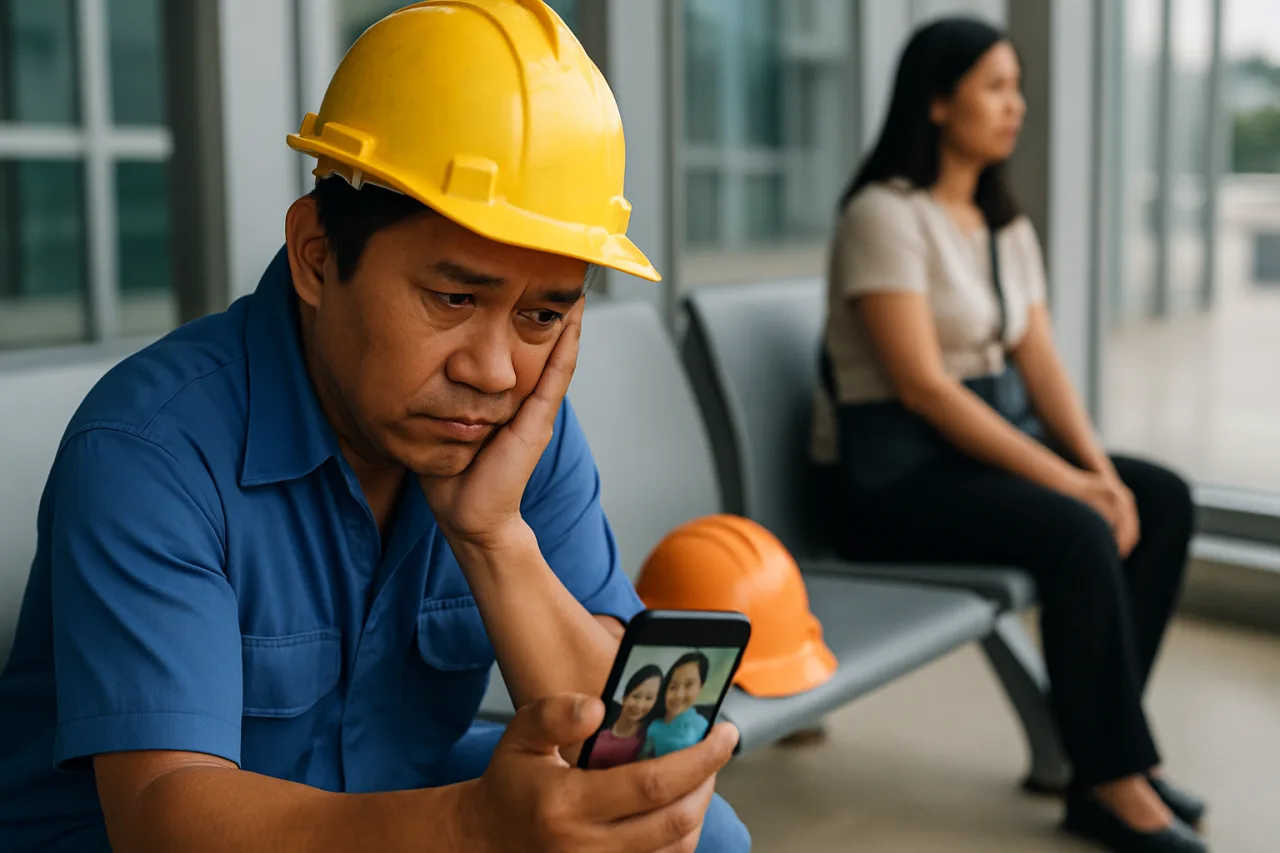
Almost half of all OFWs — 43% — admitted to feeling homesick, according to the BCG survey. This figure reveals the emotional cost of migration that no remittance statistic can capture. These homesick OFWs represent millions of Filipinos who wake up every day in a foreign country, go to work, send money home, and then lie awake at night wondering if they made the right choice.
Homesickness among OFWs is not just about missing family gatherings or Filipino food. It is a deep, persistent longing for belonging — for the sound of Tagalog on the street, for the warmth of a Philippine sunrise, for the feeling of being understood without having to explain yourself.
The homesick OFW phenomenon is particularly acute among those who have been abroad for more than five years. Over time, the Philippines they left behind changes — and so do they. The fear of returning to a country that no longer feels like home, combined with the guilt of staying away, creates an emotional paralysis that keeps millions of Filipinos trapped abroad.
Social media has both eased and worsened this homesickness. Video calls with family, Facebook groups for OFWs, and Filipino community events abroad help bridge the distance. But they also serve as constant reminders of what is missing — every birthday celebrated online, every family reunion attended through a screen. For homesick OFWs, the digital connection is both a lifeline and a wound.
Why Homesick OFWs Cannot Come Home Yet
The BCG report makes clear that the primary barrier to OFW return is not a lack of desire — it is a lack of viable options. Sixty-nine percent of OFWs said they were pushed to work abroad by the lack of local job opportunities, while 76% cited expected salary as their top consideration.
The math is simple and brutal. An OFW in Saudi Arabia, Singapore, or the United Kingdom can earn three to five times what they would make in the Philippines for the same work. For families with children in school, elderly parents who need medical care, and loans to pay, the decision to stay abroad is not a choice — it is a necessity.
“Migration becomes the path often only when the options at home feel too slow, too limited, or too uncertain,” the BCG report noted. This finding underscores a structural problem in the Philippine economy that no amount of homesickness can overcome.
The report also found that 57% of OFWs aspire to have a large savings fund — a goal that is far more achievable abroad than at home. Until the Philippine economy can offer wages that compete with overseas opportunities, homesick OFWs will remain a fixture of Filipino life. Understanding this dynamic is essential for every OFW family — and our guide on Middle East conflict and OFW remittance risk explores the financial side of this equation.
OFW Return Intentions: Who Is Coming Home?
Despite the emotional pull of home, the BCG survey found that only 21% of OFWs are certain about returning to the Philippines. Another 14% said they would most probably move back. Together, this means only about one in three OFWs has a clear plan to return.
The remaining 56% — more than half — remain undecided. These homesick OFWs are caught between the life they have built abroad and the life they left behind. They send money home every month, but they do not know when, or if, they will ever go back for good.
Among those who do plan to return, the top reasons are deeply personal: 56% want to come home to care for aging parents, and 44% cite strong emotional, social, and cultural connections to the Philippines. These are not economic motivations — they are the pull of family, identity, and belonging.
The BCG data also revealed that 62% of OFWs plan to return home within five years, according to a related analysis by Manila Standard. This suggests that while the timing is uncertain, the desire to return is widespread. For OFWs considering the transition, the government’s repatriation and reintegration programs offer some support.
Working Abroad Was Not the First Choice for Homesick OFWs
Perhaps the most striking finding in the BCG report is that working abroad is not the first choice for most Filipino workers. The survey found that only 17% of OFWs — about one in six — were certain about leaving the Philippines.
Before migrating, most OFWs tried other options first: 32% considered continuing in the same job in the Philippines, 27% considered starting a small business, 19% looked for jobs in a different province or city, and 18% looked for jobs in the same province or city where they lived.
Working abroad, for the majority of OFWs, was a last resort — a path taken only after local options were exhausted. This reframes the narrative of the OFW from one of voluntary adventure to one of economic necessity. The homesick OFW is not a wanderer — they are a worker who had no better option.
The implication is clear: if the Philippines could offer better wages, more opportunities, and a more stable economy, many OFWs would choose to stay home. The diaspora is not a sign of Filipino ambition alone — it is also a sign of Philippine economic failure.
The Scale of the Filipino Diaspora
The BCG report puts the OFW population in stark perspective. According to the Philippine Statistics Authority, there were 2.19 million OFWs in 2024 — the highest number in five years. One in every 14 Filipino families has a member working abroad.
BCG noted that if the OFW population were considered a single province, it would rank eighth among the most populated provinces in the Philippines. This is not a marginal group — it is a massive demographic that shapes the nation’s economy, culture, and identity.
The Middle East remains a major destination for OFWs, accounting for approximately $6.5 billion in annual remittances, or about 18% of the national total, according to Bangko Sentral ng Pilipinas data. The ongoing conflict in the region has added urgency to the question of OFW return, with the Philippine government allocating an additional P3 billion for repatriation and reintegration efforts in June 2026.
What the BCG Report Means for OFW Families
For the millions of families who depend on OFW remittances, the BCG findings are both reassuring and sobering. The good news: OFWs are not abandoning their families. The money keeps coming, and the emotional bonds remain strong.
The sobering news: the separation is taking a toll. The 43% of homesick OFWs are not just missing home — they are living in a state of emotional suspension, unable to fully commit to life abroad but unable to return home either.
Families should understand that the OFW’s decision to stay abroad is not a rejection of home. It is a sacrifice made out of love — a choice to endure separation so that children can go to school, parents can see a doctor, and the family can have a better future.
At the same time, the report highlights the importance of planning for return. OFWs who have a clear savings goal, a reintegration plan, and a timeline for coming home are more likely to make the transition successfully when the time comes.
The Emotional Cost of Being a Homesick OFW
Beyond the statistics, the BCG report captures something that numbers alone cannot convey: the emotional complexity of the OFW experience. Being an overseas Filipino worker is not just a job — it is an identity, a sacrifice, and a constant negotiation between two worlds.
The happy-but-homesick OFW is a paradox that defines the Filipino diaspora. They are grateful for the opportunities abroad, but they grieve for the life they left behind. They are proud of what they have achieved, but they wonder what it would have been like to stay.
For every OFW reading this, the message is clear: your feelings are valid. Being happy abroad does not mean you have stopped loving the Philippines. And being homesick does not mean you made the wrong choice. You are carrying a weight that only another OFW can understand.
The Philippines may not be ready for you yet. But when it is — and when you are — home will be waiting.
Frequently Asked Questions (FAQ)
Q: What percentage of OFWs are happy abroad according to the BCG report?
A: According to the Boston Consulting Group’s June 2026 report “The Filipino Abroad,” 47% of OFWs surveyed said they are happy with their life abroad. The survey covered 1,337 OFWs across the US, Middle East, Asia, and the UK.
Q: How many OFWs feel homesick according to the BCG survey?
A: The BCG survey found that 43% of OFWs admitted to feeling homesick, revealing an emotional complexity where nearly half of all overseas Filipino workers long for home despite being content with their lives abroad.
Q: What percentage of OFWs plan to return to the Philippines?
A: Only 21% of OFWs are certain about returning home, while 14% said they would most probably move back. The majority — 56% — remain undecided about whether to return to the Philippines.
Q: What is the main reason OFWs want to return home?
A: Among OFWs planning to return, 56% cited the desire to care for aging parents as their top reason, followed by 44% who cited strong emotional, social, and cultural connections to the Philippines.
Q: How many OFWs were there in 2024?
A: According to the Philippine Statistics Authority, there were 2.19 million OFWs in 2024 — the highest number in five years. One in every 14 Filipino families has a member working abroad.
Q: Was working abroad the first choice for most OFWs?
A: No. The BCG report found that only 17% of OFWs were certain about leaving the Philippines. For the majority, working abroad was a last resort after trying local options such as continuing in the same job (32%), starting a business (27%), or looking for work in another province (19%).
Q: What is the BCG report “The Filipino Abroad” about?
A: “The Filipino Abroad” is a June 2026 report by the Boston Consulting Group that surveyed 1,337 OFWs to understand their emotions, motivations, and intentions regarding return to the Philippines. It examines the push and pull factors of Filipino migration and the emotional complexity of life abroad.
Q: What are the top reasons Filipinos choose to work abroad?
A: According to the BCG report, 69% of OFWs cited higher income potential as the primary reason for working abroad, while one in three (approximately 33%) said they were forced to migrate due to the lack of local job opportunities in the Philippines. Expected salary was the top consideration for 76% of respondents.
Disclaimer: This article is for informational purposes only and does not constitute professional advice. Data cited from the BCG report and Philippine Statistics Authority are based on publicly available information as of June 2026.