Table of Contents
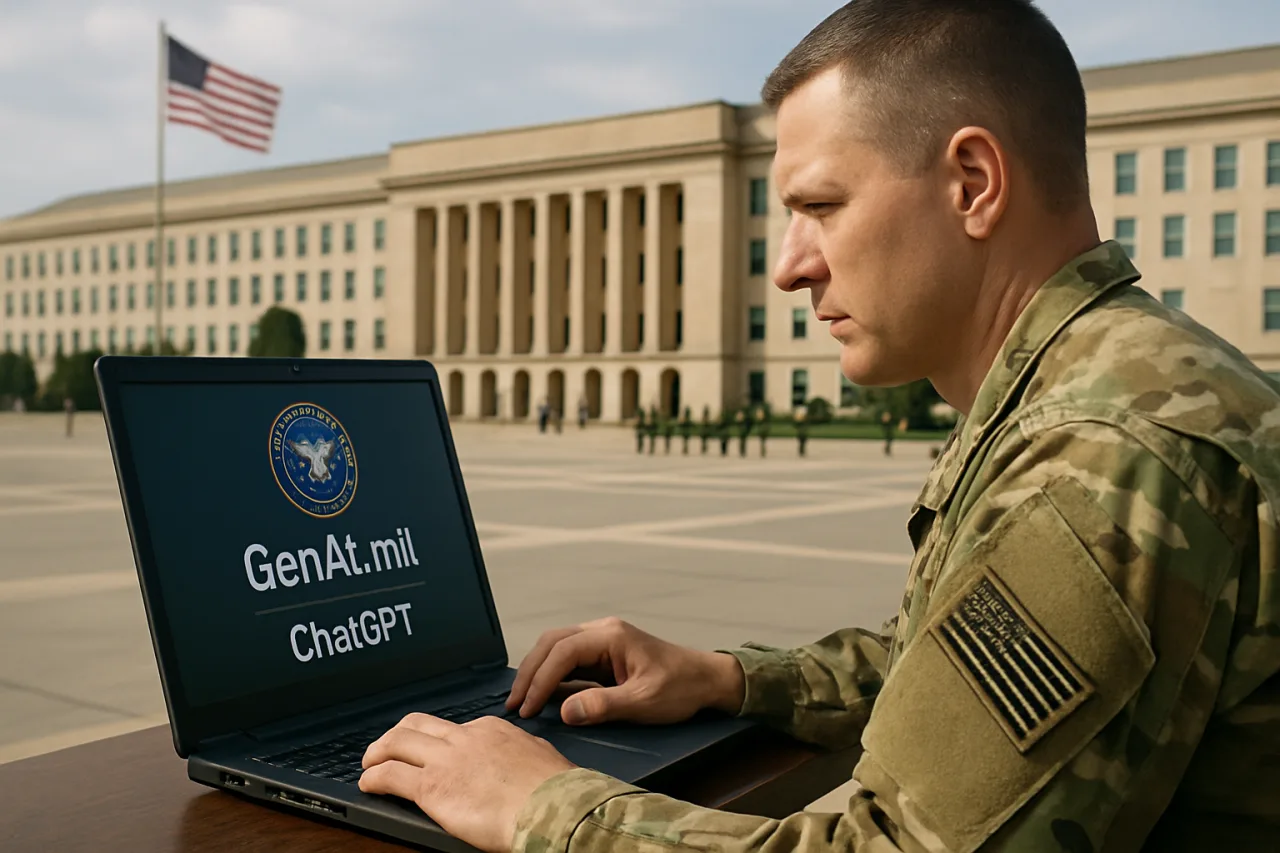
The Pentagon put ChatGPT and Grok in uniform this week — and 1.7 million users are already on the platform, as TechCrunch first reported. The Department of Defense announced on August 31, 2026 that ChatGPT Mil (OpenAI) and Grok for Government (xAI, via SpaceX’s Starshield AI) are now live on GenAI.mil, the department’s secure AI portal, giving all 3 million civilian and military personnel access to commercial frontier AI tools tailored to “warfighter needs.” The portal launched in December 2025 with only Google’s Gemini for Government; in under nine months it has onboarded more than 1.7 million unique users, making it arguably the fastest enterprise AI adoption in government history. For the Philippines — whose own Armed Forces modernization program, cybersecurity strategy, and digital government agenda are being written right now — the American military’s AI operating model is no longer abstract news. It is a preview.
Key Takeaway
- 🪖 ChatGPT Mil and Grok for Government are live on GenAI.mil — announced August 31, 2026, extending the portal beyond its original Gemini-only lineup to 3 million DOD personnel.
- 📈 1.7 million unique users in nine months — the Pentagon’s AI portal claims adoption rates most enterprises never reach, a signal for how government workforces absorb AI tools when security and access are solved first.
- 🔐 The model is security-first: unclassified work runs in contained environments exempt from consumer data collection, with classified deployments handled under separate deals.
- ⚔️ Grok’s role is operational, not clerical: the DOD credits it with mission acceleration “from market research for acquisition professionals to supply chain management for logisticians” — and a court filing claims it helped direct 2,000+ munitions onto 2,000 targets in 96 hours during the Iran war.
- 🇵🇭 The lesson for the Philippines: the AFP modernization and PH digital government programs face the same design choice the Pentagon just made — how to give an entire workforce AI without giving away the data.
GenAI.mil: What the Pentagon Just Deployed
The facts of the announcement, straight from the department’s own release. GenAI.mil, the centralized secure portal launched in December 2025, initially offered one commercial model: Google Cloud’s Gemini for Government. The August 31 expansion adds two heavyweights. ChatGPT Mil, a product of OpenAI’s government program, delivers the familiar commercial experience — chat, files, projects, custom GPTs — tuned for document-heavy, routine unclassified work: administrative tasks, logistics, planning and policy. Grok for Government, deployed through SpaceX’s Starshield AI secure satellite network, comes with a harder operational edge: deep-thinking inference, adaptive reasoning modes (Auto, Fast and Expert), customizable workspaces, persistent projects and reusable “playbooks” that capture and scale institutional knowledge.
The department’s framing of the two tools differs instructively. OpenAI’s system is positioned for scale: “document-heavy unclassified work across the Department, including planning, policy, logistics, and administration, and is built for scale to support” more than 3 million personnel, per the DOD’s own announcement. Grok is positioned for mission: “Starshield AI’s Grok for Government enables the Joint Force to execute missions faster and with greater precision across numerous operational contexts.” One assistant is a productivity layer; the other is being woven into operational workflows. The distinction tells you where each vendor sits in the Pentagon’s architecture — and both sit behind the same wall.
That wall is the point. The official military versions are exempt from the data collection that is difficult to avoid in consumer products, and sensitive government data never routes through ordinary consumer channels. The Pentagon already has separate agreements with OpenAI, xAI, Amazon Web Services, Microsoft, Nvidia and Reflection AI for classified-network deployments — GenAI.mil covers the unclassified three million, while the classified work runs on dedicated infrastructure.
1.7 Million Users: The Adoption Numbers Behind the Announcement
The most underrated number in the announcement is not 3 million — it is 1.7 million. More than 1.7 million unique DOD users have already onboarded to GenAI.mil, according to the department, out of roughly 3 million total military and civilian personnel. That is a majority-adopted AI platform in under nine months, achieved inside an institution famous for procurement friction. Enterprises spend years pushing AI copilots to skeptical workforces; the Pentagon reached critical mass in three quarters.
| GenAI.mil metric | Detail |
|---|---|
| Launched | December 2025, initially Gemini for Government only |
| Models now live | Gemini for Government, ChatGPT Mil, Grok for Government |
| Eligible population | ~3 million DOD civilian + military personnel |
| Onboarded users | More than 1.7 million unique users |
| ChatGPT Mil scope | Chat, files, projects, custom GPTs; unclassified admin, logistics, planning, policy |
| Grok for Government scope | Deep-thinking inference, Auto/Fast/Expert modes, workspaces, playbooks; operational mission support |
| Data boundary | Unclassified in-portal; exempt from consumer data collection; classified runs separately |
Three forces explain the speed. First, access: a single portal with SSO beats twenty pilot programs. Second, trust: because the environment is officially sanctioned and data-contained, the compliance anxiety that stalls enterprise AI adoption simply evaporates. Third, relevance: the tools ship pre-tuned to military workflows — playbooks, logistics, acquisitions — rather than generic chat. Any organization studying AI adoption, including Philippine agencies modernizing their own digital services, should copy the sequence: secure environment first, workforce-wide access second, workflow-specific tuning third.
The adoption figure also reframes the cost debate. At 1.7 million users, the Pentagon is not running a pilot — it is running production infrastructure, with all the operational expectations that implies. Vendors that perform well at this scale inherit the most demanding customer reference in the world. Vendors that stumble inherit something less pleasant.
The Anthropic Vacuum: Who Is Missing From the Portal and Why
The rollout is as notable for who is absent. Anthropic’s Claude — arguably the strongest enterprise coding and analysis model — is nowhere on GenAI.mil, and the reason is a fight that has run all year. The Pentagon designated Anthropic a national security supply-chain risk after the company insisted on safety guardrails for its models, specifically refusing unrestricted use for fully autonomous weapons and mass surveillance. Anthropic is fighting that designation in court — and last week a federal judge struck the designation down, calling the department’s measures against the company “illegal and baseless.”
The Pentagon’s chief technology officer, Emil Michael, said last week that removal of Anthropic’s platforms would be complete by the end of September. So the current state is a legal rebuke plus a removal timeline, with Claude being stripped from DOD systems even as the court calls the basis for that removal illegal. Watch this space: the outcome will define the boundary between government procurement power and vendor safety conditions for years — and every AI company watching is taking notes on what happens when you say no to the Pentagon.
The dispute has practical consequences beyond the courtroom. With Claude excluded, the unclassified portal standardizes on three vendors — Google, OpenAI and xAI — and the classified ecosystem on a similar roster. The competitive map of frontier AI in American government is being drawn by procurement decisions right now, which is precisely why the judge’s ruling matters: it tests whether safety-conditioned vendors can still sell to the state. Organizations in allied capitals, including Manila, are watching to see which procurement doctrine — guardrails required or guardrails negotiable — becomes the template for their own military AI acquisitions.
Grok’s Test Record: Iran, Munitions and the Reliability Question
The court filing that made Grok’s role famous deserves scrutiny. Cameron Stanley, the Pentagon’s chief digital and AI officer, wrote earlier this year — as The Hill’s defense team documented — that Grok allowed US forces to deploy more than 2,000 munitions onto 2,000 targets within 96 hours during the Iran war. Whatever one’s view of that campaign, the claim establishes Grok as an operational tool inside the targeting-and-logistics loop, not a chatbot at the edge of it.
That role collides with the reliability record. xAI’s Grok has faced repeated public criticism over response accuracy and image-generation behavior, and The Hill’s reporting notes the DOD has “repeatedly touted” the model as a national security asset despite that controversy. The Pentagon is effectively running a live experiment: can a frontier model with uneven consumer reliability be wrapped in enough process, review and domain constraint to perform at combat tempo? The answer matters far beyond one vendor — it will calibrate how all governments treat frontier-model risk in high-stakes operations.
The GSA side of the story shows how mainstream this has become. Under a General Services Administration deal, US civilian agencies can purchase Grok models for 42 cents through March 2027 — a price point that turns frontier AI into a commodity office utility across the federal government. When the same model family powers both $0.42 civilian office licenses and military logistics planning, the governance question is no longer whether AI belongs in government, but which decisions are allowed near it.
What the Pentagon’s AI Portal Means for the Philippines
The Philippines is building its own answer to the same question, which is why this American announcement reads differently from Manila than from Silicon Valley. The Armed Forces of the Philippines modernization program has named command-and-control, intelligence and cyber capabilities as priority areas. The DICT’s digital government initiatives are pushing AI into public services — a transformation we assessed alongside the Philippines’ AICON 2026 AI moment. And Filipino military and civilian planners — including the thousands of Filipinos serving in defense, IT and security roles abroad — will recognize the pattern in GenAI.mil immediately: one secure portal, multiple frontier models, clear data boundaries, and adoption numbers that prove the workforce was never the obstacle.
Three transferable lessons stand out. First, the portal model works: consolidation beat fragmentation, and the Philippines’ own government cloud and cybersecurity strategies could adopt the same architecture for safe, audited AI access across agencies. Second, the data boundary is the product: the exempt-from-data-collection design is what made adoption fast, and any Philippine equivalent must solve that trust problem before scale is possible. Third, the vendor-diversity question is live: the Pentagon chose three model families and excluded one over safety principles — a decision Philippine agencies will face in miniature with every foreign AI procurement, where the safety-condition question is not theoretical.
There is also a talent signal. The Pentagon’s deployment normalizes “military AI operations” as a career specialty — planning analysts, logistics officers and acquisition professionals now work with frontier models daily. For the Filipino defense and IT professionals watching this space, the skill combination to build is exactly the one GenAI.mil rewards — a pattern we also mapped in our Pax Silica analysis of the Philippines’ AI hardware ambitions. domain expertise wrapped around AI fluency, with the security discipline to operate inside boundaries. Our continuing coverage of how AI reshapes leadership and work tracks the same pattern in the private sector.
What Comes Next: The Portal That Became Doctrine
The watchlist from here runs on three clocks. Short term: adoption and incident data from the expanded portal — whether ChatGPT Mil’s productivity claims hold at scale, and whether Grok’s operational role survives its reliability controversies without a public failure. Medium term: the Anthropic legal endgame, which will either restore Claude to the Pentagon or cement the precedent that government can exclude vendors over safety refusals even after courts call the exclusion baseless. Long term: the doctrinal shift — when 1.7 million users make AI part of daily military work, doctrine, training and procurement all follow, and the first major AI-assisted decision failure will trigger the reckoning every institution avoids planning for.
The deeper story is that the Pentagon stopped debating whether to adopt frontier AI and started operating it — at scale, with a security architecture, and with a vendor map shaped by principle and politics alike. Whatever one thinks of the choices, the operating model is now documented, public, and available for every government — including the Philippine one — to study, adapt or reject. The portals are open. The question every capital now answers for itself is what, exactly, flows through them.
Frequently Asked Questions About GenAI.mil
What is GenAI.mil?
GenAI.mil is the US Department of Defense’s centralized, secure portal for commercial generative AI tools, launched in December 2025. It gives DOD civilian and military personnel access to frontier AI models in a contained environment, initially offering Google’s Gemini for Government and now adding ChatGPT Mil and Grok for Government. More than 1.7 million of the department’s roughly 3 million personnel have onboarded.
What are ChatGPT Mil and Grok for Government?
ChatGPT Mil is OpenAI’s government version of ChatGPT, offering chat, files, projects and custom GPTs for unclassified work such as planning, policy, logistics and administration. Grok for Government is xAI’s military deployment delivered through SpaceX’s Starshield AI, featuring deep-thinking inference, adaptive reasoning modes (Auto, Fast, Expert), persistent workspaces and reusable playbooks for operational mission support.
When did the Pentagon add ChatGPT and Grok to GenAI.mil?
The Department of Defense announced the additions on August 31, 2026, expanding the portal beyond its original Gemini-only lineup. The expansion gives all 3 million DOD personnel access to the two new tools for unclassified, military use.
Why is Anthropic’s Claude not on the Pentagon’s AI platform?
The Pentagon designated Anthropic a national security supply-chain risk after the company refused unrestricted use of its models — specifically requesting guardrails against fully autonomous weapons and mass surveillance. A federal judge recently struck down the designation as “illegal and baseless,” but the department’s CTO said removal of Anthropic platforms would be complete by end of September 2026, making the outcome a live legal and procurement battle.
What did Grok do in the Iran war?
In a court filing, Pentagon chief digital and AI officer Cameron Stanley wrote that Grok allowed US forces to deploy more than 2,000 munitions onto 2,000 targets within 96 hours during the Iran war. The claim positions Grok as an operational planning and logistics tool, though the model’s consumer-facing reliability controversies keep the deployment under scrutiny.
How many people use the Pentagon’s AI portal?
More than 1.7 million unique users had onboarded to GenAI.mil as of the August 2026 announcement, out of approximately 3 million eligible DOD civilian and military personnel — a majority-adoption milestone reached in under nine months since launch.