Key Takeaway
- 🏦 Twenty-plus cornerstone investors — BlackRock, T. Rowe Price, IFC (₱4.4B) among them — committed ₱36.5 billion to the GCash IPO: roughly 68.8% of the offer shares are pre-booked.
- 💰 The pricing signal: Mynt’s own officials expect a final price below the ₱10 maximum (₱7.50-₱8.50 reported) — set by the October 1 book-build.
- 📅 The retail window: October 6-12, listing October 20 — the application how-to stands, but the allocation math changed with the cornerstone book.
- ⚠️ The structure detail most coverage buries: roughly four-fifths of the base offer is secondary stock — early backers selling into the debut. Quality signal, exit supply: both are true.
- 🎯 The retail play: read the final price October 1, size the order against a realistic allocation, and never spend remittance money you need back before 2027.
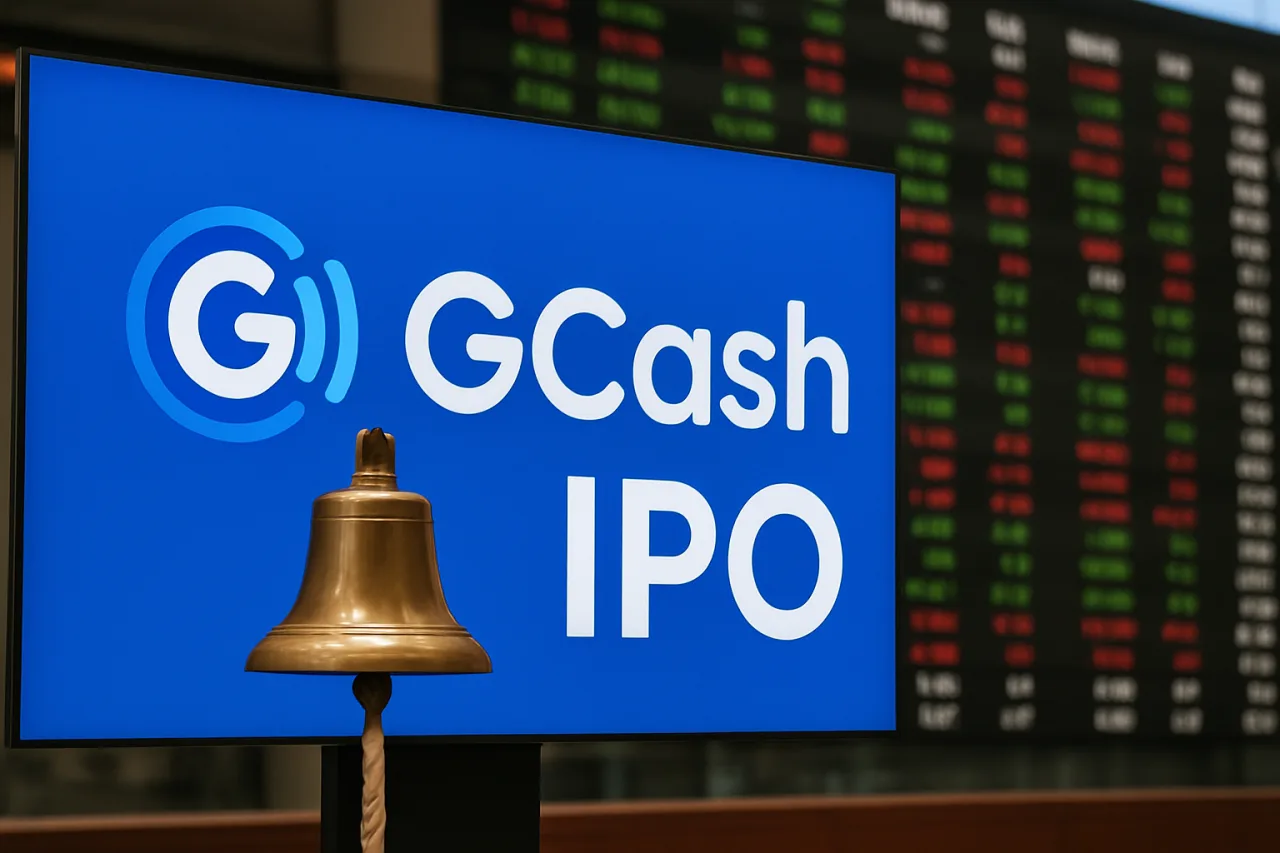
The largest stock market debut in Philippine history just received its most persuasive endorsement — and its most important caveat — in the same week.
On September 24, as Reuters reported, Mynt, the parent of GCash, filed its Red Herring with a cornerstone investor list that reads like a global fund hall of fame: BlackRock, T. Rowe Price, and the World Bank’s private-sector arm IFC taking a ₱4.4-billion (about $70 million) cornerstone stake, alongside domestic institutions.
More than twenty cornerstone investors have committed ₱36.5 billion — covering roughly 68.8% of the offer shares before a single retail order arrives.
Meanwhile, company officials themselves have signaled the final price will likely land below the ₱10 maximum — reports around the book-build point to a ₱7.50-₱8.50 zone — with pricing set October 1, the offer period October 6-12, and the listing on October 20.
Table of Contents
What the Cornerstone Book Actually Says
Cornerstone investors commit — in writing, before the offer opens — to take their shares at the final price, lock-up periods included. The book is therefore the deal’s most honest poll: institutions with analysts, access, and reputational risk voted ₱36.5 billion of “yes” on the world’s most-scrutinized fintech listing of the year.
The names matter as much as the number: BlackRock and T. Rowe Price do not take cornerstone positions in deals they expect to fumble, and IFC’s ₱4.4 billion carries the World Bank group’s development-finance diligence — an institution that underwrites emerging-market fintech with a mandate that does not chase fashions.
The book also anchors the deal’s risk profile: with ~68.8% of offer shares spoken for, the listing’s first day is substantially pre-underwritten. The classic IPO failure mode — institutions abandoning the deal after weak demand — is structurally muted when the majority is already committed.
For retail readers, the book is the single strongest argument that the deal completes; it is not, and should never be confused with, a promise about the price on October 21.
The Pricing Signal: Why Sub-₱10 Is Not Bad News
The ₱10 ceiling prices the offer at up to ₱92.3 billion — a record — but the company’s own officials have signaled the final price will likely sit below it, with the reported working range at ₱7.50-₱8.50 per share. Retail investors sometimes read sub-ceiling pricing as weakness; the institutional read is the opposite.
Pricing below the maximum is how deals leave room on the table for the aftermarket — the listing-day pop that rewards every participant — and the book-build exists precisely to discover where demand clears.
A deal that maxes its range often signals a seller’s arrogance; a deal that prices honestly signals an issuer that wants its shareholders to stay.
The practical consequence for the retail order: wait for October 1. The final price determines your actual cost per share, your payment due dates, and the valuation math on which any multi-year hold rests.
The application how-to this site published earlier this month stands — the mechanics have not changed — but the price you compute into your plan should be the final one, not the ceiling.
The Structure Warning: Four-Fifths Secondary Stock
The detail that separates a considered decision from a headline chase: roughly four-fifths of the base offer is secondary stock — shares sold by existing backers (Globe, Ayala, ANT and the earlier investors) rather than fresh capital for the company.
Mynt banks the smaller primary portion; the large majority of the ₱92.3-billion potential raise flows to selling shareholders.
The structure is not a scandal — it is what early investors were owed after years of building the country’s dominant finance super app — but it changes what the purchase means: the retail buyer on October 6 is, in large part, providing liquidity to early backers whose average entry prices sit far below the offer.
The balanced read holds both truths: the cornerstone book is a genuine quality signal, and the secondary-heavy structure is a genuine supply dynamic — early backers with exits to make can become sellers again after lock-ups, and the market knows it.
The investor who buys because BlackRock bought, without noticing who BlackRock’s co-sellers are, has read half the story.
The Retail Playbook for October 6-12
Move one — read the final prospectus pricing on October 1 before deciding anything: the final price, the lot sizes, and the payment schedule are the plan’s actual inputs.
Move two — size the order with allocation realism: with ~68.8% pre-committed, retail competes for the remainder, and oversubscription math (covered below) means the ₱8,000 minimum order may fill entirely while a ₱800,000 order may not fill proportionally.
Move three — pay on time: the application window’s payment mechanics are the step most first-time IPO participants fumble; set the funding timeline before October 6, not during.
Move four — decide the hold thesis in writing: a one-paragraph answer to “why do I own this in three years” is the difference between an investor and a lottery participant.
Move five — never use remittance money you need back soon. The GCash IPO is a decade-scale story, not a December cash source.
The OFW section below expands the rule; the short version is that IPO allocations and household liquidity budgets mix badly, and the listing’s October 20 date is close enough to the BER-month spending season to make the discipline structural.
The Allocation Math Retail Should Expect
The cornerstone book reshapes retail’s odds honestly.
If ~68.8% of offer shares are institutionally pre-taken, the retail tranche competes for roughly a third of the offer — and Philippine IPO allocations to small subscribers follow the standard oversubscription rules: small orders (the ₱8,000 board lot tier) historically fill most completely, while large retail orders fill proportionally and can be heavily scaled back.
The practical expectation for a first-time participant with an ₱8,000-₱50,000 order: meaningful but partial allocation in a hot deal — treat any full fill as a bonus, not the baseline.
The arithmetic also reframes the opportunity cost: money queued for a partial allocation sits locked through the offer and listing cycle. The household that routes its whole October liquidity into the order discovers its calendar inflexibility at exactly the wrong season.
The sizing discipline — order what you can have locked without lifestyle impact — is not caution; it is the structure of this particular deal, and the GCash IPO will remain the reference deal of the Philippine year for every listing that follows it.
The Lock-Up Question: What Happens After October 20
The secondary-heavy structure makes the lock-up calendar part of the retail thesis. Cornerstone investors carry lock-up commitments — their shares cannot trade immediately — which supports early stability; but the selling shareholders’ post-lock-up behavior is the supply overhang the market will price.
The historical pattern for secondary-heavy listings: early months trade on momentum, and the overhang surfaces in the quarters after lock-ups expire.
The retail holder who knows the calendar reads the eventual dips as the known supply dynamic instead of a surprise betrayal — the difference between a planned hold and a panicked sale is often just knowing what the calendar contains.
The business-side counterweight runs longer than any lock-up: GCash’s market position — the dominant wallet, the payments ubiquity, the expanding financial-services stack — is the asset both the cornerstone investors and the retail buyers actually own. The lock-up calendar tests patience; the franchise rewards it.
The investor who cannot yet distinguish the two should size smaller and learn on the position, not learn on the portfolio.
The Cross-Read: Our Earlier Coverage, Updated in One Paragraph
For readers arriving from this site’s earlier GCash IPO pieces — the deal anatomy, the October 20 debut playbook, and the application how-to — the updates that matter since those published: the Red Herring filing (September 24) converted the timeline from plan to process; the cornerstone book (₱36.5 billion, 68.8%) changed the allocation math this article covers; and the sub-₱10 pricing signal re-set the valuation expectations the earlier pieces’ ceiling-based math assumed.
The application mechanics stand as published; the pricing, allocation, and structure sections above are the current layer the earlier pieces could not yet contain.
The OFW Decision: Remittance Money and First Stocks
The GCash IPO will be many Filipino families’ first stock purchase, and the household framing decides whether it goes well.
The right version: the family’s long-horizon money — the savings layer this site’s income-floor plan describes — takes a sized position after the final price is read, held through the volatility every listing carries, and reviewed against the business (GCash’s actual dominance) rather than the first-day price.
The wrong version: tuition money or the emergency fund enters the order because the app that carries the remittances is going public and the group chat is euphoric.
The signal worth respecting is real: twenty-plus institutions with the best research desks on earth committed ₱36.5 billion, and the retail window they left open is one of the year’s genuine opportunities to own a piece of Philippine digital finance at a government-supervised entry price.
The discipline that makes it yours is older than any IPO: size to the horizon, read the structure, and let the smart money’s vote inform — never replace — your own.
The GCash IPO cornerstone book is the loudest institutional endorsement in Philippine market history; the October 6-12 window is where your own judgment takes its turn.
UPDATE — September 27: The Anchor Price Has Moved to ₱6.5
The signal we flagged in the sub-₱10 section has sharpened. Bloomberg reported September 22 that BlackRock, Capital Group, and Schroders are among the institutions telling Mynt they expect the deal priced below the ₱10 maximum — with the anchor level around ₱6.50. Rappler’s Vantage Point column read the same cornerstones and put the tell at ₱6.60, calling it “the clearest signal yet of where sophisticated capital sees real value.”
The brokerage research now ranges from ₱6.00 to ₱8.50 fair value, with Trading Edge’s Ron Acoba calling ₱7.00–₱8.00 “realistic” and ₱9–10 a level that “would require stronger confidence” than the tape currently shows. The reason sits in one line of Mynt’s own numbers: profit grew about 64% a year from 2023 to 2025, but first-half 2026 net income rose only 7.3% to ₱10.82 billion. At the ₱10 ceiling, the post-offer equity value reaches roughly ₱669 billion — about 38.8× 2025 earnings. Sophisticated money is saying the multiple must meet the decelerating growth somewhere below the ceiling.
What this changes for your order, in one paragraph: the allocation math we walked through above assumed a mid-range fill around ₱7.50–8.50. Reprice your scenarios at ₱6.50–8.00 as the realistic band — at ₱6.50, the same ₱10,000 order books roughly 1,538 shares instead of 1,250; at ₱8.00, 1,250 instead of 1,111. Your PSE order window (Oct 6–12) and the GCash-app mechanics are unchanged. The bet you are actually making has not moved: you are buying a decelerating-but-profitable fintech at whatever the book-build settles on October 1, with four-fifths of the offer being existing holders exiting. Size to the horizon, not to the hype.
Frequently Asked Questions
How much did cornerstone investors commit to the GCash IPO?
More than 20 global and domestic institutions committed ₱36.5 billion — about 68.8% of the offer shares — including BlackRock, T. Rowe Price, and IFC’s ₱4.4-billion (~$70M) cornerstone stake.
What will the final GCash IPO price be?
Final pricing is set October 1, 2026 via book building; the maximum is ₱10 per share (a ₱92.3-billion raise at max), and company officials have signaled pricing below the ceiling, with reports around ₱7.50-₱8.50.
When are the offer and listing dates?
The offer period runs October 6-12, 2026, with the PSE listing on October 20.
Why is most of the offer secondary stock?
About four-fifths of the base offer is shares sold by existing backers (Globe, Ayala, ANT and earlier investors) — early backers selling down — with a smaller primary portion raising new capital for Mynt.
What allocation should a small retail order expect?
With ~68.8% pre-committed, retail competes for roughly a third of the offer; small board-lot orders historically fill most completely, but a hot deal can scale allocations back — size orders accordingly.
Where do I apply during October 6-12?
Through your broker’s IPO application channel or the accredited participation channels — the application how-to this site published covers the step-by-step; the final prospectus (October 1) carries the official payment mechanics.
Financial Disclaimer: This article is for general information only and is not investment advice or an offer to sell securities. IPO terms, pricing, and allocations are governed by the final prospectus; consult a licensed broker or advisor before investing.
Live Update — October 7: the Window Is OpenUpdate, Oct 7: the retail window this piece pre-mapped is now LIVE — the offer runs October 6 through October 12, retail lane 8:00 AM–3:00 PM per the offering mechanics, at the final prints: ₱6.60 per share is the deal print (the ₱6.50–8.00 scenario band above stays as the record of how the math was built), minimum ticket ₱6,600 for one board lot, settlement October 12, listing October 20 under ticker GCASH — with the overallotment option now officially capable of making this the largest IPO in PSE history (deal documents put the raise up to ~$970 million with over-allotment; ~$844.6 million base print). the GCash IPO DragonFi retail lane closed October 7 at 3 PM; the GStocks PH real-time allocation lane remains the OFW-friendliest path through window close.
Three decision notes while the window runs: (1) the “four-fifths existing holders exiting” framing above is unchanged — you are still buying into a supply-heavy book; (2) the peso’s 62.8 print in the GCash IPO funding path means the peso-denominated GCash IPO ticket costs ~4% fewer dollars than at the year’s worst prints — the OFW funding the ticket from abroad captures that spread; (3) the inflation print (7.2%) and the Oct 23 BSP decision frame the GCash IPO listing week — rate-sensitive tech-adjacent GCash IPO-class listings historically wobble around hike weeks, which matters for your the GCash IPO listing-day sell/hold rule, not for the subscription decision itself. The GCash IPO subscription-math tool and the ten checks below carry on unchanged — the window is live and the arithmetic is now testable.
>