Table of Contents
Key Takeaway
- 🛒 New national e-commerce event: ECOMEX 2026 launched as the Philippines’ first dedicated national e-commerce expo and ecosystem event, uniting online sellers, logistics providers, and payment companies under one ecosystem.
- 📈 Growth phase: Philippine e-commerce enters its “next growth phase” in 2026, driven by rising digital adoption among MSMEs and expanding cross-border trade opportunities within ASEAN.
- 🏢 Who benefits: Filipino entrepreneurs, MSMEs, freelancers, and online sellers gain a centralized hub for resources, networking, and digital tools to scale their businesses.
- 💳 Payments integration: The launch coincides with major payment infrastructure moves — Maybank-OmniPay QRPay rollout, Dragonpay-Xendit integration — strengthening the digital payment backbone.
- 🌐 ASEAN ambition: ECOMEX 2026 aligns with the Philippines’ 2026 ASEAN Chair role and the Manila Tech Summit’s push for borderless digital trade across Southeast Asia.
ECOMEX 2026: How the Philippines’ New E-Commerce Expo Empowers Filipino Entrepreneurs
The Philippines launched ECOMEX 2026, a dedicated national e-commerce expo and ecosystem event designed to unite Philippine e-commerce leaders, entrepreneurs, and MSMEs under one ecosystem. First reported by Malaya Business Insight on July 16, 2026, and covered by Good News Pilipinas on July 10, 2026, The initiative represents the country’s most ambitious effort to consolidate its fragmented e-commerce landscape into a coordinated national e-commerce ecosystem.
The launch comes at a pivotal moment for the Philippine digital economy. The country’s e-commerce sector has been growing rapidly — driven by mobile-first consumers, expanding digital payment infrastructure, and the rise of social commerce — but has lacked a centralized national e-commerce event to coordinate stakeholders, set standards, and accelerate cross-border trade. The event aims to fill that gap.
For Filipino professionals — entrepreneurs running online stores, freelancers selling digital services, MSME owners transitioning from physical to digital sales, and investors watching the e-commerce sector — ECOMEX 2026 is a development worth understanding. It signals that the Philippine government and private sector are aligning to build the infrastructure needed for the next decade of digital trade.
What Is ECOMEX 2026 and Why It Matters
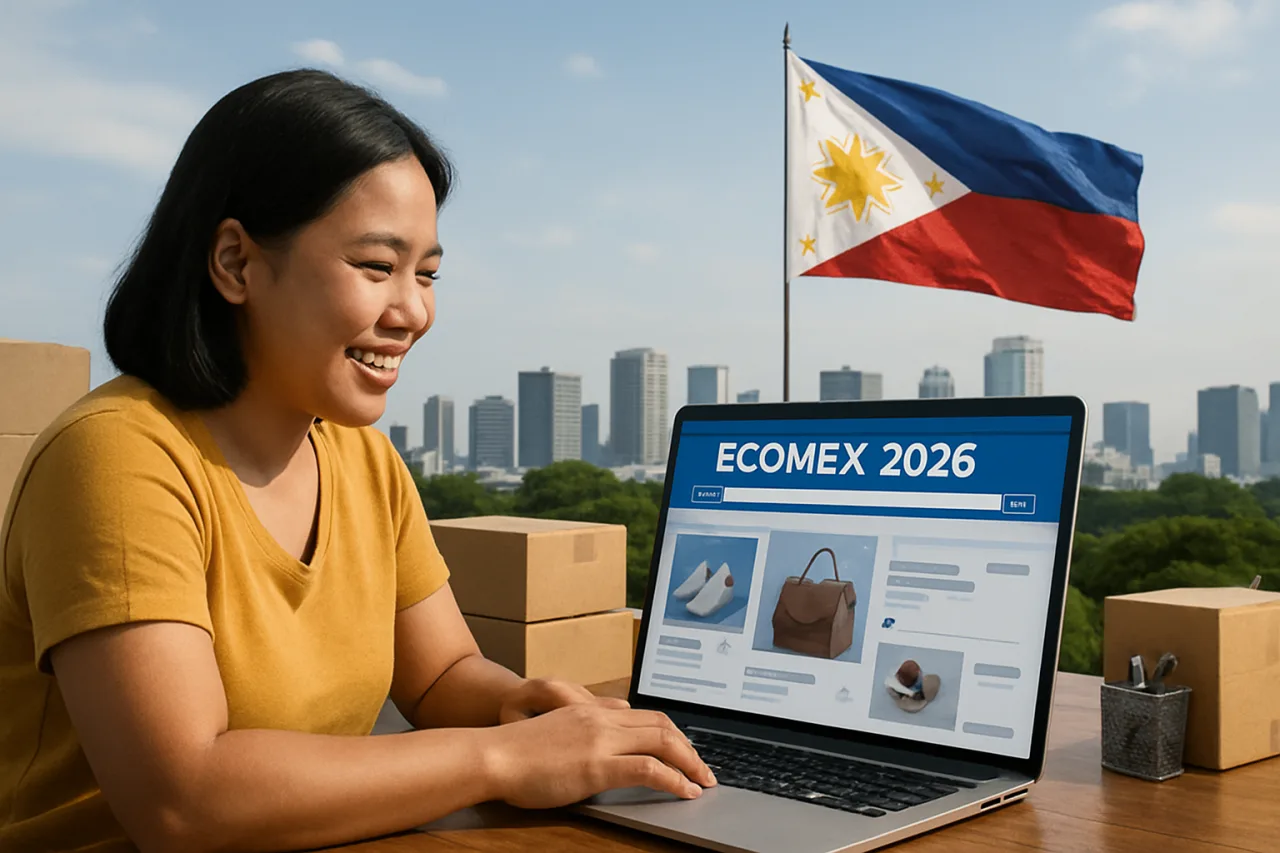
ECOMEX 2026 (the E-Commerce Expo Philippines) is scheduled for November 20 to 21, 2026 at the SMX Convention Center Aura, Taguig. The event is organized by MediaTrix Solutions Inc. under its PHILSME brand, with support from the DTI E-Commerce Bureau. It brings together entrepreneurs, online sellers, digital innovators, and industry stakeholders for two days of networking, knowledge sharing, and ecosystem-building.
The event is described as a national e-commerce expo that provides Philippine e-commerce stakeholders with a dedicated hub for collaboration, resource-sharing, and growth. According to Malaya Business Insight, the event aims to drive the “next growth phase” of Philippine e-commerce by bringing together online sellers, logistics providers, payment companies, and technology enablers.
The Manila Times reported on July 18, 2026, that the event gives the Philippine e-commerce ecosystem a “dedicated national e-commerce event” — a significant development in a market where e-commerce has historically been fragmented across individual marketplaces (Lazada, Shopee, Amazon Philippines), social media platforms (Facebook Marketplace, Instagram Shops), and independent online stores.
Good News Pilipinas noted on July 10, 2026, that ECOMEX 2026 “launches to unite Philippine e-commerce leaders and entrepreneurs,” emphasizing the event’s role in consolidating the sector rather than competing with existing marketplaces. The initiative is positioned as infrastructure — a national coordination layer — rather than a retail destination.
The Philippine E-Commerce Landscape in 2026
ECOMEX 2026 launches against the backdrop of a rapidly expanding Philippine e-commerce sector. The country’s digital economy reached PHP 2.25 trillion ($40 billion) in 2025, according to data from the Philippine Statistics Authority (PSA), representing approximately 8.5% of GDP. E-commerce is a major component of this digital economy, with growth driven by several structural factors:
Mobile-first consumers: The Philippines has one of the highest mobile penetration rates in Southeast Asia, with most consumers accessing the internet primarily through smartphones. This mobile-first behavior makes e-commerce apps and social commerce platforms the dominant channels for online shopping.
Expanding digital payments: The rollout of QRPh (the national QR code standard), InstaPay, and PESONet has dramatically reduced the friction of online payments. Digital wallet adoption — led by GCash, Maya, and ShopeePay — has made cashless transactions accessible to millions of Filipinos who previously relied on cash-on-delivery.
Rising MSME digital adoption: Small and medium enterprises, which account for over 99% of Philippine businesses, are increasingly transitioning to digital sales channels. Government programs like the DTI’s Digitalization program and the DICT’s eGov platform have accelerated this shift, but many MSMEs still lack the technical skills and infrastructure to compete effectively online.
Social commerce dominance: The Philippines is one of the world’s most active social media markets, and social commerce — selling directly through Facebook, Instagram, and TikTok — represents a massive channel that traditional e-commerce metrics often undercount.
How ECOMEX 2026 Addresses Sector Fragmentation
The Philippine e-commerce sector’s biggest challenge has been fragmentation. Sellers must navigate multiple marketplaces with different fee structures, logistics providers with varying coverage areas, and payment systems with incompatible standards. ECOMEX 2026 aims to address this by providing:
Centralized resources: A single event where entrepreneurs can access information on e-commerce regulations, tax compliance, logistics options, and digital payment integration. This is particularly valuable for MSMEs that lack dedicated legal or compliance teams.
Networking and collaboration: The event creates a venue for e-commerce stakeholders to connect — online sellers with logistics providers, payment processors with marketplaces, and technology companies with MSMEs. The launch events in July 2026 brought together leaders across the e-commerce value chain.
Standards and best practices: As a national e-commerce event, the initiative can play a role in establishing industry standards for product listings, customer service, data protection, and dispute resolution — areas where the Philippine e-commerce sector has lagged behind regional peers like Singapore and Malaysia.
Cross-border trade facilitation: The event aligns with the Philippines’ 2026 ASEAN Chair role and the broader push for borderless ASEAN digital trade. The Manila Tech Summit, held July 28-29, 2026, featured discussions on creating a seamless ASEAN digital market — a goal that the event directly supports by giving Philippine e-commerce businesses an event to prepare for cross-border expansion. For more on the Manila Tech Summit, see our coverage of the ASEAN Tech Summit 2026.
The Payment Infrastructure Behind ECOMEX 2026
ECOMEX 2026’s launch coincides with significant developments in Philippine digital payment infrastructure — the backbone of any e-commerce ecosystem:
Maybank and OmniPay launch QRPay: On July 8, 2026, Fintech News PH reported that Maybank Philippines and OmniPay launched QRPay to power QRPh collections in the Philippines. This partnership expands the QRPh network — the national interoperable QR code standard — enabling more merchants to accept cashless payments through a unified system. QRPay allows businesses to receive payments directly into their bank accounts via QR code, reducing reliance on cash transactions.
Dragonpay joins Xendit: Fintech News PH reported on March 12, 2026, that Dragonpay is now part of Xendit, five years after Xendit’s first investment in the Philippine payment platform. The integration was further confirmed by Daily Tribune on July 9, 2026, and by The Business Manual on the same date. Xendit, a Southeast Asian payment infrastructure company, now fully integrates Dragonpay’s merchant network — which includes thousands of Philippine businesses — into its regional payment network. For Filipino entrepreneurs, this means access to a broader range of payment options through a single integration.
InstaPay growth: The Fintech News PH 2026 Philippines Fintech Report, published on July 28, 2026, documented that InstaPay transactions grew 7X year-over-year, reflecting the accelerating shift toward real-time digital payments. This growth directly supports e-commerce by making instant person-to-merchant payments faster and cheaper.
These payment infrastructure developments are essential to ECOMEX 2026’s success. A national e-commerce event is only as effective as the payment rails that support its participants, and the simultaneous expansion of QRPh, InstaPay, and integrated payment platforms like Xendit-Dragonpay provides the foundation for e-commerce growth.
What ECOMEX 2026 Means for Filipino Entrepreneurs
For Online Sellers and MSMEs
The event provides a centralized resource hub that can help small businesses navigate the complexities of e-commerce — from choosing the right marketplace to understanding tax obligations under the Internet Transactions Act. For the many Filipino MSMEs that have struggled with the technical and regulatory barriers to online selling, this event could significantly reduce the cost of going digital.
For Freelancers and Digital Service Providers
The event’s focus on uniting e-commerce stakeholders creates opportunities for freelancers and digital service providers — web designers, digital marketers, logistics coordinators, and customer service specialists — to connect with e-commerce businesses that need their services. As the event grows, it could become a marketplace for digital services alongside physical goods.
For Logistics and Fulfillment Companies
The platform brings logistics providers into the same ecosystem as sellers and payment companies, creating opportunities for integrated fulfillment solutions. Philippine logistics — long challenged by the country’s archipelagic geography — is a critical bottleneck for e-commerce growth, and better coordination through a national e-commerce event could improve delivery times and reduce costs.
For Investors
The launch of ECOMEX 2026 signals growing institutional interest in the Philippine e-commerce sector. For investors watching Southeast Asian digital economy opportunities, the event represents a government-backed initiative to accelerate e-commerce growth — potentially creating investment opportunities in logistics, payment infrastructure, and e-commerce technology companies serving the Philippine market. Learn more about Philippine investment opportunities in our Philippine REIT Investing 2026 guide.
ECOMEX 2026 in the ASEAN Context
The Philippines holds the 2026 ASEAN Chair role, and ECOMEX 2026 aligns with the broader regional push for integrated digital trade. The ASEAN Tech Summit, held July 28-29, 2026, at the Marriott Hotel in Pasay, featured discussions on borderless ASEAN digital trade — a vision that would enable Philippine e-commerce businesses to sell seamlessly to consumers across all 10 ASEAN member states.
The Fintech News PH 2026 Philippines Fintech Report, published during the summit, documented that the Philippines now has approximately 370 fintech companies — a significant increase from previous years. This growing fintech ecosystem provides the payment, lending, and digital infrastructure that e-commerce ecosystems like ECOMEX 2026 need to succeed.
However, the Philippines faces strong regional competition. Indonesia’s e-commerce market is significantly larger, Singapore’s digital infrastructure is more mature, and Vietnam’s e-commerce growth rate has been faster. The event’s success will depend on whether it can translate national coordination into actual market growth for Philippine e-commerce businesses.
Challenges Ahead for ECOMEX 2026
While The initiative represents a significant step forward, the event faces several challenges:
Adoption: A national e-commerce event is only valuable if stakeholders use it. Convincing individual marketplaces, independent sellers, and logistics providers to participate in a centralized ecosystem — when many already have established direct relationships — will require clear value propositions.
Digital infrastructure gaps: The Philippines’ internet infrastructure, while improving, still lags behind regional peers in speed and reliability. E-commerce growth depends on reliable connectivity, particularly outside Metro Manila and major urban centers.
Consumer trust: Online shopping fraud, counterfeit products, and delivery failures have eroded consumer trust in Philippine e-commerce. ECOMEX 2026 will need to establish quality standards and dispute resolution mechanisms to build confidence.
Regulatory compliance: The Internet Transactions Act, the Data Privacy Act, and BSP regulations on digital payments create a complex compliance landscape that many MSMEs struggle to navigate. ECOMEX 2026’s resource hub must translate these regulations into practical guidance.
Frequently Asked Questions
What is ECOMEX 2026?
ECOMEX 2026 is a dedicated national e-commerce expo launched in July 2026 to unite Philippine e-commerce leaders, entrepreneurs, and MSMEs. It provides a centralized hub for resources, networking, and collaboration across the e-commerce ecosystem.
When was ECOMEX 2026 launched?
ECOMEX 2026 was launched in July 2026, with initial announcements reported by Malaya Business Insight on July 16, 2026, and Good News Pilipinas on July 10, 2026. The expo’s launch events brought together e-commerce stakeholders from across the Philippines.
Who benefits from ECOMEX 2026?
ECOMEX 2026 benefits online sellers, MSMEs, freelancers, logistics providers, payment companies, and investors. The event provides centralized resources for entrepreneurs transitioning to digital sales, networking opportunities for service providers, and standards for the broader e-commerce ecosystem.
How does ECOMEX 2026 relate to QRPh and digital payments?
ECOMEX 2026 launches alongside major payment infrastructure developments, including the Maybank-OmniPay QRPay rollout for QRPh collections and the Dragonpay-Xendit payment integration. These developments strengthen the digital payment backbone that e-commerce ecosystems depend on.
What is the Philippine e-commerce market size in 2026?
The Philippine digital economy reached PHP 2.25 trillion ($40 billion) in 2025, representing approximately 8.5% of GDP, according to PSA data. E-commerce is a major and growing component of this digital economy, driven by mobile-first consumers and expanding digital payment adoption.
How does ECOMEX 2026 compare to Lazada and Shopee?
ECOMEX 2026 is not a marketplace like Lazada or Shopee. It is a national e-commerce event that provides resources, networking, and standards for the e-commerce ecosystem. It complements rather than competes with existing marketplaces by addressing fragmentation and supporting cross-border trade facilitation.
What role does ECOMEX 2026 play in ASEAN digital trade?
ECOMEX 2026 aligns with the Philippines’ 2026 ASEAN Chair role and the push for borderless ASEAN digital trade. The event prepares Philippine e-commerce businesses for cross-border expansion within ASEAN by providing resources and standards aligned with regional integration goals.
Disclaimer: This article is for informational purposes only and does not constitute financial or business advice. E-commerce market data is based on reports from Malaya Business Insight, Good News Pilipinas, Fintech News PH, and the Philippine Statistics Authority as of July 2026. Always conduct your own research before making business or investment decisions.
The convergence of ECOMEX 2026, expanding QRPh payment infrastructure, and the ASEAN digital trade agenda creates a unique window for Philippine e-commerce to scale. Whether the event can translate ambition into measurable growth for Filipino entrepreneurs will determine its long-term significance.