Table of Contents
Credit Score Philippines Explained: What’s a Good Score, and How to Check Yours Free
Credit score Philippines, explained (October 2026): the CIC (RA 9510) holds your credit REPORT — the log of loans, lending obligations and utility subscriptions — accessed only with your written consent | what lenders read: the report + their own score models; scores vary per lender, and the practical target is a clean, current, dispute-free report | the free check: your CIC report on the official channels + your accounts’ own credit dashboards | the improvement levers that matter: on-time payments, utilization, mix, no churn, and disputing errors | the “good score” question answered honestly: lender-specific — the number that matters is the one attached to your next application
Key Takeaway
- 🧿 What exists and what doesn’t: the Philippines’ central registry is your CIC credit report (loans, lending obligations, utility subscriptions — RA 9510); a single national “credit score” is not what the system runs on — lenders read the report and apply their own scoring, so the score you hear about varies by institution.
- 🔍 The free checks that count: your CIC report (the registry you’re entitled to review on the official channels, per its consent rules) plus the credit dashboards your own bank and wallet apps expose inside your accounts — both together give the practical picture a beginner needs.
- 📏 Credit score Philippines “good,” answered honestly: lender-specific. The reports feed models where payment history, utilization, account age and recent applications dominate — the practical target for a good credit score Philippines-level read is a record that is clean, current and dispute-free — and the rate you’re offered reflects that record more than any single number.
- 🛠️ The improvement levers, ranked: pay every obligation on time (the heaviest weight), keep utilization modest, keep old credit accounts, avoid application churn, and dispute report errors through the CIC’s correction process — the only lever that fixes data you didn’t cause.
- ⚠️ Not advice: an explainer on record with the official sources (October 2026); rules and processes change — verify on the CIC and lender channels before acting.
Credit score Philippines searches really bundle three questions into one breath: what is a good credit score Philippines (what does the number even mean here), how do you check yours free (whose number are you checking, anyway), and how do you fix a weak one. The honest answers surprise people who learned credit from US-based content: the market’s backbone is not a single score but the CIC credit report — the registry the law requires, built from banks, lenders and utility subscriptions — which lenders read and score themselves, product by product. This piece builds the beginner’s working model: what the report contains and who may see it, how scores actually attach to it, where the free checks run, what “good” means in a lender-specific system, and the levers that move your record — including the dispute path for errors you didn’t cause.
The Backbone First: the CIC Credit Report, in Plain Language
The Credit Information Corporation — the CIC — gathers and maintains your credit information under Republic Act 9510. Your report contains the basics (name, TIN, SSS or GSIS numbers, residence, employer and business) plus the meat: all your loan contracts with lending institutions, utility subscriptions, and the other obligations the system is authorized to collect. The access rule matters as much as the content: the report is readable only with your express written consent — by you as the data subject, or by accredited institutions for legitimate credit-evaluation purposes, under the IRR of the Credit Information System Act. In plain language: your borrowing record doesn’t float around; designated institutions pull a consented view of it every time a serious application runs. How often the picture updates follows the IRR’s reporting cadence — which is why the record’s memory is measured in report-cycles, not in real time, and why fixing an error has a process, not just an apology. The cadence has two practical consequences: your recent discipline shows up in the next cycle’s read (good and bad), and an application decided this week is read on last cycle’s data. Plan the application calendar around the cycle you intend to show the lender — a cleaned-up month before a housing application is worth more than any rate negotiation afterward.
Then the Scores: How Numbers Actually Attach to the Report
On top of the report sits scoring — and here the beginner’s model must match the credit score Philippines reality, not US folklore. Lenders in the Philippine market apply their own evaluation: some run in-house score models over the CIC data; some buy bureau-adjacent scores (TransUnion operates in the Philippine market and describes the same mechanics — the higher the score, the better the chances and the rates); fintech lenders price on their own behavioral models; and the newer consumer products expose simplified scores inside their own apps. The same report can therefore produce different scores at different lenders — which is exactly why the honest answer to “what’s a good score” is: the number that moves is your lender’s decision, and the record underneath it is the thing you control.
Credit Score Philippines Free Checks: the Report and the Dashboards
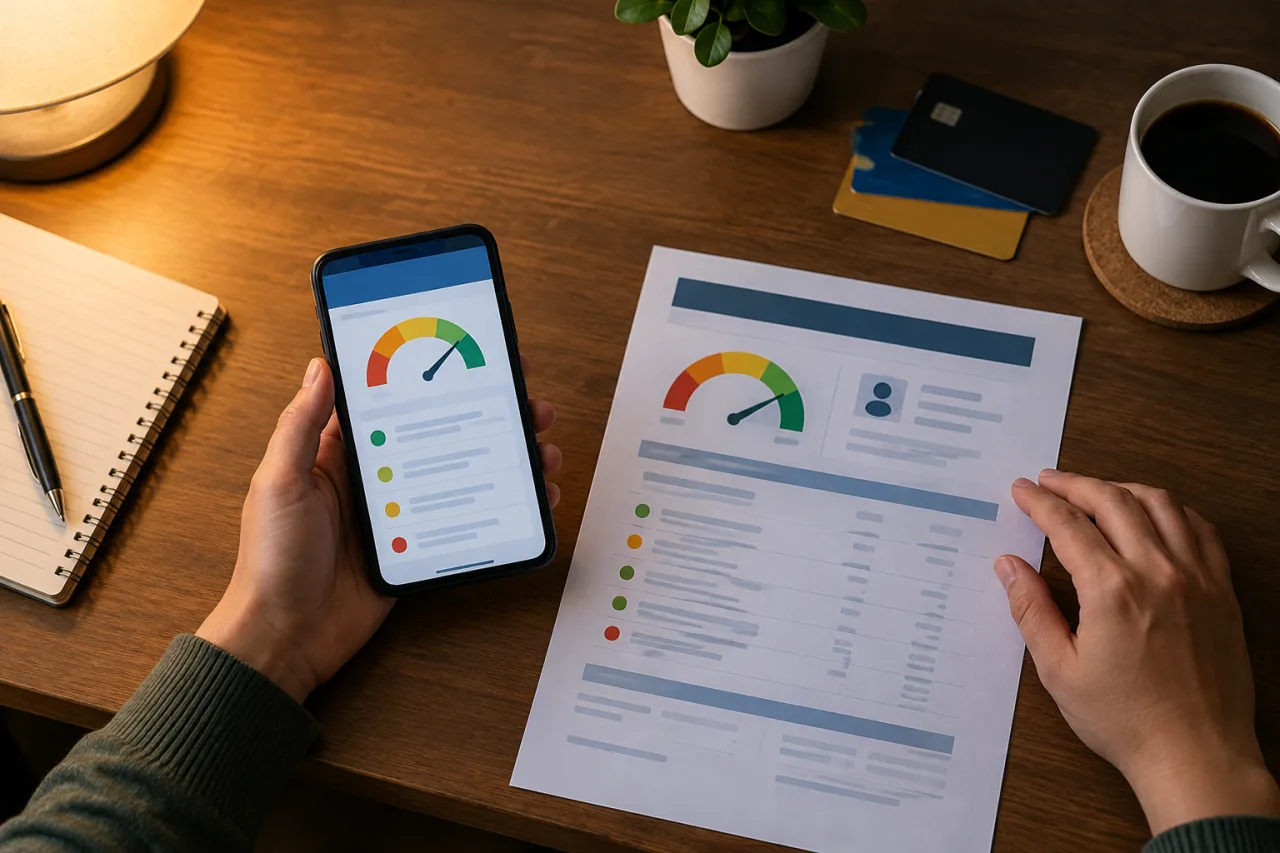
- Check one — the CIC report. The official registry’s consumer channel: request your report on the CIC’s own pages; the consent and identity rules apply, and the process (online submission, then access) is documented on the official site. Pull it, then read it like the lender will: every line is either an asset or a liability — accounts you forgot, a name variant, an obligation that closed but lingers. Two passes, different goals: the accuracy pass (right names, right balances, nothing that isn’t yours), then the lender’s pass (what the credit score Philippines market reads as pays-on-time, modest-usage, with-history — the three lines a good credit read leans on). A report audit twice a year is the whole maintenance program.
- Check two — your own dashboards. Your bank, your wallet-bank and your card apps increasingly show credit-related dashboards inside your accounts: utilization, payment streaks, pre-qualification notices. These are not official scores — they are the lender-side views you can see daily — and as practical signals they beat guessing.
- The rule of thumb: report-accurate plus dashboard-informed beats any third-party “score checker” you pay for — the official record and your own accounts are the two free checks that carry the information your applications actually face.
Credit Score Philippines: What Counts as “Good” — the Lender-Specific Answer
The practical reading of “good” runs through what the report feeds: on-time payment history (the heaviest factor in every serious model), utilization (how much of your available credit you use at statement time — modest levels read well), the age and mix of accounts (older, well-managed lines help), and recent applications (a burst of new credit reads as risk). A “good score” in the Philippine lane is therefore the report state that says: pays on time, doesn’t squeeze every limit, doesn’t churn applications, has history. The number any specific bank prints on its offer comes from its own model threshold — and improving the report state is the only lever that improves every bank’s credit score Philippines read at once.
Why the US Credit-Score Model Doesn’t Map (and What to Unlearn)
Most credit-score content a Filipino professional reads online is US-shaped, and three of its assumptions break in the Philippine lane. One: “your FICO score” — there is no single, universal number here. The registry report is the backbone; scores attach per lender and per product. Two: “your score is the decision” — the decision is a lender’s policy, scored. Income documentation, existing relationships and the product’s own rules sit beside the credit read; applications succeed on the bundle, not on a number alone. Three: “free scores from third-party checkers” — the local truth is the official record. The CIC report (your legal right to it, on the consent rules) plus your own accounts’ dashboards carry the information that actually matters; paying a checker for a number no lender issued is the import nobody needed. Unlearning these three is the beginner’s first audit — the piece you read after this one should be your next CIC pull, not another scores article.
The Fix-It Levers, Ranked by Weight
- 1. On-time everything. Every obligation — loan installment, card statement, the utility lines the CIC system collects — lands in the record. Autopay the minimums if you must; never miss the clock.
- 2. Utilization discipline. Keep card balances at a modest share of limits at statement time; the read that matters is the one the report pulls, not the one you pay after. The two-paycheck trick: make a small payment just before the statement closes, so the reported balance is the smaller one — the same limit, a better read. Utilization has no memory in most models: a heavy month reads heavy only that cycle, which makes discipline easy to restart.
- 3. Keep your old lines. Account age compounds — the card you opened at 24 is a feature, not a drawer; close the ones that cost money, keep the ones that carry history.
- 4. Stop application churn. Each new application is a fresh hard look; space them, and apply for what you can genuinely hold.
- 5. Dispute errors properly. Wrong entries go through the CIC’s correction process — documented, with evidence, per the official dispute route; fixing data you didn’t cause is the only lever that pays twice (the record and the next lender’s read).
FAQ
What is a good credit score in the Philippines?
In the credit score Philippines context, honestly: lender-specific. There is no single national score — the CIC holds your credit report, and each lender scores it with its own model (banks in-house, bureau-adjacent scores, fintech behavioral models). The practical “good” is a report that is clean, current and dispute-free — payment history, modest utilization, aged accounts, no application churn — because that state reads well to every lender at once.
How do I check my credit score for free in the Philippines?
The free-run answer for credit score Philippines checks has two parts: your CIC credit report via the official consumer channel (the registry the law gives you, under its consent rules), and the credit dashboards inside your own bank, wallet-bank and card apps (the lender-side views, updated as your accounts report). Skip third-party score checkers that charge for what the official record and your own accounts already show.
What is the CIC credit report?
The Philippines’ central credit record, set up under Republic Act 9510: your basic identifying information (name, TIN, SSS/GSIS numbers, residence, employer) plus your loan contracts with lending institutions, utility subscriptions and other collected obligations. Access runs only on your written consent, and updates follow the IRR’s reporting cadence.
Why is my score different at different banks?
Because the scores are lender-specific: the same CIC report feeds different models, thresholds and product rules at each institution. A single number is not the market’s truth; the underlying report state is. Improve the state — on-time payments, utilization, account age, no churn — and every lender’s read moves together.
How do I fix a wrong entry on my credit report?
Through the CIC’s dispute/correction process on its official channels — file with your evidence, and the registry’s correction path handles verification with the submitting entity. Fixes can take a reporting cycle to land, so start the dispute early and re-pull the report afterward to confirm the change.
Does checking my own credit hurt my score?
No. Your own access to your CIC report runs under your data-subject rights, not as a lender’s hard pull. It is the application-lookups (each bank’s evaluation of a new product) that count toward the recent-applications signal — which is exactly why spaced, purposeful applications are part of the fix-it levers. In practice: pull your report before you shop for credit (know the record the lender will read), apply inside your true capacity, and let months pass between product hunts. A credit score Philippines-lane strategy is patience with a spreadsheet.
Financial Disclaimer: This article is a financial-literacy explainer for general information only — it is not financial, legal or credit advice, and does not guarantee any score, approval, or rate. Registry processes, consent rules, scoring models and thresholds are as published on record (October 2026) and change without notice; verify every rule on the CIC’s and each lender’s official channels before acting. worldngayon.com holds no position in and is not affiliated with any institution named; it is not liable for outcomes from actions taken on this content.
Sources: the official registry’s own consumer-facing documentation — the CIC’s “about your credit report” pages (RA 9510 powers; report contents; consent-based access; IRR cadence) and its dispute channels; TransUnion Philippines’ credit-learning FAQs (score importance, report mechanics, lender usage); Metrobank’s Lifebanking series on keeping good credit (April-October 2026 on record). Score mechanics described are lender-specific by design; no single national score exists.
Cite this pagePublished Oct 29, 2026
Agron, E. (2026, October 29). Credit Score Philippines Explained: What’s a Good Score, and How to Check Yours Free. WorldNgayon. https://worldngayon.com/credit-score-philippines/
Agron, Edmon. “Credit Score Philippines Explained: What’s a Good Score, and How to Check Yours Free.” WorldNgayon, 29 Oct. 2026, worldngayon.com/credit-score-philippines/.
Agron, Edmon. “Credit Score Philippines Explained: What’s a Good Score, and How to Check Yours Free.” WorldNgayon, October 29, 2026. https://worldngayon.com/credit-score-philippines/.
Agron, E. (2026) ‘Credit Score Philippines Explained: What’s a Good Score, and How to Check Yours Free’, WorldNgayon, 29 October. Available at: https://worldngayon.com/credit-score-philippines/.
E. Agron, “Credit Score Philippines Explained: What’s a Good Score, and How to Check Yours Free,” WorldNgayon, Oct. 29, 2026. [Online]. Available: https://worldngayon.com/credit-score-philippines/
@online{agron2026creditscore,
  author       = {Agron, Edmon},
  title        = {{Credit Score Philippines Explained: What’s a Good Score, and How to Check Yours Free}},
  year         = {2026},
  date         = {2026-10-29},
  organization = {WorldNgayon},
  url          = {https://worldngayon.com/credit-score-philippines/},
  urldate      = {}
}TY - ELEC AU - Agron, Edmon TI - Credit Score Philippines Explained: What’s a Good Score, and How to Check Yours Free T2 - WorldNgayon PY - 2026 DA - 2026/10/29/ UR - https://worldngayon.com/credit-score-philippines/ Y2 - ER -
Cite the version you read; the page may be updated. Zotero and Mendeley can also import this page directly.