Table of Contents
Key Takeaway
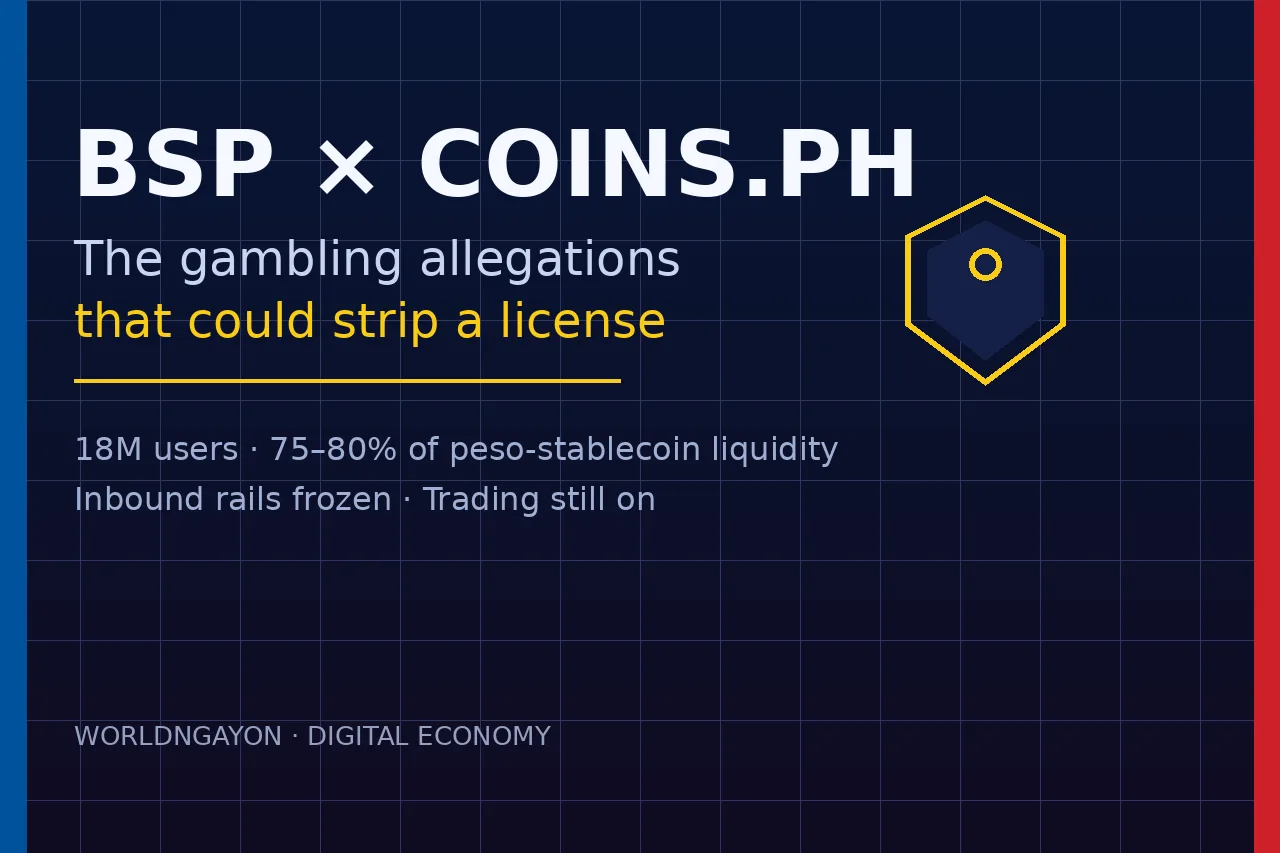
- The Bangko Sentral ng Pilipinas case against Coins.ph has escalated: a CoinDesk report citing two people with knowledge says the infractions are serious enough that the country’s largest crypto exchange could be stripped of its license to operate.
- The alleged violations involve serving offshore gambling platforms — payments for coins.ph that regulators never authorized — operators the BSP had already pushed out of e-wallet apps in 2025 — which reportedly migrated to Coins.ph and used crypto and stablecoins to pay offshore partners.
- What remains confirmed on the record: the inbound deposit freeze through wallet operator DCPay is not time-bound, no end date was given, and neither the regulator nor the company has publicly confirmed a license action. For OFW households, trading and outgoing transfers still work while inbound peso rails stay closed.
From Frozen Rails to a License-Level Case
On October 1, Coins.ph suspended incoming cash-ins after a BSP directive to its wallet operator DCPay Philippines. At the time, the play was patience: compliance remediation, timelines agreed with the regulator, funds safe. The reporting this week rewrites that framing entirely. According to CoinDesk, two people familiar with the process describe infractions serious enough to see the 12-year-old company stripped of its license — an outcome one source calls “an earthquake” for the Philippine crypto ecosystem.
The sequence now reads differently. DCPay’s inbound rails froze in late September — incoming InstaPay transfers have carried a maintenance notice since September 29, and PESONet and incoming QRPH collection followed. The restriction was explicitly not time-bound, unlike the temporary suspensions regulators typically impose for throughput or latency failures. No reason was given at the time. The gambling allegations reported on October 13 supply the first plausible explanation — sourced, but still unconfirmed by any official finding.
Our October 1 playbook told readers what still worked: crypto trading, outgoing transfers, bill payments and outbound QRPH. That guidance holds — nothing in the escalation changes which buttons function today. What changed is the range of outcomes. The floor was a prolonged freeze; the ceiling is now a market without its primary on-ramp.
What the Allegations Actually Say
The reported case turns on a migration that regulators created themselves. In August 2025, the BSP’s Monetary Board suspended e-wallet features that let customers reach gambling platforms directly, and Memorandum M-2025-029 ordered supervised institutions to remove gambling access links within 48 hours. E-wallets complied. The gambling operators did not disappear — according to the people cited in the CoinDesk report, several migrated to Coins.ph, where they could reach crypto and stablecoins to pay offshore partners.
That detail matters more than the headline accusation. If confirmed, the violation is not a late filing or a capital shortfall — it is a licensed money-services firm allegedly becoming the payment rail for activity the regulator had deliberately cut off one channel over. The BSP had also proposed, in a separate framework, requirements for institutions offering gambling payment services: identification of customers and beneficial owners, transaction monitoring, and institutional responsibilities. A firm that migrated those operators onto its rails would have stepped into exactly the territory that framework was written to police.
The evidentiary discipline matters for readers too. No official BSP finding establishing gambling-related misconduct has been published. No revocation order exists on the public record. Coins.ph has not confirmed the allegations and its public statements identify only an order to strengthen internal controls. Treat the coins.ph license story as reported, sourced, and unproven — while noting that nothing in the company’s own advisories contradicts the underlying restrictions.
Coins.ph Scale: Why 18 Million Users Are the Story
The Philippines’ crypto market is concentrated to a degree that makes single-company failures systemic. Coins.ph counts more than 18 million users and moves an estimated 75 to 80 percent of the country’s peso-to-stablecoin liquidity — the on-ramp where pesos become USDT or USDC for savings, payments and corridor transfers. Strip that rail and the effect lands the same week on every service that terminates into it, from exchange desks to remittance wallets.
This concentration is why the deposit restriction was never a niche maintenance window. Corridor services that fund peso balances through DCPay have been routing around the closure for two weeks. Stablecoin-based corridor products — the rails the BSP itself wants to formalize by 2027 — depend on on-ramps of exactly this kind. A license strip at the market leader would test the entire regulated stablecoin thesis at the worst possible moment for it.
The Regulatory Landscape Around Gambling Money
To understand how a deposit freeze escalated this far, look at what the BSP was already building. August 2025 delivered a two-part message. The Monetary Board suspended e-wallet features that let customers jump from a payment app straight to a gambling platform, and Memorandum M-2025-029 gave supervised institutions 48 hours to strip gambling access links from their apps and websites. The directive targeted the front door: the convenience path from a peso wallet into a betting site.
A separate, still-developing framework proposes the rules for institutions that legitimately serve licensed gambling businesses. It covers identification of customers and beneficial owners, transaction monitoring tuned to gambling patterns, and explicit institutional responsibility for where funds originate. The logic is standard Philippine regulatory doctrine — gambling is legal for licensees and forbidden for the unlicensed, and the payment system must be able to tell the difference.
Against that backdrop, the reported Coins.ph allegations read as the worst-case version of the risk the BSP was mapping: operators pushed out of compliant e-wallets allegedly finding a single licensed rail willing to carry them, with crypto and stablecoins as the settlement layer that crosses borders as easily as a peso transfer crosses a branch counter. The offshore-gaming industry — POGO-adjacent in everything but name — was supposedly wound down in the country, and its payment survival became a national enforcement theme. If the investigation confirms that a top EMI and VASP hybrid became that industry’s settlement layer, the license question answers itself.
The enforcement mood extends beyond this case. The Anti-Money Laundering Council recently moved against 25 crypto wallets and 86 bank accounts in the flood-control plunder probe — frozen by court order, with crypto wallets named in the filings. The BSP, for its part, has been actively formalizing the legitimate version of this market: its 2027 stablecoin framework for remittance rails depends on exactly the kind of clean, supervised on-ramp that Coins.ph was built to be. That is what makes an escalation credible even as the public record stays quiet — the regulator is building the compliant rails of tomorrow while auditing yesterday’s.
And the political economy is live: the central bank has spent 2026 pushing households toward digital rails — QRPh, InstaPay, e-wallets — while Congress debates gaming-payment safeguards. A case that touches e-money licensing, crypto supervision and gambling enforcement at once will draw legislative attention, and any Senate or House hearing would become the first public venue where actual findings surface. Watch the committee calendars of both gaming-oversight and banking panels in the weeks ahead.
The Coins.ph OFW Corridor Reality
For OFW families, the practical map is unchanged from the suspension playbook, and it is worth restating what still works. Crypto trading operates under Betur Inc., the virtual-asset entity — spot trades execute, coins can be withdrawn to external wallets. Outgoing peso transfers, bill payments and outbound QRPH continue through the affected networks’ outbound lanes. Customer balances remain covered under BSP e-money requirements, per the company’s advisories.
What stays closed is the front door: incoming InstaPay, PESONet and QRPH collection — the channels a remittance sender’s bank payout typically uses. Households that cash out through exchange partners or agent networks should confirm which rails their payout provider actually terminates into before payday, and keep a secondary cash-in path alive until restoration notices appear. The Coins.ph advisory page is the authoritative status board; restoration announcements there, not press reports, mark the de-escalation.
Stablecoin corridor economics are already documented on this beat — the business tests run on stablecoin settlement — and the PH version rides the same rails. An on-ramp outage is the failure mode those tests assume away. This case is the live drill.
The freeze timeline is worth spelling out, because it shows how a compliance action becomes a household problem. September 29: incoming InstaPay flips to a maintenance notice. Days later: PESONet and incoming QRPH collection join the closure list. October 1: the company publishes its user advisory — funds safe, internal-control enhancements underway, restoration updates to follow on the official page. October 13: the gambling allegations surface, sourced but unconfirmed. At no point in that arc did the company confirm a reason, and at no point did the regulator publish one. Two weeks of silence is a long time for the rails an economy’s remittance corridors lean on.
The Dual-Entity Structure Explains What Is Still On
The reason half the product still functions is legal architecture. Coins.ph operates through two separately licensed entities: DCPay Philippines holds the electronic-money license and runs peso wallet services; Betur Inc. holds the virtual-asset-service registration and operates the exchange. Both appear in the BSP’s payment-system register. The deposit freeze binds the e-money side; the trading side never stopped.
That split is also why the license question is murkier than headlines suggest. “Stripped of its license to operate” — which license, on which entity, attached to which finding? An EMI revocation would kill the peso wallet that 18 million people use daily. A VASP action would shutter the exchange. Both are earthquakes; they are different earthquakes, and the public record does not yet say which the regulator is weighing. The reporting describes a process, not a verdict. crypto.news’s regulatory timeline pieces together the whole documented arc — advisory dates, service-status records and the company’s own statements — for readers who want the paper trail rather than the summary, and BitPinas carries the full user advisory text.
The Tape: What to Watch Next
- Restoration notices on the Coins.ph advisory page — the first hard signal of de-escalation, and the datapoint to check before any payday.
- A second-source confirmation from a major wire, which would move the license story from “people familiar” to actionable.
- Any BSP or AMLC public filing. The AMLC has shown hard-tool appetite recently — a court froze 25 crypto wallets and 86 bank accounts in the flood-control plunder probe — so formal asset actions would not be out of character.
- Competitor flows: on-ramp volume migrating to alternatives would show the market’s own verdict before any regulator’s.
Broader regulatory context sits on this beat as well: the crypto-bank wall falling across 2026 has raised the compliance bar for hybrids of all kinds. A market leader accused of relaying prohibited flows is the stress case that compliance-first builds were designed to survive.
And there is a final frame the silence cannot hide: whoever ends up running the country’s primary on-ramp after this case — recovered and remediated, sold to a strategic buyer, or split — will inherit a Compliance-First mandate that did not exist when the company was founded in 2014. The tools demanded now exist off the shelf: travel-rule infrastructure, chain analytics tuned for gambling patterns, real-time PEP screening. Regulators have signaled in every adjacent case that the standard is no longer intent to comply but demonstrated control. That standard is the real story underneath this one, and it applies to every e-money and VASP license in the jurisdiction, not just the market leader’s.
Is Coins.ph shut down?
No. Inbound peso rails — InstaPay, PESONet, incoming QRPH — remain frozen, but crypto trading, outgoing transfers, bill payments and outbound QRPH continue. Balances remain protected under BSP requirements, per company advisories.
Can OFW families still cash in to Coins.ph?
Not through bank or wallet inbound rails — those are the frozen lanes. Outgoing transfers and trading still work, and a payout provider’s own rails determine what reaches a household.
Has the BSP confirmed the gambling allegations?
Check the status page before payday and keep a secondary cash-in route until restoration is announced. Until then, the Coins.ph status board is the only schedule that counts.
One routing note matters for payday discipline: an OFW sender’s money reaches a household through whichever rail the payout provider terminates into, and that provider’s rails — not Coins.ph’s headlines — decide whether a transfer lands on time. Families using agent networks or partner exchanges should ask the provider directly which rails are live, keep a second cash-in method funded this cycle, and treat any restoration notice on the coins.ph advisory page as the all-clear signal rather than rumors on social feeds.
What would a license strip mean for remittances?
No. The allegations come from unnamed people familiar with the process, reported by CoinDesk. No official finding, revocation order or public BSP statement confirms misconduct. The company acknowledges only an internal-controls directive.