Table of Contents
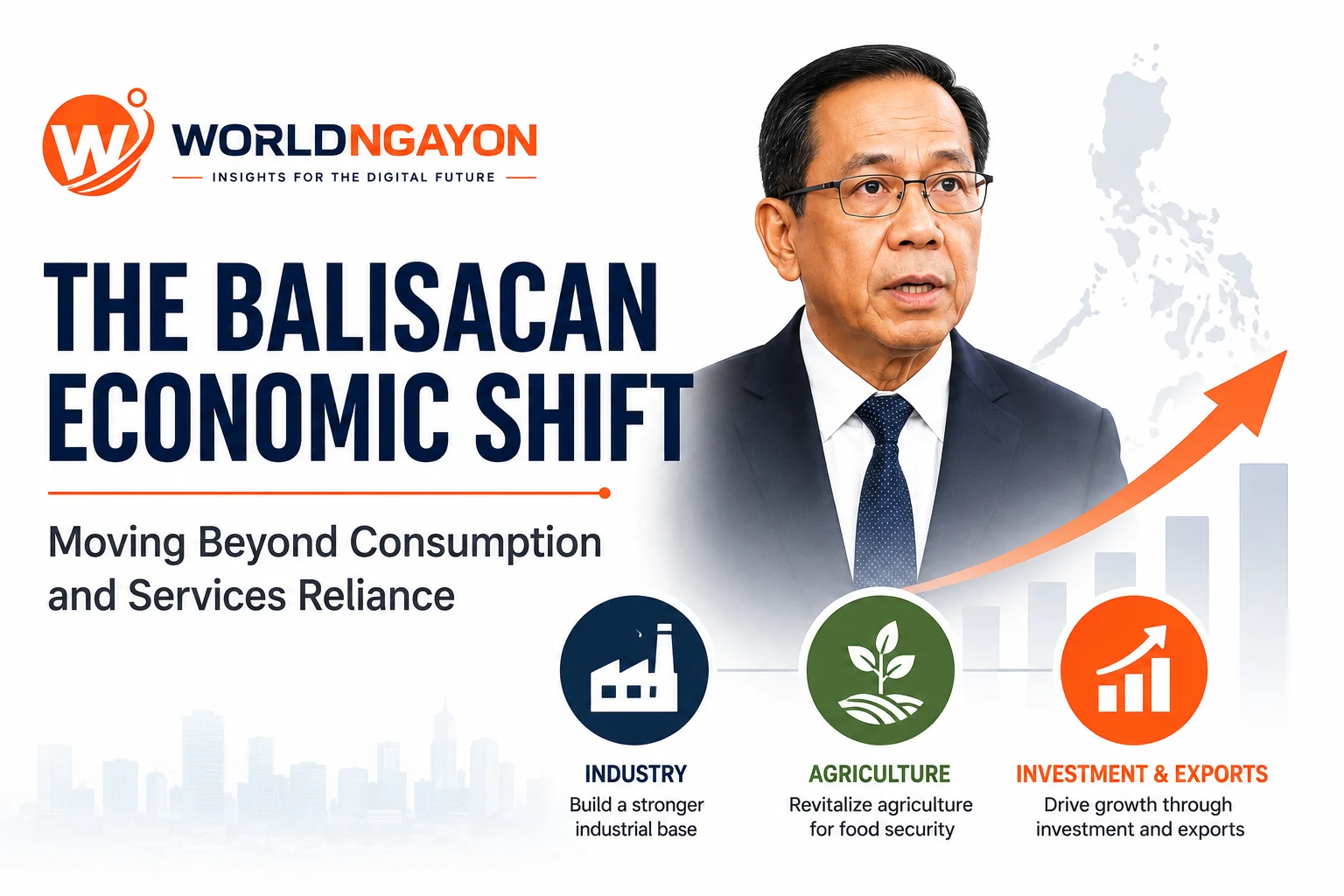
Balisacan economic shift — the call by Economic Planning Secretary Arsenio Balisacan to move the Philippines away from household consumption and services sector reliance — is not just a policy recommendation. It is an admission that the growth model that served the country for two decades has reached its structural limits.
Key Takeaway
- 🔄 Model Shift: The Balisacan economic shift calls for diversifying growth sources beyond consumption and services toward investment, exports, industry, and agriculture
- 📉 Two-Thirds Dependency: Household consumption accounts for roughly two-thirds of Philippine GDP — a level of dependency that makes the economy highly vulnerable to inflation and remittance shocks
- 🏗️ Industrialization Pivot: Balisacan explicitly urged a pivot back to industry and revitalized agriculture as growth pillars, citing innovation-driven productivity as the long-term driver
- 💡 IT-BPM Reassurance: Despite AI disruption fears, Balisacan said the IT-BPM sector is “still growing” and called fears of AI-driven job losses “quite exaggerated”
- 🎯 Government Targets: The Marcos administration targets 5-6% GDP growth for 2027-2030, inflation of 4-5% in 2027 and 2-4% in 2028, and poverty rate below 10%
The Philippines doesn’t have a growth problem. It has a growth model problem. When GDP expands at 2.3% and the government’s own economic planning secretary says the country must “diversify the sources of our growth,” the issue is not a temporary slowdown — it is the recognition that the engine driving the economy for the past two decades is no longer sufficient. The Balisacan economic shift is that recognition, and it has profound implications for every Filipino professional, business owner, and investor.
Secretary Arsenio Balisacan, head of the Department of Economy, Planning and Development (DEPDev), made the call at the Economic Journalists Association of the Philippines Economic Forum on August 14, 2026. His words were direct: “We need to diversify the sources of our growth to include, on the demand side, more investment and exports, and on the supply side, industry and agriculture.” This is not an abstract academic argument. It is a policy direction from the official responsible for the Philippine Development Plan, coming at a moment when the economy has posted its weakest growth in five years.
Why the Balisacan Economic Shift Matters Now
The timing is not coincidental. The Balisacan economic shift comes exactly one week after Q2 GDP data showed growth collapsing to 2.3% — the fourth consecutive quarter of deceleration. As we analyzed in our Philippine GDP slowdown report, the slowdown is driven by a construction crash, investment contraction, and inflation eroding household purchasing power. Balisacan’s response is not to defend the existing model but to call for a fundamentally different one.
To understand why this matters, consider what the current model looks like in practice. Household consumption accounts for roughly two-thirds of Philippine GDP. When consumption grows, GDP grows. When consumption slows — as it did in Q2 2026, expanding only 2.8% down from 3.0% in Q1 — the entire economy slows. This is not resilience. It is structural fragility. An economy that depends on consumers spending money they are losing to inflation is an economy built on a foundation that shrinks when prices rise.
The services sector — retail, transport, tourism, banking, IT-BPM, and digital services — has been the primary beneficiary of this consumption-driven model. But as the Balisacan economic shift acknowledges, services alone cannot sustain growth when the consumption base is eroding. The argument is not that services are unimportant. It is that services cannot be the only pillar.
The Industry and Agriculture Argument
Balisacan’s call for industrialization is particularly striking because it reverses decades of economic policy direction. Since the 1990s, the Philippines has increasingly deindustrialized relative to its ASEAN peers, pivoting toward services — particularly IT-BPM, financial services, and retail. Vietnam, Indonesia, and Thailand built manufacturing export bases. The Philippines built a call center industry. Both strategies generated growth, but they created different vulnerabilities.
“We can get back to industry, and we can revitalize agriculture to reinforce the pillars,” Balisacan said. “We have actually done well in terms of innovation. In the longer term, it is really productivity growth fueled by innovation that drives GDP growth.” This is an acknowledgment that the productivity gains needed for sustained 5-6% growth — the government’s 2027-2030 target — cannot come from services alone. Manufacturing and agriculture, with the right technology investment, can deliver the productivity improvements that consumption-driven services cannot.
The connection to the AI transformation is direct. As we documented in our AI economic impact Philippines analysis, AI-driven productivity gains could add P1.8 trillion to the Philippine economy. But those gains are concentrated in sectors that adopt AI — and manufacturing and agriculture are prime candidates for AI-driven productivity improvements. Precision agriculture, automated manufacturing, and AI-optimized supply chains could deliver the productivity growth Balisacan is calling for. The Balisacan economic shift is, in effect, a call to channel AI investment into productive sectors rather than purely consumer-facing services.
What the Data Shows About Household Spending
The Daily Tribune reported that BPI lead economist Emilio Neri Jr. noted consumer demand remained soft during Q2, with household consumption expanding by only 2.8% as inflation spiked to a three-year high in April. “A closer look at spending patterns suggests that households became increasingly selective in their expenditures, allocating a larger share of their budgets toward essential goods and services while cutting back on discretionary purchases,” Neri said.
This behavioral shift — from discretionary spending to essentials-only — is exactly the kind of structural change that makes a consumption-dependent growth model unsustainable. When households cut back on discretionary spending, the services sectors that depend on that spending — retail, tourism, entertainment, dining — contract. Those sectors employ millions of Filipinos. When they contract, employment and wages suffer, which further reduces consumption. This is the negative feedback loop that the Balisacan economic shift is designed to break.
The data also reveals a positive signal that Balisacan highlighted: exports grew 12.2% in Q2, supported by stronger semiconductor exports driven by global demand for AI-related products. This is evidence that the export and industry pillars Balisacan wants to strengthen are already showing capacity. The question is whether policy can accelerate that trend. For investors, this connects to our Philippine AI stocks investment guide — companies positioned in semiconductor exports and AI manufacturing are aligned with the Balisacan economic shift direction.
The IT-BPM Question: Is AI Really Exaggerated?
One of the most notable moments in Balisacan’s forum appearance was his reassurance about the IT-BPM sector. “The fear that we would lose a lot of our IT-BPM in this evolving AI does not seem to be — or appears to be quite exaggerated — because despite the AI, the sector is still growing,” he said.
This is a significant statement from the government’s chief economic planner, and it deserves scrutiny. The IT-BPM industry’s own data, as we reported in our Philippine Digital Workforce guide, shows that the 2028 employment projection was reduced from 2.5 million to as low as 1.85 million. AI chatbots now handle 60-75% of routine inquiries. First-contact resolution rates with AI have reached 85-92%. These are not signs of a sector untouched by AI — they are signs of a sector being transformed by it.
Balisacan’s point may be more nuanced than it appears. The sector is still growing in revenue terms even as employment projections decline. AI augmentation is making remaining workers more productive, not eliminating the sector entirely. But for the 650,000 Filipino workers whose jobs are in the gap between the old 2.5 million projection and the new 1.85 million, the distinction between “growing” and “shrinking employment” is not academic. The Balisacan economic shift implies that even if IT-BPM revenue grows, the Philippines cannot rely on it as the primary employment engine it once was. Diversification into industry and agriculture is not just about GDP growth — it is about employment resilience.
What This Means for Filipino Professionals
The Balisacan economic shift has three practical implications for Filipino professionals making career and business decisions in 2026.
First, the services sector will remain important but will no longer be the automatic growth engine it was for the past decade. Professionals in IT-BPM, retail, and tourism should not panic, but they should hedge — developing skills that transfer to industry and agriculture as those sectors receive renewed policy attention and investment. The AI skills we outlined in our AI agents workforce guide are relevant here: AI-augmented manufacturing and precision agriculture will need workers who understand both technology and traditional industry processes.
Second, the government’s 2027-2030 target of 5-6% growth depends on the Balisacan economic shift succeeding. If investment flows into industry and agriculture as Balisacan intends, new career paths will open in manufacturing technology, agricultural technology, and export-oriented production. These are sectors that have been relatively neglected in Philippine professional culture, which has historically favored services and overseas employment. The shift could rebalance the career landscape.
Third, the inflation target — 4-5% in 2027 and 2-4% in 2028 — is an admission that inflation will remain above the current 3.0% target for at least another year. Professionals should plan personal financial decisions around elevated inflation persisting into 2027. This means prioritizing investments that hedge against inflation, as we explored in our OFW remittances analysis, and avoiding long-term fixed-income instruments that lock in below-inflation returns.
The Deeper Question: Can Policy Actually Shift the Model?
Here is the analytical tension in the Balisacan economic shift: calling for diversification is easy; achieving it is hard. The Philippines has been consumption-driven for decades because of structural factors — a young population that consumes, remittance inflows that fund consumption, and a services sector that grew faster than manufacturing. Shifting toward industry and agriculture requires investment, and investment has been contracting for four straight quarters.
Balisacan’s own acknowledgment of the flood-control corruption scandal illustrates the challenge. President Marcos Jr. admitted that public spending incurred a 7% shortfall due to the controversy. When public infrastructure spending is frozen by corruption probes, the investment needed for industrialization cannot flow. The Balisacan economic shift requires not just policy intent but governance credibility — the assurance that public funds will reach their intended projects without being siphoned off. That credibility is currently damaged.
Nevertheless, the call itself is significant. When the government’s chief economic planner publicly states that the growth model must change, it creates policy momentum. Budget priorities, investment incentives, and trade policies may begin to align with the Balisacan economic shift direction. For professionals and investors, the strategic question is not whether the shift will happen overnight — it will not — but whether to position early for a direction that the government has now explicitly endorsed.
Frequently Asked Questions About the Balisacan Economic Shift
What is the Balisacan economic shift?
The Balisacan economic shift is the call by DEPDev Secretary Arsenio Balisacan to diversify the Philippine economy’s growth sources away from household consumption and services toward investment, exports, industry, and agriculture. He made the call at the Economic Journalists Association of the Philippines Economic Forum on August 14, 2026.
Why does the Philippines need to shift its economic model?
The current model relies on household consumption for roughly two-thirds of GDP, making the economy highly vulnerable to inflation and remittance shocks. With GDP growth slowing to 2.3% in Q2 2026 and investment contracting for four straight quarters, the consumption-driven model has reached its structural limits.
What did Balisacan say about the IT-BPM sector and AI?
Balisacan said fears of AI-driven job losses in the IT-BPM sector appear “quite exaggerated” because the sector is still growing despite AI adoption. However, industry data shows employment projections have been reduced from 2.5 million to 1.85 million by 2028, suggesting the sector is transforming rather than shrinking.
What are the government’s economic targets for 2027-2030?
The Marcos administration targets 5-6% GDP growth for 2027-2030, inflation of 4-5% in 2027 and 2-4% in 2028, and a poverty rate below 10%. These targets assume the Balisacan economic shift toward industry and agriculture succeeds in delivering higher productivity growth.
How does the Balisacan economic shift affect Filipino professionals?
Professionals should expect renewed policy attention and investment in manufacturing, agriculture, and export-oriented sectors. Those in services should hedge by developing skills that transfer to industry. The shift also implies that inflation will remain elevated into 2027, affecting personal financial planning.
What role does innovation play in the Balisacan economic shift?
Balisacan explicitly cited innovation as the long-term driver of productivity growth, stating: “In the longer term, it is really productivity growth fueled by innovation that drives GDP growth.” AI-driven productivity improvements in manufacturing and agriculture are key to achieving the shift.
Can the Philippines actually shift back to industrialization?
The shift faces significant challenges, including four straight quarters of investment contraction and governance credibility issues from the flood-control corruption scandal. However, Balisacan’s public endorsement of the direction creates policy momentum that could influence budget priorities, investment incentives, and trade policies over the remaining two years of the Marcos administration.
How does the Balisacan economic shift connect to AI transformation?
AI-driven productivity gains in manufacturing and agriculture align directly with the Balisacan economic shift. Precision agriculture, automated manufacturing, and AI-optimized supply chains can deliver the productivity improvements needed for sustained 5-6% growth, channeling AI investment into productive sectors rather than purely consumer-facing services.
Sources: Daily Tribune, “Balisacan seeks broader growth beyond consumption,” August 16, 2026 | Inquirer Business, “Balisacan urges shift from household spending, service sector reliance,” August 17, 2026 | Philippine Statistics Authority, Q2 2026 GDP Report, August 7, 2026 | DEPDev Secretary Balisacan’s statement at the EJAP Economic Forum, August 14, 2026
This article is for informational purposes only and does not constitute financial or investment advice. Readers should consult a licensed financial advisor before making investment decisions based on economic policy analysis.