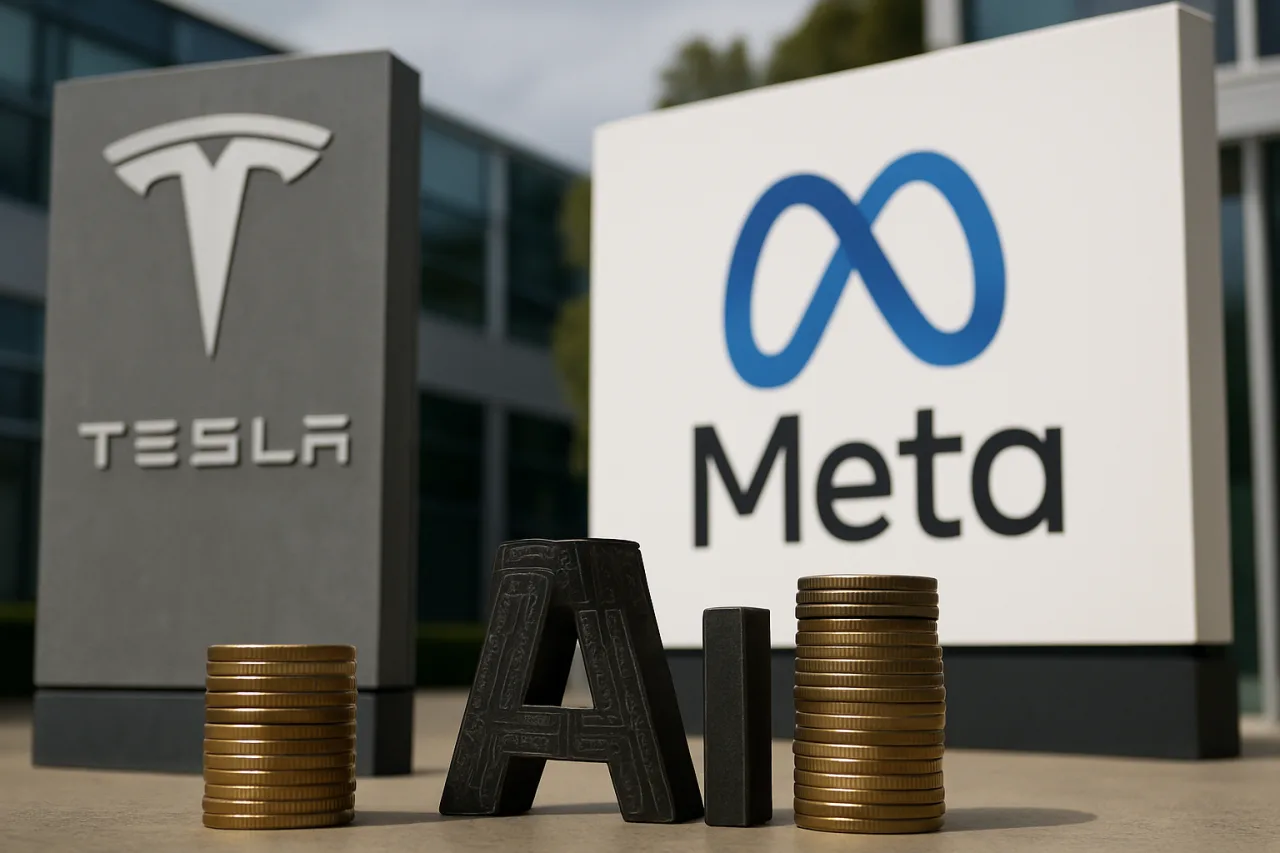
Tesla beat its quarter and its stock fell anyway; Meta raised its AI spending outlook and its stock rose all the same. The two reactions, hours apart on the same night, delivered the clearest verdict yet on how markets now score the AI trade: capital expenditure has become the decisive line item — the number that translates belief in artificial intelligence into balance-sheet commitments — and the market just showed it rewards the raise and punishes the cut. Nasdaq-100 futures slipped between 0.7% and 1.3% through the morning after the divergence landed (Investor’s Business Daily tracked the tape hour by hour), and the AI-infrastructure complex spent Thursday repricing around one question: whose AI spending number do you trust?
Key Takeaway
- The paradox that settled the debate: Tesla beat on revenue ($28.05 billion) and adjusted EPS ($0.48) with Q3 capex of $4.73 billion — and fell 3.3% after hours when it cut 2026 AI spending guidance to roughly $20 billion, down about 20% from prior plans above $25 billion.
- The other verdict: Meta raised its 2026 capital-expenditure range to $135-145 billion — one of the largest single-year hardware commitments ever disclosed — and rose more than 2% in extended trading on 26% revenue growth.
- The rule the market wrote: for AI-adjacent companies, beats on sales and profit no longer predict the stock reaction; the capex guidance — how much a company commits to GPUs, data centers and power — has become the market’s verdict line on the AI trade.
- The suppliers felt both moves: Meta’s raise keeps pressure on memory and GPU pricing (DD5-class demand already squeezing consumer prices), while equipment maker Lam Research slumped 7.4% on a guidance miss the same week.
- The context line: last week’s AI-linked selloff put CoreWeave at the storm’s center; this week’s countersignals — SpaceX’s first public profit (+7.8%), Super Micro’s beat (+9.6%), Dell +5.3% — say the trade is intact but now graded on a harder curve.
Two results, two verdicts — the night in numbers
The numbers first, because the paradox needs them. Tesla’s third quarter: $28.05 billion in revenue, adjusted EPS of $0.48 — figures that landed at or above what the market braced for — and quarterly capex of $4.73 billion, up more than 100% year over year but far below the $7.7-7.95 billion analysts expected. Free cash flow came in around $1.53 billion, better than the negative figure the street had modeled. Then the guidance: Tesla told investors to expect roughly $20 billion of capital expenditure for 2026, a cut of about 20% from the company’s own prior framing above $25 billion. The stock dropped 3.3% in post-market trading — punished not for missing the quarter but for trimming the future.
Meta’s night ran the opposite arc: 26% revenue growth, and a 2026 capital-expenditure range raised to $135-145 billion — among the largest single-year hardware commitments any public company has ever disclosed — and the market paid for it immediately, lifting the shares more than 2% after hours. Two profitable AI-era giants, two opposite directions on AI spending, two opposite stock reactions. The market did not score the quarters; it scored the commitments.
Why AI spending guidance became the verdict line
The logic is not mysterious, but this earnings cycle made it explicit. Capital expenditure is the cleanest forward indicator an AI-era company offers: GPUs bought, data-center buildings contracted, networking and power infrastructure booked — the physical grammar of belief in the AI roadmap. When guidance rises, the company is saying it sees demand ahead of supply; when guidance falls, every reading is possible — efficiency, discipline, delayed ambition — but the market now defaults to the bearish one, especially for companies whose entire valuation story is their AI transition. A trader’s shorthand has hardened into a rule: in this market, the AI spending line is the earnings call.
That is the regime shift this week completed. Through 2023-2025, AI-era stocks could rally on narrative; the selloff that put CoreWeave at its center changed the bar. As one Asia-Pacific derivatives head put it this week, markets have moved from trading AI hype to demanding extremely high standards from whatever beats expectations. The evidence is now bidirectional: Meta proves AI spending still buys a stock reaction — when it comes from a company whose core business compounds independently. Tesla proves a cut reads as retreat — when the cut touches the exact line the valuation story rests on.
Tesla’s cut, read correctly
Fairness requires the bull case too, because Tesla’s cut has a defensible core. The company’s stated agenda — Optimus production lines, Cybercab manufacturing, the compute build for autonomy, and the Terafab-style chip facility with SpaceX — depends on massive, sustained AI spending; trimming near-term capex improves free cash flow and signals discipline rather than retreat IF the projects are being timed rather than killed. The company’s own quarter showed it can generate cash: the $1.53 billion free-cash-flow beat came from exactly this discipline. The bear reading, which the market chose overnight, is simpler: for a company telling investors its future value lies in AI and robotics, spending less on the hardware that carries the story reads as hedging the story. Musk complicated the read himself — musing the same week that a SpaceX-Tesla merger would be ‘a good idea’ after SpaceX posted its first profit as a public company, a remark that lifted both stocks and added a merger-shaped variable to an already crowded signal field.
The honest synthesis: Tesla’s number is ambiguous in a way Meta’s is not, and this market has stopped paying for ambiguity. Until the next quarter adds specifics about what the trimmed billions were for — and when — the stock will trade on the cut’s implication, not its intention.
Meta’s raise, read correctly
Meta’s raise carries its own risks, which the market discounted overnight. A $135-145 billion hardware commitment in one year concentrates the bet: it assumes AI demand keeps absorbing the compute, that power and chips arrive on schedule, and that returns eventually justify the depreciation wall every data-center build creates. The knock-ons are real and immediate in both directions — component suppliers get a guaranteed demand curve into next year (which is why the memory squeeze our HBM shortage coverage tracked keeps intensifying: AI demand competing with consumer PC builders for the same DDR5 output, pushing retail prices to multiples of MSRP), while the depreciation schedule quietly narrows the margin for error on ad-revenue growth. The market paid for the signal; the bill arrives on a future income statement. The correct read of Meta’s night is neither triumph nor caution — it is that the market now prices the AI trade off intentions, and Meta’s intentions are the largest in the sector.
The wider tape: the week told one story in three parts
Three market chapters, one storyline. Part one, the reassurance: SpaceX — public, profitable for the first time, up 7.8% — and Super Micro’s guidance beat (+9.6%, dragging HPE +3.7% and Dell +5.3% along) gave the AI buildout its counter-evidence day, with strategists calling it a good start, not an answer. Part two, the warning shot: Lam Research — the equipment maker one layer upstream of every fab — slumped 7.4% on a guidance miss, and Broadcom’s chief executive had already likened parts of the AI rally to gamblers who do not understand the risks; the supply chain’s own numbers said demand is strong but unevenly distributed. Part three, the macro undertow: Middle East tensions pushed crude past $110 a barrel and sent money toward Treasuries, so the AI re-pricing happened against a risk-off tape — futures down, the safe-haven bid up, every AI-era multiple is now carrying a second, older discount rate — the AI spending math must clear it too. Global equities retreated through Thursday sessions on the combination (Time News’ session wrap carries the cross-market detail); the Philippines’ own PSEi, up 0.26% at 5,821.51 on Wednesday’s close, trades its own AI-exposure via the same global plumbing — the lesson travels without translation — as our Elice IPO post-mortem showed on Seoul’s Kosdaq.
What to watch next: the capex scorecard
Four numbers decide whether this week was noise or regime. First: the remaining mega-cap capex guides this earnings season — each raise or trim re-prices the whole complex. Second: the memory suppliers’ pricing power, the DDR5 squeeze being the leading indicator of how much of Meta’s $135-145 billion actually converts into hardware orders on time. Third: the depreciation-to-revenue slope at the spenders — the moment returns lag commitments visibly, ‘AI spending’ flips from verdict line to warning label. Fourth: the CoreWeave-class debt-funded operators — our CoreWeave debt-crisis coverage traced the leverage at the storm’s center, and every hyperscaler capex raise strengthens that balance sheet while every demand wobble tests it. Our Anthropic-file piece tracked the demand side of the same equation — usage growing while prices fall — and the capex verdict is simply the supply side of that chart. Watch both sides meet, and the AI trade’s true price emerges.
Financial Disclaimer
This article is for general information and analysis, not financial advice. It references specific companies, stocks, indices and market events to explain market dynamics; nothing here is a recommendation to buy, sell, or hold any security, or a prediction of returns. Markets carry risk, including the loss of principal; past performance does not guarantee future results; and AI-sector exposure in particular carries elevated valuation and execution risk as described. Do your own research or consult a licensed financial advisor registered with the appropriate regulator — including the Philippine SEC or PSE-accredited brokers for Philippine positions — before acting on anything discussed here. WorldNgayon publishes market analysis in good faith from sources believed reliable at publication time; we do not guarantee completeness or accuracy, and we hold no positions in the securities discussed.
FAQ
Why did Tesla stock fall after beating its quarter?
Because it cut 2026 capital-expenditure guidance to roughly $20 billion — about 20% below prior plans above $25 billion. In the current AI-focused market, a capex cut from a company whose valuation story rests on its AI transition reads as retreat, and the stock dropped 3.3% after hours despite beating on revenue ($28.05 billion) and adjusted EPS ($0.48).
Why did Meta stock rise after raising its AI spending?
Because a raise is the strongest demand signal a company can send: Meta raised its 2026 capex range to $135-145 billion — among the largest single-year hardware commitments ever disclosed — alongside 26% revenue growth. Investors read continued AI spending as belief in returns ahead of supply, lifting the stock more than 2% after hours.
Why is capital expenditure suddenly the market’s key metric?
Because it is the cleanest forward indicator an AI-era company offers: it shows how much real money is committed to GPUs, data centers and power. After last week’s AI-linked selloff centered on CoreWeave, markets moved from rewarding narrative to requiring evidence — and capex guidance became the evidence line.
What did Lam Research’s drop tell the market?
That AI demand is strong but unevenly distributed: the semiconductor-equipment maker slumped 7.4% after issuing guidance that missed estimates. When the company that supplies every fab struggles, the market questions the breadth of the buildout — even as data-center names beat the same week.
What does this mean for tech suppliers and memory prices?
Meta-sized raises keep pressure on component pricing into next year: DDR5 memory already competes between AI data centers and consumer PC builders, pushing retail GPU and memory prices well above list. Each new capex range effectively extends the squeeze — good for suppliers with capacity, painful for consumers buying retail.
How does this affect Filipino investors?
Indirectly but meaningfully: AI-era US equities move through global risk appetite, so the same capex verdicts echo into the PSEi’s own tech and conglomerate exposures, the peso’s risk-on/off cycles, and OFW-held funds with US allocations. The discipline travels: judge AI-era positions on the capex-return math, not the narrative.