Key Takeaway
- 📊 The density ladder, in one line: legacy air-cooled data centers ran 3-8 kW per rack (20-30 kW in dense halls); AI-ready racks need 30-100 kW; NVIDIA’s GB200 NVL72 rack — 72 Blackwell GPUs in a rack — is specced around 120 kW nominal and reported at 130-132 kW under full load (NVIDIA/HPE 2025); the GB300 NVL72 continues the liquid-cooled rack-scale architecture; next-generation racks are projected to push 300 kW and beyond (projections, labeled as projections).
- 🧊 The cooling boundary is the hard wall: the air-cooling ceiling sits below AI rack density — 72 GPUs in one rack throw more heat than air can move, which is why liquid cooling is a REQUIREMENT, not an upgrade, from the GB200 class up; the retrofits (new power distribution, plumbing, heat rejection, leak detection) are major reconstruction.
- ⚖️ Three hosting constraints, ranked: power delivery per rack (most facilities cannot feed 100 kW+ to a single rack), structural floor loading (a fully equipped liquid-cooled rack can weigh 3-5× its air-cooled predecessor; older raised floors rated 1,000-1,500 kg/m²), and liquid-cooling infrastructure (pipes, manifolds, leak detection — the three things air-cooled halls lack).
- 🏗️ The planner’s numbers: density per rack × racks per row × rows per hall = the hall’s true power draw; the PUE (power usage effectiveness) converts IT load to facility load; and the performance-per-kilowatt metric is the real spec — NVIDIA’s published compare: GB200 delivers 25× the performance of H100 air-cooled infrastructure at the same power.
- 🎯 The practical verdict: AI rack density decides where AI gets hosted — purpose-built facilities (liquid-cooled from the slab), not retrofits; modular and containerized builds exist for the fast path; and the density metric is how buyers read a facility’s AI-readiness in one number.
AI rack density is the number that decides where AI compute can actually live — and it has moved more in three years than the data center industry moved in twenty. Legacy air-cooled racks ran 3-8 kW (dense halls reached 20-30 kW); AI-ready racks need 30-100 kW-plus; NVIDIA’s GB200 NVL72 rack — 72 Blackwell GPUs and 36 Grace CPUs as one liquid-cooled unit — carries a nominal spec around 120 kW with deployed systems reported at 130-132 kW under full load (NVIDIA/HPE, 2025); the follow-on GB300 NVL72 keeps the liquid-cooled rack-scale architecture; and next-generation rack classes are projected toward 300 kW and beyond. This guide explains the metric, dates the ladder, marks the cooling boundary where air ends, ranks the three hosting constraints, and gives the planner’s arithmetic from a single rack to a full hall.
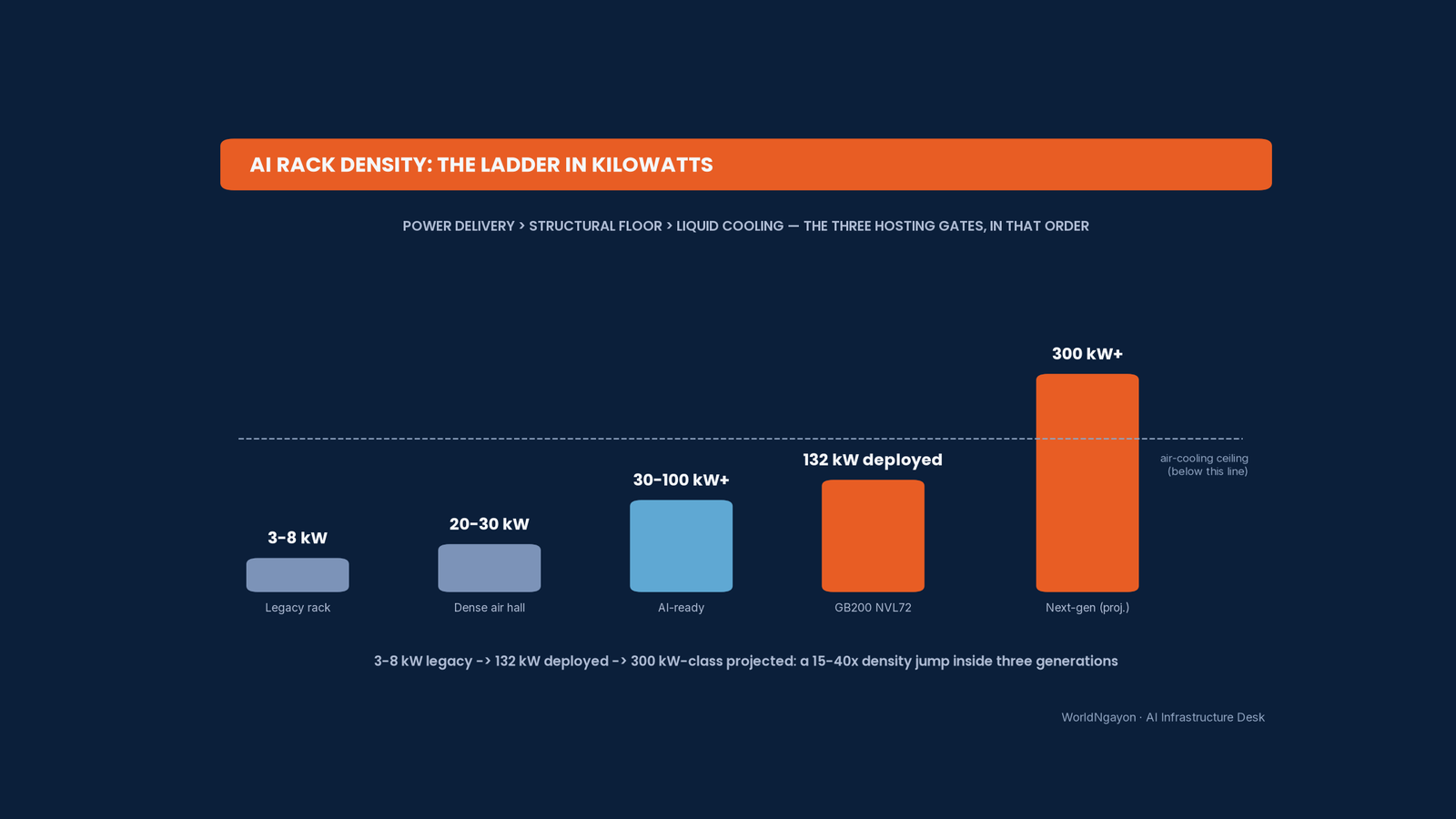
Table of Contents
AI rack density: the metric and its ladder
The metric, defined: AI rack density is electrical power delivered to a single rack (kW per rack) — the number that determines the heat that must be removed, the structural load the floor carries, and the facility class that can host the hardware. Everything else (racks per hall, halls per campus) multiplies it. The metric’s importance is architectural: a facility’s power density is the first gate AI hardware hits — many existing data centers cannot deliver 100 kW-plus to a single rack without major electrical upgrades, which is why the number alone rules out hosting locations before cooling even enters the conversation.
Why the number moved at all: AI concentrated computing. A general enterprise rack spreads its CPUs across a hall; an AI training rack concentrates the same computational purpose into one metal cabinet — the GPU count is the point (72 GPUs act as one GPU through NVLink). Concentration buys latency, bandwidth and scale; its price is density, and density’s price is cooling and structure.
WorldNgayon Analysis: density is the physical expression of the infrastructure economics this site tracks — the same concentration story the immersion-cooling guide tells at the fluid level and the who-pays analysis carries at the financial level: every kw per rack is a decision about where the money and the risk sit.
Bottom Line: kW per rack is the AI-readiness number — one spec that prices the heat, the floor and the hosting.
The dated ladder: legacy to NVL72 and beyond
| Class | Density | Cooling | Status |
| Legacy enterprise rack | 3-8 kW | Air | The installed base; 15-40× below the AI rack class |
| Dense air-cooled hall | 20-30 kW | Air, engineered | The legacy ceiling (Introl, 2025 reporting) |
| AI-ready rack | 30-100 kW+ | Hybrid air/liquid | The 2026 planning baseline — a 6-20× jump over legacy designs |
| NVIDIA GB200 NVL72 | ~120 kW nominal; 130-132 kW reported full-load (NVIDIA/HPE, 2025) | Liquid (direct-to-chip), required | Deployed and shipping; 25× the performance of H100-class air-cooled infrastructure at the same power (NVIDIA figure) |
| NVIDIA GB300 NVL72 | Liquid-cooled rack-scale; 72 Blackwell Ultra GPUs + 36 Grace CPUs | Liquid, required | Shipping for test-time-scaling inference and AI reasoning; the AI-factory output claim: up to 50× with Quantum-X800/Spectrum-X networking (NVIDIA figure) |
| Next-generation racks | 300 kW+ per rack (industry projections, labeled as projections) | Liquid at scale; immersion candidates | Design-stage; the density race continues |
Reading the ladder honestly: the two NVIDIA rows carry published specs and reported deployment figures (the vendor’s own platform pages plus deployment reporting); the 300-kW row carries projections — the truth-tier separation (the announced-vs-shipped discipline) applies to hardware exactly as to models: specs are claims, deployed megawatts are facts.
WorldNgayon Analysis: the ladder’s rate matters more than its rungs: a 15-40× density jump inside three generations is the compression event that forces everything downstream (grid interconnection economics, cooling retrofits, the campus interconnect layer, the SMR siting race in the nuclear playbook). Density is the leading edge; the rest of the infrastructure stack chases it.
Bottom Line: 3-8 kW to 130+ kW in three generations — the ladder’s slope is the industry’s whole stress test.
The cooling boundary: where air ends
The boundary, plainly: air cooling removes heat by moving air across a heat sink; its practical ceiling in engineered halls sits in the tens of kW per rack. The GB200-class rack — 72 GPUs throwing heat inside one cabinet — exceeds what air can remove regardless of fan engineering, which is why the platform was DESIGNED liquid-cooled from the start: direct-to-chip liquid carries the heat off the silicon into coolant loops the hall never sees. NVIDIA’s own framing makes the requirement structural: liquid cooling increases compute density, reduces floor space and enables the high-bandwidth NVLink communication the rack-scale architecture depends on.
What the boundary means for hosting: retrofitting an air-cooled facility to liquid means new power distribution, coolant distribution units (CDUs), manifolds, leak detection and heat-rejection upgrades — near-total reconstruction per the modular-build analyses, not a facilities project. Purpose-built liquid-cooled facilities host AI racks as a class; the retrofit path is economic only at strategic scale or with the modular fast lane (factory-built, liquid-from-birth modules). The fluid layer itself — why immersion and dielectric fluids matter at higher densities — the immersion guide carries in full.
WorldNgayon Analysis: the cooling boundary is also the industry’s sorting event: it split the hosting market into liquid-ready and legacy, repriced the liquid-ready stock, and made cooling the capability investors price (the money-circle pieces carry the financing of that split).
Bottom Line: air ends below 72 GPUs in a rack — past the boundary, liquid is the design, not the upgrade.
The three hosting constraints, ranked
1 — Power delivery: can the facility feed one rack 100+ kW? Most cannot without major electrical upgrades (busways, switchgear, the utility feed itself) — power shapes siting before anything else, and is why AI campuses concentrate where the electrical infrastructure (or the SMR lane, per the nuclear playbook) can be built. 2 — Structural loading: a fully equipped liquid-cooled AI rack weighs 3-5× its air-cooled predecessor (the liquid loops, manifolds and heavier cabinets add up); older raised-floor systems rated at 1,000-1,500 kg/m² fail the check — the floor is a spec, not an assumption. 3 — Liquid-cooling infrastructure: plumbing, manifolds, leak detection, structural reinforcement — the systems air-cooled facilities simply do not have, and the retrofit’s real cost driver.
WorldNgayon Analysis: the ranking explains a market pattern worth naming: AI capacity concentrates in NEW builds because the retrofit gate (three constraints at once) prices most legacy facilities out of the first rank — the same new-build gravity the SEA buildout analysis documents regionally.
Bottom Line: power, floor, fluid — three gates, in that order, and most legacy halls fail at least one.
The planner’s numbers: from rack to hall
The arithmetic, in four lines: 1 — rack density × rack count = IT load (120 kW × 20 racks/NVL72 pod-style hall = 2.4 MW IT); 2 — IT load × PUE (power usage effectiveness — the facility overhead ratio; 1.2-1.5 for modern liquid-cooled designs, worse for legacy) = facility load; 3 — facility load against the utility feed or on-site generation defines the campus’ energy plan (the storage and grid pieces carry that half); 4 — redundancy tiers (N, N+1, 2N) multiply the installed capacity for resilience. Worked example: 40 GB300-class racks at ~130 kW each = 5.2 MW IT; at PUE 1.25 the facility draws ~6.5 MW — roughly the continuous load of a small regional hospital system, inside one hall.
WorldNgayon Analysis: the planner’s AI rack density numbers also carry the BUYER’s lens: rent-vs-build evaluations price the colocation premium on density — facilities engineered for high power density charge for it, and the GPU-rental market analysis shows that premium flowing through to compute rates. The density number is also the simplest AI-readiness check a buyer can run on any facility claim: ask the kW, ask the PUE, ask the floor rating — three questions, and the facility’s true class answers itself.
Bottom Line: four lines of arithmetic turn a facility brochure into a hosting decision — ask the kW, the PUE and the floor.
What this means for work, money and the Philippines
For careers: the density race hires the trades that liquid cooling and high-power delivery need — electrical engineers, thermal specialists, leak-detection and CDU maintenance roles, structural engineers for high-loading floors; the AI-jobs analyses carry the wage logic and the certification paths.
For investors: density splits the hosting market — liquid-ready facilities carry the AI premium, legacy stock discounts; the same split reprices the cooling technology vendors and the electrical infrastructure suppliers; the watchlist discipline applies to the concentration read on the NVL72-class ecosystem.
For Filipino professionals and OFWs: the region’s data center buildout (the SEA analysis) imports the same density race — the Philippines’ own AI-campus plans hit the same three gates, and the careers that clear them travel (the Gulf and SEA hiring maps, here and here). The peso lens carries what imported high-power infrastructure costs a currency that pays in imported fuel.
For teams buying AI rack density capacity: the practical takeaway is the three questions: per-rack kW, PUE, floor rating — and the hosting geography follows the capex logic: capacity concentrates where all three gates open cheaply.
Verdict: density decides the hosting map
AI rack density, settled: the metric (kW per rack — the number that prices heat, floor and hosting), the ladder (3-8 kW legacy → 20-30 kW dense air halls → 30-100 kW AI-ready → 120-132 kW GB200-class deployed → 300 kW-class projected), the boundary (air ends below the 72-GPU rack; liquid from the GB200 class up), the three gates (power delivery, structural loading, liquid infrastructure — most legacy halls fail one), and the planner’s four-line arithmetic (density → IT load → PUE → facility load). The density race is why AI hosting concentrates in purpose-built liquid-cooled facilities, why retrofits read as reconstruction, and why the capacity map of the next decade is being drawn in kilowatts per rack. One number, one ladder — and the map follows.
Sources on the record: the NVIDIA GB200 NVL72 platform page · the Vertiv cooling-blueprint release.
Financial Disclaimer
This article is editorial analysis of publicly reported information, not investment or financial advice, and no outcome is promised. Figures are as reported by the named sources at the stated dates; verify before acting. Markets and infrastructure projects carry substantial risk.
One more AI rack density habit worth keeping: ask for the kW, the PUE, and the floor rating every time a facility says AI-ready. AI rack density is the one number that prices all three constraints at once – the power delivery behind it, the structural floor under it, and the liquid cooling that carries its heat – and an AI rack density claim that cannot answer any of the three is a brochure, not a spec sheet. The arithmetic from rack to hall does the rest.
- nvidia.com/en-us/data-center/gb200-nvl72 — the NVIDIA GB200 NVL72 platform page
- vertiv.com/en-us/about/news-and-events/corporate-news/vertiv-codevelo… — the Vertiv cooling-blueprint release
External sources linked in this article, in order of first mention. Spotted an error or a broken link? Tell us.
Cite this pagePublished Nov 2, 2026
Agron, E. (2026, November 2). AI Rack Density Explained: Power, Cooling and the Numbers Behind 300kW+. WorldNgayon. https://worldngayon.com/ai-rack-density/
Agron, Edmon. “AI Rack Density Explained: Power, Cooling and the Numbers Behind 300kW+.” WorldNgayon, 2 Nov. 2026, worldngayon.com/ai-rack-density/.
Agron, Edmon. “AI Rack Density Explained: Power, Cooling and the Numbers Behind 300kW+.” WorldNgayon, November 2, 2026. https://worldngayon.com/ai-rack-density/.
Agron, E. (2026) ‘AI Rack Density Explained: Power, Cooling and the Numbers Behind 300kW+’, WorldNgayon, 2 November. Available at: https://worldngayon.com/ai-rack-density/.
E. Agron, “AI Rack Density Explained: Power, Cooling and the Numbers Behind 300kW+,” WorldNgayon, Nov. 2, 2026. [Online]. Available: https://worldngayon.com/ai-rack-density/
@online{agron2026airack,
  author       = {Agron, Edmon},
  title        = {{AI Rack Density Explained: Power, Cooling and the Numbers Behind 300kW+}},
  year         = {2026},
  date         = {2026-11-02},
  organization = {WorldNgayon},
  url          = {https://worldngayon.com/ai-rack-density/},
  urldate      = {}
}TY - ELEC AU - Agron, Edmon TI - AI Rack Density Explained: Power, Cooling and the Numbers Behind 300kW+ T2 - WorldNgayon PY - 2026 DA - 2026/11/02/ UR - https://worldngayon.com/ai-rack-density/ Y2 - ER -
Cite the version you read; the page may be updated. Zotero and Mendeley can also import this page directly.