Table of Contents
Key Takeaway
- 🏦 The verified deal: Bank of America, Blackstone, Citi and Morgan Stanley announced (Oct 26, 2026) a $63 billion financing structure — the AI money circle’s founding public document — to deploy AI compute capacity on Broadcom technology for Anthropic — deliveries start calendar 2027 (Broadcom’s own press release).
- 🧩 The machine: a special purpose vehicle (SPV) buys Broadcom’s XPU AI accelerators and networking and leases them to Anthropic — the AI lab rents, the SPV owns, Wall Street funds.
- 🔗 The credit stack: BofA, Citi and Morgan Stanley arrange the first-lien portion; Blackstone is the sole committed provider of the second lien; Broadcom provides residual-value support equal to the first-lien amount — the chipmaker backstopping its own sale.
- 🌀 Why the AI money circle debate exists: the same week put Nvidia’s $3 billion into Meta’s equity offering and Meta’s upsized $25 billion share sale at 5× demand (a $98B AI war-chest) — vendors and buyers now fund each other, and the circular-financing critique got sharper.
- 📉 The risk under the yield: Anthropic’s own S-1 shows a $80.7 billion first-half loss on $16.3 billion revenue — these structures price Anthropic’s future compute bill, on Anthropic’s future revenue, against Broadcom’s residual values.
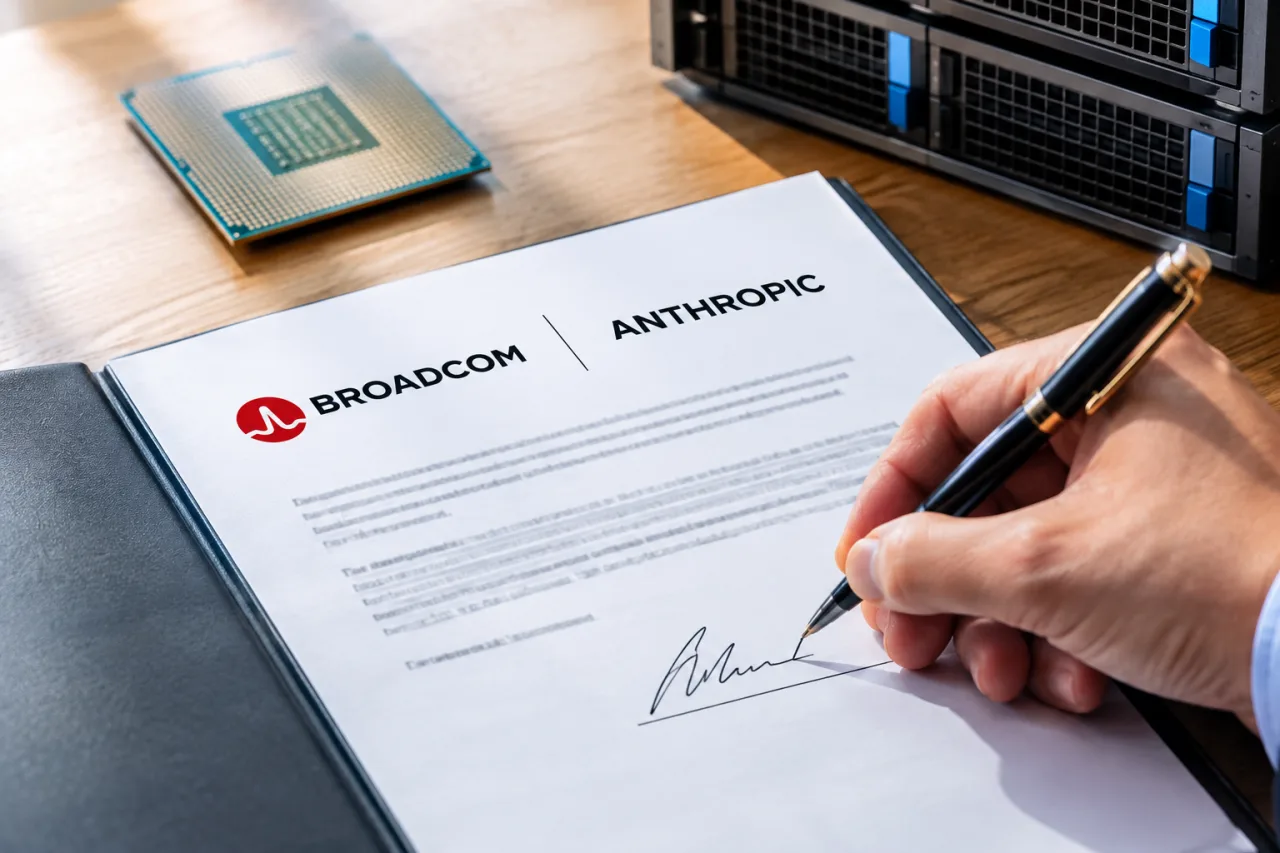
AI money circle mechanics went from an argument on fintech Twitter to a signed, dated, $63 billion document this week — and the document reads like the blueprint of the next AI financing era. On October 26, 2026, Broadcom’s investor-relations desk published the primary record: Bank of America, Blackstone, Citi and Morgan Stanley announced a landmark $63 billion financing structure to enable AI compute capacity, on Broadcom’s technology, for Anthropic — executed through a newly formed special purpose vehicle whose committed financing buys Broadcom’s XPU AI accelerators and networking solutions and leases them to Anthropic, with deliveries starting in calendar 2027. Every party is named, every lien is labeled, and the most revealing line sits at the end: Broadcom is providing residual value support to the SPV for an amount equivalent to the first lien — the vendor is guaranteeing the resale value of the very chips it sells. This piece takes the deal apart the way the Masters desk takes a filing apart: the structure, the money flows, why structured credit arrived at AI capex, and the risks printed on the same page.
The Verified Deal: an SPV, Four Wall Street Names and a Lease
The architecture, straight from Broadcom’s announcement. The SPV — a newly formed special purpose vehicle — holds the committed financing from the four Lead Financial Partners and executes the purchase of Broadcom’s XPU AI accelerators and high-speed networking solutions. The lease: the hardware is leased directly to Anthropic, whose strategic compute capacity agreement with Broadcom (announced earlier) defines what arrives — deliveries expected to begin in calendar 2027. The credit stack: the first-lien portion of the financing is arranged by Bank of America, Citi and Morgan Stanley; Blackstone is the sole provider of the committed second-lien portion — a classic senior/mezzanine split, where the first lien gets paid before the second in any liquidation and prices accordingly. The backstop: Broadcom’s residual value support equals the first-lien portion — covering the financing’s senior exposure against the possibility that the chips’ resale values disappoint. The market’s first verdict: AVGO added roughly 1.3% after-hours Monday. Nothing in that paragraph is interpretation; all of it is the announced document’s own language — which is exactly the kind of foundation the desk’s standards demand before any analysis rides on it.
How the AI Money Circle Actually Closes
Follow the money one full loop and the AI money circle stops being a slogan. Broadcom sells the chips — but instead of waiting for Anthropic to raise the cash, Broadcom aligns with Wall Street to finance the purchase its own buyer will lease; the SPV pays Broadcom today-ish (deliveries 2027), Anthropic pays the SPV in lease payments over the contract’s term, and Broadcom’s residual-value support caps the SPV’s downside on the assets that secure the first lien. The vendor wins a $63 billion commercial commitment with financing certainty; the banks win origination fees and spread; Blackstone wins a second-lien book priced for more; Anthropic wins compute without a frontier-scale balance-sheet draw today. The wider circle: in the same week, Nvidia announced a $3 billion investment in Meta’s equity offering (per the market’s earnings-day coverage) while Meta upsized a $25 billion share sale with demand near five times the available shares — a $98 billion raise aimed squarely at AI infrastructure spending. Vendors are buying their buyers; buyers are selling paper to fund the vendors’ products. The AI money circle is no longer a critique’s metaphor — it is the current financing architecture of the buildout, and this deal is its cleanest public exhibit yet.
Why Structured Credit Arrived at the AI Money Circle
The math that summoned Wall Street: AI infrastructure is the largest capex program in corporate history — global AI investment is forecast to hit $2.7 trillion in 2026 and $3.6 trillion in 2027 per Gartner’s forecast (the cited market coverage) — and the buyers most eager to rent it (AI labs) are precisely the companies whose cash flows haven’t grown into it yet. Anthropic’s own IPO filing quantifies the gap: $16.3 billion of first-half 2026 revenue against a $80.7 billion half-year loss — a burn profile that makes outright purchase of tens of billions in hardware unrealistic without either dilution or leverage. Structured instruments are the compromise: the SPV isolates the assets and their financing; the lease converts a capex mountain into an operating cost against future revenue; the vendor’s residual support bridges the banks’ unfamiliarity with used-AI-chip markets. The precedent line matters for the OFW reading of this story: the same structured logic now underwrites the neocloud buildouts and the compute economics described in the desk’s AI capex guide and neocloud explainer — the financing layer everyone downstream (freelancers, businesses, API prices) eventually pays for.
The Risks Printed on the Same Page
First, the AI money circle’s circular-demand critique gets material. When vendors finance the buyers who buy the vendors’ products, demand signals blur: some of the industry’s chip revenue is now vendor-financed rather than end-funded, and the dot-com-era textbook warns exactly where that road bends. The counterweight is that a lease-backed SPV with residual support is not the same instrument as vendor paper issued to a failing buyer — the structures are newer, the parties are bigger, and the disclosure here is unusually complete. Second, the residual-value bet is genuinely unpriced. Used AI chips in 2027 are five-year-old silicon in a market where next-generation accelerators arrive annually; Broadcom is guaranteeing values on a depreciation curve nobody has observed in this regime — if training demands shift to newer architectures faster than leases amortize, the backstop is a real cost, not a formality. Third, Anthropic’s revenue has to show up. An $80.7 billion first-half loss is a financing structure resting on future growth at a scale few corporate revenue curves have matched; the S-1 risk factors (the desk’s ANT analysis covered the 90-plus-page catalog) say so in the company’s own words. The AI money circle verdict, in our view: the deal is honest but levered to the bull case, every layer priced today assumes the AI compute demand curve keeps its slope into and through 2027.
What Would Change the AI Money Circle Reading
- Pricing disclosure. When the SPV’s lease rate or Broadcom’s support terms surface in detail, the yield-vs-risk arithmetic either firms up or the “landmark” adjective deflates — watch for amendment filings
- Anthropic’s next milestone — the IPO pricing (JPMorgan is leading retail share sales per Wednesday’s reports) or any revenue-recognition shift would reprice every structure that leans on its future bills.
- Residual-value trouble anywhere — a similar SPV restructuring, or used-GPU prices collapsing — the AI money circle’s vendor-lease pattern as a risk, not a tool.
- The Meta/Nvidia leg moving first: if Meta’s $98B raise under-delivers post-launch or Nvidia’s $3B stake reprices the circular critique into the mainstream, the copycat wave (and its financing premiums) can stall.
.
.
.
What the Evidence Supports, by Reader Situation
Education desk, not an advisory service — decision inputs, never instructions.
- If you invest in AI-linked names: the verified structure is a $63B SPV lease with named first- and second-lien providers and vendor residual support — the diligence lenses it adds are the residual-value assumptions and the lessee’s revenue curve, not the headline amount.
- If you’re an OFW or professional tracking where AI money lands: financing-layer jobs and compute-capacity buildouts are the downstream payees of this structure — the desk’s $2.7-trillion money-trail analysis maps who gets paid as the wave deploys.
- If you run a business that buys AI capacity: the precedent is instructive — lease-vs-buy is now institutional practice at frontier scale, which makes your own lease-or-buy calculus a matter of writing down the assumptions (usage certainty, price direction, chip-cycle speed) instead of copying headlines.
FAQ: the AI Money Circle’s $63 Billion Anthropic-Broadcom Structure
What exactly did Broadcom and the banks announce?
A $63 billion financing structure announced October 26, 2026 by Bank of America, Blackstone, Citi and Morgan Stanley to enable AI compute capacity on Broadcom’s technology for Anthropic — a special purpose vehicle with committed financing buys Broadcom XPU AI accelerators and networking solutions and leases them to Anthropic, part of a strategic compute-capacity agreement with deliveries starting calendar 2027.
Who holds which risk in the SPV?
The first lien (arranged by BofA, Citi, Morgan Stanley) is protected first in any liquidation; Blackstone’s second lien is the junior committed tranche; Broadcom’s residual value support equals the first-lien amount — the vendor absorbing downside on the chips’ future resale values; Anthropic carries the lease obligations against future revenue.
Why is this called “circular financing”?
Because the AI money circle means the vendor sells hardware it helps finance for the buyer to lease, and in the same week NVIDIA invested $3 billion into Meta’s offering while Meta raised $98 billion (an upsized $25 billion sale at 5× demand) for AI infrastructure — money cycling among vendors, buyers and their financiers rather than arriving only from end customers.
What happens to Anthropic’s IPO in this context?
Anthropic’s S-1 filings show $16.3 billion first-half 2026 revenue against an $80.7 billion half-year loss, with JPMorgan tapped to lead retail share sales in what reports call a potentially record-setting IPO — the structures above are, in effect, priced against that future revenue curve.
Is this the same as the neocloud financing story?
Same logic, bigger stage: neoclouds borrowed to buy chips and rent them out; this deal formalizes the pattern with an SPV, four Wall Street names, and a vendor backstop — the desk’s neocloud guide covers the smaller-scale version of the same economics.
Does this replace traditional project finance?
It extends it: the SPV-lease pattern is project finance logic applied to accelerators — assets in a vehicle, revenues as contracted leases, a sponsor backstop standing behind the senior tranche. What differs from bridges and power plants is the asset class: chips whose generations rotate annually and whose resale markets are young. That is precisely why the residual-value support matters more here than in infrastructure finance — and why the AI money circle’s critics watch Broadcom’s balance sheet as closely as Anthropic’s revenue.
What happens if AI demand slows before 2027 deliveries?
The honest answer: the structure prices that question and does not eliminate it. Lease obligations make Anthropic’s bill contractual through the term; residual support protects the SPV’s senior tranche against value decline; neither mechanism conjures end-demand. If compute demand cools, the costs compress elsewhere — Broadcom writes down its support book, the second lien absorbs more, and the industry’s appetite for vendor-financed AI money circle deals contracts accordingly. Watch the resale markets and the IPO pricing, not the announcement headline.
Could this structure be replicated for other AI labs?
Technically yes — that is the point of a landmark deal: the template (SPV, bank first-lien, private-credit second lien, vendor residual support, lease payments) is now on the public record with named roles, and other labs with compute agreements and thin balance sheets are natural candidates. The constraint is the same for every replica: a buyer whose future revenue curve justifies the lease annuity. The AI money circle scales only as fast as its lessees’ revenue does.
Financial Disclaimer
This article is for general information and education only. It is not financial, investment, legal or tax advice, and it does not recommend the purchase, sale or holding of any security or instrument, or the assessment of any company’s credit. Deal structures, pricing and risk allocations change without notice; every figure was sourced from Broadcom’s own announcement and dated market reports on October 26–28, 2026 and must be re-verified before any decision. WorldNgayon does not hold any position in the securities or companies discussed, and no content on this site should be acted upon without independent verification and, where appropriate, advice from a licensed professional.
- investors.broadcom.com/news-releases/news-release-details/bank-americ… — Broadcom’s own press release
- finance.yahoo.com/technology/ai/articles/broadcom-partners-wall-stree… — AVGO added roughly 1.3% after-hours Monday.
- fortune.com/2026/10/28/sp-500-1-2-all-time-high-broadcom-nvidia-ai-st… — while Meta upsized a $25 billion share sale
- markets.ft.com/data/announce/full?dockey=600-202610261615PR_NEWS_USPR… — the cited market coverage
External sources linked in this article, in order of first mention. Spotted an error or a broken link? Tell us.
Cite this pagePublished Oct 29, 2026
Agron, E. (2026, October 29). Broadcom’s $63 Billion Bet on Anthropic: Inside the AI Money Circle Reshaping 2026. WorldNgayon. https://worldngayon.com/ai-money-circle/
Agron, Edmon. “Broadcom’s $63 Billion Bet on Anthropic: Inside the AI Money Circle Reshaping 2026.” WorldNgayon, 29 Oct. 2026, worldngayon.com/ai-money-circle/.
Agron, Edmon. “Broadcom’s $63 Billion Bet on Anthropic: Inside the AI Money Circle Reshaping 2026.” WorldNgayon, October 29, 2026. https://worldngayon.com/ai-money-circle/.
Agron, E. (2026) ‘Broadcom’s $63 Billion Bet on Anthropic: Inside the AI Money Circle Reshaping 2026’, WorldNgayon, 29 October. Available at: https://worldngayon.com/ai-money-circle/.
E. Agron, “Broadcom’s $63 Billion Bet on Anthropic: Inside the AI Money Circle Reshaping 2026,” WorldNgayon, Oct. 29, 2026. [Online]. Available: https://worldngayon.com/ai-money-circle/
@online{agron2026aimoney,
  author       = {Agron, Edmon},
  title        = {{Broadcom’s \$63 Billion Bet on Anthropic: Inside the AI Money Circle Reshaping 2026}},
  year         = {2026},
  date         = {2026-10-29},
  organization = {WorldNgayon},
  url          = {https://worldngayon.com/ai-money-circle/},
  urldate      = {}
}TY - ELEC AU - Agron, Edmon TI - Broadcom’s $63 Billion Bet on Anthropic: Inside the AI Money Circle Reshaping 2026 T2 - WorldNgayon PY - 2026 DA - 2026/10/29/ UR - https://worldngayon.com/ai-money-circle/ Y2 - ER -
Cite the version you read; the page may be updated. Zotero and Mendeley can also import this page directly.