
Key Takeaway
- 🚨 The AI-generated malware warning, verified and dated: the UK’s National Cyber Security Centre (NCSC, part of GCHQ) published “State of the Cyber Nation” on November 3, 2026, judging it “highly likely” that AI-powered malware will have been used in a ransomware attack on UK critical national infrastructure between now and 2028 — a likelihood assessment from the agency that defends the power, transport, health and telecom networks.
- 🤖 What changes in the attack chain: per the agency, hostile actors using AI will hit “harder and faster” across the full chain — from the first phishing message to the final encryption routine — and AI will find vulnerabilities that were “tolerated for far too long” at a scale “once unimaginable” (NCSC chief executive Richard Horne).
- 🇨🇳 The state layer: the NCSC named China as likely the best equipped to conduct such operations, alongside criminal and state use of AI from Russia and others — the AI-malware threat is dual-tail (crime speeds up ransomware; states harden infrastructure targeting).
- 🛡️ The detection answer (the guide’s practical half): the AI-malware era raises the detection bar — AI-driven detection systems, behavioral (rather than signature) monitoring, human-verified response (the workflow AI Security’s class carries), and the basics that still decide ransomware outcomes: offline backups, segmentation, tested recovery, and zero-trust on the supply chain.
- 💷 The response, dated: the UK committed £60 million last week for phase one of a national Cyber Shield investment in AI-for-cyber-defence — the state’s answer is to fight AI with AI; enterprises get the same homework at their own scale.
AI-generated malware just got its official forecast — the AI-generated malware warning the agency that defends those very networks published. The UK’s National Cyber Security Centre published State of the Cyber Nation on November 3, 2026, with the judgment that it is “highly likely” AI-powered malware will have been used in a ransomware attack on UK critical national infrastructure between now and 2028 — the airports, hospitals and power-stations class. Chief executive Richard Horne’s framing: hostile actors will exploit vulnerabilities “tolerated for far too long” at a scale “once unimaginable,” with the report naming China as likely the best-equipped state. This guide carries the warning at its verified tier (a likelihood assessment, not an incident), explains what AI changes across the attack chain, and delivers the detection answer — the practical stack of AI-driven detection, behavioral monitoring and human-verified response, plus the ransomware basics that still decide outcomes.
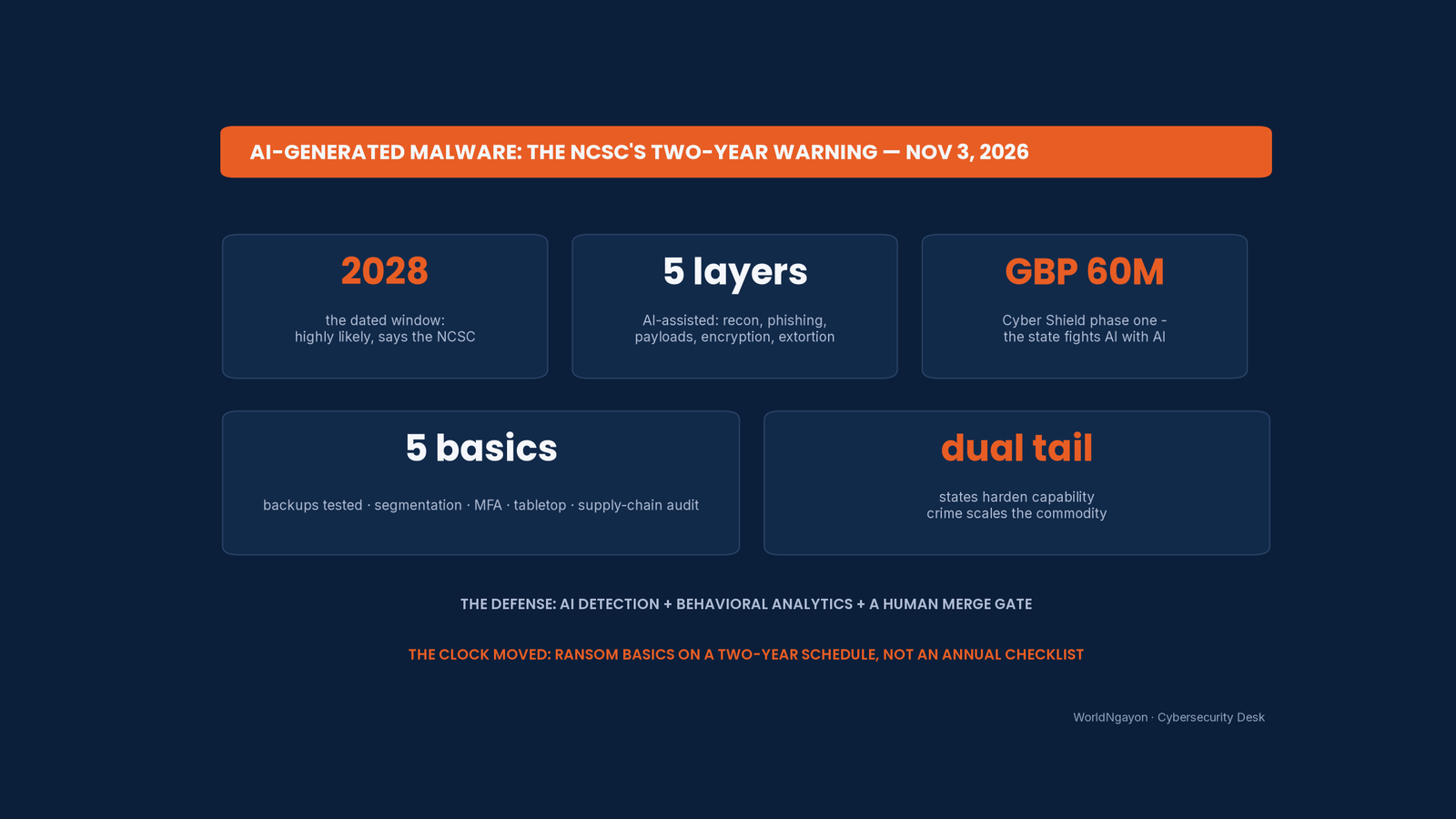
Table of Contents
AI-generated malware: the warning and its tier
What the NCSC actually said (verified tier): the agency’s annual report, published November 3, 2026, assesses it HIGHLY LIKELY that between now and 2028, AI-powered malware will feature in a ransomware attack on UK critical national infrastructure — covering the airports, hospitals, power stations and telecoms class. The warning is a LIKELIHOOD assessment by the defending agency, not a report of an incident — and it lands hard precisely because its author watches those networks daily. The same report ties AI to “scale and efficiency” gains for hostile actors across the full attack chain, and the chief executive supplied the diagnosis behind it: too many organizations and supply chains in Britain spent decades “doing tech on the cheap,” leaving the vulnerabilities AI now finds economical to exploit.
WorldNgayon Analysis: the tier discipline (the claims-ledger rule) matters here: ‘highly likely by 2028’ is a probability from a credible witness — neither a prediction to trade on nor a rumor to shrug at. The warning’s real function is calendaring: the defending agency just published the attack class’s EXPECTED WINDOW, which converts an abstract AI threat into a dated planning horizon. The security cluster’s framing (the AI-security-workflow guide and the edge-device security analysis) picks up exactly where this window opens.
Bottom Line: the UK’s cyber authority put AI-malware ransomware on a dated horizon — the two-year window is the planning calendar.
What AI changes in the attack chain
Four layers, ranked by consequence: 1 — reconnaissance: AI reads a target’s external surface (job posts, code leaks, vendor lists) at machine speed and drafts the attack plan the way it drafts everything — fast and personalized. 2 — the phishing layer: the personalized lure — language-fluent, context-aware, mistake-free phishing at scale — collapses the clumsy-email era that spam filters were tuned for. 3 — the malware itself: AI-assisted payload construction and polymorphic variation (malware that rewrites its own footprint faster than signature updates chase it) — the technical core of the agency’s warning. 4 — extortion and negotiation: the same generation models power the negotiation bots and the data-leak websites that run the ransomware business’s back office.
The state layer the report names: China likely best equipped (for disruption-class operations against infrastructure), with Russia and criminal ecosystems carrying the ransomware economy — a dual-tail threat: states HARDEN capabilities while criminals SCALE them. The UK’s £60 million Cyber Shield phase-one investment (announced by Chancellor John Healey in the week before the report) shows the state answer’s shape: AI for cyber defence, funded as defense.
WorldNgayon Analysis: the attack chain’s AI layer also explains the defender’s response set: every layer has an AI counter — AI-driven detection against AI-crafted lures, behavioral analytics against polymorphism, identity controls against reconnaissance — and the economics (the capex lens) now price cyber defense as a first-order line item, not compliance overhead.
Bottom Line: AI touches every link from first phishing message to final encryption — the defense that wins scales the same way.
The detection answer: fighting AI with AI
The AI-malware detection stack, in the order to deploy it: 1 — AI-driven detection systems: machine-learning detectors that read behavior instead of signatures — the ring’s ‘AI-powered malware detection system’ lane is the deployment class; the tools exist across the major endpoint platforms, and the honest buyer question is false-positive rate at YOUR environment, not the demo. 2 — behavioral analytics: baselines for process chains, data movement and authentication — the layer that catches the polymorphic payload by what it DOES, not what it looks like. 3 — human-verified response: the AI-drafts-humans-own-the-merge workflow (the AI-security guide’s discipline) applies to incident response exactly as to code review — the agent drafts the containment decision; a human signs it. 4 — the supply-chain audit: the NCSC’s own diagnosis (decades of ‘tech on the cheap’ and tolerated vulnerabilities) makes the vendor stack the audit’s first chapter — AI-malware is most efficient against the debt that already exists.
WorldNgayon Analysis: the detection stack’s hard truth is asymmetric budgets: the state’s Cyber Shield and the cloud platforms carry capabilities enterprises cannot build alone — the practical enterprise answer rides them (managed detection, cloud-native controls) rather than replicating them. The careers layer: AI-security detection and incident-verification roles are the hiring lane (the AI-jobs analyses).
Bottom Line: AI-driven detection plus behavioral analytics plus a human merge gate — the three-layer answer that meets the machine-speed threat.
The ransomware basics that still decide outcomes
The basics, unchanged and decisive: 1 — offline, tested backups (the AI-era payload encrypts at machine speed; the restore clock is your only real insurance — test the restore, not just the backup); 2 — network segmentation (the blast radius decision: an infected airport-class network with no segmentation is an outage; segmented, it is an incident); 3 — identity hygiene (phishing-resistant multi-factor, least privilege — the phishing layer’s counter); 4 — the tabletop (practice the 72-hour decision script before the clock runs; the orgs that fail ransomware fail the FIRST meeting, not the incident); 5 — supply-chain zero-trust (the ‘tech on the cheap’ audit — every tolerated vulnerability is the AI-assisted attacker’s first target). None of these five is new; ALL of them are why ransomware with AI still loses to prepared organizations (the recovery-discipline pieces — the 3-2-1 backup guide — carry the backup half).
WorldNgayon Analysis: the honest read of ‘AI-powered malware’ is proportion: AI multiplies the attacker’s SPEED, not the defender’s irrelevance — the same five basics decide outcomes against AI payloads because ransomware’s economics (encrypt, extort, restore) did not change. What changed is the clock: the detection window shrinks and the basics move from annual checklist to living process — the cadence rule that survives every threat class.
Bottom Line: the basics still decide; the AI-assistant era compresses their clock from months to hours.
What this means for work, money and the Philippines
For security teams: the two-year window converts to a backlog: deploy the detection stack, run the segmentation review, retune MFA, schedule the tabletop — the NCSC’s warning is the memo that funds all four (the edge-security guide carries the hardware layer).
For the Philippines and Southeast Asia: the region’s critical infrastructure sits in the SAME threat class — power grids, telecoms and the airline networks the diaspora flies — and the UK warning is the region’s free intelligence briefing: the same two-year window applies anywhere AI-assisted ransomware finds cheap tech debt (the SEA buildout guide carries the regional exposure map).
For Filipino professionals and OFWs: the careers angle is the era’s steadiest: AI-malware detection, incident response and the compliance functions that regulators worldwide (the UK’s NCSC, the US’s supply-chain rules — the compliance story) now fund are travel-capable trades (the Gulf and SEA jobs maps). And the family angle: the household’s ransomware defense is the same five basics in miniature — the backup guide is the home version of the £60-million lesson: the insurance clock is the one you control (the peso lens carries the family-budget framing).
Verdict: two years of notice
AI-generated malware, settled at its tier: the UK’s cyber defense agency (the NCSC, November 3, 2026) put a ‘highly likely’ date on AI-powered ransomware against critical infrastructure — inside the 2028 window — with China named the best-equipped state actor, the attack chain AI-assisted from phishing to encryption, and vulnerability debt (‘tech on the cheap’) named the enabler. The defense answer runs in parallel — AI-driven detection, behavioral analytics, human-verified response, the funded Cyber Shield — and the five basics (tested offline backups, segmentation, identity hygiene, the tabletop, the supply-chain audit) still decide outcomes because ransomware’s economics did not change; the clock did. Two years of notice from the agency that watches those networks — the organizations that read the calendar now will not spend 2028 reading their own incident.
Sources on the record: the AP News NCSC warning report · the Straits Times report.
Financial Disclaimer
This article is editorial analysis of publicly reported information, not investment or financial advice, and no outcome is promised. Figures and claims are as reported by the named sources at the stated dates; verify before acting. Markets and policy carry substantial risk.
Two more sections complete the playbook. First, the AI-generated malware era’s endpoint reality: the family version of the NCSC window is cheaper than any enterprise deployment — tested backups on the household machines, phishing-resistant sign-ins on the accounts the family money flows through, and the habit of patching before the payload arrives; the AI-generated malware threat scales DOWN as well as up, and the household that ran the basics through the last ransom wave already knows the drill. Second, the careers the two-year window hires for: AI-generated malware detection analysts, incident-response leads who can run an AI-assisted forensics process, and the compliance and audit roles the regulators now fund — UK’s Cyber Shield phase and the supply-chain enforcement layer in parallel. The AI-generated malware story’s honest ending is the same five basics with a sharper clock: the organizations that fund the detection stack, audit the debt, and rehearse the 72-hour script will read the 2028 warning from the safe side — the side where the ransom note never arrives because the restore clock beat the encryption one.
The two-year backlog, as a working set: the NCSC window converts into a dated checklist the security org can actually schedule. Quarter one: the backup audit (every critical system’s restore tested, offline copies verified — the encryption clock’s only insurance); the MFA review (phishing-resistant methods on every identity that matters). Quarter two: the segmentation pass (an AI-generated malware payload hitting an unsegmented network is an outage; hitting a segmented one is an incident — draw the lines before the attacker does). Quarter three: the supply-chain audit (the ‘tech on the cheap’ inventory — every tolerated vulnerability is the AI-assisted attack’s first target); the detection-stack deployment (behavioral baselines, AI-driven detection, the false-positive budget named). Quarter four: the tabletop (the 72-hour script rehearsed with the executives who will run it). The AI-generated malware era’s defense economics favor exactly this pacing: the window is two years, the backlog is four quarters, and the state layer (the UK’s funded Cyber Shield; the regulators’ enforcement layers) sets the external clock. The AI-generated malware warning’s honest use: a schedule, not a scare — the organizations that run it meet 2028 from the prepared side.
The state layer, priced: the UK’s GBP 60 million Cyber Shield investment (phase one) is one ministry’s answer inside a global re-arming; the AI-generated malware threat has every bloc funding defense AI at national scale — the detection stack, the threat-intelligence infrastructure, the resilience programs. The AI-generated malware era’s investment frame is the same as its attack frame: dual-tail — states fund counter-AI-malware defense as strategic capability while criminals industrialize the attack commodity; the enterprise inherits both tails in its risk register. The response set’s pricing lesson: the state layer’s capabilities (national detection, sector coordination) are shared infrastructure — the enterprise’s own stack rides them rather than replicating them, which is why the managed-detection lane is the practical deployment class for most organizations reading this window.
- apnews.com/article/europe-britain-cybersecurity-attacks-artificial-in… — the AP News NCSC warning report
- straitstimes.com/world/europe/uk-must-expect-ai-powered-attack-on-cri… — the Straits Times report
External sources linked in this article, in order of first mention. Spotted an error or a broken link? Tell us.
Cite this pagePublished Nov 4, 2026
Agron, E. (2026, November 4). AI-Generated Malware: the 2028 Threat Warning and the Detection Answer. WorldNgayon. https://worldngayon.com/ai-generated-malware/
Agron, Edmon. “AI-Generated Malware: the 2028 Threat Warning and the Detection Answer.” WorldNgayon, 4 Nov. 2026, worldngayon.com/ai-generated-malware/.
Agron, Edmon. “AI-Generated Malware: the 2028 Threat Warning and the Detection Answer.” WorldNgayon, November 4, 2026. https://worldngayon.com/ai-generated-malware/.
Agron, E. (2026) ‘AI-Generated Malware: the 2028 Threat Warning and the Detection Answer’, WorldNgayon, 4 November. Available at: https://worldngayon.com/ai-generated-malware/.
E. Agron, “AI-Generated Malware: the 2028 Threat Warning and the Detection Answer,” WorldNgayon, Nov. 4, 2026. [Online]. Available: https://worldngayon.com/ai-generated-malware/
@online{agron2026aigenerated,
  author       = {Agron, Edmon},
  title        = {{AI-Generated Malware: the 2028 Threat Warning and the Detection Answer}},
  year         = {2026},
  date         = {2026-11-04},
  organization = {WorldNgayon},
  url          = {https://worldngayon.com/ai-generated-malware/},
  urldate      = {}
}TY - ELEC AU - Agron, Edmon TI - AI-Generated Malware: the 2028 Threat Warning and the Detection Answer T2 - WorldNgayon PY - 2026 DA - 2026/11/04/ UR - https://worldngayon.com/ai-generated-malware/ Y2 - ER -
Cite the version you read; the page may be updated. Zotero and Mendeley can also import this page directly.