
Table of Contents
Key Takeaway
- 🔍 Check the source before the pixels. A reverse image search settles more AI-generated image cases than any detector tool, because most viral fakes are stolen or recycled pictures.
- 🧾 Content credentials and SynthID exist, but absence proves nothing. Labels get stripped by screenshots and re-uploads, so a missing label never clears a suspicious photo.
- 🧠 Look for the classic errors second: hands, text, shadows, reflections. The newest models hide these, but the checks take seconds and still catch a share of real-world fakes.
- ⚖️ Treat detector scores as one clue, never a verdict. Research on images circulating in 2024 shows detector accuracy collapsing on real-world fakes, and no tested commercial tool reached 90 percent.
- 📣 Rules arrived in 2026. Under the EU AI Act, deepfakes must be disclosed, and providers must mark AI content in a machine-readable format, yet unlabeled images still travel through every feed, every day.
A photo of a flooded school. A missing-person poster. A smiling investor next to a luxury car. A politician saying something she never said. Every one of these now has a version that never happened, produced by the same tools that write your emails and plan your trips.
Telling an AI-generated image from a real photograph used to be a hobby for fact-checkers. In 2026 it is a basic digital safety skill, the same class of skill as checking a link before you click it. The stakes run from a harmless joke that ruins a friend’s evening to a marketplace listing built to take your money, and fact-checkers at Debunk.org document how far the gap has widened.
This guide gives you a working order of checks, from the one that settles most cases in under a minute to the ones that need a closer look. It also covers the real limits of the tools, because the research on AI-generated image detection in the wild is humbling.
Why the Question Changed This Year
Three shifts moved this skill from specialist to everyday.
- The models got good. Modern image generators produce faces, hands, and text with far fewer errors than the generations that trained most people’s habits, and the old habit of searching for extra fingers no longer guarantees anything.
- The rules changed. Under the EU AI Act, which you can read in plain language at the Commission’s AI Act Service Desk, providers of AI systems must mark generated content in a machine-readable format and detectable way, and anyone who publishes a deepfake must disclose it.
- The volume exploded. Detector research published on arXiv in 2025 built a benchmark from media circulating on real social platforms, and the finding matters: academic detector benchmarks are out of date, and tools that look strong on lab data weaken badly on real-world fakes.
Regulation helps where it reaches. Platforms label and detect what their systems can see, and the Commission adopted a voluntary code of practice on marking AI-generated content in June 2026. But a screenshot strips metadata, a crop cuts a watermark, and a re-upload erases a label. The last mile of verification is still you, before you hit share.
Start With the Source, Not the Pixels
Full Fact, the UK fact-checking charity, puts it plainly: fact checking usually starts with an attempt to find the original. An AI-generated image is often also a recycled image, and the original tells you what you are actually looking at.
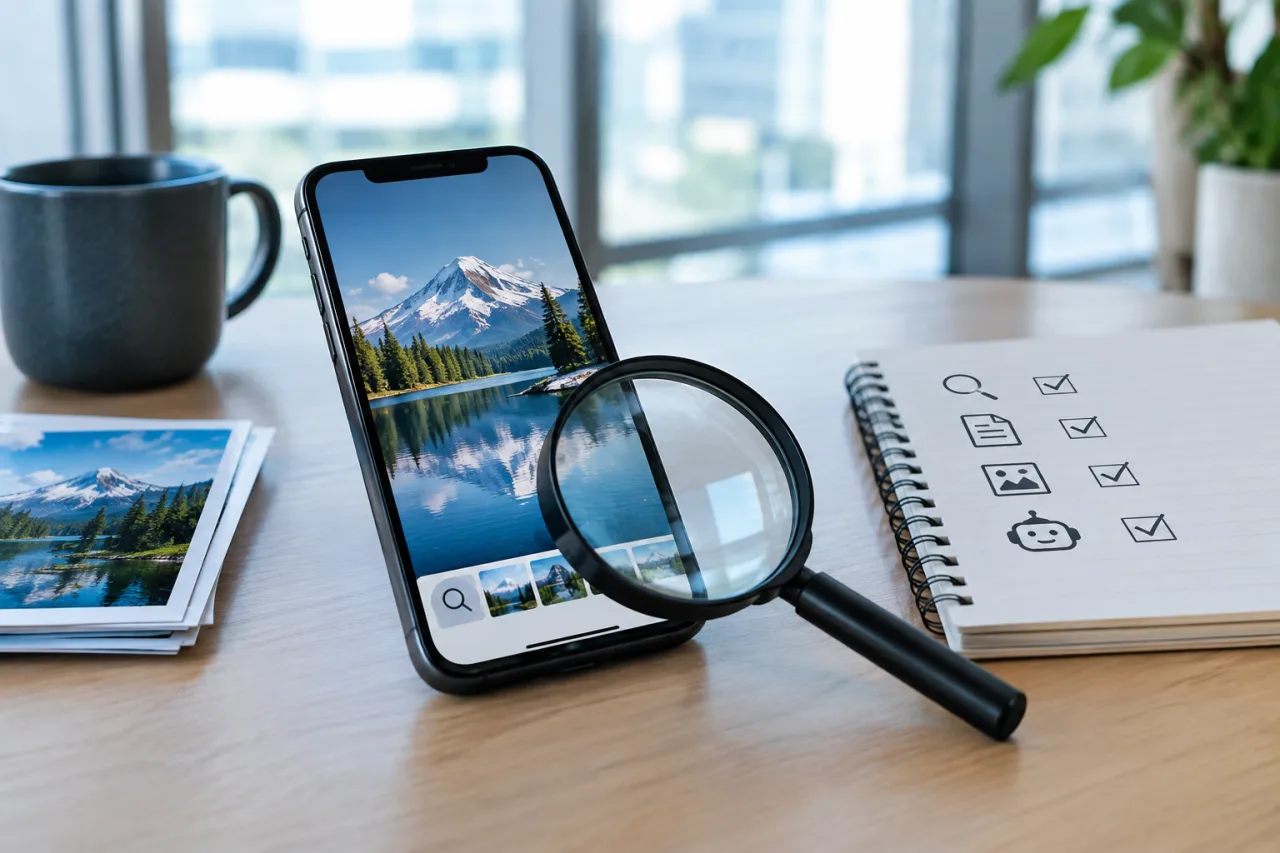
- Reverse search the image. Upload it or paste its address into Google Lens, Bing Visual Search, or TinEye. You are looking for the earliest copy, a credible publisher, or an existing fact check.
- Check who posted it first. A named journalist, an official agency, or a local newsroom is different from an account created last week that posts nothing but outrage.
- No results is itself a signal. A dramatic photo of a flood, an explosion, or a celebrity arrest that no major outlet has ever published deserves suspicion before analysis.
- Remember the other half. A perfectly real photo can still mislead when it is recycled with a new caption, and a reverse search settles those cases too. The check finds where an image has lived, not just where it was born.
This first step settles a large share of cases in under a minute, which is exactly why it comes first. The checks below catch what a reverse search cannot.
The Checks That Catch Most AI-Generated Images
Researchers who study misidentification group the visible errors into a handful of families: anatomy, text, objects, physics, and style. Work through them in order of speed.
- Hands and bodies. Extra fingers, merged fingers, nails that do not exist, jewelry that melts into skin. The FBI’s public guidance on synthetic media lists unrealistic accessories such as glasses and jewelry among the strongest tells.
- Text inside the image. Road signs, shop fronts, product labels, and documents often carry garbled or invented lettering. Text is improving fast, so a clean caption proves nothing, but a garbled one still convicts.
- Light and physics. Shadows falling in different directions in one frame, reflections that do not match the scene, objects that float, or edges that merge where they should stay separate.
- Faces, on close look. Misaligned pupils, teeth that change count, ears or mouth proportions that drift between frames of the same face, skin smoothed to an unnatural gloss.
- Motive. The last check needs no vision at all: what does the image want from you? Urgency, outrage, money, or outrage-plus-money are red flags regardless of how the pixels look.
One warning from the same research: these errors are shrinking. A guide by researchers at Northwestern published in 2024 groups the tells, but the same literature notes that newer models produce fewer of them. That is precisely why the source checks and the credential tools below matter more each year, and why no single error check can stand alone.
Where Fake Images Go Looking for Your Money
Most people never get fooled by a picture at a funeral. They get fooled by a picture with a price tag.
- Marketplace and rental listings. Security researchers document fake rental listing pages where an AI-generated image stands in for a room no one ever photographed, because the room does not exist. Before you pay a deposit, reverse search the property images; a photo harvested from another continent gives itself away.
- Investment ads with famous faces. An AI-generated image of a famous investor praising a platform is the ad staple. No public figure endorses a trading app from your feed’s ad slot, so treat the picture as a red flag, not as a résumé.
- Disaster and donation drives. After floods and typhoons, recycled and generated photos circulate beside genuine appeals. Match the appeal to a named organization’s official page before money moves.
- Dating and messaging profiles. Reverse search profile photos on the dating and messaging apps where strangers appear. If the search shows a stock model or another account entirely, you have your answer.
The pattern across all four: the image is the lure, and the payment is the goal. Verification is cheapest before the transfer, and it costs a minute. For readers who fund families across borders, this habit pairs well with our cybersecurity guide for Filipino professionals and OFWs, which covers how to protect your accounts and your data online.
The AI-Generated Image Detector Question: One Clue, Never a Verdict
Detection tools are easy to use and just as easy to overtrust. The evidence, gathered on images that actually circulate online, says to lower your expectations.
- The in-the-wild benchmark. The Deepfake-Eval-2024 benchmark collected audio, image, and video deepfakes from social media in 2024 and tested detectors against them. Performance fell sharply compared with older academic benchmarks, and several open-source systems landed close to coin-flip territory on the hardest slices.
- The commercial ceiling. In the same study, the strongest commercial tools tested reached roughly 0.82 accuracy on images, 0.78 on video, and 0.89 on audio, and none reached 90 percent. Useful as a signal, dangerous as a verdict.
- The human baseline. A large human experiment, summarized on arXiv in 2025, found that people do little better: a Microsoft-backed study of more than 12,500 participants reported an overall success rate of about 62 percent, only slightly above chance. Participants did best with human portraits and worst with landscapes.
- The free-tool reality. Debunk.org ran four free AI image detectors against ten synthetic images: two caught all ten, one caught four, and two flagged a real photograph as AI-made. A tool that punishes real photos is a tool that can defame them.
- SynthID and its limit. Google’s SynthID watermark can be checked in the Gemini app, and since May 2026 in Search results, but the check only recognizes content made with Google’s own tools. A clean SynthID scan does not clear an image built elsewhere.
What should you do with a borderline score? Run a second tool if the stakes justify it, look for a Content Credentials record, and finish the reverse search you were going to skip. A detector that agrees with your other checks strengthens them; a detector that contradicts three of them is outvoted. Nobody should share, buy, or accuse on a single number, and an accusation of fakery carries its own harm when it is wrong.
One more practical rule: an AI-generated image that passes a detector is still an unverified image, and a real photo that trips one deserves a deeper look, not a verdict. Scores describe pixels; verification includes the story. Keep the difference in view and the tools serve you instead of steering you.
Content Credentials: the Label That Travels With the File
The strongest technical signal available to everyday users is file-level metadata: a cryptographic record of how an image was made and edited, attached to the file itself.
- What it is. Content Credentials, built on the open C2PA standard, are backed by companies including Adobe, Microsoft, OpenAI, Sony, and the BBC.
- How to check. Visit the Content Credentials Verify site, upload the image, and read whatever record it carries. Google also surfaces creation details in its About this image feature where records exist.
- What absence means. Most images still carry no credentials, so a missing record proves nothing. A record that does exist, showing an AI-generated image origin with named tools, is meaningful.
- Where it breaks. Screenshots, aggressive compression, and some platform re-encoding strip metadata. The label travels with the file only as long as the file stays intact, which is why the label is evidence about the file, not about the story behind the photo.
Video and Voice: the Checks Change Shape
Moving and spoken fakes fail differently, and the checks follow the material.
- Lips and blinking. The MIT Media Lab’s Detect Fakes project suggests watching whether lip movements track the audio naturally and whether a person blinks at a human rate. Sync errors and stiff faces remain common in deepfake video.
- Gestures on request. Security guidance from Hong Kong’s investor education body suggests asking a caller to perform a specific gesture on camera, such as touching their nose, and watching how the face responds. Real video follows the instruction; fakes often lag or stall.
- Context. Does the studio match the logo of the channel that broadcast it? Would this person really be promoting this product or investment? Context catches what pixels cannot.
- Voice. For calls, the FBI recommends agreeing on a code word with family members, because a cloned voice can imitate anyone you love. Lag, odd phrasing, and a lack of small talk are tells, and the code word is the verdict. For more on how organized AI scam operations target families, see our explainer on AI scam compounds in Southeast Asia.
What the New Rules Mean for You
The law changed in 2026, and knowing the shape of it helps you read the feed.
- Providers must mark outputs. Since August 2, 2026, AI systems that generate audio, image, video, or text in the EU must mark outputs in a machine-readable format and detectable as artificially generated or manipulated, as far as technically feasible.
- Deepfakes must be disclosed. Anyone deploying a system that generates an AI-generated image or video of a real person must disclose that the content is artificial, with room for artistic and satirical work to carry lighter labeling that does not spoil the work.
- Text has an editorial exception. AI-generated text published after human review with editorial responsibility is exempt from the disclosure duty, a carve-out for publishers rather than raw feeds.
- Enforcement reaches where the content is used. These obligations bind the EU market, but global platforms serving EU users already label AI content world-wide, which is why you now see “AI-generated” labels on feeds far outside Europe.
- Governments are lining up their own rules. The Philippines created its National AI Council by Executive Order 131 in November 2026, covered in our EO 131 explainer, and Southeast Asian regulators are drafting in the same direction. Marking and disclosure obligations look set to spread faster than any single market’s rulebook.
Labels are obligations for the people who publish, not guarantees for the people who scroll. A screenshot of a screenshot has neither a label nor a watermark, so the reading skills in this guide stay the load-bearing layer.
Where to Report a Fake
- On the platform. Report the post where you saw it. Facebook, TikTok, X, and YouTube all have reporting flows for misleading synthetic media.
- To facts about the claim. If the image is attached to a claim about a public event, search the claim plus the words fact check before you share an answer, since fact-checkers often move faster than platforms.
- To your circle. Families that discuss verification together catch each other’s mistakes. A code word for emergencies and a shared habit of reverse-searching suspicious photos costs nothing.
If a suspicious account has already done damage, our guide on recovering a hacked Facebook account walks the cleanup. And when a photo is just one part of a bigger information storm, the recovery routine starts with slow: verify, sleep on it, then share. An AI-generated image spreads because it is fast; the cure is the same speed, in reverse.
FAQ
How do I tell if a photo is AI-generated?
Reverse search it first with Google Lens or TinEye, check for a Content Credentials record, then study hands, text, shadows, and reflections. Finish by asking what the image wants from you. Run all of the checks before deciding.
Are AI image detectors reliable?
As one clue, sometimes. Research on images circulating in 2024 found that detector accuracy drops sharply on real-world fakes, and no commercial tool tested reached 90 percent accuracy. Two free detectors in one test also flagged real photos as AI-made. When two tools disagree about the same AI-generated image, treat the score as a tie and break it with a reverse search.
Can Google detect AI-generated images for me?
Partly. Google can check for its SynthID watermark in the Gemini app and in Search, but the check only recognizes content made with Google’s own AI tools. Google’s About this image feature also surfaces origin-details records where they exist, and the Gemini app can explain whether a file looks machine-made. Both help, and neither certifies every AI-generated image on your feed.
What are Content Credentials?
A metadata record, built on the C2PA standard, that documents how an image was created and edited. Adobe, Microsoft, OpenAI, Sony, and the BBC back the standard. You can check an image for a record on the Content Credentials Verify site, but screenshots can strip the record, so absence proves nothing.
Is it illegal to post an AI-generated deepfake?
Laws vary by country. In the EU, since August 2, 2026, deployers of AI systems generating deepfakes must disclose the content as artificial, with exemptions for plainly artistic, satirical, or fictional work. Other jurisdictions are moving on their own timetables, and impersonation, fraud, and defamation laws already apply to malicious fakes almost everywhere.
What is the fastest check for a suspicious photo?
A reverse image search. It takes seconds, needs no tools beyond your browser, and settles most cases by finding the original, an older copy, or an existing fact check. Do that before you do anything else.
- debunk.org/how-to-spot-deepfakes-and-ai-images — Debunk.org
- Official ai-act-service-desk.ec.europa.eu/en/ai-act/article-50 — AI Act Service Desk
- Research arxiv.org/abs/2503.02857 — arXiv in 2025
- Research arxiv.org/abs/2507.18640 — arXiv in 2025
- c2pa.org — C2PA standard
External sources linked in this article, in order of first mention. Spotted an error or a broken link? Tell us.
Cite this pagePublished Nov 15, 2026
Agron, E. (2026, November 15). How to Tell If a Photo Is an AI-Generated Image: the Checks That Actually Work. WorldNgayon. https://worldngayon.com/ai-generated-image-checks/
Agron, Edmon. “How to Tell If a Photo Is an AI-Generated Image: the Checks That Actually Work.” WorldNgayon, 15 Nov. 2026, worldngayon.com/ai-generated-image-checks/.
Agron, Edmon. “How to Tell If a Photo Is an AI-Generated Image: the Checks That Actually Work.” WorldNgayon, November 15, 2026. https://worldngayon.com/ai-generated-image-checks/.
Agron, E. (2026) ‘How to Tell If a Photo Is an AI-Generated Image: the Checks That Actually Work’, WorldNgayon, 15 November. Available at: https://worldngayon.com/ai-generated-image-checks/.
E. Agron, “How to Tell If a Photo Is an AI-Generated Image: the Checks That Actually Work,” WorldNgayon, Nov. 15, 2026. [Online]. Available: https://worldngayon.com/ai-generated-image-checks/
@online{agron2026aigenerated,
  author       = {Agron, Edmon},
  title        = {{How to Tell If a Photo Is an AI-Generated Image: the Checks That Actually Work}},
  year         = {2026},
  date         = {2026-11-15},
  organization = {WorldNgayon},
  url          = {https://worldngayon.com/ai-generated-image-checks/},
  urldate      = {}
}TY - ELEC AU - Agron, Edmon TI - How to Tell If a Photo Is an AI-Generated Image: the Checks That Actually Work T2 - WorldNgayon PY - 2026 DA - 2026/11/15/ UR - https://worldngayon.com/ai-generated-image-checks/ Y2 - ER -
Cite the version you read; the page may be updated. Zotero and Mendeley can also import this page directly.