Table of Contents
Key Takeaway
- 🏠 Private RAG means your files never leave the machine: retrieval-augmented generation pairs a small local model with a local vector database, so contracts, client notes, and personal archives stay off other people’s servers.
- 🧰 Three free tools do it: Ollama runs the models, ChromaDB stores the vectors, and a few dozen lines of Python glue the pieces together, and the setup runs entirely on a mid-range laptop.
- 💵 The cost is one-time and low: everything is open source, so the only spend is electricity and optional RAM; at the peso’s November 2026 level there is no subscription to outgrow and no per-request bill.
- ⚠️ Retrieval quality lives and dies at ingestion: how you chunk documents and how you key them determines whether the answers feel brilliant or random.
- 🔒 For client work, private RAG changes the conversation: when the data never reaches a cloud provider, the confidentiality question shifts from “who do we trust” to “whose disk holds the files”.
A private RAG knowledge base solves the problem every independent professional eventually hits: the facts you need are scattered across invoices, contracts, meeting notes, and old proposals, and asking a chatbot to “remember” them all means shipping your files to someone else’s cloud. RAG, short for retrieval augmented generation, flips that. A local model receives only the slices of your own documents that answer the current question, and nothing leaves the hardware you control.
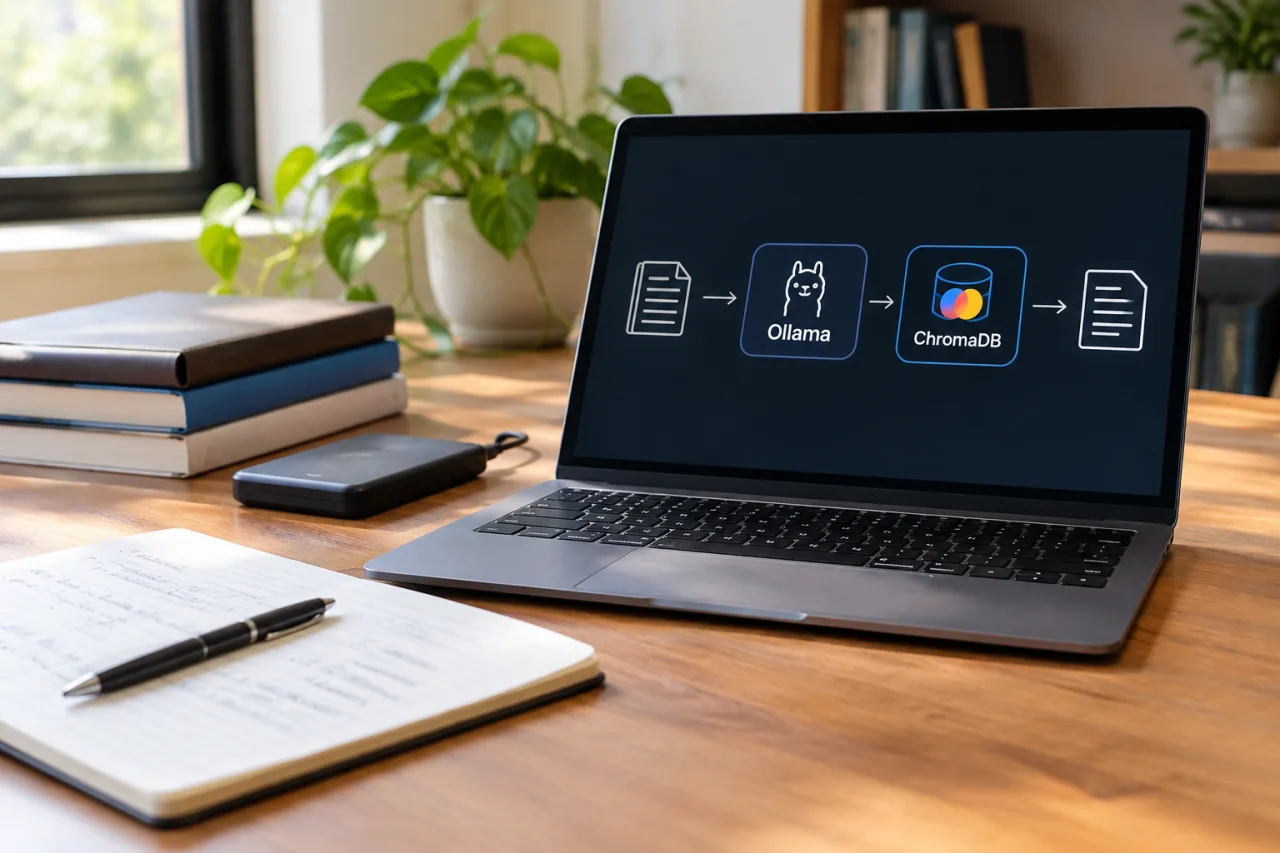
This guide builds one end to end with tools that cost nothing: Ollama for the models, ChromaDB for the vector store, and plain Python connecting them. It runs offline after setup. If you have read our guide to running LLMs locally, part of this will feel familiar; the new piece is the retrieval layer that turns a chat model into a database-aware assistant.
What a Private RAG Knowledge Base Actually Does
Retrieval augmented generation is a pattern, not a product. The model itself never “learns” your documents. Instead, when you ask a question, the system computes what the question means, finds the passages in your collection that are semantically closest to it, and pastes those passages into the prompt before the model answers. The model reasons over your text; it never ingests it for training.
That is why the private version matters for different people for different reasons. A solo freelancer keeps client contracts on their own disk, so a confidentiality review never involves a third-party server. A small import-export business in Cebu keeps supplier records on a shop PC with no reliable internet. A parent building a family archive keeps medical notes and school records where children cannot accidentally paste them to a public site. The cross-platform AI privacy checklist covers the settings that limit cloud exposure; a private RAG build removes the exposure entirely.
What it is not: a general internet tool. The corpus is only what you ingest. Garbage in, shallow answers out, and no amount of model swaps fixes an empty or messy collection.
The Four Moving Parts of the Build
Every private RAG setup, from a hobby project to an enterprise deployment, reduces to four parts.
1. An embedding model. This is a small, specialized model that converts a sentence into a long array of numbers capturing its meaning. Ollama’s own documentation lists the common choices: mxbai-embed-large at 334 million parameters, nomic-embed-text at 137 million, and all-minilm at just 23 million. Smaller is fine for text chunks; the embedding model runs in seconds even without a GPU.
2. A vector database. ChromaDB is the default recommendation for a first build because it is a single pip install and keeps state on disk. Its own docs describe it as open-source infrastructure that “runs on your machine”. Alternatives like FAISS or Elasticsearch exist, but ChromaDB’s zero-infrastructure start is the least-friction entry point.
3. A generation model. The chat model that finally writes the answer. A 3B to 8B parameter model such as Llama 3.1 or Qwen 2.5 in their small variants handles grounded answers well when the retrieved text is good, and it runs on the CPU you already own, slowly on the oldest machines.
4. The glue script. A short Python program with three jobs: read Documents in, call the embedding model, store the vectors with keys you can trace, and answer questions by retrieving then generating.
Install and Pull the Models
On any Linux, macOS, or Windows machine, install Ollama from its site, then pull the two models you need from a terminal:
ollama pull mxbai-embed-largeollama pull llama3.1:8b
Install the Python side with pip install ollama chromadb. That single line is the whole dependency story for a minimal private RAG build; no API keys, no accounts, no card details. If your network is metered, note the total download is roughly 5 GB for both models on an 8 GB machine, a oneetime cost on any fiber plan.
Ollama’s published example for exactly this pattern runs generation against a small model on the same machine, and its REST endpoint at localhost:11434 stays entirely on your hardware. That localhost boundary is the privacy feature: nothing in the pipeline knows how to reach the internet unless you give the machine something that does.
Ingest the Documents the Right Way
Ingestion is where private RAG builds are won. The loop is always the same shape, matching the example in Ollama’s embedding documentation:
import ollama, chromadb
client = chromadb.Client()
collection = client.create_collection(name="knowledge")
for i, chunk in enumerate(chunks):
collection.add(ids=[f"id{i}"], documents=[chunk], embeddings=ollama.embed(model="mxbai-embed-large", input=chunk)["embeddings"][0])
Three decisions inside that loop decide quality for years. First, chunking: split documents by meaning (a paragraph per insurance policy clause) rather than by a fixed character count, because retrieval matches meaning, not length. Second, metadata: store the source filename and date beside each chunk so answers can cite where they came from. Third, keys: ChromaDB’s own guidance warns against positional IDs, because re-indexing after a file changes then silently overwrites the wrong vectors; key each chunk from its source path and content instead.
A concrete example beats an abstract one, so here is the pass most freelancers should write first. You have 200 client contracts as PDFs, and you want a system that answers “which contract covers the Delgado project’s warranty period”. Split each PDF at its section headings (a clause per chunk), and beside each chunk store three metadata values: the client’s name, the contract’s date, and the section’s own heading. The ingestion loop embeds each chunk once and writes it keyed on clientname/contractdate/section. Two weeks later, the Delgado question retrieves the exact warranty clause, cites its source file, and the answer takes seconds on the same machine that wrote the invoices. The entire pass over 200 contracts runs in an evening on an ordinary laptop, because embeddings are the cheap part of the pipeline.
For persistence, swap chromadb.Client() for chromadb.PersistentClient(path="./chroma_data"), the pattern in the Chroma getting-started guide, so the collection survives reboots without a server process. One folder now holds your knowledge base, which also makes backups trivial: copy the folder.
Ask Questions at Generation Time
Answering is a two-call pattern. Retrieve the closest chunks, then generate with them in the prompt:
hit = collection.query(query_embeddings=ollama.embed(model="mxbai-embed-large", input=question)["embeddings"][0], n_results=4)
context = " ".join(hit["documents"][0])
output = ollama.generate(model="llama3.1:8b", prompt=f"Using this data: {context}. Answer this: {question}")
The retrieved slices are the model’s only evidence. When answers drift into invention, the fix is almost never “use a bigger model”; it is “retrieve better chunks”. Keep n_results modest (three to six), demand that the model say when the data does not contain the answer, and print the source filenames next to every reply so trust is checkable at a glance.
That last habit matters more than any code. A private RAG system earns its keep when you can open the cited file and confirm the sentence exists. If you wire the retrieval into an agent that takes actions, our guide to MCP servers covers how tool connections expose exactly that boundary, and the same rule applies: the model proposes, your script decides.
When the Local Build Beats the Cloud, and When It Does Not
Fairness demands the other half of the comparison, because a private RAG build is not free of trade-offs. What you gain: documents that never leave the machine, zero monthly cost, no per-request usage meter, and answers that work when the internet does not. What you give up: model ceiling, speed ceiling, and sharing ceiling.
The model ceiling matters when questions genuinely require frontier reasoning, such as multi-document legal analysis across hundreds of pages with conflicting clauses. A local 8B model grounded in good retrieval handles most daily questions, but it will not match a frontier cloud model on the hardest reasoning runs. The speed ceiling matters when you want sub-second answers; local generation on CPU measures in seconds per token stream, not milliseconds. The sharing ceiling matters for teams: a single laptop is one person’s tool, and true multi-user access means promoting the build to a shared box, which reintroduces the question of who holds the keys.
The sweet spots are visible. A solo professional with confidential files and daily factual questions is the strongest case. A family archive is a strong case. A five-person team with heavy cross-border collaboration already lives in the cloud, and their marginal privacy gain from a local build may be smaller than their productivity loss. Price both paths with our break-even analysis before you pick.
One more needed boundary: local does not mean risk-free. The machine that holds the corpus can be stolen, synced to a public cloud folder by mistake, or hit by the same ransomware that targets any disk. Private RAG moves confidentiality from the vendor’s retention policy to your own disk discipline; the privacy checklist and a real backup routine of the drive belong in the same picture. Private from the cloud is not private from everything.
What the Hardware Costs to Run
The working hardware table for a private RAG build, at the peso’s November 2026 level of roughly ₱64 per dollar:
| Component | Requirement | Cost |
|---|---|---|
| Embedding (mxbai-embed-large) | Runs fine on CPU | ₱0, free weights |
| Chunked corpus of 50,000 documents | A folder on disk | ₱0 to a few hundred for storage |
| Generation (8B model) | 8 GB RAM minimum, 16 GB comfortable | ₱0 if owned; a RAM upgrade costs about ₱2,500 to ₱4,000 |
| Electricity for daily use | A few watt-hours per question | Below ₱10 per working day in most PH households |
| Monthly software | Everything open source | ₱0 |
Compare that with the subscription rails in our local versus cloud cost analysis: a cloud assistant with file upload tends to bill monthly forever, while the private build front-loads its cost as a one-time RAM purchase and then runs quiet. Hardware changes are the update trigger for this guide; nothing in it depends on a vendor billing cycle.
Private RAG Pitfalls That Sink First Builds
Four failure modes account for nearly every abandoned first attempt.
Chunk soup. Dumping whole PDFs as single chunks means retrieval returns irrelevant pages, and answers follow them into nonsense. Fix: chunk by section, keep chunks small enough to quote whole in a prompt.
The re-index wipe. Re-running ingestion with positional IDs overwrites old vectors with unrelated content, and the collection slowly rots. Fix: content-derived keys, and test a re-ingest on a copy before touching the live folder.
Permission leakage. A shared machine where everyone queries one collection means one sibling’s draft letter surfaces in another’s answers. Fix: separate collections per person or project, and keep the folder permissions tight. A private RAG build that everyone shares is not private.
Model envy. Upgrading the generation model from 8B to 70B while retrieval stays broken produces the same wrong answers, slower, on a machine with fans you can hear from the street. Fix the corpus first; the model is the cheapest part.
FAQ
What does RAG stand for?
Retrieval augmented generation. The system retrieves relevant passages from your own document collection and augments the model’s prompt with them, so answers are grounded in files you supplied rather than what the model remembered from training.
Is a private RAG setup really private if Ollama is American software?
Privacy here is about data flow, not corporate nationality. The models run on your hardware after download, and the pipeline makes no outbound calls at query time, so your documents never leave the machine. The vendor could change its software; the fix is pinning versions you tested, which is why the maintenance plan matters.
How many documents can a laptop handle?
Tens of thousands of chunked pages on an ordinary machine if they are embedded once and stored on disk; the retrieval query itself touches only the closest handful at answer time. The bottleneck is the initial ingestion pass, which you run once.
Can a private RAG knowledge base answer in Tagalog or Taglish?
Yes, on two levels: the small chat models handle Taglish prompts comfortably, and embedding models match on meaning across languages reasonably well. Corpus quality decides it; test with ten real questions in the language your documents actually use.
How is this different from uploading files to ChatGPT?
Uploading ships your files to a vendor’s servers and their retention rules. A private RAG build keeps the files on your disk, embeds them with a model that runs locally, and answers from a database you control. The trade is capability: cloud models are larger and faster, and our local versus cloud guide prices that trade in full.
Do I need a GPU for this?
Not for the retrieval side, and not for a small generation model on a recent machine. An 8B model runs acceptably on a modern CPU with 16 GB of RAM; a GPU makes generation faster but changes nothing about correctness, which lives in your corpus.
How long does the first ingestion pass take?
Seconds per chunk on the embedding side, so the real variable is document count. A two-hundred-contract corpus finishes in an evening on CPU; ten thousand chunked pages run overnight. Because the pass is one-time, most people start it before bed and clean the results in the morning.
Can I run the build on a rented VPS instead of my own laptop?
You can, and it changes the privacy boundary you are buying. A VPS keeps the data off your device but places the corpus on a provider’s disk, under that provider’s terms, so the build is no longer private in the same sense. It remains an option for teams that need shared access with more control than a consumer cloud assistant gives, and our MCP servers guide covers the tool-connection layer either way.
Keeping It Alive: the Maintenance Plan
An evergreen build needs named triggers, and this one has four. Model releases: the weights are free, but pull a new embedding model only when you are ready to re-ingest, because embeddings from different models do not mix; pin your versions and note the date beside the collection. Library upgrades: ChromaDB moves fast, so upgrade in a scratch folder first and re-run a ten-question test before touching the live data. Corpus growth: schedule one evening a month for new files, with the same chunking rules from day one. Hardware changes: a RAM or disk upgrade is the moment to re-run the benchmark questions and confirm response times. Write the four triggers on a note beside the folder; a knowledge base nobody maintains slowly becomes a museum.
Financial Disclaimer
WorldNgayon publishes technical guidance for general information only. Hardware prices, electricity rates, and exchange rates change; verify current figures against the official pages linked above before committing money to any setup. Nothing in this article is financial or investment advice.
- ollama.com/blog/embedding-models — Ollama’s own documentation
- docs.trychroma.com/docs/overview/getting-started — Its own docs
External sources linked in this article, in order of first mention. Spotted an error or a broken link? Tell us.
Cite this pagePublished Nov 13, 2026
Agron, E. (2026, November 13). How to Build a Private RAG Knowledge Base (No Cloud Required). WorldNgayon. https://worldngayon.com/private-rag-knowledge-base/
Agron, Edmon. “How to Build a Private RAG Knowledge Base (No Cloud Required).” WorldNgayon, 13 Nov. 2026, worldngayon.com/private-rag-knowledge-base/.
Agron, Edmon. “How to Build a Private RAG Knowledge Base (No Cloud Required).” WorldNgayon, November 13, 2026. https://worldngayon.com/private-rag-knowledge-base/.
Agron, E. (2026) ‘How to Build a Private RAG Knowledge Base (No Cloud Required)’, WorldNgayon, 13 November. Available at: https://worldngayon.com/private-rag-knowledge-base/.
E. Agron, “How to Build a Private RAG Knowledge Base (No Cloud Required),” WorldNgayon, Nov. 13, 2026. [Online]. Available: https://worldngayon.com/private-rag-knowledge-base/
@online{agron2026privaterag,
  author       = {Agron, Edmon},
  title        = {{How to Build a Private RAG Knowledge Base (No Cloud Required)}},
  year         = {2026},
  date         = {2026-11-13},
  organization = {WorldNgayon},
  url          = {https://worldngayon.com/private-rag-knowledge-base/},
  urldate      = {}
}TY - ELEC AU - Agron, Edmon TI - How to Build a Private RAG Knowledge Base (No Cloud Required) T2 - WorldNgayon PY - 2026 DA - 2026/11/13/ UR - https://worldngayon.com/private-rag-knowledge-base/ Y2 - ER -
Cite the version you read; the page may be updated. Zotero and Mendeley can also import this page directly.