Table of Contents
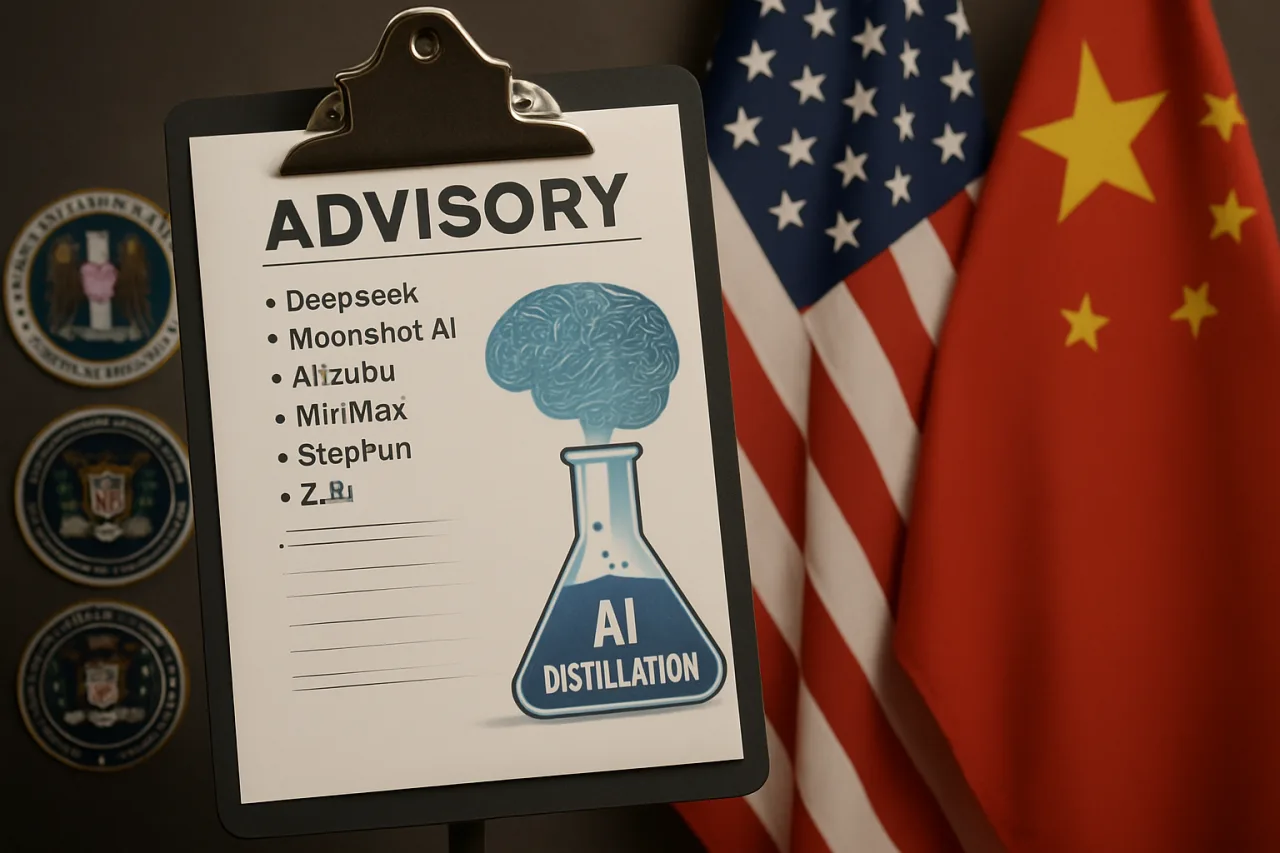
AI distillation moved from industry jargon to geopolitical charge this week: a joint advisory from the National Security Agency, CISA, and the FBI publicly named six Chinese AI companies — DeepSeek, Moonshot AI, Alibaba, MiniMax, StepFun, and Z.AI — accusing them of “aggressive, malicious, and targeted distillation activities at an industrial scale” against US frontier models since at least late 2024, per the advisory published on CISA’s site September 9. The word inside the accusation is the whole story: distillation, the technique of training smaller models on the outputs of larger ones, is simultaneously a standard industry practice, a terms-of-service violation, and — in this advisory’s framing — a state instrument of industrial policy. For every professional building on AI models, including the Philippine teams training on international APIs, that double meaning is now a compliance question.
Key Takeaway
- 📜 The advisory: NSA, CISA, and FBI jointly named DeepSeek, Moonshot AI, Alibaba, MiniMax, StepFun, and Z.AI, alleging billions of tokens extracted across millions of queries from Claude, GPT, Gemini, and Grok since late 2024.
- 🔬 The specific charges: Moonshot allegedly distilled 18 different US models — including Anthropic’s Fable 5 — to train its Kimi K2 and K3 releases; Alibaba allegedly distilled Claude-4, Claude Opus, Claude Sonnet, and GPT-5 for its Qwen family in late 2025.
- 🎭 The methods alleged: fraudulent accounts, bulk premium subscriptions, and proxy routing through “transfer stations” to bypass regional restrictions and evade detection.
- 🇵🇭 Why Philippine teams must care: if your company trains on any international model’s API, the same advisory’s logic applies to you — the compliance line between competitive learning and “malicious distillation” just became a legal frontier, and PH firms sit on the same fault line.
The technical practice itself deserves a definition before the politics, because the advisory’s power comes from fusing them. AI distillation is a widely used AI development technique in which outputs from a large, expensive model are fed into a smaller one to train it more cheaply — the practice is common across the industry, and per the northeasttimes summary of the advisory, it frequently violates AI providers’ terms of service. Every major lab has used distillation in legitimate forms, including on their own models. What the three agencies allege crosses a line in scale and intent: that for the six named Chinese firms, distillation was “not a supplementary tool but the central method of building their products,” executed through multi-pathway routing designed to disguise the origin of queries and violate the terms of use of Anthropic’s Claude, OpenAI’s ChatGPT, Google’s Gemini, and xAI’s Grok.
The named allegations are specific enough to have consequences, and they show exactly where the AI distillation line is drawn. The advisory says the companies spent billions of tokens across millions of exchanges. Moonshot AI allegedly ran a campaign against 18 distinct US models, using millions of queries designed to extract enhanced capabilities in agentic reasoning, coding, data analysis, computer vision, and larger logical frameworks — targeting Fable 5, which the advisory identifies as Anthropic’s current most advanced commercially available model. Alibaba’s late-2025 campaign allegedly hit Claude-4, Claude Opus, Claude Sonnet, and GPT-5 to improve Qwen models’ software engineering, customer-service dialogue, and image generation. The agencies also describe the operational security of the campaigns: transfer stations, bulk accounts, and proxy routing designed to make attribution hard. The full advisory is published on CISA’s site with the company-by-company detail.
Why the Advisory’s Recommendations Matter More Than Its Accusations
The most operationally interesting part of the AI distillation advisory is not the naming but the advice, because it reveals how the US government wants this fight conducted. The agencies recommend that American AI companies quietly degrade responses for accounts identified with high confidence as conducting malicious distillation — rather than blocking them outright. That is an unusual defensive doctrine: instead of the binary ban that tells the adversary exactly what was detected, the recommendation is calibrated response reduction, keeping the distillation campaign running on degraded output so the extracting party cannot confirm what leaked and what did not. For security professionals, that is a new playbook entry: counterintelligence logic applied to API traffic, treating model access the way signals agencies treat compromised channels.
The advisory also distributes responsibility beyond the labs. Its implicit argument — supported by the War on the Rocks analysis published alongside it — is that API porosity is the vulnerability, and model providers have been “embarrassingly porous”: Anthropic’s most restricted model was accessed by Discord hobbyists before its public release, during which time hundreds of fake accounts ran millions of queries. The recommended response set includes identity verification hardening, abuse-pattern detection at scale, and the quiet-degradation doctrine. For Philippine and Southeast Asian companies building products on international model APIs, the compliance translation is direct: know your API provider’s distillation policy in writing, keep account credentials clean and non-transferable, and assume that bulk automated querying of frontier models now carries geopolitical risk it did not carry a year ago. The CyberScoop reporting documents the full recommendation set.
What the AI Distillation Advisory Means for Philippine AI Teams
The Philippines sits closer to this fight than the distance from Washington suggests, for three reasons. First, the country’s AI development community is heavily built on international APIs — the same Claude, GPT, and Gemini endpoints named in the advisory — which means the terms-of-service enforcement wave this advisory presages will arrive as compliance requirements attached to the exact platforms Philippine products run on. Second, the Philippines is building AI infrastructure and policy at speed — the AI infrastructure build-out and the pending AI legislation we covered mean Philippine labs and enterprises are training and fine-tuning models on international foundations right now, and the line between legitimate distillation and the advisory’s “malicious” category is exactly the line those teams need to understand. Third, the espionage framing around a commercial technique creates precedent risk: once distillation is framed as a state instrument in one bilateral context, that framing travels.
The distinction that keeps Philippine AI teams safe is the same one the advisory itself provides, read carefully: the alleged violations were not the technique but the methods — fraudulent identities, evaded regional restrictions, terms-of-service violations, multi-pathway routing designed to hide origin. Legitimate use of international APIs within their terms — paying for premium access, honoring usage limits, documenting provenance — is not distillation-theft no matter what anyone’s trade policy says. The teams that should be alarmed are those whose workflows involve bulk automated querying under manufactured identities, and the teams that should be preparing documentation are all of them, because provenance documentation is what turns a compliance question into a filing exercise. Our coverage of the Philippine AI bill tracks the domestic law side of exactly this boundary.
The Philippine Compliance Boundary — Read the Advisory as a Checklist
For teams building on international model APIs, the AI distillation advisory converts into a compliance checklist more useful than its rhetoric, and the checklist has five lines. One: read your provider’s terms of service in full and archive the version you operate under, because the advisory’s central charge is terms-of-use violation and provenance of terms is the first defense. Two: keep account identities clean — no shared credentials, no bulk accounts manufactured for query volume, no accounts under identities that are not real, because fraudulent accounts are the first-named method. Three: honor regional restrictions rather than routing around them, because transfer stations and proxy routing are the named techniques that turned volume into an espionage framing. Four: document provenance for every training set your models touch — which model outputs, under what terms, at what dates — because provenance documentation is what makes a compliance inquiry a filing exercise instead of a crisis. Five: meter your bulk querying against the provider’s published abuse patterns, because the advisory’s quiet-degradation recommendation means enforcement may arrive as subtle quality changes rather than a block you can appeal.
That checklist is not anti-innovation caution; it is what lets Philippine AI teams keep building on the international models that give them frontier capability at Philippine costs. The companies named in the advisory were not targeted for using APIs — they were named for the methods the advisory documents, and the distinction between the two is entirely architectural. Teams that architect their training pipelines inside provider terms keep the same technical options the named six allegedly lost, with none of the exposure. That boundary, now published by three US agencies in a single document, is the most useful compliance artifact the Philippine AI sector has received this year — written by someone else’s government, applicable by anyone training on someone else’s model.
The Diplomatic Timing, and the Response
The advisory’s timing is not accidental, and the reporting caught the geography of it: it landed days before planned Trump-Xi talks, with China hitting back at the “malicious” distillation claims ahead of the meeting, per ABC News’ wire coverage. Beijing maintains the US claims are groundless, and the Chinese counterposition is now on record in the same news cycle as the safety dialogue that opens this month — meaning the distillation dispute arrives at the bilateral talks as a named, contested item rather than background noise. Treasury Secretary Bessent sharpened the frame the same day, telling an SMU Dallas audience that China can “never get ahead” of the US in AI. An advisory, a rebuttal, a presidential meeting, and a cabinet-level taunt — the distillation fight is now a four-act diplomatic production.
Watch three things through the rest of September, because each will define how the AI distillation charge ages. Whether the named six respond with litigation, counter-advisories, or silence — DeepSeek and Alibaba have global customer bases that give them options beyond denial. Whether US AI companies begin implementing the quiet-degradation doctrine, which would be visible only as subtle quality differences and would create the strangest attribution dispute the industry has faced. And whether the Philippine and ASEAN policy response engages the distillation boundary explicitly, because the region’s AI companies are building on the same international models and deserve definitional clarity before enforcement finds them. The advisory named six companies; the category it created includes everyone training on someone else’s outputs. Knowing which side of the AI distillation definition you stand on is now a governance requirement, not an academic exercise.
Frequently Asked Questions About the AI Distillation Advisory
What is the US advisory on AI distillation?
A joint cybersecurity advisory from the NSA, CISA, and FBI published in September 2026, alleging that six Chinese AI companies — DeepSeek, Moonshot AI, Alibaba, MiniMax, StepFun, and Z.AI — conducted industrial-scale “malicious distillation” of US frontier AI models since at least late 2024, using fraudulent accounts, bulk subscriptions, and proxy routing to violate providers’ terms of use.
Which US models were allegedly targeted?
The advisory names Anthropic’s Claude (including Claude-4, Opus, Sonnet, and Fable 5), OpenAI’s GPT line, Google’s Gemini, and xAI’s Grok. Moonshot AI allegedly distilled 18 different US models including Fable 5; Alibaba’s alleged campaign covered four models including GPT-5 for its Qwen family.
What is distillation in AI, and is it illegal?
Distillation trains smaller models using outputs from larger, more capable ones — a standard, legal technique within a provider’s terms of service. What the advisory alleges is distillation outside those terms: multi-pathway routing, fraudulent identities, and bulk extraction designed to evade detection, which the agencies frame as industrial espionage rather than development technique.
How should Philippine AI teams respond to the advisory?
Teams training on international model APIs should document provenance, honor usage limits and regional restrictions, avoid bulk automated querying outside intended use, and keep records of their providers’ terms. The compliance boundary the advisory draws is identity-and-method based, not nationality based — legitimate use within terms is not the target, but bulk extraction under manufactured identities now carries a named category.
What happens in the US-China dispute over AI distillation next?
China has formally rejected the claims as groundless, and the dispute arrives days before planned US-China leadership talks. Watch for whether distillation mechanisms get addressed in any bilateral framework smaller than export controls — because the definitional precedent that emerges will govern every AI company training on international models, in every market.
Financial Disclaimer
This article discusses government advisories, technology competition, and market dynamics for informational purposes only. It is not financial, investment, legal, or professional advice. Compliance requirements and market conditions may change. Readers should conduct independent research and consult qualified professionals before making decisions based on regulatory developments. WorldNgayon.com accepts no liability for actions taken based on this content.