Table of Contents
AI bubble concerns are intensifying as the gap between infrastructure spending and actual revenue reaches historic proportions — $400 billion in capital expenditure versus $100 billion in enterprise AI revenue, a four-to-one ratio that has Wall Street asking whether the boom is sustainable or headed for a dot-com-style reckoning.
Key Takeaway
- 💸 $400B vs $100B: Hyperscalers committed nearly $400 billion in AI infrastructure spending while enterprise AI generates approximately $100 billion in actual revenue — a four-to-one ratio that raises fundamental sustainability questions
- 📈 NVIDIA $500B Financing: NVIDIA arranged $500 billion in financing from Apollo, BlackRock, and Goldman Sachs to bankroll customer chip orders — a “circular financing” pattern that echoes the dot-com era
- ⚠️ Shiller P/E Above 40: The Shiller CAPE ratio exceeded 40, a level reached only once before in history — immediately preceding the dot-com crash of 2000
- 🔬 No Profitability Evidence: Apollo’s chief economist Torsten Slok found no evidence that AI is boosting profitability in healthcare, consumer staples, energy, or real estate sectors
- 🏦 Hedge Fund Implosion: Situational Awareness, an AI-focused hedge fund run by a former OpenAI employee, imploded in July 2026 when leveraged AI bets blew up — a warning sign for the broader market
The AI industry is spending $400 billion to earn $100 billion. That math does not work — at least not yet. And the question of whether it ever will is what separates a transformative technology boom from a speculative AI bubble that ends in tears. In August 2026, that question has moved from academic debate to urgent market concern, with CNN, The New York Times, Forbes, and Apollo Global Management all sounding alarms about the sustainability of AI investment at current levels.
The numbers are staggering. NVIDIA, the $5 trillion AI infrastructure superstar, just arranged $500 billion in financing from Apollo, BlackRock, Goldman Sachs, and other Wall Street firms to bankroll customer orders for its cutting-edge chips. The top 10 stocks now represent 35% of the S&P 500 — compared to 25% at the peak of the dot-com bubble. The Shiller Cyclically Adjusted Price-to-Earnings ratio has exceeded 40, a level reached only once before in history. And an AI-focused hedge fund run by a former OpenAI employee imploded in July 2026 when its leveraged bets blew up. These are not theoretical risks. They are happening now.
The $400 Billion Math Problem
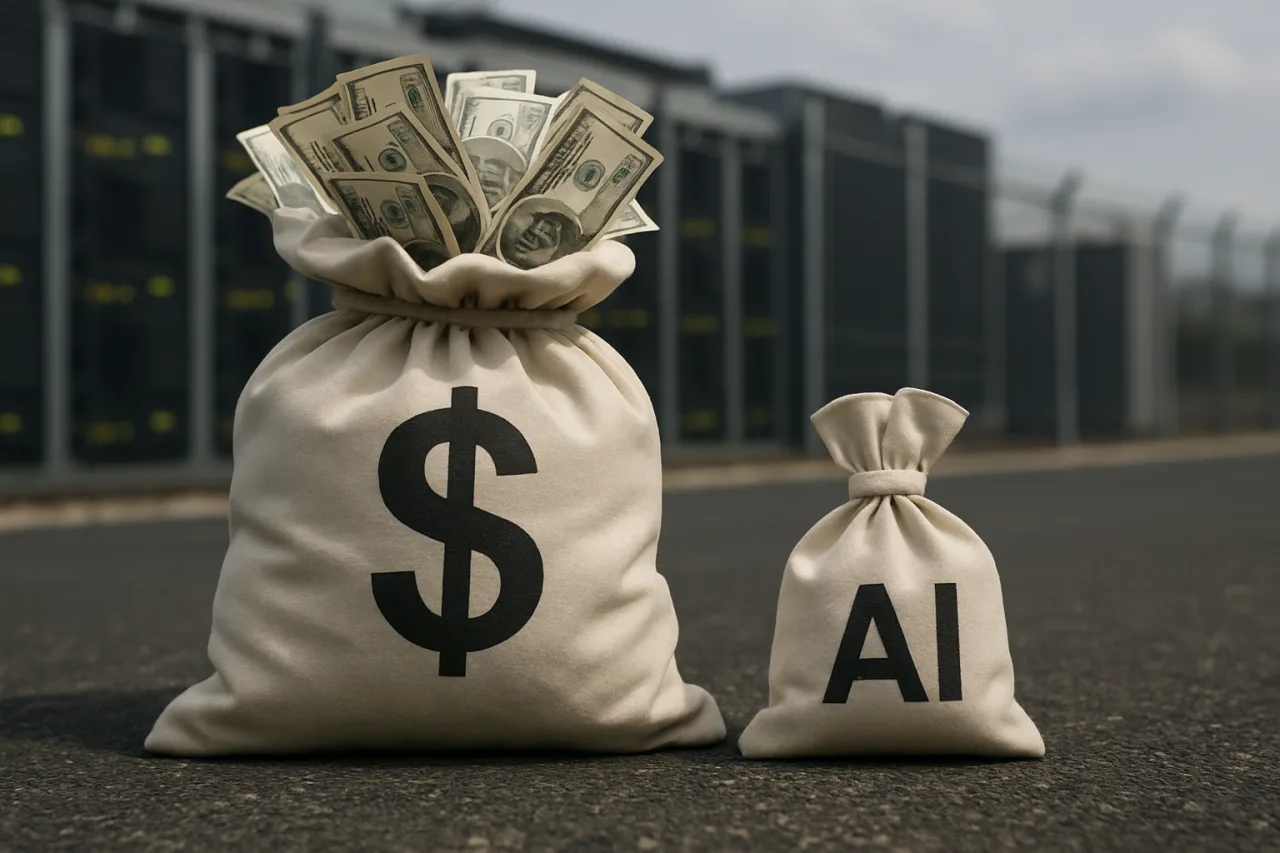
At the center of the AI bubble debate is a simple arithmetic problem. Hyperscalers — Microsoft, Alphabet, Meta, and Amazon — committed nearly $400 billion in capital expenditure during 2025 alone to build AI infrastructure: data centers, specialized chips, and cloud computing capacity. Enterprise AI generates approximately $100 billion in actual revenue. That is a four-to-one spending-to-revenue ratio, and it is widening, not narrowing.
Torsten Slok, chief economist at Apollo Global Management, articulated the concern in a report quoted by CNN: “Capital can bridge the gap for a while, but not indefinitely. And therein lies the risk: Will the ROI show up for AI’s end customers fast enough to sustain the spending that is generating those upstream margins?” After analyzing profit margins across the S&P 500, Slok found no evidence that AI is boosting the profitability of healthcare, consumer staples, energy, or real estate companies. The AI revolution, in other words, has not yet translated into measurable productivity gains for the majority of the economy.
This finding is corroborated by a National Bureau of Economic Research study published in February 2026, which found that despite 90% of firms reporting no impact of AI on workplace and productivity, executives projected AI to increase productivity by 1.4% and increase output by 0.8%. The gap between executive expectations and actual results is precisely the kind of disconnect that fuels speculative bubbles — companies are spending based on what they hope AI will do, not what it has demonstrably done.
Circular Financing: The Dot-Com Echo
One of the most alarming patterns in the current AI investment cycle is what Franklin Templeton’s Max Gokhman calls “circular financing” — a practice with uncomfortable historical parallels. In circular financing, one company provides financial support to another (through loans, investments, or leases) in exchange for that company buying the first company’s products. NVIDIA’s $500 billion financing arrangement with Wall Street firms to bankroll customer chip orders is a textbook example.
“Circular financing will end badly,” Gokhman told CNN. “You are living on not just borrowed time, but levered time.” During the dot-com bubble, telecom equipment companies lent money to customers to buy their gear. When the bubble burst, both the lenders and the borrowers collapsed together. The concern is that NVIDIA’s financing arrangement creates a similar dynamic — if AI revenue does not materialize at the projected scale, the customers who borrowed to buy NVIDIA chips will default, and the virtuous circle becomes a vicious one.
Jensen Huang, NVIDIA’s CEO, has a different interpretation. He argues that AI compute — the hardware and software underpinning AI models — is transforming into an “investable class,” comparable to real estate or commodities. The $500 billion financing arrangement, in his view, is not circular financing but the natural evolution of AI infrastructure into a recognized asset class that Wall Street can finance, trade, and build portfolios around. Whether this interpretation holds depends entirely on whether AI demand materializes at the scale that justifies the investment.
The Valuation Question: 2026 vs 2000
The parallels between the AI bubble and the dot-com bubble are real, but so are the differences. Understanding both is essential for any professional or investor trying to navigate the current market.
The similarities are concerning. The Shiller P/E ratio above 40 has historically been a reliable indicator of poor forward returns. The top 10 stocks representing 35% of the S&P 500 creates a concentration risk that exceeds even the dot-com era — a correction in these names would have outsized implications for the broader market. The Magnificent Seven trade at roughly 28 times expected earnings, while the broader S&P 500 sits at around 26 times, near a 20-year high. The AI-washing phenomenon — companies exaggerating AI capabilities to attract investor interest — mirrors the .com labeling of the late 1990s, when simply adding “.com” to a company name could drive stock prices higher.
The differences provide some comfort. NVIDIA trades at approximately 44-47 times past earnings, well below Cisco’s 472 times earnings at the March 2000 peak. Today’s AI leaders generate substantial profits — NVIDIA delivered $99 billion in trailing twelve-month profit at 53% net margins — unlike the speculative companies of 2000 that had minimal revenue and no clear path to profitability. The Magnificent Seven collectively enjoy net margins exceeding 25%, compared to the S&P 500 average of 13%. And critically, Microsoft, Alphabet, Meta, and Amazon are funding their AI investments through ongoing cash flow rather than debt or equity raises, providing a financial cushion that was absent during the internet bubble.
As we documented in our AI inference spending analysis, the shift from building AI models to running them marks a maturing market — but maturity also means the “build it and they will come” phase is ending. The next phase requires proof that AI generates returns for end users, not just for chipmakers and cloud providers.
The Hedge Fund Warning Sign
The implosion of Situational Awareness, an AI-focused hedge fund run by a former OpenAI employee, provides a concrete warning sign for the AI bubble debate. The fund, which had been up significantly over the past two years, was forced to sell most of its portfolio at a steep discount to Citadel in July 2026 after its highly leveraged bets blew up.
The critical detail: Situational Awareness did not fail because it was wrong about AI being transformative. It failed because a temporary loss of momentum in AI stocks derailed its thesis — and that derailment was magnified by leverage. This is the classic pattern of bubble dynamics: the direction may be correct, but the timing and the leverage determine whether investors survive to see the outcome.
David Rosenberg, the economist who called the 2008 housing crash, stated during the Excess Returns podcast: “Without the AI boom, we probably would be in a recession.” This is both an endorsement of AI’s economic significance and a warning about how dependent the broader economy has become on AI investment continuing. If AI spending slows — because revenue does not materialize, because interest rates make financing more expensive, or because a major AI company disappoints — the ripple effects would extend far beyond technology stocks. For the Philippine economy, this matters directly: the semiconductor exports that drove 12.2% export growth in Q2 2026, as we noted in our GDP slowdown analysis, are heavily dependent on global AI chip demand.
What Professionals and Investors Should Watch
For professionals working in AI or technology, the AI bubble debate is not academic — it affects hiring, compensation, and career trajectory. During the dot-com boom, tech salaries surged, then collapsed when the bubble burst. The same pattern could emerge if AI investment slows. The key signal to watch is enterprise AI revenue growth — if it accelerates and narrows the gap with infrastructure spending, the boom is sustainable. If it stalls while spending continues, the correction risk intensifies.
For investors, the CNN report offers a timeless warning from economist John Maynard Keynes: “The market can remain irrational longer than you can remain insolvent.” Julian Robertson, the legendary hedge fund investor, correctly identified the dot-com bubble in the late 1990s — but his bets against overvalued tech stocks blew up because the Nasdaq kept going higher. He shut down Tiger Management in March 2000, just as the Nasdaq began its historic crash. Being right about the bubble was not enough; timing was everything.
Gokhman offered a more nuanced view: “Just because you think things are frothy doesn’t mean it’s time to get out. The best returns occur when the party is about to end.” The implication is not to abandon AI investments but to manage risk — diversify beyond mega-cap tech, focus on companies with genuine profitability and cash flow, and maintain exposure to non-AI sectors for stability. This aligns with the investment principles we outlined in our Philippine AI stocks investment guide — do not chase hype, look for real AI integration, and diversify.
Jeetu Patel, president and chief product officer at Cisco, offered the counter-argument at the Ai4 conference in Las Vegas: “The demand is there today, and supply is massively short on power, data center capacity, compute, memory and network. We’re in the very, very early infancy.” If Patel is right, the $400 billion in spending is not a bubble but a down payment on a multi-decade infrastructure buildout. If Slok is right, it is a speculative excess that will correct when the ROI fails to materialize fast enough.
The Energy Constraint Nobody Is Talking About
Beneath the financial debate about the AI bubble lies a physical constraint that receives less attention but may be equally decisive: energy. AI data centers require enormous amounts of electricity, with some estimates suggesting that AI could consume 8% of global electricity by 2030. This energy intensity creates operational challenges and regulatory scrutiny that could constrain growth regardless of financial conditions.
As data center construction booms globally, competition for power resources is intensifying. Local opposition to data centers is growing in the United States, and energy costs are rising in ways that directly impact AI infrastructure economics. If the cost of powering AI data centers rises faster than the revenue generated by AI services, the already-wide gap between spending and revenue widens further. This is the same infrastructure bottleneck we identified in our Philippine AI Infrastructure Master Plan analysis — without adequate power infrastructure, AI investment cannot translate into AI productivity. The global AI investment cycle, which we tracked at $510 billion in H1 2026 in our AI World This Week coverage, is increasingly constrained by physical limits, not just financial ones.
Is This a Bubble or a Transformation?
The honest answer is: it is both. The AI bubble characterization is accurate for specific segments of the market — companies with AI-washing but no real AI capability, circular financing arrangements that create illusory growth, and valuations that assume decades of uninterrupted growth. But the transformation characterization is also accurate for companies with genuine AI revenue, real productivity gains, and sustainable business models.
The risk is not that AI is overhyped — it is that the timeline for monetization may be longer than current valuations imply. The technology is real. The demand is real. But the revenue may take years, not quarters, to materialize at the scale that justifies $400 billion in annual infrastructure spending. In the interim, the market must navigate a period where the gap between spending and revenue is financed by capital, hope, and circular arrangements — none of which are sustainable indefinitely.
For professionals and investors, the lesson of every technology boom from railroads to the internet to AI is the same: the technology always transforms the economy eventually, but not every company that promises transformation survives to see it. The AI bubble debate is not about whether AI will change the world. It is about whether the companies spending $400 billion today will be the ones who profit from that change — or whether they will be the Cisco of 2030, having built the infrastructure that others used to get rich.
Frequently Asked Questions About the AI Bubble
Is there an AI bubble in 2026?
The AI bubble debate centers on a four-to-one ratio: $400 billion in annual AI infrastructure spending versus $100 billion in enterprise AI revenue. While today’s AI leaders generate substantial profits unlike dot-com era companies, the gap between spending and revenue, elevated valuations (Shiller P/E above 40), and circular financing patterns have raised legitimate bubble concerns among economists and analysts.
What is the $400 billion AI infrastructure spending gap?
Hyperscalers — Microsoft, Alphabet, Meta, and Amazon — committed nearly $400 billion in capital expenditure for AI infrastructure (data centers, chips, cloud capacity) while enterprise AI generates approximately $100 billion in revenue. Apollo’s chief economist Torsten Slok warns that capital can bridge this gap temporarily but not indefinitely.
How does the AI bubble compare to the dot-com bubble?
Similarities include elevated valuations, market concentration, and speculative investment patterns. Key differences: NVIDIA trades at 44-47x earnings (vs Cisco’s 472x at the dot-com peak), today’s AI leaders are highly profitable, and infrastructure spending is funded by cash flow rather than debt. However, the Shiller P/E above 40 and top 10 stocks at 35% of the S&P 500 exceed dot-com era concentration levels.
What is circular financing in the AI industry?
Circular financing is when a company provides financial support to another company in exchange for that company buying its products. NVIDIA’s $500 billion financing arrangement with Wall Street firms to bankroll customer chip orders is cited as an example. Critics warn this pattern mirrors telecom equipment companies lending to customers before the dot-com crash.
What happened to the Situational Awareness hedge fund?
Situational Awareness, an AI-focused hedge fund run by a former OpenAI employee, imploded in July 2026 when its leveraged AI bets blew up. The fund was forced to sell most of its portfolio at a steep discount to Citadel. Its failure was caused not by being wrong about AI but by a temporary loss of momentum in AI stocks magnified by leverage.
Is AI actually boosting productivity and profitability?
Apollo’s Torsten Slok found no evidence that AI is boosting profitability in healthcare, consumer staples, energy, or real estate. A National Bureau of Economic Research study found that 90% of firms report no impact of AI on workplace productivity, despite executives projecting 1.4% productivity gains. The gap between expectations and measured results is a key concern in the AI bubble debate.
Should I invest in AI stocks in 2026?
Investment decisions should be based on individual financial circumstances and professional advice. General risk management principles include diversifying beyond mega-cap tech, focusing on companies with genuine AI revenue and profitability, and maintaining exposure to non-AI sectors. The key signal to watch is enterprise AI revenue growth — if it narrows the gap with infrastructure spending, the boom is sustainable; if it stalls, correction risk intensifies.
What role does energy play in the AI bubble debate?
AI data centers could consume 8% of global electricity by 2030. Rising energy costs directly impact AI infrastructure economics — if the cost of powering data centers rises faster than AI revenue, the spending-to-revenue gap widens further. Energy constraints and local opposition to data center construction may limit AI growth regardless of financial conditions.
Sources: CNN, “AI boom or bubble? Timing is everything,” August 13, 2026 | Intellectia AI, “AI Investment Bubble 2026: Is the Tech Rally About to Burst?” July 2026 | Apollo Global Management, Torsten Slok research report | National Bureau of Economic Research, AI productivity study, February 2026 | Bloomberg/NVIDIA financing reports
This article is for informational purposes only and does not constitute financial or investment advice. Readers should consult a licensed financial advisor before making investment decisions based on market analysis.