Table of Contents
Reading Time: 7 minutes
Key Takeaway
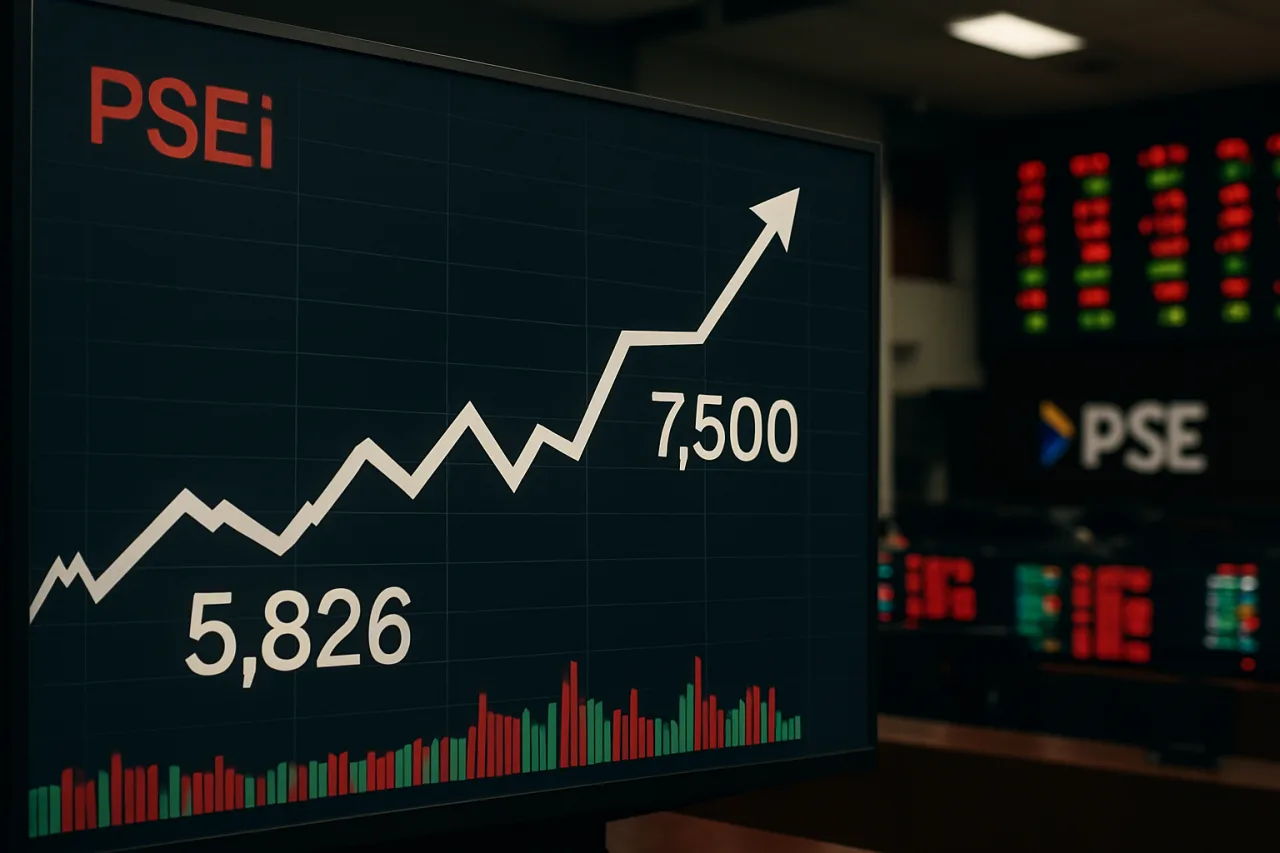
- 📊 The market just proved it can still bounce. The PSEi jumped 1.67% on Friday to 5,825.97, snapping a five-day losing streak and climbing back above 5,800 from a 10-month low — bargain hunters bought the fear.
- 📏 The PSEi forecast gap is the story: 28%. COL Financial’s 7,500 year-end target sits 28.7% above Friday’s close — that spread is the entire bull case, priced as a bet on earnings, liquidity, and the GCash IPO effect.
- 🏦 The bounce had leaders. JG Summit, Metrobank, SM Investments, and BDO gained 1–2% after flirting with 52-week lows, while ICTSI rose 3.95% to ₱920 — the bounce was bought, not given.
- 💧 A ₱92-billion liquidity event is nine trading days away. The GCash IPO offer window opens October 6 — history says big listings drain short-term cash before they attract new money; position for both phases.
- 🧭 The OFW playbook: tranche into weakness, never all-in on one bounce, keep the remittance income floor untouched — the BSP OFW remittance data is where that floor gets measured — and let the 28%-gap math set expectations, not the daily ticker.
Every PSEi forecast on the street now has to answer the same spread, and this week the spread moved: the index closed Friday at 5,825.97, and the most-watched year-end target in the local market — COL Financial’s 7,500 — sits 28.7% above it, and that spread is this week’s PSEi forecast debate. That is not a typo and it is not a broker’s fantasy; it is the arithmetic of a market that just touched a 10-month low while the country’s largest-ever IPO prepares to price. This is PSE Watch #002, the whole-market PSEi forecast read: what Friday’s bounce actually bought, the five core numbers that frame the gap, the cycle position nobody’s talking about, and the practical PSEi forecast playbook for the GCash-wave investor deciding whether 5,800 is a floor, a trap, or a runway.
Related: PSE Watch #012: PSEi Reclaims 5,700 on Positive Breadth — the Two Date
The Five Core Numbers on the Board
| Number | Level | What It Says |
|---|---|---|
| PSEi close (Sep 25) | 5,825.97 (+1.67%) | First gain after five straight down days; reclaimed 5,800 |
| All Shares | 3,246.21 (+1.11%) | Breadth followed the leaders — bounce had company |
| COL year-end target | 7,500 | +28.7% versus Friday’s close — the whole debate in one line |
| 10-month low | ~5,730 zone | The floor the bargain-hunters just defended |
| GCash IPO raise | up to ₱92.32B | Pricing Oct 1; offer Oct 6–12; debut Oct 20 — the liquidity wildcard |
Read the table top to bottom and Friday makes sense: a market that fell five days in a row into multi-month lows finally met buyers who had done their homework. Regina Capital’s Luis Limlingan attributed the turn to bargain hunting and expectations that local gas prices would fall the following week, easing cost pressures — a reminder that Philippine index moves often start with jeepney-and-logistics economics, not Wall Street. AB Capital noted the index closed at its day’s high with heavyweights doing the lifting: JG Summit, Metrobank, SM Investments, and BDO Unibank each gained 1–2% after approaching 52-week lows. When the country’s biggest banks and conglomerates lead a bounce from the lows, that is not a dead-cat twitch — it is money choosing conviction names at prices their owners consider cheap.
Price Versus Value: Reading the PSEi Forecast Gap Like an Investor
The PSEi forecast of 7,500 is a claim about the next twelve months, and the honest way to use it is to ask what has to be true. The index at 5,826 trades where fear is priced; 7,500 requires the opposite mood. The bridge between them is not one event but a stack: earnings growth that survives the BER-quarter spending cycle, foreign money that stops net-selling, rate relief if the Fed’s next moves allow it, and the confidence effect of a record ₱92-billion listing landing without a hitch. Strip the stack down and the two load-bearing pieces are earnings and liquidity — everything else is weather, and every PSEi forecast you read is really a bet on those two.
The risk side of the PSEi forecast ledger is equally concrete. A 10-month low does not appear without causes: the five-day slide that preceded Friday’s bounce reflected the same pressures the market has carried all quarter — a soft peso, global crude volatility, and rate expectations that keep borrowing costs elevated. And the GCash IPO cuts both ways: in the offering window, the largest IPO in PSE history will vacuum liquidity out of secondary names as institutions fund allocations — the very effect our cornerstone analysis flagged — before potentially returning it to the market with interest once the listing attracts new retail money on October 20. The 28% gap assumes the second phase; the next three weeks will deliver the first.
Cycle Position: Where This Sits in the Investor’s Calendar
September ends the weakest stretch of the Philippine trading year and opens the strongest: the BER months bring remittance peaks tracked in BSP OFW remittance data, 13th-month pay expectations, bonus season, and the year-end window-dressing that institutions deny and then perform. Friday’s bounce landed exactly on that seam — the PSE’s own market information page is the primary source for every number cited here — cheap prices meeting the calendar’s seasonal demand. For a first-time investor riding the GCash wave, the cycle read is the practical one: entries made near multi-month lows into a seasonally strong quarter have historically asymmetric odds versus entries made after the pop. Nobody knows if 5,826 is the low; the discipline is that tranches spread across the October window beat a single all-in day, whatever the PSEi forecast turns out to be worth in December — the tranche calendar, not the target, is the discipline.
WorldNgayon Analysis: The 28% gap is best read as a range, not a promise. Bull cases behind any PSEi forecast in Philippine equities have a habit of arriving in bursts separated by boring, drifting months — the investor who buys the level, not the target, is the one still solvent when the target finally matters. For OFW money in particular, the index at 5,826 with heavyweights near 52-week lows is the cheapest entry zone this market has offered since the fourth quarter of last year; the correct size is the one your household floor can carry through a drawdown.
Bottom Line: Friday proved buyers exist at the lows; the 7,500 PSEi forecast is the market’s homework, not its promise — tranche accordingly and let the GCash window be your calendar, not your signal.
Three Scenarios for the Fourth Quarter — and What Each Asks of You
Forecasts deserve ranges, and the 28% PSEi forecast gap is best handled as three written scenarios with a plan attached to each. The bear path (index stays 5,700–6,000): the IPO window drains liquidity, foreign selling persists, and the market chops sideways into year-end. The demand this makes of you is patience and tranching — average in across October and November, keep single-stock bets small, and let dividend yields of the heavyweight banks do the carrying. The base path (index grinds to 6,200–6,500): the GCash listing lands cleanly, retail money returns after October 20, third-quarter earnings land in line, and the BER season does its usual work. This path pays the tranche investor without requiring heroics — and it is the scenario the year-end targets quietly assume. The bull path (7,500 territory): everything in the base path plus foreign-flow reversal and a rate environment that turns friendlier — by December, the index would need to gain roughly 5% a month from here, which has happened in exactly the kind of liquidity-rich quarters the GCash debut could ignite. The honest read: the bull path exists but requires the most things to go right; size your positions for the base path, and let the bull path be upside rather than plan. Writing these three down before the window opens is the difference between a strategy and a mood.
Each scenario also has a tell you can watch without a terminal. Bear: the index closes back below the 10-month-low zone on rising volume — the buyers Friday found were tourists. Base: the All Shares index holds its gains for a week while the GCash book prices without drama. Bull: consecutive sessions of foreign net buying into the banks and conglomerates that led Friday’s bounce, validating the PSEi forecast at last. One glance a day, one line each — market monitoring that costs a minute and saves a portfolio, whatever the quarter decides to do with this PSEi forecast.
The Investor-Mindset Reading Order, Applied to This Week
Run the week through the same reading order we use for every single-stock watch — it works on the whole market too. First, the business: the PSEi is a basket of the country’s largest banks, telcos, conglomerates, and property firms; their earnings engine this quarter is the BER spending cycle plus remittance season, with the GCash listing as the exclamation point. Second, the five core numbers (table above) — close, breadth, the 7,500 target, the 10-month-low floor, and the ₱92.32 billion liquidity wildcard. Third, price versus value: at 5,826 the index trades near the bottom of its 52-week range while corporate earnings continue to grow in nominal pesos — the gap between price and trend is the value case, and the 28% PSEi forecast gap is its loudest expression. Fourth, the cycle: September weakness rolling into a seasonally strong fourth quarter, with the IPO window as the wildcard in the middle. Fifth, risk and behavior: five down days followed by one bounce is exactly the pattern that whipsaws new investors — the ones who bought Friday’s open on emotion will sell the next red day on the same emotion — a PSEi forecast cannot fix that; a written plan can. Sixth, foreign flows and breadth: watch whether the All-Shares bounce repeats with foreign net-buying; a one-day index pop on local bargain hunting is a start, breadth is the confirmation. Seventh, the OFW income anchor: money you send home this month feeds families first — the market tranche comes from what remains. That is the whole method; the PSEi forecast and the ticker only supply the numbers — the reading order supplies the judgment.
Frequently Asked Questions
What is the latest PSEi forecast for 2026?
The most-watched year-end call is COL Financial’s 7,500 target — about 28.7% above the September 25 close of 5,825.97. It assumes earnings growth, foreign-flow recovery, and a stable macro backdrop through the fourth quarter; treat it as a scenario map, not a guarantee.
Why did the PSEi bounce on September 25?
Bargain hunting after a five-day losing streak that took the index to a 10-month low. Heavyweights led — JG Summit, Metrobank, SM Investments, and BDO gained 1–2% near 52-week lows — helped by expectations of lower fuel prices easing cost pressures.
Is the GCash IPO good or bad for the stock market?
Both, in sequence. The offer window (October 6–12) temporarily drains liquidity from other stocks as money funds allocations; the listing (October 20) historically attracts new retail money into the market. Position sizing around both phases beats trying to time either.
Should OFWs invest in the PSE now or wait for the GCash IPO?
The practical answer is both are the same decision made at different sizes: invest only the surplus above your household income floor, tranche entries across several weeks rather than one day, and remember that IPO applications and index positions compete for the same peso.
What does a 10-month low mean for new investors?
It means prices are 10-month cheap — and that fear is doing the selling. Multi-month lows near market support are where disciplined tranching historically earns its premium; they are also where panic feels most reasonable, which is exactly why the plan must be written before the ticker tests it.
Financial Disclaimer: This article is for general information and education, not personalized investment advice. Index levels, targets, and market commentary reflect reports available as of September 27, 2026, and change with every session. WorldNgayon.com is not a broker, dealer, or investment adviser; do your own research or consult a licensed financial adviser before making investment decisions.