Table of Contents
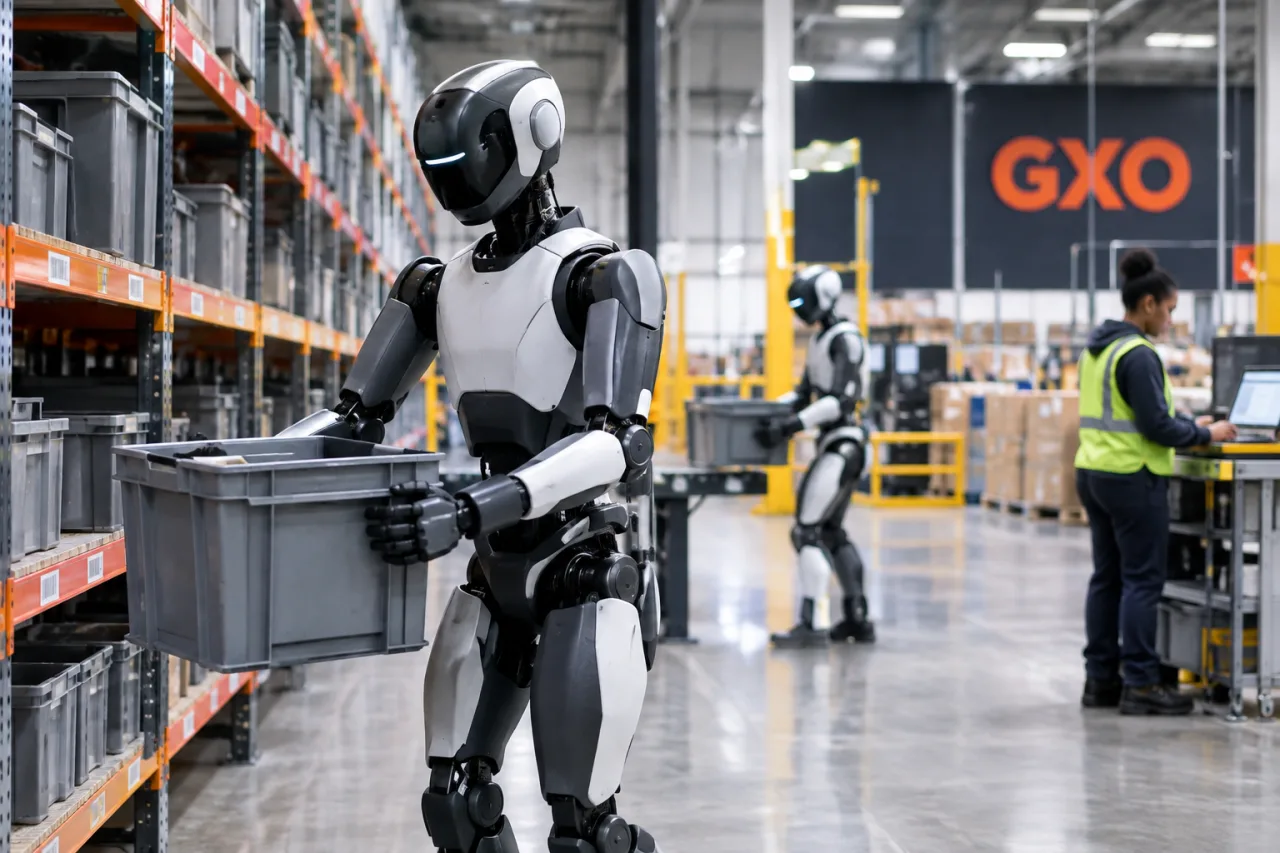
Warehouse deployments of humanoid robots produced the clearest scoreboard of 2026 — because shipping thousands of units and doing paid work are different achievements, and the warehouse floor is where the difference shows: GXO’s multi-year robot-as-a-service deal put Agility’s Digit into commercial operation at a Georgia facility (the industry’s first formal commercial humanoid deployment, now backed by a claimed 65,000+ hours of real production experience across the fleet), Figure’s 02 fleet graduated into the first paid commercial-scale humanoid contract with an initial 40-robot order for BMW’s Spartanburg plant, and Apptronik raised $935 million at a $5 billion valuation while its Apollo 2 pilots inside Mercedes-Benz’s Berlin factory and GXO warehouses — production versions targeted for 2027. This guide separates the contracts from the pilots, and the pilots from the press releases.
The bar applied throughout: a deployment counts when a named robot operates for an arms-length customer at a named site, with revenue attached. Everything else — paid demo rentals, R&D installations, maker’s-own-warehouse shows — is labeled exactly what it is, because this is where humanoid marketing does its quietest work.
Key Takeaway
- ✅ One humanoid is genuinely at commercial work: Agility’s Digit runs warehouse tote-moving at a GXO-operated Spanx facility under a multi-year RaaS contract — the first formal commercial humanoid deployment, with fleet production experience that has crossed 65,000 hours by the maker’s own count.
- 🏭 Figure has converted pilots into purchase orders: the BMW Spartanburg program (Figure 02 fleets) matured into the first paid commercial-scale humanoid contract — an initial 40-unit fleet on Figure 03 hardware, backed by the BotQ line now building one robot per hour.
- 🔬 Apptronik is the data-engine bet: $935 million raised (Series A total, ~$1 billion all-in) at a $5 billion valuation; Apollo 2 unveiled June 30, 2026; the Robot Park training facility pairs teleoperation with autonomous execution to train Google DeepMind’s Gemini Robotics models — CEO Jeff Cardenas: “we’ll continue to pilot through this year, and then we’ll start to see real production versions… in 2027 and beyond.”
- 🚫 Everything else is pilots, demos or nothing: GXO’s incubator also tests Apptronik and Reflex prototypes; Tesla’s Optimus remains unorderable with no verified deployment; the 1X NEO has 10,000+ home pre-orders and zero verified public deliveries.
- 📋 The robots actually deployed at logistics scale don’t walk: Amazon operates 1,000,000+ wheeled AMRs (with the DeepFleet AI model coordinating their traffic) — the humanoid’s warehouse benchmark is a fleet of wheels, and that comparison prices the gap honestly.
The deployment bar: how warehouse deployment claims earn the word “deployed”
The humanoid industry uses “deployed” loosely; this warehouse deployments guide uses it strictly. A verified commercial deployment needs three verifiable parts: a named customer, a named site, and revenue (a contract rather than a courtesy). Below that bar sit three graded levels: piloting (customer-site evaluation without commercial scale — Apptronik at Mercedes and GXO), demoing (controlled showcases), and announced (press releases without public evidence). The independent trackers that maintain deployment boards agree on the practical result: as of mid-2026, exactly two bipedal humanoids clear the arms-length bar — Digit and Figure’s 02 — with a wheeled third (Galbot’s S1, operating a CATL battery line) clearing on wheels. Every claim in this guide is graded against that ladder, and the umbrella field context lives in our embodied-AI cornerstone guide.
The verified scoreboard
| Company / robot | Status on the bar | The verified record |
|---|---|---|
| Agility — Digit | DEPLOYED (commercial, revenue) | Multi-year RaaS contract with GXO; commercial operation at a Spanx facility in Georgia; tote handling integrated with warehouse automation; first formal commercial humanoid deployment; 65,000+ fleet production hours claimed by the maker; Digit does not yet share space with human workers — the safety boundary is part of the deployment design. |
| Figure — 02 / 03 | DEPLOYED (commercial pilots → contract) | Figure 02 fleets at BMW’s Spartanburg plant; program converted into the first paid commercial-scale humanoid contract (initial 40-robot fleet); BotQ factory delivering 350+ units with an end-of-line yield above 80%. |
| Apptronik — Apollo / Apollo 2 | PILOTING (customer sites, named) | Production-environment evaluations at Mercedes-Benz’s Berlin-Marienfelde digital factory campus and GXO logistics labs; $935M Series A (incl. Google, Mercedes-Benz, AT&T Ventures, John Deere, QIA) at ~$5B valuation; Apollo 2 unveiled June 30, 2026; Robot Park Austin generates training data for Google DeepMind’s Gemini Robotics; “hundreds” of Apollo 2s built; production versions targeted 2027+. |
| Reflex Robotics | PILOTING (incubator) | Third prototype partner in GXO’s warehouse incubator alongside Agility and Apptronik. |
| Galbot — S1 (wheeled) | DEPLOYED (wheeled, commercial) | CATL battery-line operation — the only wheeled humanoid on the arms-length board. |
| Amazon fleet (non-humanoid) | DEPLOYED AT SCALE (wheeled AMRs) | 1,000,000+ mobile robots across the logistics network, coordinated by the DeepFleet AI traffic model — the operating benchmark humanoids are measured against. |
| Tesla — Optimus | ANNOUNCED only | No orderable unit, no public price, no verified arms-length deployment; Musk’s $20,000-30,000 price target has floated since October 2024. |
| 1X — NEO | PRE-ORDER stage | 10,000+ home pre-orders at $20,000 or $499/mo; home deliveries committed before end-2026; zero verified public deliveries as of mid-2026. |
Read this warehouse deployments table as a ladder, not a ranking: each row’s status is checkable, dated and re-checkable — which is what makes this a standing tracker rather than a monthly mood.
The Digit case study: what a real warehouse deployment looks like
Digit’s GXO contract is the reference case because every element is public and dated. The deal structure is robot-as-a-service: GXO pays for performance, not hardware, which keeps uptime obligations on Agility’s side. The work is tote induction — carrying totes from induction carts onto conveyor systems integrated with the facility’s existing automation, the repetitive short-haul lane where structured environments and predictable handling overlap. The site is a Spanx distribution facility in Georgia, announced as the industry’s first formal commercial humanoid deployment and its first humanoid RaaS engagement. The operational boundary is stated by GXO itself: Digit currently does not work with or near human workers — the robot operates in its own lane, the safety envelope is architectural rather than negotiated. And the fleet is real production experience: Agility separately claims more than 65,000 hours across its deployed fleet, a number that grows weekly and is checkable against the maker’s own published count. For buyers pricing the humanoid question, this case defines the honest template: one lane, one site, contracted service — not a fleet of generalists, and not yet a human-adjacent one.
Figure and Apptronik: the two paths to the next warehouse deployments
Figure’s path runs through manufacturing floors: fleets at BMW’s Spartanburg plant under a program that converted — measurably — into the first paid commercial-scale humanoid contract (the initial 40-robot fleet riding on production Figure 03 hardware from the BotQ line, whose 1-robot-per-hour rate our production analysis tracks). Apptronik’s path runs through data capital: the $935 million Series A, the Apollo 2 unveiling, and the Robot Park facility where teleoperations and autonomous execution generate the training corpora for Google DeepMind’s Gemini Robotics models — dozens of the “hundreds” of Apollo 2s already built are, in effect, data-collection engines first and pilots second, which mirrors the deployment logic of Figure’s BotQ flywheel. Both companies converge on the same dated milestone: production-grade deployments in 2027 and beyond, priced as service contracts once pilot data justifies fleet scale.
What the benchmark says about warehouse deployments: wheels vs legs
The honest context for every humanoid warehouse deployment claim is the Amazon number: 1,000,000+ mobile robots in logistics operation, coordinated by the DeepFleet model, at costs per-task that bipeds are nowhere near matching. AMRs move payloads reliably at scale precisely because they avoid the hard problems humanoids solve — and humanoid makers’ own deployment choices (tote lanes, safety separation, RaaS pricing) concede that legs earn their keep slowly, one narrow lane at a time. The market signal to track is therefore not “humanoids are coming for warehouses” but “which structured lane converts next”: tote induction has converted; trailer unloading, sortation induction and line-side delivery are the named next lanes in the pilot programs above. Each conversion is a dated, checkable event — a deployment-board update that should move prices and procurement both.
What warehouse deployments mean for work — the worker’s side of the warehouse deployments story
The near-term labor effect of warehouse deployments is a lane split, documented from inside them: the robots take the repetitive tote lane, the workers take exception handling, quality, configuration and fleet-side maintenance — exactly the adjacent-role structure GXO describes. The job math is small so far: a handful of deployed units per site, not the hundreds that move wage curves. The skills that pay are buildable now: mechatronics, fleet-operations monitoring, teleoperation and exception-handling — the early hiring data is in our robot operator jobs analysis, and the durable-skill picture is in our AI-proof trades guide. For readers watching from the Philippines or Singapore’s logistics hub — the region most likely to host the next fleet contracts — the skills-first route is the actionable one, the same lane our global capability centers analysis maps for operations work.
WorldNgayon Insight: warehouse deployment contracts are the receipt, pilots the promise
What changed: 2026 produced the first paid commercial-scale warehouse deployments and the first revenue-generating RaaS deployment, against a backdrop of 50,000-unit shipment forecasts. Why it matters now: the gap between shipped and working is the industry’s real valuation question — and each conversion closes it measurably. Why it lasts: the deployment bar (named customer, named site, revenue) is checkable forever, which turns this scoreboard into a standing tracker with dated update triggers (Apptronik’s 2027 production window, NEO’s delivery commitments, the next lane conversions). Who is affected: warehouse operators pricing automation, robotics investors separating pilots from receipts, and workers choosing adjacent skills early. What to do: track deployments, not announcements — the price tables our humanoid prices guide audits tell you what robots cost; this board tells you which of them earn. Risks, opportunities, costs, skills: the risks are overbuilt fleets chasing pilots; the opportunities are lane conversions and the RaaS pricing that follows; the costs are falling per-task toward AMR benchmarks; the skills are the exception-handling and fleet-side ones the deployments create. Connection to work and money: the hardware behind every row rides the same power-and-compute buildout documented in our sovereign AI pillar.
Are humanoid warehouse deployments real in 2026?
One is: Agility’s Digit operates commercially at a GXO-operated Spanx facility in Georgia under a multi-year RaaS contract, moving totes as the industry’s first formal commercial humanoid deployment, with a claimed 65,000+ fleet production hours. Figure’s 02 fleets at BMW Spartanburg advanced into the first paid commercial-scale humanoid contract (an initial 40-robot fleet on Figure 03 hardware).
What is the difference between a pilot and a deployment?
A deployment has a named customer, named site and revenue; a pilot is a customer-site evaluation without commercial scale (Apptronik’s Apollo at Mercedes-Benz’s Berlin factory and GXO labs are pilots); a demo is a controlled showcase. Most humanoid coverage blends these three — the scoreboard keeps them separate.
Is Tesla’s Optimus deployed anywhere?
No. Optimus has no orderable unit, no public price (only Musk’s $20,000-30,000 target, floated since October 2024) and no verified arms-length deployment. Its status at mid-2026 is “announced.”
How many humanoid robots has Apptronik deployed?
None commercially – Apptronik pilots Apollo 2 at Mercedes-Benz and GXO, has built “hundreds” of Apollo 2 units (many serving as training-data generators at its Robot Park facility for Google DeepMind’s Gemini Robotics), and targets production versions in 2027 and beyond.
What does GXO’s warehouse deployment incubator include? The three programs
Three concurrent prototype programs – Agility’s Digit (deployed), Apptronik’s Apollo (piloting) and Reflex’s humanoid (piloting) – trained and tested inside GXO warehouses, with battery life, payload, gripping and automation-integration improvements credited to the program.
Why are wheeled robots still ahead of humanoids in logistics?
Amazon runs 1,000,000+ wheeled AMRs coordinated by its DeepFleet AI model – wheels solve the structured-transport problem far cheaper than legs. Humanoids earn their narrow lanes one conversion at a time (tote induction first), and the deployment board tracks which lane converts next.
What jobs do humanoid warehouse deployments create?
Lane-splitting, not replacement: robots take repetitive tote handling; workers take exception handling, quality, configuration, teleoperation and fleet maintenance. Volume is small so far – a handful of units per site – but the skill list is buildable now, and regional logistics hubs are where deployments (and those jobs) land next.
Financial Disclaimer
This article is editorial analysis of publicly reported contracts, funding and deployment records, not investment or procurement advice, and no outcome is promised. Funding valuations, contract terms and RaaS pricing change; verify current facts with the named companies before decisions. Technology markets carry substantial risk.
Sources: The Robot Report — Digit’s first official commercial deployment (GXO/Spanx contract details, safety boundary); GXO — the humanoid incubator (Agility, Apptronik, Reflex; the integrated-automation record); Agility Robotics — Digit’s 65,000+ production hours and the GXO partnership; Figure AI — BotQ production and the Figure 03 fleet ramp; Apptronik — the $935M Series A (investors incl. Google, Mercedes-Benz); CNBC — Apptronik’s $5B valuation and the Mercedes/GXO test programs; Apptronik — Robot Park: Apollo 2 data generation for Gemini Robotics; Reuters — the Apollo 2 unveiling and the 2027 production timeline; The Mimic — Apollo’s verified Mercedes Berlin-Marienfelde pilot record. Deployment grading is editorial; maker-claimed figures are labeled as such.