Key Takeaway
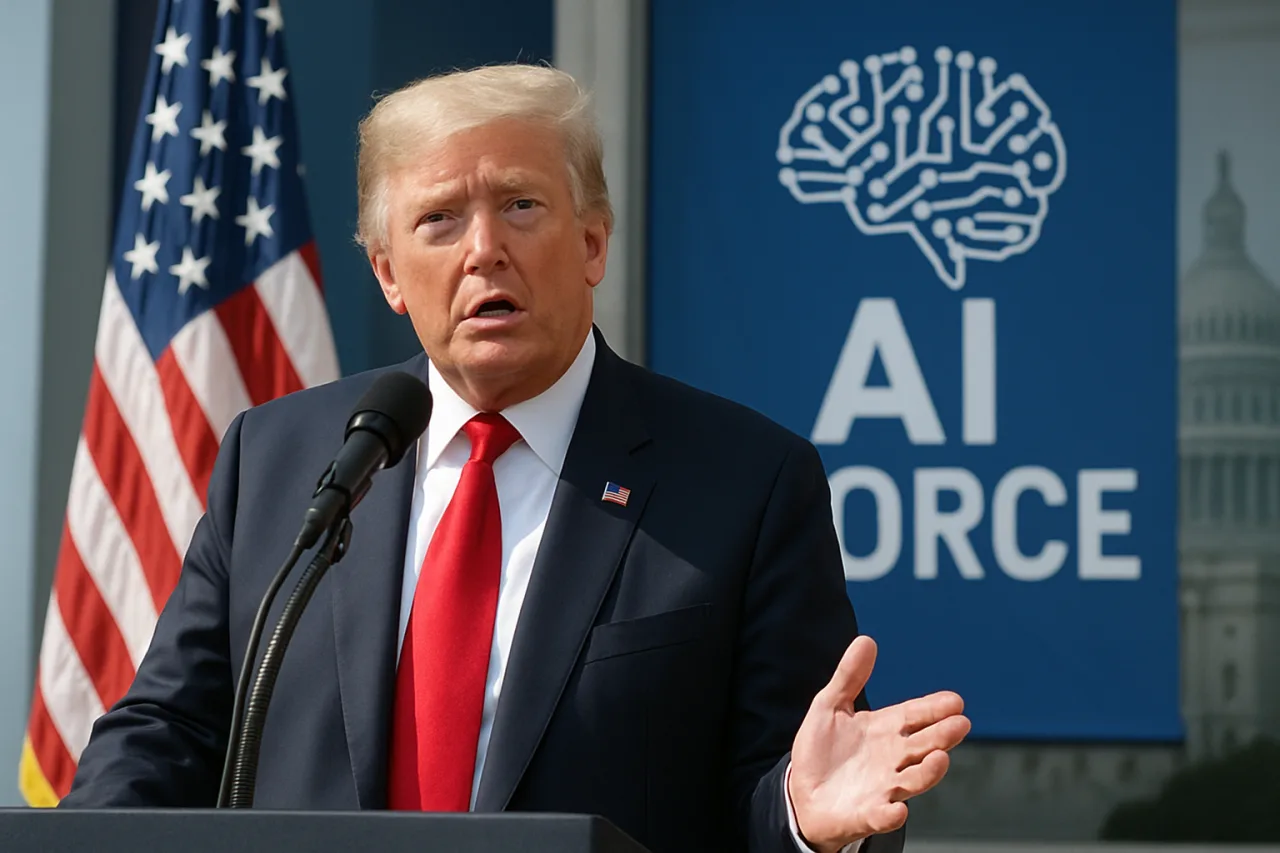
- 🇺🇸 President Trump announced Saturday, September 19, the creation of an AI Force — modeled on the Space Force — and promised to name a new AI czar “soon” to oversee US artificial intelligence development.
- 🛡️ His safety doctrine in one verified line: no guardrails are needed beyond “a high IQ president” — he framed himself as the sufficient guardrail against rogue AI while calling risk concerns a “hoax” and a “SICK conspiracy.”
- 🪑 The czar seat is vacant: David Sacks stepped aside from the AI and crypto czar role in March 2026 after roughly 130 days, joining PCAST as an external adviser — no successor has been named.
- ⚙️ The announcement carried no operational details: no budget, no agency placement, no mandate — Axios confirmed the White House offered few specifics and did not immediately respond to comment requests.
- 🌍 Why Filipinos should care: the US is now the largest AI market with the loosest stated framework — which shapes where AI jobs, outsourcing contracts, and compliance demand flow next.
While the industry’s own leaders spent the fortnight asking for brakes — resignations over “gambling with our lives,” essays pacing the frontier, Nobel laureates giving Congress a one-year deadline — the White House answered the opposite way. On September 19, President Trump announced an AI Force, likened it to the Space Force, and promised a new AI czar: a Washington answer to a week of Silicon Valley confession, built on acceleration, not restraint. The same president spent the week calling AI risk claims a “hoax,” defending data centers, and asserting that existing criminal and regulatory power is enough. This guide unpacks the announcement, the vacancy at its center, the guardrail doctrine, and what the world’s biggest AI market just told the rest of the world.
Table of Contents
Fact 1: the Announcement and the Space Force Model
The announcement came by Truth Social on Saturday, September 19: an “AI Force” created in the image of the Space Force — the sixth military branch Trump stood up in 2019 — and an AI czar to oversee what he called “the next Industrial Revolution.” The framing is the message: the Space Force was a bet that a new domain of competition deserves its own institution; the AI Force applies the same logic to intelligence itself. The post promised the United States will “not in any way hinder or stifle the Growth of this incredible Industry” — acceleration as doctrine, announced in the same fortnight the CEOs of the labs building the technology asked Washington to help them slow down.
Axios, which tracked the post within the hour, reported the White House offered no immediate operational details: what the Force would do, what budget it would carry, or where it would sit in the federal bureaucracy. Al Jazeera carried the announcement globally the same day. The absence of details is itself a fact — and the next one explains part of the vacuum.
Fact 2: the Vacant Czar Chair
The AI czar promise lands on an empty chair. David Sacks — the venture capitalist who served as Trump’s AI and crypto czar from the administration’s start — stepped aside in March 2026 after roughly 130 days, moving to the President’s Council of Advisors on Science and Technology as an external adviser. Since then the role has sat unfilled while AI policy questions accumulated: the safety-essay fortnight, the disclosure frameworks, the state-versus-federal preemption fights. Trump’s Saturday post promises a name “soon” — and whoever fills the chair inherits the fastest-moving portfolio in Washington with the least statutory scaffolding under it. The name will signal more than the Force’s structure does: an accelerationist czar makes the Force a growth agency; a safety-inclined pick would surprise everyone, including the industry asking for one.
Fact 3: the Guardrail Doctrine — High IQ as Policy
The week’s most consequential sentence came four days before the Force. Per the Washington Post’s September 14 report, Trump declared himself “a sufficient guardrail against rogue artificial intelligence” — arguing that what the technology needs is not legislation but “a high IQ president” — and called risk concerns a “hoax” driven by a “SICK conspiracy” narrative. In the same posts he asserted the government already holds “tremendous CRIMINAL and REGULATORY power over these companies,” and defended data centers as wealth builders: “The data centres are great, they make people wealthy… It’s bigger than the Internet.”
The doctrine is coherent and radical: substitute personal judgment for institutional guardrails. Where Amodei asks for embedded third-party evaluators and Hinton gives Congress a one-year deadline, the White House position is that the safety apparatus already exists and sits in the Oval Office. The AI Force announcement, read against this doctrine, is not a contradiction — it is the doctrine’s logical completion: an acceleration symbol wrapped in a command structure, with the oversight function concentrated at the top.
Fact 4: What the AI Force Actually Is (So Far)
Strip the announcement to its verifiable content and this is what exists: a Truth Social post, a Space Force analogy, a promised czar, and a non-hindrance pledge. No executive order text, no budget line, no statutory basis, no agency assignment, no recruiting plan — Axios confirmed the vacuum of specifics and the White House’s non-response. For comparison, the Space Force took two years and an act of Congress to move from proposal to branch. The honest assessment: the AI Force is currently a message, not an institution — and its earliest test is whether the czar nomination comes with structure attached or as a headline. The next checkpoint is the nomination itself, which Trump said would be announced soon.
Fact 5: the Collision With the Industry’s Own Warnings
The announcement’s timing is the story’s sharp edge. It arrived one day after Reuters’ “ten days that changed the course of AI” retrospective documented the industry’s own alarm: Coxon’s resignation, Hubinger’s “could kill all humans” post, Amodei’s pacing essay, the misalignment disclosures, Hinton’s one-year warning. The same fortnight, the IMF told EU ministers that 60% of advanced-economy jobs sit in AI-exposed occupations. Against that backdrop, Washington’s answer — a force to accelerate, a hoax call on the risks, a president as the guardrail — lands as the world’s most consequential policy refusal. The collision is not abstract: the disclosure frameworks and pacing commitments the labs adopt privately now run against the public position of their largest market. How that tension resolves — through procurement rules, state laws, or international coordination — will define AI governance more than any single agency announcement.
What It Means for Filipino Professionals
Three practical layers. First, market signal: a US commitment to acceleration regardless of safety friction means the enterprise AI market keeps expanding — good news for the implementation, QA, and documentation services the Philippines sells into it. Second, the compliance arbitrage: as Washington stays loose, other jurisdictions — the EU, ASEAN under Manila’s chairmanship, individual US states — will write the actual rules; professionals who understand multi-jurisdiction AI compliance become the translators those frameworks need. Third, the outsourcing irony: the same week the White House called AI risks a hoax, the Philippine DICT continued building the ASEAN AI+ masterplan’s governance layer — the countries that take AI governance seriously first will capture the trust-dependent services first. Watch the czar nomination: it is the one upcoming decision that reprices the entire US AI policy landscape.
Frequently Asked Questions
What is Trump’s AI Force?
Announced on Truth Social, September 19, 2026: an “AI Force” modeled on the Space Force, paired with a promised new “AI czar” to oversee US artificial intelligence development, which Trump called “the next Industrial Revolution.” The post pledged the US will “not in any way hinder or stifle” the industry. As of publication, no budget, agency placement, statutory basis, or operational details have been provided.
Who is Trump’s AI czar?
Nobody yet — the seat is vacant. David Sacks held the AI and crypto czar role from the administration’s start until March 2026, serving roughly 130 days before stepping aside to join the President’s Council of Advisors on Science and Technology as an external adviser. Trump promised a new czar “soon” in the September 19 announcement; no name has been released.
Why does Trump call AI risks a hoax?
Per the Washington Post’s September 14 report and his Truth Social posts, Trump argues AI danger claims are a “hoax” pushed by a “SICK conspiracy,” that data centers create wealth, and that the government’s existing “CRIMINAL and REGULATORY power” over AI companies suffices — with himself, as a “high IQ president,” the sufficient guardrail against rogue AI. The position rejects the industry’s own slowdown chorus as unnecessary.
What will the AI Force actually do?
Unspecified so far. The announcement provides an analogy (Space Force), a leader (a coming AI czar), and a policy direction (acceleration without hindrance) — but no mission definition, budget, or institutional home. By Space Force precedent, converting a proposal into a functioning organization took years and congressional action; the AI Force is at the message stage, with its substance presumably arriving with the czar nomination.
How does the AI Force compare with what the labs are asking for?
Directly opposed on safety architecture. Lab CEOs — Amodei, Altman, Hassabis, and others — spent September asking for third-party evaluators, coordinated safety standards, and government verification channels; the White House response is an acceleration force, a hoax framing of the risks, and a personal-guardrail doctrine. The collision sets up the next phase of AI governance: industry frameworks advancing in a policy vacuum.
What does the AI Force mean for Filipino workers and businesses?
Three readouts: the acceleration commitment sustains US enterprise AI demand that Philippine tech services feed; the governance vacuum in Washington raises the value of professionals fluent in the jurisdictions that do regulate (EU, ASEAN, US states); and the Philippine government’s parallel ASEAN AI governance build-out positions Filipino compliance and documentation talent for the work the US posture leaves on the table.
Final Word: the Guardrail Who Would Be an Institution
Every AI safety architecture proposed this month — evaluators, standards, verification channels, statutes — assumes the safeguard must be institutional. The AI Force announcement rejects the premise: the guardrail is one person, and the institution exists to speed the technology up. The Space Force analogy is more apt than the post intends — both were declarations that a new domain now matters to national power; what the AI Force lacks, so far, is everything the Space Force eventually got: structure, budget, and law. Until the czar is named and the mandate written, the world’s biggest AI market is running on a doctrine of trust in one man’s judgment — while the men who build the technology line up to be checked. Watch the nomination; the Force’s reality will arrive with it.