Table of Contents singapore johor data center
Key Takeaway
- 🏙️ Singapore has hit its data center ceiling — with only 200 MW of new capacity approved under strict PUE 1.25 efficiency rules, the city-state is turning away billions in AI infrastructure investment.
- 🇲🇾 Johor, Malaysia is absorbing the overflow — the Nxera 280 MW AI-ready campus in Iskandar Puteri is just 30 minutes from Singapore and is already attracting Google Cloud, Microsoft, and hyperscalers priced out of the city-state.
- 💼 Filipino engineers have a front-row seat — the corridor is becoming Southeast Asia’s most active AI infrastructure zone, with immediate demand for bilingual talent, network engineers, and cloud architects.
- ⏰ The window is open NOW — TM Nxera’s first phase goes live in second half 2026, with more facilities in Batam and Johor due online before year-end.
Singapore Johor Data Center Corridor: What Filipino Engineers Must Understand
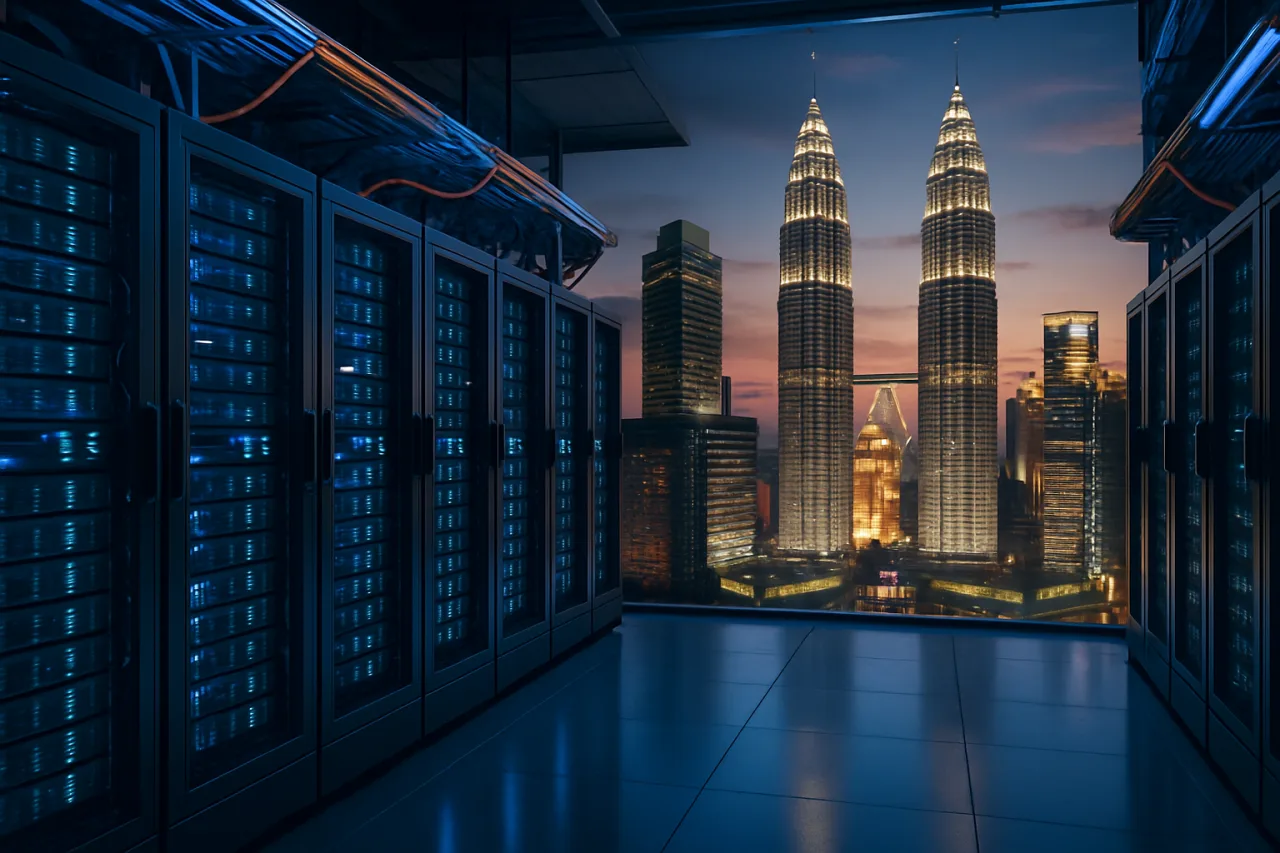
Singapore Johor data center migration is reshaping Southeast Asia’s AI landscape. !– IMAGE: Singapore skyline and Johor Bahru cityscape connected by causeway, representing the data center corridor –>
Singapore Johor Data Center Shift: When Singapore Said No More
On a humid Tuesday morning in May 2026, officials at Singapore’s Energy Market Authority quietly confirmed what many in the regional data center industry had already suspected: the city-state had reached its physical limits.
After approving just 200 megawatts of new data center capacity under its famously strict Power Usage Effectiveness (PUE) 1.25 requirement, Singapore effectively told the world’s largest technology companies what no global financial hub ever wants to say: we are full.
For Filipino professionals who have spent years treating Singapore as Southeast Asia’s default technology destination, this was not a minor policy adjustment. It was a tectonic shift.
The 200 MW cap, while substantial by most national standards, represents less than half the capacity that hyperscalers like Google Cloud, Microsoft Azure, and Amazon Web Services had collectively requested for their 2026-2027 expansion plans. Singapore’s reasoning was sound — the island nation faces genuine physical constraints: limited land, expensive power, and a national commitment to sustainability that makes energy-guzzling AI data centers politically difficult.
But sound policy does not eliminate business demand. It merely redirects it.
And that redirection is flowing directly across the Johor Strait, into Malaysia — creating a facility corridor that did not exist as an AI destination just 18 months ago.
Singapore Johor Data Center Solution: Malaysia’s AI Gold Rush
On May 15, 2026, TM Nxera — a joint venture between Telekom Malaysia and Singtel-owned data center operator Nxera — announced the structural completion of its Iskandar Puteri campus in Johor, Malaysia. The ceremony, held three months after securing a multi-year 280 MW power supply agreement with Malaysia’s national utility Tenaga Nasional Berhad (TNB), marked the moment when Johor officially became Southeast Asia’s most sought-after AI infrastructure destination.
The numbers are staggering.
The TM Nxera campus, located just 30 minutes by car from Singapore’s Woodlands checkpoint, will deliver its first 64 MW phase in the second half of 2026. When fully built out, the 280 MW facility will more than double Nxera’s total operational and pipeline capacity across the region.
To put this in perspective: a single the facility campus of this scale requires more electricity than a mid-sized Malaysian city. It employs, directly and indirectly, over 3,000 workers during construction and 800-1,200 permanent staff at full operations.
And TM Nxera is only the beginning of the corridor transformation.
Google Cloud announced a $2 billion investment in Malaysia’s cloud and AI infrastructure in 2025, with its first Malaysian cloud region going live in 2026. Microsoft committed an additional $2.2 billion for AI and cloud services. Amazon Web Services, not to be outdone, pledged $6.2 billion for data center infrastructure across the country.
All of this investment is flowing into a corridor that is redefining how Southeast Asia thinks about AI infrastructure.
Singapore Johor Data Center Economics: Why Johor Won the Overflow
The the cross-border corridor is not an accident of geography. It is a deliberate economic strategy that plays to Malaysia’s strengths while solving Singapore’s constraints.
Johor offers what Singapore cannot: space, power, and regulatory flexibility.
Land and Power Costs: Industrial land in Iskandar Puteri costs roughly 60-70% less than equivalent space in Singapore’s Tuas or Changi areas. Electricity rates in Malaysia, while rising, remain significantly below Singapore’s commercial tariffs. For a this infrastructure zone consuming 280 MW — the equivalent of powering approximately 280,000 homes — these cost differentials translate to hundreds of millions of dollars in operational savings over a decade.
Regulatory Environment: Malaysia’s data center moratorium, unlike Singapore’s blanket restriction, specifically targets non-AI projects. This means AI-focused data centers — the exact type hyperscalers want to build — face a streamlined approval process. The Malaysian Investment Development Authority (MIDA) has created a dedicated “AI Infrastructure Fast Track” that reduces permitting time from 18 months to as little as 6 months for qualifying projects in the facility corridor.
Proximity Advantage: Johor’s location is not merely convenient — it is strategically essential. The 30-minute drive from Iskandar Puteri to Singapore’s financial district means companies can maintain their Singapore headquarters while running their compute infrastructure in Malaysia. For financial services firms subject to Singapore’s stringent data sovereignty requirements, this proximity allows regulatory compliance without the physical constraints of building in Singapore itself.
Fiber Connectivity: The cross-border fiber infrastructure between Singapore and Johor is among the densest in Southeast Asia. Multiple submarine cables land in both locations, and the Johor-Singapore causeway corridor hosts over 20 independent fiber routes. This means latency between a the regional hub and Singapore’s financial exchanges is measured in single-digit milliseconds — effectively local for trading and real-time AI applications.
Singapore Johor Data Center Jobs: What Filipino Professionals Must Know
For Filipino engineers, technicians, and data center professionals, the TM Nxera campus in the the development corridor represents more than infrastructure news. It represents employment opportunity at scale.
The facility is explicitly designed as “AI-ready” — meaning its cooling systems, power density per rack, and network architecture are optimized for GPU-intensive workloads, not generic cloud storage. This matters because AI-ready data centers require different skills than traditional facilities.
Skills in highest demand at Nxera and similar facilities:
- Liquid Cooling Engineers: AI servers generate 2-3x the heat of traditional racks. Direct liquid cooling (DLC) and immersion cooling specialists are among the highest-paid technical roles in the sector.
- High-Voltage Power Specialists: Managing 280 MW requires expertise in medium-voltage distribution, uninterruptible power supply (UPS) systems, and generator synchronization that goes far beyond standard electrical engineering.
- Bilingual Network Architects: The cross-border nature of operations requires professionals fluent in English (the business language) and either Malay or Mandarin (the operational languages of many contractors).
- AI Infrastructure Operations: Unlike traditional data center operations, AI facilities require professionals who understand GPU cluster management, InfiniBand networking, and the thermal profiles of NVIDIA H100 and B200 deployments.
The talent pipeline is already forming. Telekom Malaysia has partnered with Universiti Teknologi Malaysia (UTM) to create a dedicated data center engineering curriculum, with guaranteed internship placements at Nxera facilities. Nxera itself has begun recruiting from Philippine universities, specifically targeting graduates from Mapua University, De La Salle University, and the University of the Philippines’ electrical engineering and computer science programs for its this project operations.
Singapore Johor Data Center Ecosystem Beyond Nxera
While TM Nxera dominates the headlines, it is part of a much larger ecosystem taking shape across the the buildout corridor.
Sedenak Tech Park: Located 40 minutes north of Iskandar Puteri, this 1,200-acre development is positioning itself as Malaysia’s answer to Silicon Valley’s industrial parks. Early tenants include a Foxconn-backed server manufacturing facility and a Yondr Group build-to-suit campus for an unnamed hyperscaler widely believed to be Microsoft.
Nusajaya Tech Hub: Adjacent to the Nxera campus, this mixed-use development is attracting data center suppliers, contractors, and service providers. Companies specializing in precision cooling, electrical switchgear, and fire suppression systems for data centers are establishing regional headquarters here to serve the the expansion corridor.
Pasir Gudang Industrial Zone: Malaysia’s largest port is expanding its fiber landing station capacity to handle the expected surge in submarine cable connections. At least three new cable systems are planned to land in Johor by 2027, connecting Malaysia directly to Japan, Hong Kong, and the United States.
For Filipino professionals, this ecosystem development means opportunity beyond direct employment. The supplier networks, contractor relationships, and service companies supporting these the zone facilities will create thousands of secondary roles — from logistics coordinators to compliance auditors to bilingual project managers.
Singapore Johor Data Center Strategy: Singapore Connects to Johor
Singapore has not surrendered its technology leadership ambitions. Rather, it has pivoted — from trying to host all the infrastructure itself, to becoming the intelligence and capital layer above the infrastructure.
The Singapore Economic Development Board (EDB) announced in March 2026 a new “Cross-Border Digital Infrastructure Partnership” that provides tax incentives and regulatory coordination for Singaporean companies operating data centers in Johor. This means a Singapore-headquartered AI startup can maintain its intellectual property and senior leadership in Singapore while running its compute workloads in a the site, with seamless regulatory treatment.
For Filipino professionals, this creates a dual-market opportunity. Professionals who can navigate both Singapore’s regulatory environment and Malaysia’s operational landscape — the bilingual, cross-border “bridge” talent — command premium salaries and rapid career advancement in the the sector.
Google Cloud’s Malaysia country director, in a May 2026 interview with TechWire Asia, explicitly cited “access to regional talent, including the strong Filipino technical workforce” as a key factor in Malaysia selection.
Singapore Johor Data Center Risks: What Could Slow the Boom
No infrastructure buildout of this scale is without risks, and Filipino professionals considering relocation to the the campus corridor should understand them.
Power Constraints: While Tenaga Nasional has committed 280 MW to Nxera, Malaysia’s national grid faces broader capacity challenges. Additional data center demand beyond current commitments could strain generation capacity, particularly during peak demand periods.
Political Transition Risk: Malaysia’s political environment, while more stable than in past decades, still experiences policy shifts with government changes. The current AI-friendly regulatory framework could be modified by future administrations.
Infrastructure Lag: While the the complex facilities are being built rapidly, supporting infrastructure — housing, transportation, schools, healthcare — is struggling to keep pace. Iskandar Puteri’s residential capacity is already showing strain, with rental prices rising 40% year-over-year as foreign workers arrive.
Currency Volatility: The Malaysian Ringgit has experienced significant volatility against the US dollar and Singapore dollar in 2025-2026. For professionals earning in Ringgit but remitting to Philippine Peso, exchange rate risk is a genuine consideration.
Regulatory Complexity: Operating across Singapore and Malaysia means navigating two distinct regulatory regimes: Singapore’s Personal Data Protection Act (PDPA) and Malaysia’s Personal Data Protection Act (PDPA) have overlapping but non-identical requirements. Compliance professionals who understand both frameworks are in demand but short supply.
Singapore Johor Data Center Timeline: When Things Happen
For Filipino professionals evaluating whether to pursue opportunities in the the infrastructure corridor, timing matters.
| Period | Milestone | Opportunity |
|——–|———–|————-|
| **Q3 2026** | TM Nxera Phase 1 (64 MW) goes live | Construction completion jobs, initial operations hiring |
| **Q4 2026** | Google Cloud Malaysia region operational | Cloud engineering, customer-facing roles |
| **Q1 2027** | Nxera Phase 2 expansion begins | Engineering and project management surge |
| **Mid 2027** | Additional submarine cables land in Johor | Network infrastructure, submarine cable specialist roles |
| **2027-2028** | Full 280 MW campus operational | Peak employment — 1,200+ permanent staff |
The pattern is consistent across all major the network developments: the highest-paying roles go to early arrivals who help build the facility, not latecomers who join after operations stabilize.
Singapore Johor Data Center Careers: How Filipinos Can Position
The the operation corridor is not a theoretical opportunity. It is a construction site, a hiring pipeline, and a career accelerator — right now.
For Electrical/Mechanical Engineers: Data center-specific certifications are increasingly mandatory. Consider the Uptime Institute’s Tier Design Specialist certification or Schneider Electric’s Data Center Certified Associate program. Both are available online and recognized across Southeast Asia.
For IT/Network Professionals: Cloud platform certifications (AWS Solutions Architect, Google Cloud Professional, Azure Solutions Architect) are baseline requirements. Add data center networking specializations — Cisco’s Data Center track or Juniper’s Data Center certification — to differentiate yourself for technical roles.
For Project Managers: The cross-border nature of the venture projects requires familiarity with both Singapore’s Building and Construction Authority (BCA) standards and Malaysia’s Construction Industry Development Board (CIDB) requirements. Professionals who can navigate both systems are rare and well-compensated.
For Recent Graduates: The the initiative sector values hands-on experience over advanced degrees for operational roles. Entry-level positions in Johor facilities often pay 30-40% above comparable roles in the Philippines, with faster promotion timelines.
Singapore Johor Data Center Bottom Line: The Corridor is Open
When Singapore closed its doors to new data center construction, it did not end Southeast Asia’s AI infrastructure boom. It merely moved it 30 minutes north, across a causeway that thousands of Filipino professionals cross every day.
The the development corridor is not a consolation prize for missing Singapore. It is the next evolution of Southeast Asia’s technology infrastructure — bigger, more specialized, and more explicitly focused on AI workloads than anything that preceded it.
For Filipino engineers, technicians, and technology professionals, the message is clear: the window is open, the demand is verified, and the timeline is immediate.
The only question is who moves through it first.
Frequently Asked Questions
Is Johor safe for Filipino workers? Yes. Iskandar Puteri and surrounding areas have active Filipino professional communities. However, as with any international relocation, verify employment contracts, housing arrangements, and work permit status before committing.
Do I need to speak Malay to work in the region facilities? English is the primary business language in all major data center facilities. However, basic Malay language skills improve daily life and integration with local contractors and service providers. Mandarin is also valuable given the significant Chinese-Malaysian presence in technical trades.
How do Johor salaries compare to Singapore? Salaries in Johor are typically 40-50% lower than equivalent Singapore roles. However, the cost of living is 50-60% lower, and the proximity allows cross-border commuting for some positions. Many professionals report equivalent or better disposable income in Johor.
Will the TM Nxera campus hire Filipino workers directly? TM Nxera has announced partnerships with Philippine universities for talent pipeline development. Direct hiring is expected to begin in Q3 2026 for Phase 1 operations, with the largest recruitment wave in Q1-Q2 2027.
What is PUE and why does it matter? Power Usage Effectiveness (PUE) measures data center energy efficiency — total facility power divided by IT equipment power. A PUE of 1.25 (Singapore’s requirement) means only 25% of energy is lost to cooling and infrastructure. Malaysia’s less stringent standards allow slightly higher PUE, reducing costs but potentially increasing environmental impact.
Can I work in Singapore while living in Johor? Cross-border commuting is common but requires proper work permits. Singapore’s Employment Pass and S Pass holders can live in Johor and commute daily, though immigration queues at peak hours can exceed 90 minutes. Many professionals adopt a hybrid model: weekdays in Singapore accommodation, weekends in Johor.
What certifications should I get before applying to this hub roles? Uptime Institute Tier certifications, Cisco Data Center certifications, and cloud platform certifications (AWS/Google/Azure) are most valued. For safety-critical roles, Malaysia’s CIDB safety certifications are mandatory.
Is this a temporary boom or long-term career opportunity? Industry analysts project Southeast Asian data center capacity to grow 8-10x by 2030. The the area corridor is positioned as the region’s primary hub. For professionals who establish themselves now, career runway extends well into the 2030s.
How does Malaysia’s AI data center policy differ from Singapore’s? Malaysia blocks non-AI data centers while encouraging AI-focused facilities. Singapore blocks nearly all new data centers regardless of type. Both aim to control energy consumption, but Malaysia is more explicitly positioning itself as an AI infrastructure hub.
What about Indonesia’s Batam data center plans? Nxera is also developing facilities in Batam, Indonesia, as part of its broader regional strategy. Batam offers even lower costs than Johor but faces greater regulatory and infrastructure challenges. For conservative professionals, the this market corridor offers the best balance of opportunity and stability.
Where can I find current the ecosystem job openings? Monitor Telekom Malaysia’s careers portal, Nxera’s website, and LinkedIn for “data center” positions in Iskandar Puteri and Johor Bahru. Recruitment agencies specializing in ASEAN infrastructure roles — including Philippine-based firms — are increasingly active in this market.
Disclaimer: The information in this article is based on publicly available sources and industry reports as of July 2026. Job markets, policies, and investment timelines can change. Filipino professionals considering relocation should verify current conditions through official channels and consult with qualified immigration and employment advisors.
Sources: Malaysian Investment Development Authority, Singapore Economic Development Board.