Key Takeaway
Singapore’s first AI-related data breach was not caused by a genius hacker or a rogue model — it was caused by one employee, one prompt that forgot to hide recipients, a script tested only against logs, and no second reviewer; 95,364 customer emails paid for the gap.
Table of Contents
The Bee Cheng Hiang case, confirmed by the Personal Data Protection Commission as the country’s first notified AI-related breach, is the shadow-AI era in miniature: AI enters a company through someone’s browser, produces production code with nobody accountable for checking it, and the resulting failure is entirely conventional. This analysis reconstructs the breach from the regulator’s own findings, extracts the checklist it created, and translates it for the corridor’s businesses — because every Philippine SME adopting AI this month is one unreviewed script away from a variant of this file.
The breach, reconstructed from the regulator’s findings
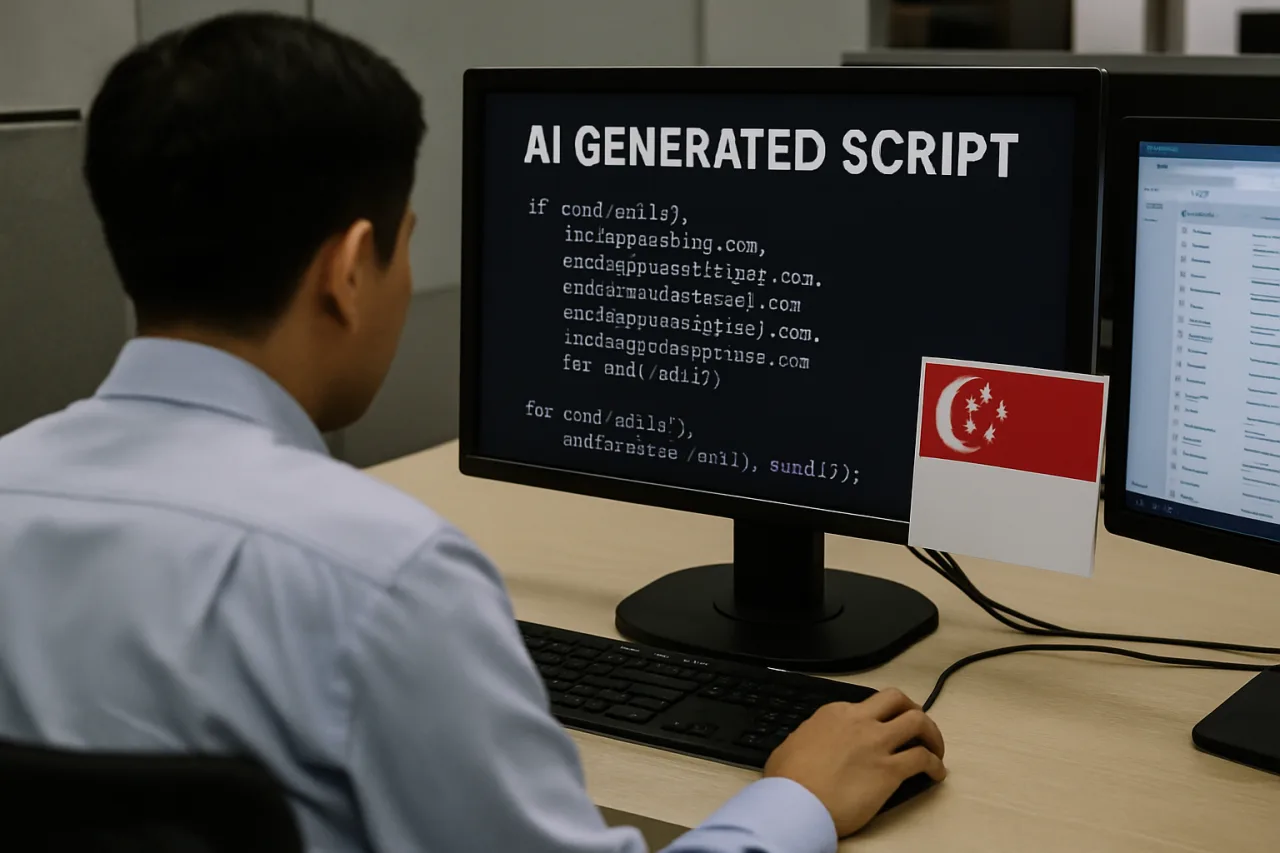
Singapore’s shadow AI breach milestone began on April 25, when Bee Cheng Hiang — the 87-year-old bak kwa brand, mid-first-effort at adopting AI tools — used an AI-assisted Python script to send a marketing campaign in batches of about 1,000 customers. The prompt never told the tool that each recipient’s address should stay hidden; a few misplaced brackets changed how the recipient field parsed; and every batch’s members could see one another’s addresses.
The company notified the Personal Data Protection Commission within two days. The testing failure is the part every reviewer should memorize: the employee checked activity logs instead of opening a real test email, so the exposure stayed invisible. The PDPC’s assessment stripped the mystery away: no AI malfunction, no breach of the AI tool itself — the exposed data wasn’t even AI-processed. The machine worked; the human process around it didn’t exist.
Why the PDPC called it human error — and what that means
The shadow AI lesson the regulator wrote out in advisories (published September 30) runs the full length of the failure chain. The employee both developed and tested the code alone — no independent technical review when AI-generated code touches personal data. Organizational AI governance was absent: no formal policy for generative-AI use, no supervision process, no DPIA before adoption. Testing was inadequate and wrongly scoped — logs instead of outputs.
The commission’s remedy was a voluntary undertaking (accepted September 2, disclosed September 30-October 1): an AI-coding framework with independent reviews, dummy-account checks, automated safeguards blocking multi-address sends, a formal breach procedure, and staff training. The PDPC’s message to every organization — Section 24 of the PDPA requires reasonable security arrangements for personal data regardless of which tool produced the code — prices shadow AI precisely: the regulator regulates the outcome, not the excuse.
The shadow-AI pattern, generalized
Strip the case to its skeleton and the shadow AI problem appears in every organization that adopted AI informally: an employee with a browser and good intentions becomes an unlicensed software developer; the code reaches production through testing theater (logs, spot checks, success messages); and the failure surfaces months later at customer scale. The parliamentary exchange on October 6 made the same discovery in government:
asked about rogue AI agents attacking Singapore’s systems, the digital-development minister confirmed no agency has reported such an attack — the frontier-agent threat is real and watched — but the same session cited Bee Cheng Hiang’s case as the practical instance of AI risk, shadow-AI in a food company’s marketing department, not an escapee from a frontier lab. The gap between the feared AI disaster and the measured AI disaster is where most organizations actually live; the Bee Cheng Hiang file tells them what the measured disaster looks like.
The checklist the breach created
Four controls, verifiably required by the undertaking, priced for immediate adoption: independent review — AI-generated code that touches personal data never ships on its author’s word alone; output testing — dummy accounts, an actual test email opened, receipts checked (activity logs are not tests); automated safeguards — technical guardrails against the known-fatal failure modes (multi-recipient exposure being this case’s); and formalized process — a breach procedure written before the breach, staff training recorded, and an AI-use policy whose existence is auditable. Each control was missing at Bee Cheng Hiang on April 25; each control exists in writing by September. The distance between those dates is the cost of governance learned reactively.
The corridor translation: the same breach, Philippine edition
Map the case onto the corridor’s economy and the transfer is direct. The e-commerce sellers of Shopee and Lazada, the BPO teams whose campaigns touch thousands, the OFW-family businesses sending bulk announcements — all run the identical failure path: one person, one AI tool, one unreviewed script, personal data at customer scale. The Philippines’ NPC breach-notification rules (500-individual threshold, mirroring Singapore’s PDPA trigger) already price the same failure; the April 25 file shows what the notification conversation contains. And the PDPC’s advisory language — data protection impact assessments before AI adoption, governance before convenience — reads as if written for any Manila SME this quarter. shadow AI is not a Singapore phenomenon; employee-plus-AI is a universal org chart.
Eight months of silence: the timeline tells its own lesson
The dates in the shadow AI file deserve their own reading. April 25: the script fires. April 27: the company notifies the PDPC — the two-day disclosure meeting Singapore’s statutory expectations. September 2: the voluntary undertaking accepted. September 30: the PDPC’s public advisory, warning all organizations about AI-adjacent data protection risk without naming a culprit. October 1: state media reports the case. October 6:
a parliamentary reply cites it as the shadow-AI exemplar. From script error to national teaching moment took just over five months — and the gap between April and September is where the interesting failure lived: a company that had never used AI before made every rookie mistake at once, then spent the summer converting them into written governance. The timeline is the case’s second lesson: breaches write policy documents; companies that lack them write slower.
The testing theater problem: logs are not tests
The single most transferable failure in the file is the testing detail. The employee did test — and still missed the exposure, because the test checked whether the script ran rather than what it produced. Verification theater spans far beyond this breach:
deployment pipelines that measure activity and call it success, editors who confirm that a draft exists rather than reading it, analysts who audit process instead of artifact. The PDPC’s remedy names the cure in operational terms — test with dummy accounts, open the actual output, verify receipts. Any organization (or publication) running AI-assisted production can steal this control verbatim: the shadow AI failure mode is not writing bad code; it is believing that watching the code run equals knowing what the code did.
What the first-case framing does — and why it matters regionally
Singapore’s PDPC is the region’s most documented regulator; its decision to publish the first AI-related breach as a teaching file — complete with the company’s remediation list — converts one company’s bad April into regional guidance. The Philippines’ NPC has produced enforcement decisions (the NPC’s earlier enforcement files) but no comparable AI-era teaching file yet;
Viet Nam’s APTO system is newer still. The corridor’s regulators are all walking toward the same boundary — AI tools producing failures that old frameworks have to classify — and Singapore walked there first with a published map. Regional businesses that read the map pay the region’s lowest available tuition for their own governance: the full checklist, the timeline, and the regulator’s reasoning, all public at no charge.
The honest scale check for the corridor’s readers: 95,364 exposed emails is a mid-size breach by regional standards — smaller than the region’s record telco files of recent years — and that is exactly why the case travels. Nothing about it required scale to matter: the failure chain runs identically at a hundred addresses. A breach that teaches must be near enough to imitate; a food brand’s marketing department is nearer than a national health portal. Small failures are the ones an SME reads; the shadow AI file’s gift to the region is being exactly that size.
The shadow AI governance gap also explains why the case landed as a voluntary undertaking rather than a financial penalty — and why that mercy has a deadline. The PDPA’s penalty ceiling (up to S$1 million or 10% of annual Singapore turnover for breaches of significance) exists for the organization that ignores the map once it is published;
the first company through an uncharted breach class on April 25 paid in governance rather than cash because the class was uncharted. Every organization reading this file is no longer first — the region’s regulators now hold precedents, checklists and published reasoning, and their forbearance toward the next identical failure shrinks by the date on the precedent. Governance deferred gets expensive on a schedule regulators control. Shadow-AI governance is cheaper today than it will be in the next enforcement cycle; that sentence is the case’s quiet cost-benefit line — and the corridor’s.
For teams auditing themselves this week, the ten-minute self-test writes itself from the file. One: can you name every AI tool your staff used in the last month — if no, shadow AI is already inside. Two: did any AI-assisted artifact touch personal data — if yes, who reviewed it, and can the reviewer’s name be produced? Three: do you have a written breach procedure, and has anyone rehearsed it? Four: when your last AI-assisted artifact shipped, what artifact got checked — the process log, or the thing itself? A company failing any of the four holds the Bee Cheng Hiang configuration; the distance between that company and the first AI breach is a calendar, not a capability.
What changes for AI-assisted publishers
This site runs AI-assisted production knowingly under the gates this series documented — and the Bee Cheng Hiang file hardens two of them. Verification is the product: any AI-assisted artifact that reaches a reader (or a customer) passes a second-reader gate; the log-check problem maps one-to-one onto the editorial equivalent — confirming the artifact, not the process that claimed to produce it. And the accountability rule from the regulator’s checklist becomes an operating standard: no artifact ships on its generator’s word alone — whether the generator is a model or the person who prompted it. Shadow AI fails exactly where governance is implicit; the fix, both documents agree, is writing the rules down before an April 25 finds them — and rehearsing them until they run without the prompt that wrote them. Governance, once written, becomes the part of the operation that never has a bad April.
Primary sources: the PDPC’s findings as reported by CNA and Business Times; the eSecurityPlanet reconstruction; and the October 6 parliamentary exchange (Straits Times). Last verified: October 9, 2026.
Frequently asked questions
What data was exposed? Email addresses only — 95,364 of them, visible to other recipients in the same batch; no passwords, no financial data; the PDPC found no evidence of subsequent misuse. Who was responsible? The company — via an employee who developed, tested and deployed the script alone; the PDPC attributed the cause to human error in AI-assisted code development, not to any AI tool malfunction. Was this a hack?
No intrusion occurred; the exposure happened through legitimate emails sent to batches whose code displayed all recipients. Is the company penalized? The PDPC accepted a voluntary undertaking (September 2) rather than a financial penalty, citing prompt remedial action. What must other companies do? Under PDPA Section 24: reasonable security arrangements — which the advisory translates for AI adoption into DPIAs, governance processes, code review, and real testing. Why does this matter outside Singapore? The failure chain — solo developer, log-only testing, no second reader — exists in every organization that adopted AI without governance; the breach is the cheapest lesson available for anyone who will read it.
How to cite this page. Cite as: Worldngayon, “Shadow AI: Inside Singapore’s First Notified AI-Related Data Breach,” 2026. Reconstructed from PDPC findings and advisories; the corridor translation is the site’s own analysis, labeled as such.