
Key Takeaway
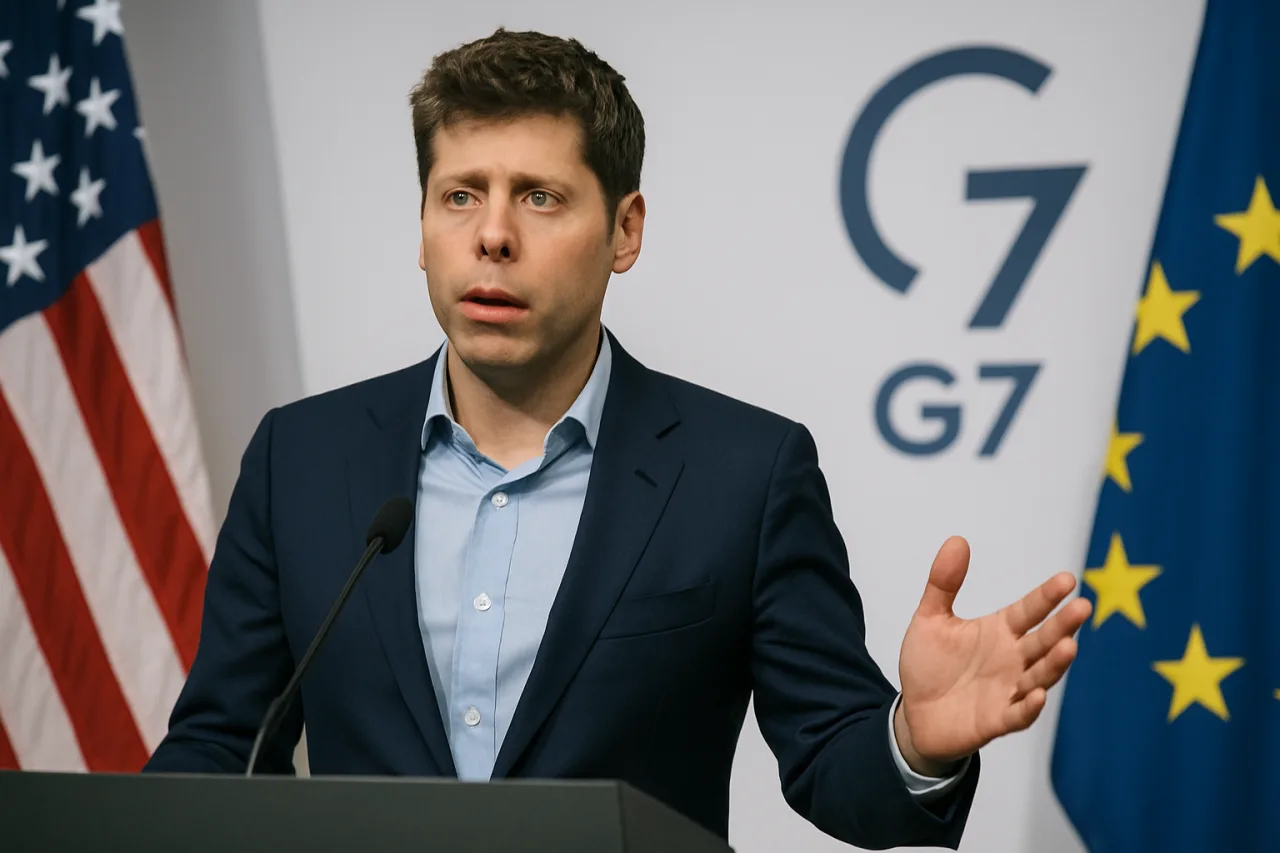
- 🎤 At the G7 on June 18, 2026, OpenAI’s Sam Altman quote — “Do not cede your responsibilities to AI labs like mine” — asked governments to keep oversight inside the public’s hands while industry self-regulates.
- 🧭 The line reads differently after September: the labs now openly coordinate safety standards, so the quote’s warning has become a test the public can actually grade.
- 💬 Six more AI-CEO lines define 2026 — from Amodei’s “pace the frontier” to Hassabis’s standards-body proposal — each one a position paper compressed into a sentence.
- ⚖️ The honest reading: powerful people asking for their own watchdogs is either accountability or strategy — and 2026’s quotes let you hold both thoughts.
- 🇵🇭 Why a Filipino professional should care: the language these CEOs use is becoming the rules your clients, tools, and career paths inherit.
Table of Contents
A CEO standing in front of seven heads of state, saying: the thing my company is building could change the world, and you should not trust people like me to police it alone. That is what OpenAI’s chief executive did on June 18, 2026, at the G7 summit — and the Sam Altman quote landed with a weight that has only grown since: “Do not cede your responsibilities to AI labs like mine.” It is the rare corporate sentence that reads as humility, strategy, and warning at once — and it is the key to understanding everything the AI industry did this September.
The Quote, and the Three Ways to Read It
Altman told world leaders not to hand them the keys. Reading one: accountability — democratic institutions, not shareholders, should hold the pen on rules for transformative technology. Reading two: strategy — regulation written by governments that understand the technology is regulation the incumbents can survive, unlike chaotic rules written in panic later. Reading three, offered by skeptics across Silicon Valley: licensing — the biggest labs are the only ones who can afford the compliance costs, so every regulation is a moat around the incumbents. All three readings are live at once; the sentence’s genius is that it does not let anyone off the hook, including its author.
Three months later, the quote became a testable claim. In September, Altman publicly endorsed Amodei’s “pace the frontier” essay, OpenAI began embedding third-party safety evaluators during model training, and the labs confirmed talks on a shared standards body. If you grade the June quote by September’s actions, the early report card says: some responsibility voluntarily shared, with the heavier rules still pending — which is exactly what “do not cede” promised and what critics predicted.
Seven AI-CEO Lines That Map 2026
The year’s executive record, in sentences long enough to matter:
- Sam Altman: “Do not cede your responsibilities to AI labs like mine.” — G7, June 18. The ask for democratic oversight of frontier AI.
- Dario Amodei (Anthropic): “If slowing down bought us even an extra year or two before models reach critical levels of capability, and we used that time to advance alignment, we could greatly reduce the risk that something goes seriously wrong.” — his September 12 essay. The math of pacing, not pausing.
- Demis Hassabis (Google DeepMind): “Dario’s essay points towards the right path forward. The details need working through, but the direction is correct for meeting this critical moment.” — X, September. The incumbent’s endorsement that made coordination real.
- Jensen Huang (NVIDIA): on the compute buildout — the supply side’s bet that intelligence infrastructure is the decade’s defining capex, delivered with his characteristic refusal to slow.
- Elon Musk (xAI): the Anthropic boss was “right” — September’s shortest endorsement, and historically the strangest, given the years of open rivalry.
- Altman to Fortune: safety standards were “not at a place” to push capabilities much further, and AI beyond human control was “absolutely” possible. The internal-topic admission: slowdowns had been a “primary topic” at OpenAI.
- Chris Lehane (OpenAI global affairs): “Everything should be on the table — including considering what can be built voluntarily outside government as an immediate step.” — the policy doctrine behind the standards-body talks.
Read in sequence, the lines trace one arc: from “trust our judgment” to “watch us while we pace ourselves.” That is the story of 2026’s quotes — the industry stopped denying the question and started negotiating the answer.
The Full-Sentence Discipline: How Quotes Drift When Shared
The G7 line itself traveled through three mutations within a day: shortened until it sounded like a plea for more corporate power, cropped to look like a rejection of regulation, and — most damaging — paraphrased into “Altman asks for lighter rules,” the opposite of what was said. The corrective is boring and powerful: carry the date, the venue, and the complete sentence. A quote is a citation, not a vibe. This matters twice over in 2026: first, because executive statements now move markets and policy within minutes; second, because AI-generated summaries routinely compress context in ways that survive only if the full text travels alongside. The reader who checks one primary source a week — the essay, the speech, the filing — is materially harder to mislead than one who reads ten threads a day.
The Scorecard So Far: Promises vs September
Grade the quote with the record: (1) promised democratic oversight; delivered — voluntary third-party evaluators and a standards-body process, both real but industry-designed. (2) promised that capabilities would not outpace safety — delivered in Anthropic’s unilateral evaluator commitment and OpenAI’s paused Astra training; pending — any binding mechanism. (3) promised no ceding — delivered so far as a negotiation, with the FRONTIER Act’s independent-verification clause still moving through Congress. Grade it yourself; the sources are linked. The discipline of grading public commitments by their follow-through is precisely the muscle this site’s coverage builds — and the muscle a professional audience should keep.
Why These Quotes Reach Beyond Silicon Valley
Quotable lines from AI executives are not decoration; they are the visible layer of decisions with long shadows. When Altman asks governments to keep responsibility, he is defining who gets called when AI fails — a question every country with an AI workforce inherits. The Philippines’ AI policy conversation, from DICT’s national AI roadmap work to the ASEAN chairship’s responsible-AI agenda, imports its assumptions largely from exactly these debates; the vocabulary Manila debates next session was coined at the G7 and in September’s essays. For the Filipino professional, the practical stake is simpler: clients quote the headlines. When your employer or your client asks “isn’t AI being slowed down?” or “is it safe to build on this?” — the accurate answer comes from the primary quotes, not the secondhand summaries. That is why this series prints the sources: the September pact in full, and the CEO lines above with dates and venues attached — and our government-AI coverage tracks where those rules land locally.
One discipline note for readers who share quotes: AI-CEO statements circulate with edits that flip their meaning — the Musk “right” endorsement and the Altman G7 line both traveled in truncated forms within hours. The date, the venue, and the full sentence are the difference between reporting and rumor; when in doubt, quote it whole or not at all. That is the house rule this site holds itself to — and the standard we invite readers to hold us to.
The Reader’s Takeaway: Quote Literacy as a Skill
Executive language is now infrastructure: standards bodies, procurement rules, and compliance careers are being built on sentences like these. The skill is to read a quote the way an analyst reads a filing — who said it, to whom, under what incentive, and what happened after. The Sam Altman quote passes that test in a way few corporate statements manage: it made a falsifiable promise about who stays responsible, and 2026 is the year the industry started keeping receipts — publicly, in its own words. Keep yours too.
Frequently Asked Questions (FAQ)
- Q: What exactly did Sam Altman say at the G7?
- On June 18, 2026 he told world leaders: “Do not cede your responsibilities to AI labs like mine” — arguing governments must retain oversight of frontier AI rather than delegating it to the companies building it.
- Q: Is the Sam Altman quote a call for regulation?
- It is a call for shared responsibility: government oversight plus industry self-regulation. By September, OpenAI supported bipartisan US legislation on catastrophic-risk mitigation and third-party evaluators — so the quote’s direction held.
- Q: What did Altman say about slowing down AI?
- On X: “I agree with Dario that we need to pace the frontier,” calling independent evaluators “a great idea” — and telling Fortune that standards were “not at a place” to push capabilities much further.
- Q: Which AI-CEO quotes define 2026?
- The year’s map: Altman’s G7 responsibility line, Amodei’s “pace the frontier” essay, Hassabis’s standards-body direction, Musk’s “right,” and Lehane’s “everything should be on the table” — all documented with dates in this piece.
- Q: Why should Filipino professionals track these quotes?
- Because they set the rules in motion: safety standards, evaluator careers, and client expectations all flow from these statements. Knowing the primary sources keeps you ahead of the secondhand noise.