Table of Contents
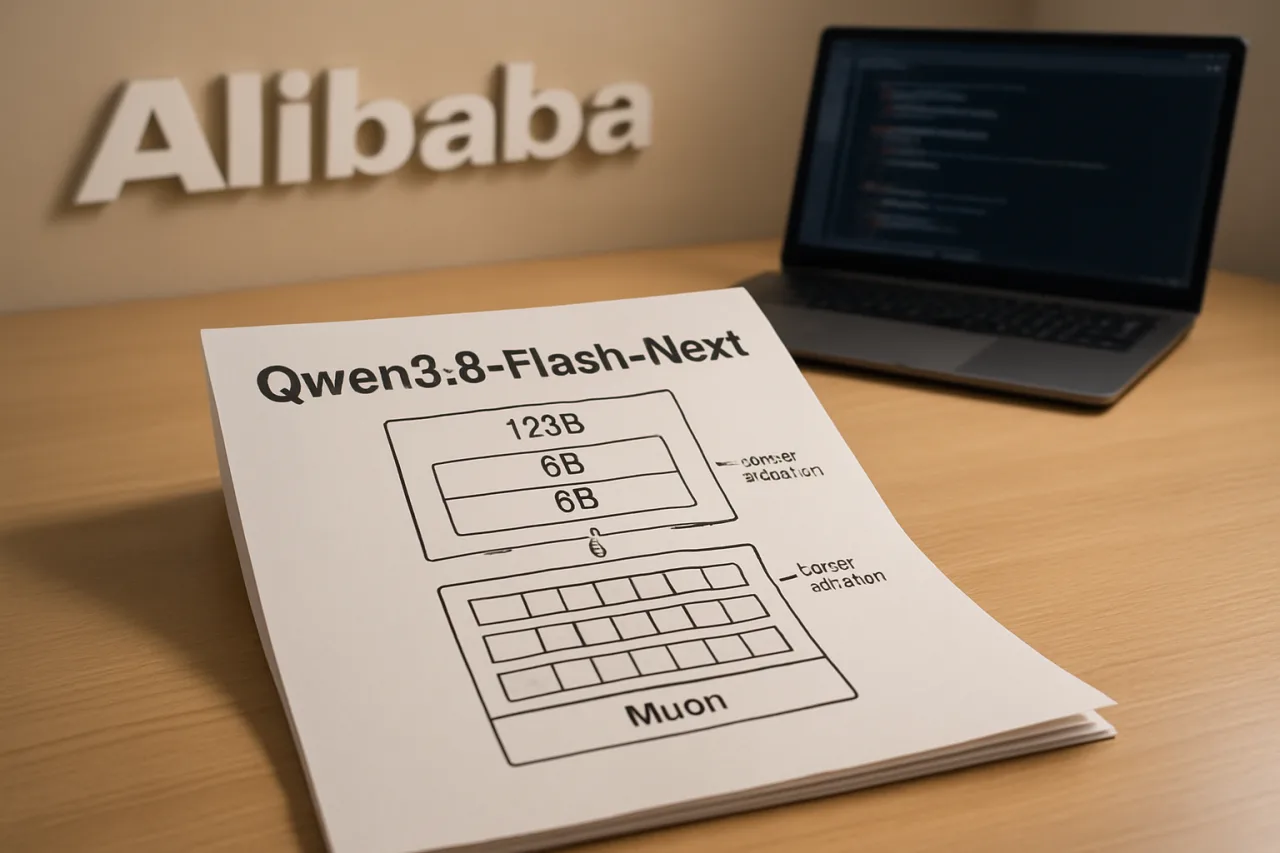
Qwen3.8-Flash-Next architecture reading is the highest-leverage homework an AI engineer can do this quarter: Alibaba quietly released this open-weight model on August 26, 2026 — the second-generation “Next” research line — and almost every design choice inside it points at the same target: drive down the cost of a token without giving up capability. The specifications read like a manifesto: 125 billion total parameters but only 6 billion active per token (a 48-layer mixture-of-experts design), Qwen Sparse Attention processing context in blocks, a 51-billion-parameter n-gram embedding table that compresses the input sequence before the expensive layers ever see it, and the Muon optimizer’s momentum trick sharpening training. None of these ideas is entirely new — but Flash-Next is the first production-grade open model combining them all, and its architecture is explicitly the blueprint Alibaba has said will underpin the next generation, Qwen4. This Qwen3.8-Flash-Next guide explains what each component actually does, why the efficiency-first design matters for anyone running AI on their own hardware (including the private AI setups this publication covers), and how to decide today whether to deploy Flash-Next, wait for Qwen4, or stick with the incumbent — because the architecture you learn now is the architecture you will be tuning for the next year.
Key Takeaway
- 🏗️ The design in one line: 125B total parameters, 6B active per token (MoE), Qwen Sparse Attention, N-gram Embedding, GDN + QSA attention hybrid, Muon optimizer — efficiency at every layer of the stack.
- 🧪 The research-as-product pattern: the “Next” line ships research as production weights one year ahead of mainline — Qwen3-Next (Sep 2025) designed the family, Flash-Next (Aug 2026) previews Qwen4.
- 💰 Who should care: self-hosters and cost-sensitive API buyers — the architecture targets token cost directly, and the open weights let you verify the claims on your own hardware.
- 📅 What to wait for: Qwen4 has not launched; the September rumors rest on one unverified leak — but the architecture Flash-Next exposes is confirmed, and it is the blueprint.
Every AI efficiency breakthrough arrives twice: once as a paper nobody reads, and once as a model that changes your bill. Qwen3.8-Flash-Next is the second arrival of ideas that first shipped in Qwen3-Next almost exactly a year earlier — and the pattern Alibaba has established is worth naming before the specifications are, because it changes how you should read this model: the “Next” line is Alibaba publishing its research as production weights, on a one-year cadence, before committing the design to the mainline family. Qwen3-Next in September 2025 introduced Gated Delta Net plus Gated Attention; that design then powered every Qwen release for the following year. Flash-Next in August 2026 introduces the next stack — Qwen Sparse Attention, Gated Residual connections, N-gram Embedding, and its open weights live on Hugging Face — the documentation states the intent plainly: this design is intended to underpin Qwen4. By the time Qwen4 ships, the community will have stress-tested these components at scale for a year. For engineers, that makes Flash-Next not a model release but a syllabus: the components are the exam material for whatever Alibaba ships next, and for the open ecosystem that will inevitably fine-tune, quantize, and deploy it. This guide reads the architecture component by component, translates each into operational consequences, and closes with the deployment decision framework — including the honest caveats about where sparse attention and MoE routing complicate life on modest hardware.
The Qwen3.8-Flash-Next Mixture-of-Experts Core: 125B Brains, 6B Active
The Qwen3.8-Flash-Next headline specification — 125 billion total parameters with roughly 6 billion active per forward pass — is the design’s economic engine, and it works through routing. A mixture-of-experts transformer contains many “expert” feed-forward blocks; a learned router inspects each incoming token and dispatches it to a small number of relevant experts (Flash-Next’s class of design routes each token to a fixed number), so the model holds vast knowledge but pays compute only for the experts a token actually consults. The operational consequences are concrete. Memory cost stays large: all 125 billion parameters must sit in memory — MoE saves compute per token, not hardware — which is why Flash-Next deployments cluster on multi-GPU nodes or aggressive quantization. Throughput is the payoff: with only ~5% of the network active per token, generation speed per GPU rises sharply compared to a dense 125B model, and the cost-per-token economics follow. Batching behavior changes: MoE models route different requests to different experts, so batch efficiency depends on traffic diversity — a self-hosted deployment serving many users gets better expert utilization than a single-user box, which is the technical reason Flash-Next is aimed at serving infrastructure rather than hobbyist laptops. For readers running the private AI setups this publication documents, the honest guidance: Flash-Next is a “KVM 4 and up” workload at native precision — per the independent architecture analyses, viable on smaller hardware only after quantization — and quantized MoE quality is exactly the kind of claim the open weights let you verify yourself rather than trust.
Qwen Sparse Attention: Flash-Next’s Answer to the Long-Context Tax
Standard attention is the transformer’s tax: every token attends to every previous token, so cost grows quadratically with context length — the reason long documents get expensive. The Qwen3.8-Flash-Next answer, Qwen Sparse Attention, processes context in blocks: each token attends fully to a local window and selectively to a broader context through learned block-level patterns (the released design uses block-level budgets rather than full matrices), which converts the quadratic tax into something closer to linear-plus-constant for most workloads. The operational translation for practitioners: long-context tasks become affordable — the retrieval-style workloads, long-code analysis, and document pipelines where context length previously dominated the bill. The honest caveats: sparse attention changes model behavior at the margins — retrieval quality over very long spans depends on the sparsity pattern learning what to skip, which is precisely the kind of design choice community stress-testing (the purpose of the Next line) is meant to validate; and not every inference engine has optimized kernels for this attention variant yet, so real-world speedups depend on the serving stack you run. The strategic read: attention sparsity is the industry’s consensus answer to the long-context cost problem, and Alibaba shipping it as open production weights — a year before the mainline family adopts it — is how the technique gets battle-hardened in public. Engineers who learn QSA now are learning the attention economics their next twelve months of deployments will bill against.
Qwen3.8-Flash-Next’s N-gram Embedding and Muon: The Layers That Compound
Two Qwen3.8-Flash-Next components receive less headline attention than MoE and sparsity, and both deserve the engineer’s attention precisely because they are the compounding kind. N-gram Embedding: Flash-Next adds a 51-billion-parameter lookup table — 20 million entries of bigram and trigram statistics — at the second layer, giving the model a compressed, hard-wired map of common token sequences before the expensive attention machinery engages. The idea is old (n-gram language models are prehistory in NLP terms) and the implementation is new: the table lets the model resolve frequent patterns cheaply, reserving the expensive reasoning for the tokens that need it — efficiency by memory rather than computation. The practical consequence shows up in throughput and in cost-per-token at scale, which is the design’s whole thesis. Muon: the optimizer choice matters less at inference and more at training and fine-tuning time — Muon’s momentum-orthogonalized updates have shown faster convergence in open research, and its presence in Flash-Next’s recipe matters most for the community: faster fine-tuning convergence means cheaper adaptation of the open weights to local languages and domains, which is directly relevant to the Filipino-language model efforts this publication has tracked. Neither component is glamorous. Together they signal the design philosophy: efficiency is not one big trick but a stack of medium tricks, each shaving a percentage — compounded across a serving fleet, the stack is the difference between marginal and competitive economics.
Qwen3.8-Flash-Next Deployment Guidance: Now, Qwen4 Later — or Neither?
The Qwen3.8-Flash-Next deployment decision, honestly weighted for three reader profiles. For the self-hoster (the Ollama-on-VPS crowd this publication serves): Flash-Next at native precision needs multi-GPU-class hardware; quantized deployments bring it toward the feasible, and the open weights mean the community’s quantization work arrives fast — the practical move is to test the quantized build against your actual workload and measure tokens-per-second and quality on your own data, because MoE plus sparsity makes benchmark extrapolation unreliable. For the API buyer: the relevant comparison is cost-per-token against the incumbent Chinese-lab options — DeepSeek’s V4.1 Flash line in particular — and the honest guidance is to benchmark on your own task mix, because MoE efficiency claims translate to real invoices only when your traffic pattern matches the architecture’s assumptions. For the researcher and the Qwen ecosystem bettor: Flash-Next is the public preview of Qwen4, and the year-long community stress-test is the point — early engagement with the architecture (its quirks, its kernels, its quantization behavior) is how expertise compounds ahead of the mainline launch. What to wait for: Qwen4 itself — the September launch rumors trace to a single unverified YouTube leak that Alibaba never confirmed, and this publication’s freshness gate holds that a launch date built on one leak is a rumor, not a date. The staged rollout that Qwen3.8’s own releases followed is the likely Qwen4 pattern: preview, then staged mainline. Plan infrastructure for it; do not plan announcements around it.
Why the Qwen3.8-Flash-Next Architecture Matters: The Open-Weight Efficiency Race
The Qwen3.8-Flash-Next release sits inside a shift bigger than any one model: the open-weight ecosystem has made efficiency — tokens per dollar, quality per active parameter — the decisive competitive axis, because capability gaps are closing while serving costs remain the binding constraint for everyone actually deploying AI. DeepSeek’s V4 line proved the demand side: an architecture family whose API pricing collapsed within days of launch, with V4.1 Flash absorbing the flagship’s traffic at Flash rates. Flash-Next is Alibaba’s answer in kind: publish the efficiency architecture as open weights, let the community stress-test it for a year, and arrive at the mainline launch with the components already proven in production. For the markets that consume this wave — the Philippines among them, where local deployments run on exactly these open weights — the trend compounds in one direction: every efficiency improvement in an open model is a permanent price floor for everyone downstream, and every architecture lesson published this way transfers to the next builder. The practical conclusion for engineering teams is the one this guide has carried throughout: the teams that learn the efficiency architectures now — MoE routing behavior, sparse attention kernels, quantization interplay — will be the ones deploying the Qwen4 generation on day one at costs the previous generation could not touch, while the teams that wait for the headline launch will be learning the syllabus the winners finished a year earlier. The model is open. The homework is assigned.
Frequently Asked Questions
What is Qwen3.8-Flash-Next?
Alibaba’s open-weight efficiency-focused model released August 26, 2026 — a 125-billion-parameter mixture-of-experts design with about 6 billion active parameters per token, featuring Qwen Sparse Attention, a 51B-parameter N-gram Embedding table, Gated Delta Net plus QSA attention hybrid, and the Muon optimizer. It is the second-generation “Next” line release: research shipped as production weights, explicitly intended to preview and stress-test the Qwen4 architecture.
How does Flash-Next reduce cost per token?
Through compounding efficiency layers: mixture-of-experts routing activates only ~5% of parameters per token (cutting compute per token), sparse attention converts the quadratic long-context cost toward linear, and the N-gram table resolves frequent token sequences cheaply before expensive layers engage. The combined effect targets the serving economics — more tokens per GPU-hour — which is what shows up in API prices and self-hosting bills.
Can I run Qwen3.8-Flash-Next on a single GPU or small VPS?
Not comfortably at native precision: all 125 billion parameters must reside in memory even though only 6 billion activate per token, which puts native deployments on multi-GPU nodes. Quantized builds change the math and are exactly what the community tests — the practical approach for smaller setups is to try the quantized builds against your workload and measure, rather than assume either way. For modest VPS-class hardware, smaller full-attention open models remain the sane default.
When does Qwen4 launch?
No confirmed date exists. A July 2026 YouTube leak claimed September 2026, but Alibaba has not confirmed it and the leak’s other claims remain unverified — treat any specific launch date as rumor until Alibaba announces. The verified pattern: the “Next” line previews the architecture roughly a year ahead, and Qwen3.8’s own releases followed a staged rollout.
Flash-Next vs. DeepSeek V4.1 Flash — which should I deploy?
Benchmark on your own workload; the honest comparison depends on traffic patterns. Both are efficiency-first MoE designs from the Chinese open-weight wave, but routing behavior, sparsity patterns, and quantization maturity interact with task mix unpredictably — aggregate benchmarks are poor predictors of your bill. The open weights exist for both: the team that tests on its own data deploys with evidence rather than hype.
Why does the “Next” release pattern matter for engineers?
Because it converts research papers into deployable, testable artifacts a year before mainline adoption: Qwen3-Next’s 2025 design powered every subsequent Qwen release, and Flash-Next’s components are the stated Qwen4 blueprint. Engineers who engage with the Next-line models accumulate the exact operational knowledge — kernels, quantization, routing quirks — that the next generation will demand, on a timeline measured in years rather than weeks.
Financial Disclaimer
This article is published for general information and engineering guidance. It is not investment or purchasing advice. Architecture details are from Alibaba’s published materials and independent technical analysis as of September 2026; benchmark claims should be verified against your own workloads before deployment decisions.