Table of Contents
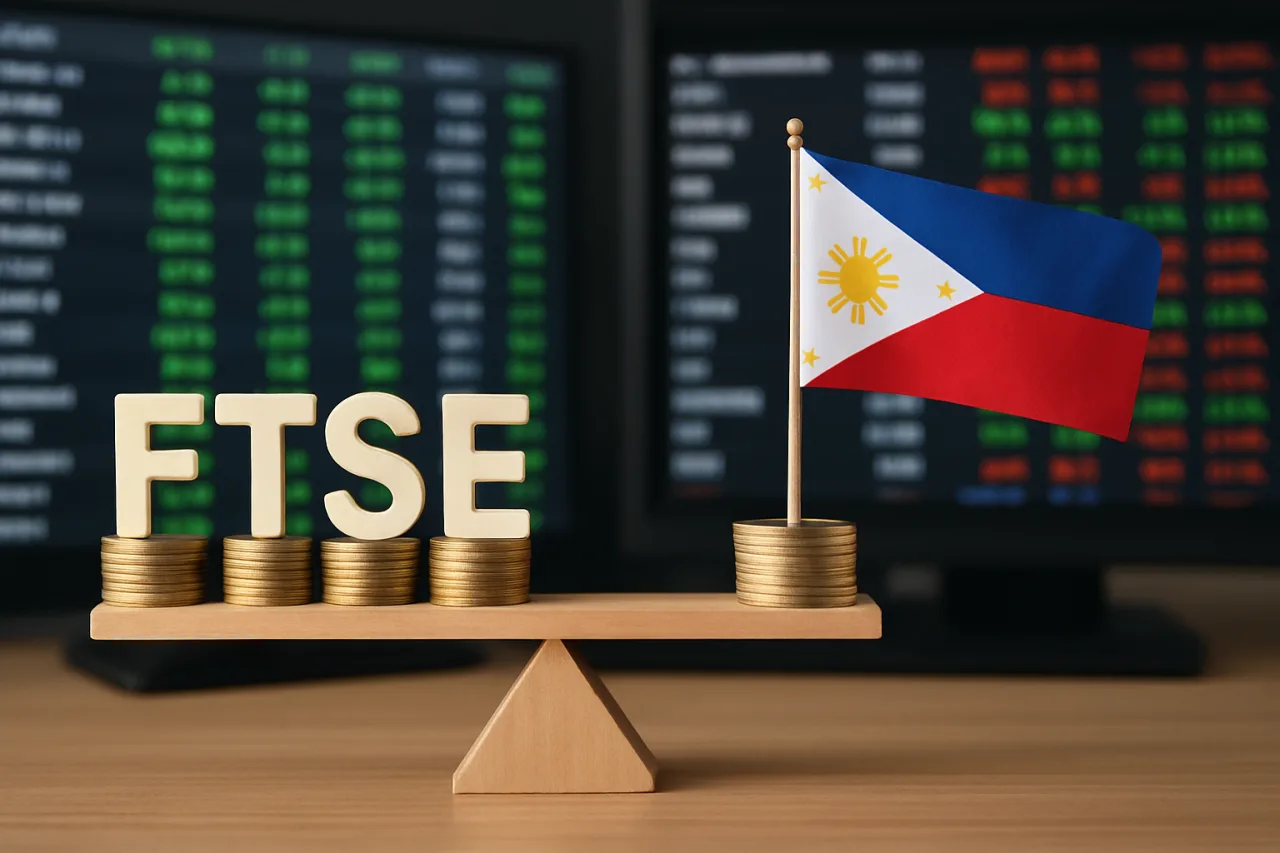
FTSE rebalancing day arrives at the Philippine Stock Exchange this Friday, September 18 — the semi-annual moment when index funds across the world adjust their Philippines holdings to match FTSE Russell’s updated indices, and when Manila’s trading floor sees volume spikes that have nothing to do with news and everything to do with arithmetic. The mechanics are simple and the stakes are real: index funds tracking FTSE’s global and Philippines indices must buy whatever enters the index and sell whatever leaves it, in exact proportion, at the closing auction — which is why the last hour of a rebalancing Friday routinely trades multiples of an ordinary day. The history says what to expect: on previous rebalancing days the PSEi has closed marginally lower (6,135.35, down 0.3%, on one such day per Manila Standard’s reporting), individual stocks have moved sharply on flows rather than fundamentals, and the advance-notice effect means most of the price impact happened weeks ago, when the changes were first announced. For the Filipino retail investor, this guide covers what actually happens on rebalancing day, which mistakes cost money, why the smartest move is usually the boring one, and the one classification change in this year’s global review that touches every emerging-market portfolio — including the funds holding Philippine stocks.
Key Takeaway
- 📅 What’s happening: FTSE Russell’s semi-annual review rebalances its index series after Friday’s September 18 close, with changes effective Monday (FTSE Russell’s official reconstitution resources) — expect the heaviest volume of the week in the final hour.
- 📊 What history says: index changes are announced weeks ahead, so most of the price impact is priced in before the day; recon-day moves are often smaller than the anticipation trading that preceded them.
- 🇻🇳 The big global change: Vietnam upgrades from frontier to secondary emerging market effective September 21 — a capital-flow shift across Southeast Asia that touches regional fund allocations, including Philippine weightings.
- 🧘 The retail playbook: do nothing impulsive — no chasing index additions on the day, no panic-selling deletions; place any needed orders before the final-hour turbulence, and let the funds’ arithmetic pass through.
Index rebalancing is the closest thing financial markets have to a tide: predictable, powerful, and completely indifferent to your opinion. Twice a year — March and September for the FTSE Global Equity Index Series — FTSE Russell recalculates its indices: companies that grew into large-cap size move up, companies that shrank or delisted drop out, free-float adjustments re-weight everyone else. None of this is opinion. It is formula. But the formula moves real money: every index fund and ETF benchmarked to the affected indices must trade to match, billions of dollars globally, and in a market the size of the Philippines — where daily turnover is modest by world standards — even modest foreign repositioning prints abnormally high volume. The professional preparation began weeks ago, when FTSE published its review results; by Friday, most index-tracking trades are already positioned, and the day itself is largely about execution: passive funds squeezing their trades through the closing auction, arbitrageurs providing liquidity, and the occasional retail investor paying the spread by trading into the turbulence. This FTSE rebalancing guide explains the machinery — who moves, why, and when — then gives the retail playbook that turns a confusing Friday into a non-event, plus the Vietnam upgrade angle that makes this particular rebalancing more interesting for Southeast Asian portfolios than most.
How FTSE Rebalancing Actually Works — the Mechanics in Plain Language
The machinery has three stages, and knowing them explains everything you will see on the tape. Stage one: the announcement, weeks ahead. FTSE Russell publishes its review results — additions, deletions, reclassifications — roughly five weeks before the effective date. This is when the money moves: active traders position early, index funds begin planning execution, and the price pressure from the changes largely happens here, not on the effective day. Research on reconstitution effects consistently shows the advance-notice pattern: additions tend to rally on announcement and deletions tend to weaken — and by the time the effective date arrives, much of that impact is already priced in, sometimes to the point of overshoot, where actual rebalance-day trades reverse the anticipation moves. Stage two: the effective date’s close. The formal switch happens at the close of the third Friday of the review month — September 18 this cycle, changes live from Monday the 21st. Index funds must execute their rebalancing trades at or near that close to minimize tracking error, which compresses enormous flow into the final auction: the highest-volume closing prints of the quarter, in markets like the Philippines especially. Stage three: the after. Within days, the abnormal volume fades and prices drift back toward fundamentals — the index effect, on average, is temporary. The reason a Filipino investor should understand this machinery: rebalancing Fridays generate news that looks meaningful (big volume, sharp intraday moves, “foreign selling” headlines) and is mostly mechanical — and investors who mistake the tide for weather make the expensive decisions.
What the September 2026 FTSE Rebalancing Means for Philippine Stocks
This FTSE rebalancing’s local stakes sit inside a bigger regional shuffle, verified against FTSE Russell’s published ground rules. The headline change is Vietnam: effective September 21, Vietnam upgrades from frontier to secondary emerging market status in the FTSE classification — a change that forces emerging-market funds to consider Vietnamese exposure and, mechanically, redistributes regional allocation attention. The Philippines is unaffected as a classification, but a Southeast Asian neighbor’s upgrade matters for Filipino investors because emerging-market funds allocate country weights in competition: capital that flows to newly upgraded Vietnam can come from the region’s other markets, and the Philippines’ weight in regional funds is a standing question every review. The local composition questions: the Philippine index’s constituents shift with market-cap moves and the September cycle’s review decisions — and this year’s local context adds unusual texture, with big-cap earnings season just closed and Robinsons Retail having delisted from the PSE at the end of August (index deletions follow delistings) and Emperador having returned to the FTSE global index in August per the company’s announcement, boosting its foreign-investor reach. The realistic expectations: as the local market commentary noted, this rebalancing is “not as big as MSCI” — the PSE’s weight in global indices is modest, so the flows are proportionally modest, and the main observable effect is a volume spike, some pressure on the specific stocks entering and leaving, and headlines that overstate both. The professional takeaway for a Filipino stock investor is calibration: rebalancing Fridays matter for execution and for understanding tape noise, but they are not investment theses — no one’s long-term thesis about a Philippine blue chip should change because a formula moved it 0.1% of a global index.
The Retail Playbook: Five Rules for FTSE Rebalancing Friday
The mistakes that cost money on FTSE rebalancing days are predictable, which makes them avoidable by rule. Rule one: do not chase the addition. The stock entering the index often rises on announcement — weeks before the effective day — and buying it on rebalancing Friday means paying the peak of anticipation; academic and practitioner research on index effects consistently shows the post-inclusion period can disappoint precisely because the demand surge is behind it. Rule two: do not bargain-hunt the deletion. The stock leaving the index often looks “oversold” on the day — and sometimes it is, with reversals documented — but deletions leave for reasons (shrinking size, liquidity, delisting) that persist after the mechanical selling ends; the index effect is noise, the reason for deletion is signal. Rule three: if you must trade, trade early. Placing a needed order before the final hour avoids the compressed-liquidity window where spreads widen and fills suffer; the closing auction belongs to the index funds and their execution algos, and there is no retail edge in competing with them for prints. Rule four: ignore the volume headlines. “PSE turnover surges on FTSE rebalancing” explains the tape, not the future — the volume is mechanical, the day after reverts to normal, and reading strategy into a plumbing event is how retail investors donate money to the arbitrage community. Rule five: use the day as a checklist moment. The one genuinely productive rebalancing-day activity is portfolio hygiene: if an index deletion reminds you that you own a stock you have not reviewed since you bought it, the review is due regardless of the index — the rebalance is the calendar reminder, not the reason.
The Bigger Picture: What Index Membership Means for the Philippines
Zoom out from the day and the deeper story is what index architecture means for a market the size of Manila. Index inclusion is passive capital’s permission structure: the deeper the Philippine weight in the global series, the more automatic, sentiment-blind money flows into PSE stocks — and the reverse. That is why the classifications matter beyond the calendar: FTSE’s Vietnam upgrade signals to every global allocator that Southeast Asia’s frontier is graduating, and the Philippines — already classified as secondary emerging — competes for the same global attention with a market whose 2026 has been, by the PSE’s own framing, challenging: an index that touched 5,768.76 in May (its lowest since November 2025) before recovering toward the 6,100s — the 6,000-line battle our market coverage has followed all year, and a delisting (Robinsons Retail’s ₱18.4-billion privatization) that shrinks the investable universe. The strategic reading for Filipino investors: index mechanics are neither friend nor enemy, but they are a wind gauge — foreign passive money amplifies whatever direction the market is already moving, and the PSE’s periodic inclusions and exclusions mark where that wind is shifting — the same flows our PSEi rebound coverage tracked. The local market’s long-running project — more listings, deeper liquidity, stronger fundamentals that earn larger index weights — is how the Philippines graduates from “rebalancing footnote” to “allocation conversation,” and every review cycle is a small referendum on that progress. Friday’s volume spike is the sound of that referendum’s mechanics, not its verdict.
Frequently Asked Questions
What is FTSE rebalancing?
FTSE rebalancing is the semi-annual review (March and September) in which FTSE Russell recalculates its global index series — adding and removing stocks based on market capitalization, liquidity, and free-float criteria, and reweighting everything else. Changes are announced weeks ahead and take effect at the close of the third Friday of the review month; this September, that is Friday the 18th, with changes live from September 21.
How does FTSE rebalancing affect Philippine stocks?
Philippine stocks entering or leaving FTSE indices see temporary demand shifts — additions typically gain on announcement as index funds buy, deletions lose support — but because the changes are announced weeks in advance, most price impact occurs before the effective day. The observable effect on September 18 itself is mainly a volume spike in the final hour, and history shows rebalance-day price moves are often smaller than the anticipation trading that preceded them.
Is the FTSE rebalancing as big as the MSCI rebalancing for the PSE?
No — as local market commentary notes, the FTSE review is “not as big as MSCI” for Philippine flows. MSCI’s Philippines weight in its emerging-markets index draws larger passive flows, so MSCI rebalancing months produce the bigger tape; the FTSE cycle still moves meaningful volume for the specific stocks affected and deserves execution care, but its market-wide price impact is typically modest.
What is the Vietnam upgrade and why does it matter to Philippine investors?
Effective September 21, 2026, FTSE reclassifies Vietnam from frontier to secondary emerging market status — a global recognition that redirects emerging-market fund attention and capital toward Vietnam. The Philippines keeps its classification, but regional allocations compete: an upgraded Vietnam competes for the same global emerging-market flows, which is why the change is relevant to every Southeast Asian allocation, including funds holding Philippine stocks.
Should I buy index additions or sell deletions on rebalancing day?
The evidence-based answer is: not on the day. The anticipation effect — announcement to effective date — is where most of the price impact happens, and rebalancing-day trades sometimes reverse it. Chasing additions at the peak of passive demand or bargain-hunting deletions whose reasons persist are both documented retail losses; the disciplined move is to let the funds’ arithmetic pass through and make portfolio decisions on fundamentals, not index plumbing.
Does the PSEi usually fall on FTSE rebalancing day?
Not reliably. On one previous Philippine rebalancing day the PSEi closed down 0.3% at 6,135.35, but index-effect research across markets shows no consistent directional pattern on the day itself — the changes are announced weeks early and largely priced in before the close. Treat the day’s moves as mechanical noise around the real signal: the fundamentals of the companies entering and leaving.
Financial Disclaimer
This article is published for general information and financial education. It is not investment advice or a recommendation to buy or sell any security. Index composition and market data are from FTSE Russell’s published ground rules and press reporting as of September 2026; markets involve risk, and readers should conduct their own research or consult a licensed advisor before investment decisions.