Table of Contents
Key Takeaway
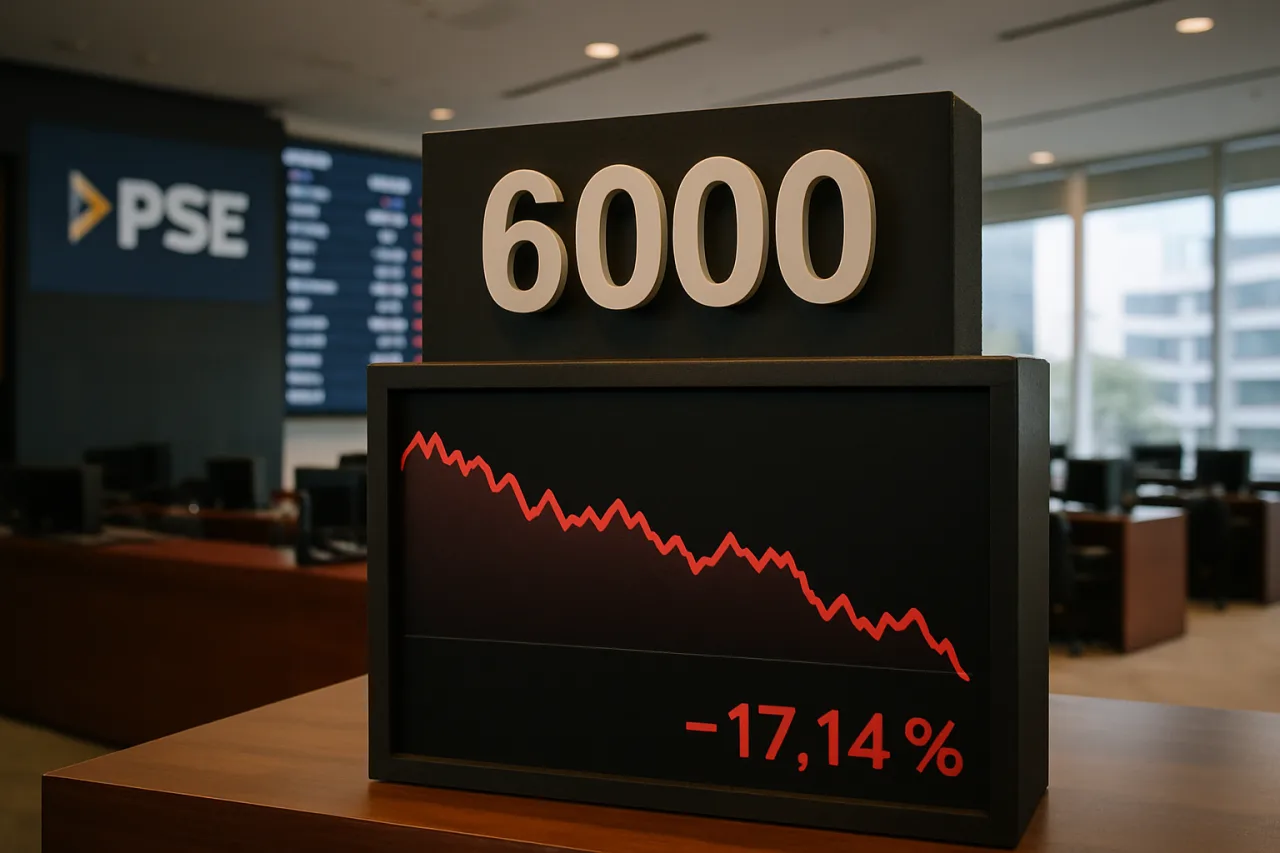
- 📏 The PSEi 6000 line is holding — barely: The PSEi closed at 6,007.78 on September 15, 2026, down 67.29 points (-1.11%), erasing the prior session’s rebound and hovering just 0.13% above the psychological 6,000 mark.
- 💱 The peso backdrop worsened: The peso hit a record-low finish of ₱62.86 on Monday before recovering 2.5 centavos to ₱62.835 — with an intraday low of ₱62.925 showing the pressure never left.
- 💵 The household flip side: A $500 monthly remittance now converts to roughly ₱31,400, up about ₱1,400 from a year ago — the same weakness that pressures the index pads the family budget.
- 🎯 The analyst range: Philstocks projects the PSEi finishing 2026 between 6,000 and 6,628 — meaning the current level sits at the very bottom of professional expectations, not the middle.
- 🧭 The playbook: Investors without a written plan for a close below 6,000 are winging it — the decision framework below covers position sizing, averaging rules, and what would actually signal a buying window.
The PSEi is holding 6,000 by its fingernails. Tuesday’s session erased Monday’s rebound — 67.29 points gone, closing at 6,007.78 — and left the index 7.78 points above the round number that Philippine markets have been treating as a floor, a ceiling, and a dare all at once. Beneath it sits a weaker peso, with the currency’s record-low finish on Monday still fresh and its intraday trough of ₱62.925 on Tuesday proving the pressure never left. Above it sits a professional consensus that offers little comfort: Philstocks’ September outlook expects the PSEi to finish the year in a range of 6,000 to 6,628, which places today’s level not in the middle of the forecast but at its very floor. The PSEi 6000 question is now the market’s central referendum, and one point of index movement is noise. What happens after a confirmed close below 6,000 is a portfolio decision — and the honest question for every Filipino investor right now is whether that decision has been made in advance or will be improvised in panic.
Related: How Long Before a Filipino Blog Earns Its First Peso? The 2026 Timelin
Why the PSEi 6000 Level Actually Matters
Round-number levels are psychology, not mathematics — and in markets, psychology trades real money. The 6,000 mark functions simultaneously as a support line that bulls defend, a stop-loss trigger that systematic traders act on, and a headline number that frames every financial-news segment for ordinary investors. The PSEi 6000 test is exactly this dynamic in motion: when an index spends multiple sessions hovering just above such a level, each close becomes a referendum: hold, and the floor strengthens; break it, and the same psychology that defended the level accelerates the fall beneath it.
The recent tape shows exactly this dynamic. The index fell through early September, snapped a four-day losing streak with a rebound we covered at the time — the September 2 recovery and what to do before it faded — then ground back down toward the line. Tuesday’s 1.11% drop undid that rebound’s gains in a single session on ₱4.84 billion of traded value. The pattern of sharp recoveries followed by sharp givebacks is characteristic of a market that has not decided where it wants to be, which is precisely the environment where the psychological levels matter most.
What makes the PSEi 6000 line heavier than most: it is not just a chart line. It anchors the bottom of the professional forecast range. When the sell-side’s own year-end projection starts at your current price, the market is being told there is, in the consensus view, essentially zero upside left in 2026 — a message that does not require a headline to move money.
The Peso Is the Other Half of the Story
Equities are only half the picture, and the other half is deteriorating faster. The peso closed at ₱62.835 against the dollar on Tuesday, a 2.5-centavo recovery from Monday’s all-time-low finish of ₱62.86 — but the intraday low hit ₱62.925, meaning the currency probed deeper into record territory before rebounding. For context on how fast the floor has moved: the peso sat near 57 a year ago, meaning nearly 10% of purchasing power against the dollar has evaporated in twelve months, a slide we tracked through the peso’s 9.6% annual drop and its record-low streak.
The practical peso math for households is worth stating plainly. A family receiving $500 a month received about ₱28,500 at last year’s rate; at this week’s rates, the same dollar remittance converts to more than ₱31,400 — a windfall of roughly ₱1,400 per $500 sent, arriving without any change in the sender’s sacrifice. That arithmetic is why remittance-dependent households experience this market differently from portfolio investors: the currency weakness that pressures the index literally pays a monthly dividend to the families the index’s weakness worries. Both effects are real, and only one of them shows up in the stock headlines.
The two markets move together, and the mechanism runs through foreign money. A weakening peso raises the bar for foreign portfolio investors: peso-denominated returns must clear the currency’s slide before an overseas investor earns anything in dollar terms. When the peso makes new lows, foreign flows that fund Philippine equities demand either cheaper entry prices or leave entirely — which is how a currency story becomes an equity story within days. The foreign portfolio flow dynamics we analyzed in September showed exactly this channel at work.
For OFW families, the same weakness is income: every dollar remitted converts to more pesos, and the remittance record set against the weak peso captures that mirror image. The peso’s fall is bad news for the index and good news for the remittance receipt — and both sides of that trade are happening at once.
What Breaks First: Three Scenarios for the Rest of 2026
The honest way to hold a view at a psychological line is to write down the scenarios before the tape decides. Three plausible answers to the PSEi 6000 question, each with its tell:
Scenario one — the PSEi 6000 hold. The index bases above the line, the peso stabilizes, and buyers who priced in catastrophe never get their lower entry. The tell: a session that closes above the line on heavier volume after testing the intraday breach — capitulation selling absorbed by patient money. This is the base case of the Philstocks range, and history’s reminder: Philippine equities have repeatedly bottomed precisely when headlines said the floor had given way.
Scenario two — the break that fakes: the index closes below 6,000 for a day or two, triggers every stop-loss in the retail ecosystem, then reclaims the line within a week. This is the most common pattern at psychological levels globally — the level breaks exactly far enough to transfer shares from weak hands to strong ones. The tell: heavy volume on the breach days followed by a rapid recovery close back above the round number.
Scenario three — the confirmed break: the index accepts below 6,000, the peso makes fresh record lows, and the combination becomes self-reinforcing — foreign outflows pressure both markets simultaneously. The tell: a close below the level followed by lower highs, with the peso making new record finishes rather than recovering. In this scenario the prior support becomes resistance, and the next meaningful support sits measurably lower.
Which one arrives is not knowable in advance — which is the entire argument for preparing for all three instead of predicting one.
The Investor’s Decision Tree for a Close Below 6,000
A written plan converts volatility from a threat into a framework. The decisions that matter, in order:
First, know your exposure before the PSEi 6000 break, not after. Every investor should be able to state, on paper, what percentage of their portfolio is Philippine equities and what a 10% further decline would mean in pesos. A position that would cause sleep loss at 5,700 is too large — the time to trim is while the index still holds the level, when selling is a choice rather than a surrender.
Second, separate the panic sellers from the forced sellers. A psychological-level breach produces two very different flows: retail panic and mechanical de-risking. Neither is informed by valuation. The PSEi’s earnings yield improves with every leg down, and blue chips that clear their dividend yields against the peso’s weakness become institutionally interesting precisely when headlines turn darkest. The discipline is being able to tell “cheaper for a reason” from “cheaper because of a stampede” — the former justifies adding, the latter justifies waiting.
Third, average on a schedule, never on a hunch. For long-term investors adding to positions, the mechanical rule beats the tactical one: pre-committed tranches at pre-set levels — for example, adding a fixed amount if the index closes below 5,900, again at 5,500 — remove the improvisation that ruins compounding. The investor who buys “a little more” every red day runs out of ammunition at the actual bottom; the investor with written levels still has powder when it matters.
Fourth, watch the peso as confirmation, not as noise. A PSEi 6000 break on a stable currency reads as a local repricing; a break accompanied by fresh peso lows reads as capital leaving the country. The second is the one that changes allocation decisions, because it prices in a longer recovery. The BSP’s rate decisions against this backdrop remain the single most informative policy signal for both markets — the central bank is choosing between defending the currency and supporting growth in real time, with every move published on the BSP’s official site.
Fifth, respect the difference between trading money and life money. The 6,000 question matters most for the OFW and professional investor building a retirement position over decades. For that money, a psychological-line break is a change of weather, not a change of climate: the case for steady accumulation through volatility has survived every version of this debate for a century. The money meant for next year’s tuition has no business riding an index through a technical breakdown.
What to Watch This Week
Three signals convert the scenario framework into a daily discipline. The close: any finish below 6,000, and whether the next session reclaims it — the fake-break pattern announces itself within 48 hours. The peso: whether ₱62.925 holds as the intraday floor or the currency prints fresh lows, because the currency leads the narrative. And the foreign flows: net foreign buying turning into sustained selling is the institutional tell that the consensus range is being abandoned rather than defended. None of these requires a trading terminal — each is visible in the Philippine Stock Exchange’s daily trading information and BSP’s published reference rates — each is visible in the daily market recaps — and together they turn the line’s outcome into information instead of anxiety.
Frequently Asked Questions About the PSEi 6000 Level
Where did the PSEi close on September 15, 2026?
The PSEi closed at 6,007.78, down 67.29 points or 1.11%, on 4.84 billion pesos of traded value — leaving the index just 7.78 points above the psychological 6,000 mark.
Why is the PSEi 6000 level important?
Round-number levels act as psychological support and stop-loss triggers. At 6,000, the level also anchors the bottom of professional forecasts — Philstocks projects a 2026 finish between 6,000 and 6,628 — so the index currently sits at the floor of the consensus range.
What happens if the PSEi closes below 6000?
Three patterns are possible: a quick reclaim (the fake break, the most common outcome at round numbers), a confirmed break with lower highs and fresh peso lows (support becomes resistance), or a basing pattern that holds the line. A single close does not settle the question — the following 48 hours of price action usually does.
Is a PSEi 6000 break a buying opportunity?
A break driven by panic selling at otherwise intact fundamentals has historically preceded recoveries, while a break accompanied by currency records and sustained foreign selling signals a longer repricing. The distinction — not the break itself — is the signal, and it is why position sizing and written averaging levels matter more than prediction.
How does the weak peso affect PSE stocks?
A weaker peso raises the dollar-denominated hurdle for foreign investors, pressuring flows and valuations; it also lifts the peso value of dollar remittances and exporters’ revenues. The net effect is sector-dependent — which is why the currency’s trajectory is the key confirmation signal for any equity decision.
What should a long-term OFW investor do at this level?
Decades-horizon money has historically been served by steady, scheduled accumulation through volatility rather than tactical exits at psychological lines. The written-tranche approach — pre-set levels, fixed amounts — keeps the strategy mechanical when headlines get loud. Money needed for near-term expenses should not be in equities at all.
Financial Disclaimer
This article is for informational and educational purposes only and does not constitute professional investment advice. Stock prices, exchange rates, and analyst projections change constantly; verify current figures with official sources such as the Philippine Stock Exchange and the Bangko Sentral ng Pilipinas before making investment decisions.