Table of Contents
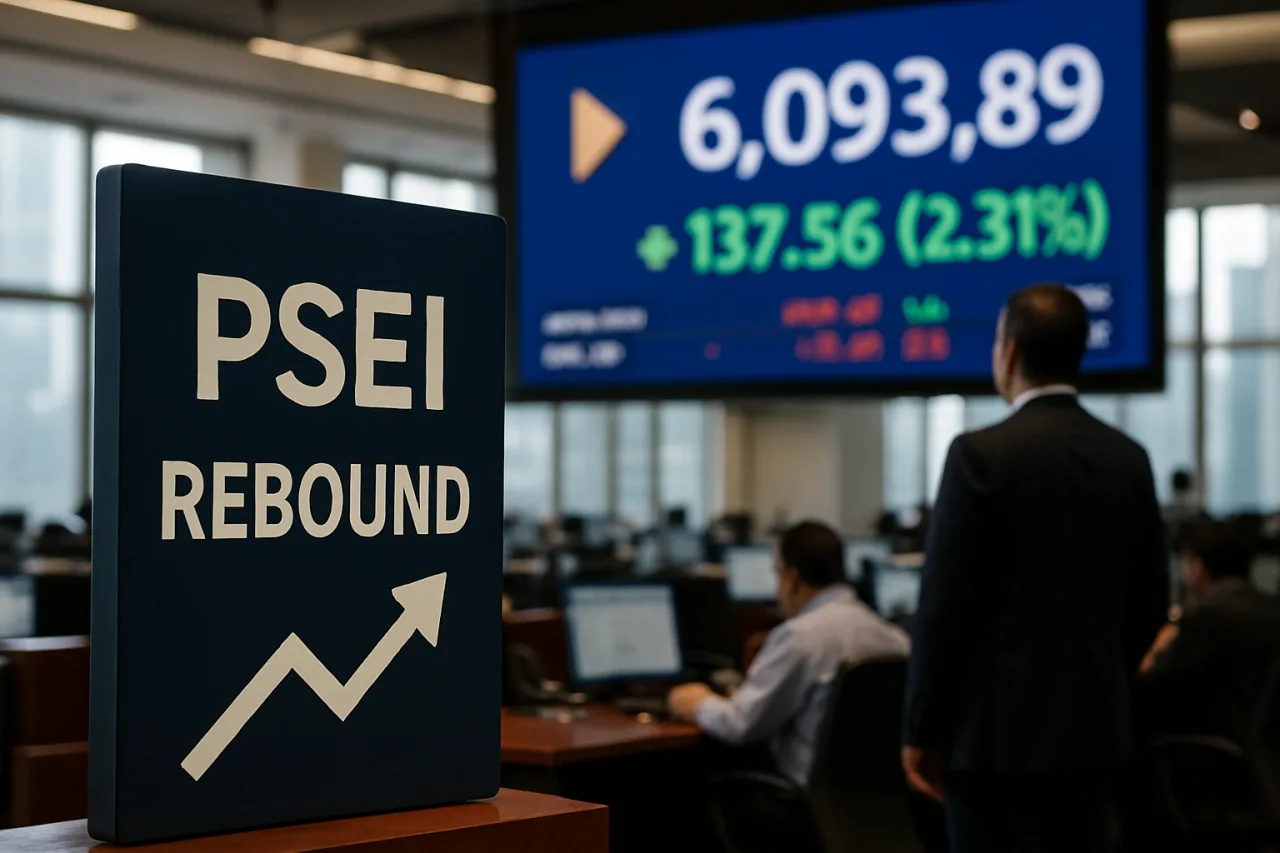
The Philippine Stock Exchange Index snapped a four-day losing streak on Tuesday, September 1, 2026, jumping 137.56 points — a 2.31 percent surge — to close at 6,093.89, reclaiming the psychologically critical 6,000 level as bargain hunters swarmed stocks beaten down by last week’s selloff. The rebound came on ₱8.24 billion in traded value, with the Services sector leading the charge at +5.45 percent, and it landed on the same day the peso sank to a record low of ₱62.40 against the US dollar. One session, two stories: local investors found their nerve, while the currency continued telling the more troubling story underneath.
Key Takeaway
- 📈 PSEi closed at 6,093.89, up 2.31% (+137.56 points) on September 1 — snapping a four-day losing streak and recovering the 6,000 level after last week’s selloff.
- 🛒 Bargain hunting drove the bounce, amplified by manufacturing data showing factory activity at a near 10-year high — evidence the real economy is sturdier than the index suggested last week.
- 🥇 DigiPlus led gainers at +7.91% to ₱10.78; JG Summit was the worst index performer, dropping 5.88% to ₱20.
- 💰 The peso hit a record low ₱62.40 the same session — OFW families sending money home are getting historic conversion rates even as import costs climb.
- 📊 What to watch: whether the rebound survives the BSP’s Monetary Policy Report on September 4, which will detail the central bank’s inflation outlook after three straight rate hikes.
PSEi Rebound: The Numbers Behind the 6,000 Recovery
The closing tape — as the Inquirer’s market desk reported it — told the story of a market finding its footing. The Philippine Stock Exchange Index jumped 2.31 percent — 137.56 points — to 6,093.89, undoing most of the damage from a four-day slide that had dragged the benchmark below the 6,000 threshold. Traded value reached ₱8.24 billion, healthy participation for a session driven by bottom-fishing rather than passive drift. The catalyst stack was unusually legible: investors hunting bargains among oversold names, plus stronger manufacturing data that eased macro anxiety just enough to put money back to work.
Sector performance confirmed the risk-on character of the day. Services surged 5.45 percent, the day’s clear leader — a sector that had been beaten hardest in the selloff, and whose rebound signals conviction returning to domestic-facing growth names. Mining and oil sat at the other extreme, dropping 1.20 percent as commodity sentiment cooled. Among index members, DigiPlus Interactive was the standout, vaulting 7.91 percent to ₱10.78, while JG Summit Holdings fell 5.88 percent to ₱20, the biggest laggard in an otherwise recovering tape.
| September 1, 2026 market detail | Reading |
|---|---|
| PSEi close | 6,093.89 (+137.56 points, +2.31%) |
| Streak | Snapped a 4-day losing streak |
| Value traded | ₱8.24 billion |
| Best sector | Services, +5.45% |
| Worst sector | Mining and oil, −1.20% |
| Top index gainer | DigiPlus Interactive, +7.91% to ₱10.78 |
| Top index laggard | JG Summit Holdings, −5.88% to ₱20 |
| Peso (same day) | Record low ₱62.40 vs USD |
Why the PSEi Fell Below 6,000 — and What the Bounce Actually Fixes
Understanding the rebound requires honoring what caused the fall. Last week’s selloff was not noise; it was repricing. The Bangko Sentral ng Pilipinas delivered its third consecutive rate hike on August 27, lifting the benchmark rate to 5.00 percent — a quarter-point increase stacked onto April and June moves, all aimed at containing inflation that hit a three-year high of 7.2 percent in April and was still running at 6.2 percent as of July. Higher rates compress equity valuations mechanically: future earnings are discounted harder, and yield-hungry money migrates toward deposits and fixed income. We covered the hike’s mechanics and the OFW money moves it demands in our SSS emergency loan and household finance analysis.
The peso compounds the pressure. Its slide to ₱62.40 — a record low — reflects the same global forces driving BSP caution: elevated oil prices tied to Middle East tensions, a strong dollar, and capital that prefers US yields to emerging-market risk. A weak peso is a double-edged blade for the stock market: it lifts the dollar-value of exporters’ earnings and remittance-backed consumption, but it imports inflation through fuel and food, forcing exactly the tight-money policy that weighs on equities. The market’s Tuesday bounce did not resolve this tension; it simply decided that last week’s prices had overpaid for the fear.
The manufacturing data did real work in that repricing. Philippine factory activity rose to a near 10-year high in August, per S&P Global’s survey confirmed in Philippine News Agency’s market coverage, — a signal that domestic production, employment and order books remain resilient even as monetary policy tightens. Markets caught between a hawkish central bank and a resilient real economy are choosing, for one session at least, to believe the real economy. Whether that belief holds through the BSP’s September 4 Monetary Policy Report — which will lay out the central bank’s latest inflation forecasts and risk assessment — is the immediate test. Our coverage of the World Bank’s Philippine growth forecast frames the wider macro picture behind that question.
What the PSEi Rebound Means for Filipino Investors
For retail investors — the fastest-growing cohort on the PSE — Tuesday’s session teaches three lessons that outlast the tape. First, 6,000 on the PSEi is psychology before it is economics: the level matters because thousands of traders, algorithms and headlines treat it as the line between caution and opportunity, and bounces that defend it tend to feed on themselves. Second, bargain hunting only works with a shopping list: the investors who profited Tuesday were those who had already done the research on which quality names were oversold, not those chasing green candles. Third, sector rotation is where the signal lives: Services +5.45 percent against Mining and Oil −1.20 percent is the market advertising where it wants to be — domestic growth, not commodity cyclicality. Each PSEi rebound of this cycle has rewarded the same discipline: identify the fundamentally sound names the selloff dragged down indiscriminately, size positions for the volatility that persists after the first bounce, and let the rotation confirm the thesis before adding. The investors hurt most by this cycle were not those who held through the fall — they were those who bought the first green day without a list, and sold the first red one without a plan.
The practical frame for portfolios at this juncture is staged, not all-in. A market that rebounded 2.31 percent into a record-low peso and a 5.00 percent policy rate is a market pricing in partial relief — it is not a market that has been told inflation is beaten. The BSP’s own projections still see average headline inflation breaching the 4 percent ceiling in 2026 and 2027, which tempers how far the PSEi rebound can run before fundamentals catch up. That argues for scaling into positions across multiple sessions, keeping liquidity for the volatility around the September 4 MPR, and favoring businesses whose earnings are peso-weakness-resistant: remittance-linked consumption, exporters, and firms with pricing power. Readers building longer-term positions can compare the current setup with our August market outlook for Filipino investors, which flagged the exact rate-hike risk that materialized last week.
For OFW households, the calculus is different and better on one axis: the record ₱62.40 exchange rate means every dollar remitted this month converts into more pesos than at any point in Philippine history. Families funding tuition, small business or property purchases from abroad are getting the strongest purchasing-power tailwind in years — even as the same weakness raises the price of imported goods those pesos buy. The rational response is not celebration but planning: lock in the favorable conversion for planned expenses, and treat the PSEi rebound and the 6,000-level wobble as the entry opportunity it historically becomes for patient money. Remittance timing also matters more in this cycle than in stable-currency years — families splitting conversions across weeks average out the volatility, while those converting lump sums at record rates capture the full benefit. Either way, the currency and the equity market are telling one coherent story: pesos earned abroad stretch further today, and Philippine assets cost less than they did a month ago.
The PSEi Rebound vs the Headwinds: Scenarios Into Year-End
Mapping forward scenarios keeps expectations honest. The constructive case: inflation eases toward the 4 percent band by late 2026, the BSP pauses after its third hike, the peso stabilizes as the dollar peaks, and the market re-rates the resilient real economy — putting 6,200 to 6,500 in play by December. The cautious case: oil shocks and El Niño keep inflation sticky, the BSP delivers a fourth hike (ING projects one more 25-basis-point move in Q4), and the index oscillates in a 5,900-to-6,200 band while valuations grind lower. The bear case — sustained peso weakness forcing aggressive tightening — is possible but requires new external shocks beyond the current known set. Foreign flows are the swing variable in all three scenarios: foreign investors had been net sellers into the slide, and the PSEi rebound only holds if that selling exhausts. Watch the daily foreign buying figures on the PSE’s market data page through the September 4 report; a second consecutive week of net foreign buying after a record-low peso would be the strongest confirmation signal the constructive case can get, because it means global funds are being paid — through valuation discounts and the weak peso itself — to come back.
The September 4 Monetary Policy Report is the near-term pivot, and smart positioning means preparing for its two outcomes rather than predicting one. If the BSP signals a pause, the Services-led rally likely extends and consumer-facing names lead. If the report doubles down on tightening language, expect the 6,000 level to be retested — and expect that retest to be the cleaner entry than Tuesday’s gap-up. Either way, the four-day streak that just ended was a reminder the index can fall fast; the 2.31 percent bounce was proof it can also recover fast. Volatility is the price of admission in this cycle, not a sign the game has changed.
One structural note closes the analysis: Philippine equities remain cheap by regional standards after the selloff, with the index still down roughly 4 percent over the past month and below its level a year ago. Markets do not stay dislocated from a resilient real economy forever — and August’s near-decade-high factory activity is exactly the kind of fundamental anchor that eventually pulls prices back toward fundamentals. The rebound has started. The question is only whether it continues in a straight line or through another test of 6,000 first.
Frequently Asked Questions About the PSEi Rebound
Why did the PSEi rise above 6,000 on September 1, 2026?
Bargain hunting drove the rebound: after a four-day losing streak dragged the index below 6,000 during last week’s selloff, investors bought oversold stocks, and stronger manufacturing data — factory activity at a near 10-year high in August — eased economic concerns. The index closed at 6,093.89, up 2.31 percent or 137.56 points.
What caused the PSEi selloff before the rebound?
The main drivers were monetary tightening and currency pressure: the BSP’s third consecutive rate hike on August 27 lifted the policy rate to 5.00 percent to fight inflation still running at 6.2 percent, while the peso’s slide to record lows raised import-cost and foreign-outflow concerns. Higher rates compress equity valuations and pull capital toward deposits.
Which stocks led the PSEi rebound?
DigiPlus Interactive was the top index performer, surging 7.91 percent to ₱10.78. The Services sector led all sectors with a 5.45 percent gain. JG Summit Holdings was the biggest laggard, falling 5.88 percent to ₱20, and Mining and Oil was the weakest sector at −1.20 percent.
Is the PSEi rebound a good time to invest?
It is a better setup than last week’s panic, but staging matters more than timing: the BSP still projects inflation above its 4 percent target ceiling through 2026-2027, ING expects one more rate hike in Q4, and the September 4 Monetary Policy Report could reset expectations in either direction. Scaling in gradually, keeping liquidity, and favoring peso-weakness-resistant businesses remains the disciplined approach.
What should OFW families make of the record-low peso?
The ₱62.40 rate is the strongest remittance conversion in Philippine history — dollars sent home now buy more pesos than ever, a genuine advantage for families funding education, business or property. The same weakness raises imported-goods prices, so the practical move is converting planned expenses at current levels and budgeting for higher local prices rather than waiting for a rebound that may not come soon.
What is the next key date for the Philippine stock market?
September 4, 2026 — the BSP publishes its third Monetary Policy Report of the year, laying out updated inflation forecasts and the Monetary Board’s risk assessment after three straight hikes. The report’s tone on future tightening is the most likely catalyst for the index’s next major move above or below the 6,000 level.
This article is for general information and education, not personalized investment advice. Stock investing involves risk; consult a licensed financial adviser and consider your own circumstances before making investment decisions.