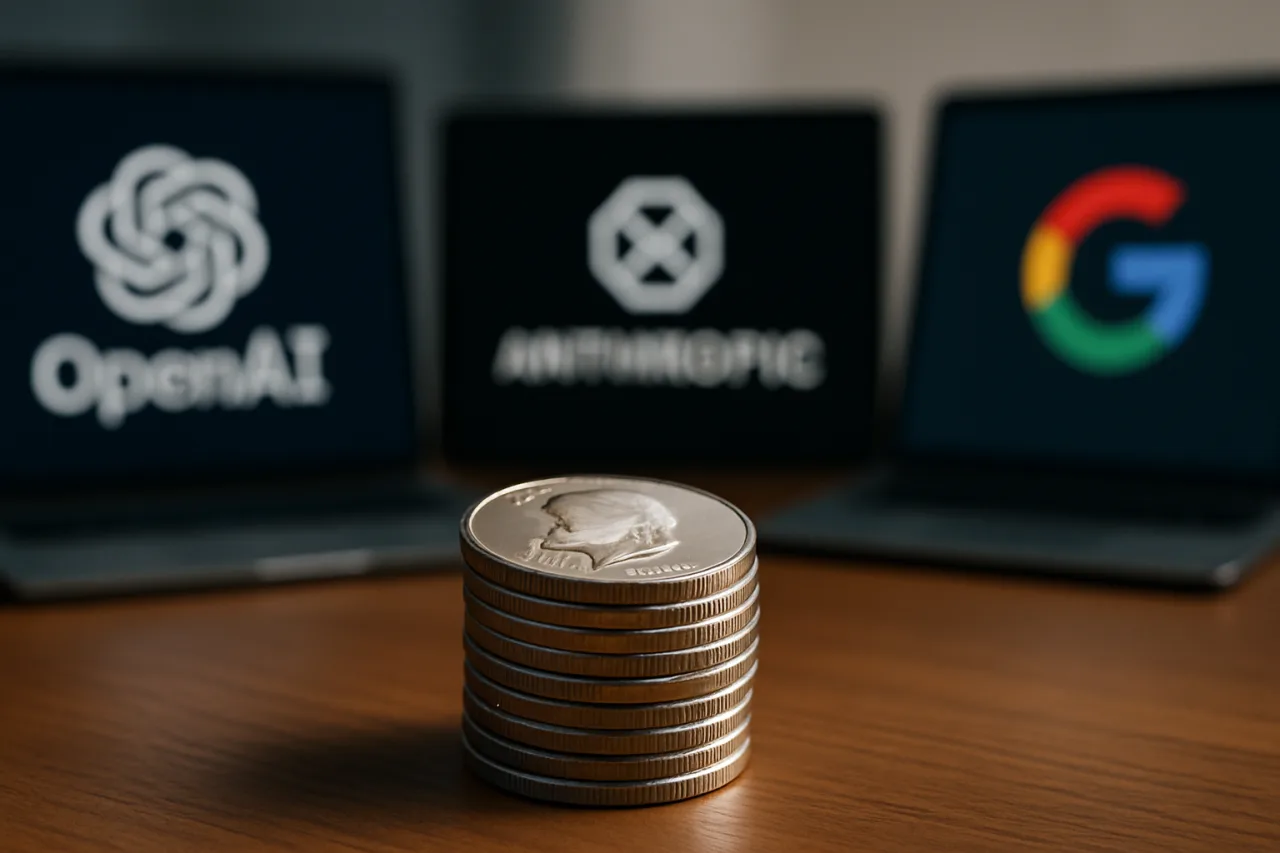
Every frontier AI lab now charges the same number for the same thing: ten cents per million cached input tokens. OpenAI lists it for GPT-6.1 Sol. Anthropic halved Claude Sonnet 5.5’s cache-read price to it on October 7. Google’s 95% discount on Gemini 4 Argon’s $2 input rate lands on the identical figure. The prompt caching convergence – three labs, one number, inside four weeks – is the AI bill’s quietest revolution, and it came with a deadline attached: Google’s introductory Argon pricing doubles on December 1 ($2/$10 becomes $4/$20). This guide explains why the convergence happened, the exact rate card each lab runs, the December deadline that changes the math, and the caching strategy every team running agents should adopt before the quarter ends.
Key Takeaway
- The convergence: all three frontier labs now price cached input at ~$0.10 per million tokens – OpenAI for GPT-6.1 Sol, Anthropic’s October 7 cut for Sonnet 5.5, and Google’s 95% discount on Gemini 4 Argon.
- The deadline: Gemini 4 Argon’s introductory $2/$10 rates end November 30 – the public price becomes $4/$20 from December 1, and cached-input terms are not restated for the new rate.
- The economics: agent workloads re-read the same context every turn – system prompts, tool definitions, documents – so the cached rate is the real rate for AI agent budgets.
- The discounts stack: Anthropic and OpenAI both apply ~50% batch discounts for asynchronous work, and Anthropic’s subscription credits (Max 5x: $100/month in Platform credits; Max 20x: $200/month) change the effective prototyping price.
- The strategy: re-architect for cache stability – stable system prompts, stable tool blocks, hot context cached – before the December repricing resets the comparison.
What prompt caching is – and why it won
Prompt caching is the pricing mechanism that rewards repetition: instead of charging full price to re-read the same context – the system prompt, the tool definitions, the document library your agent checks every turn – the provider prices repeated reads at a steep discount, because the compute to reprocess them is genuinely cheaper once the context is resident. The feature existed before 2026 as an optimization footnote; the agent era made it the budget center. An agent that reads a 100,000-token context twenty times per session is doing 2 million tokens of input work per session – at fresh rates that is $4 per session on a $2 model, at cached rates ten cents. The ratio explains everything that happened this month.
The convergence did not happen by accident either. All three labs spent September and October shipping agentic models – and every agentic workload is, structurally, a caching workload. The lab with the worse caching price loses the agent-billing comparison at the invoice level regardless of benchmark scores, so the prices raced to the same floor. The efficiency framing each lab published says the quiet part: Anthropic calls Sonnet 5.5’s October 7 cache-cut a move that lowers typical agentic-work costs by about 20%; OpenAI’s docs describe cached input as the design assumption for its Coding and computer-use models; Google’s Argon launch terms build the discount into the architecture from day one.
The rate card every lab runs in October 2026
The table that matters this quarter, with each lab’s exact published shape:
| Model | Input /1M | Cached input /1M | Output /1M | Status |
| OpenAI GPT-6.1 Sol | $2.00 | $0.10 | $10.00 | Official pricing page, updated Oct 21 |
| Google Gemini 4 Argon (to Nov 30) | $2 | 95% off input = $0.10 | $10 | Introductory, public access |
| Google Gemini 4 Argon (from Dec 1) | $4 | Not restated | $20 | Announced increase |
| Anthropic Claude Sonnet 5.5 | ~$2 (reported) | $0.10 read ($0.20 before Oct 7), $2.50 write | see Anthropic pages | GA since Sept 28 |
| Anthropic Claude Opus 5.5 | $4 | $0.20 cache read | $20 | Current flagship |
Three footnotes matter. One: the labs’ cached-discount structures are not interchangeable – Anthropic charges a cache WRITE premium (cache creation costs more than cache reading), OpenAI prices cached input flat, Google discounts the input rate itself; porting a workload between providers means re-porting the caching assumptions. Two: Anthropic’s Opus 5.5 sits above the convergence at $0.20 cache reads – the flagship tier does not compete on cache, which is precisely why Sonnet 5.5’s cut reads as a segment declaration. Three: batch discounts stack on cache in both directions – Anthropic and OpenAI each halve standard processing for asynchronous batches, which compounds the savings for non-realtime agent pipelines.
The December 1 deadline: Google’s intro pricing ends
The calendar is the quarter’s real event. Google’s own terms say Argon’s introductory $2 input and $10 output rates end November 30, and the public price becomes $4/$20 from December 1 – a straight 100% increase on the input line, with the cached-input terms not restated for the new rate in the announcement this guide draws from. The honest budget math for a team running on Google’s cached rates: if the new regime keeps the same 95% discount shape, cached inputs move from $0.10 to $0.20 per million – still competitive, but the October comparison table dies on December 1 and every cached-rate decision made this month needs a re-check next month. The desk’s advice is calendar arithmetic, not prophecy: teams that sign December-start commitments in November should model both rate cards, and the workloads that must stay cheap should benchmark Anthropic’s and OpenAI’s converged rates as the fallback.
The deadline also explains the strategy visible in every launch this window: labs are buying agent workloads onto their platforms with introductory economics and betting the retention on the tooling lock-in – the model garden, the CLI integrations, the platform governance. The price convergence plus the December divergence means November is the repricing window of the quarter.
Why the convergence happened: the agent economy
Zoom out and the convergence tells one story: the AI bill’s center of gravity moved from generation to re-reading. Chat-era billing priced what the model produced; agent-era billing prices what the agent re-reads to decide – and the re-read is where caching lives. Every lab’s launch materials this quarter describe exactly this workload shape: Anthropic’s AutomationBench framing, OpenAI’s computer-use tier, Google’s agentic-workload messaging in the Argon terms. The $0.10 convergence is the market pricing agentic re-reading as the commodity it has become – and the competitive frontier moving to the next layer: write premiums, discount structures, subscription credit bridging and batch stacking.
The compressed release calendar amplified it. Five weeks brought Sonnet 5.5, Haiku 5.5, GPT-6.1 Sol, Argon’s general availability and a DeepSeek Flash update – and any benchmark table older than three weeks now describes a different market. In that churn, prompt caching is the one pricing lever teams can pull unilaterally: it requires no vendor announcement, just architecture. That is why the desk writes it as strategy rather than news.
The strategy: what to do before the quarter ends
Four moves, in the order they pay. First: audit the workload’s cache hit rate – agents re-reading stable context should see the majority of input tokens billed at the cached rate; if your invoices say otherwise, the architecture, not the vendor, is the cost problem. Second: stabilize the system prompt and tool blocks – any change to cached prefixes invalidates the cache and reprices the next read; version-locked prompts are a budget feature. Third: route by tier – Astra-class or Opus-class intelligence for the hard step, Sol/Luna/Sonnet-class or better cached rates for the routine steps, with the batch discount applied wherever latency tolerates it. Fourth: put the November 30 deadline on the procurement calendar – model the December cards before the December invoices arrive, and let at least one workload benchmark across two providers, because the convergence makes switching cheap in a way it has never been. The teams that do this reprice their AI bills by quarter-end; the teams that do not inherit whoever’s default the platform kept.
The deeper read for the budget owner: the prompt caching convergence signals that the AI cost curve is now an engineering contract, not a market fate – the labs competed on a number and met at it, which means the next negotiation happens in your architecture, not in theirs. The teams treating caching as a first-class budget line this quarter are the ones whose agents scale without the invoice horror story; the rest will discover the new rate card in December, at $4 per million, with the old receipts stapled to the lesson.
The provider playbook: how to negotiate the caching era
Procurement teams should also read the convergence as leverage. The labs met at $0.10 cached because the comparison was public and portable – which means the same comparison can run at renewal time. The ask list: cached-rate terms written into the enterprise agreement with the measurement defined (hit rate on whose logs?), December-rate modeling priced into the contract (the Argon case shows introductory rates are a product, not a promise), batch economics stated per tier, and the model-garden or platform fee surfaced as its own line – the OpenAI-on-Google-Cloud arrangement this month made consolidated billing a real product, and the fee structure under it deserves the same scrutiny as the token rates. The negotiating position is simple and now documented: the convergence printed a public floor this month, and any deal priced above the public floor needs a reason in writing.
One more strategic note for the builders whose products carry AI costs: pass the caching win to your customers’ invoices deliberately. Products that meter AI usage downstream inherit the cache savings only if their metering separates cached tokens from fresh ones – the billing transparency is a product feature this quarter, and the teams that expose it will be audited favorably by the same procurement lists above. The caching era rewards the whole chain that ships transparency, from lab to platform to product to invoice – and quietly punishes every layer that hides the number that just converged.
FAQ
What is prompt caching?
Prompt caching is the pricing mechanism where re-reading the same input context – system prompts, tool definitions, documents – costs a fraction of the full input rate, because the provider’s compute can reuse the already-processed context. All three frontier labs now price cached input around $0.10 per million tokens.
Why did all three AI labs converge on $0.10 cached input?
Because agentic workloads re-read context constantly, the cached rate became the real billed rate for AI agents – and each lab’s agent-platform strategy required matching the cheapest cached price. Anthropic cut Sonnet 5.5’s reads 50% on October 7, OpenAI listed $0.10 for GPT-6.1 Sol, and Google’s 95% Argon discount landed on the same effective figure.
What changes on December 1?
Google’s introductory Gemini 4 Argon pricing ends November 30: the public rate moves from $2/$10 per million input/output tokens to $4/$20 from December 1. The cached-input terms are not restated in the announcement, so cached-rate budgets on Google need re-checking before December renewals.
How much can prompt caching save on agent workloads?
Anthropic says its October 7 cache-read cut lowers typical agentic-work costs by about 20%; teams that re-architected for stable cached prefixes commonly report far larger savings, since agent sessions can re-read the same context dozens of times. The Batch API discounts stack for asynchronous work.
Is prompt caching pricing the same at every lab?
The effective cached rate converged near $0.10 per million tokens, but the structures differ: Anthropic charges a cache-write premium ($2.50 per million on Sonnet 5.5) and separate flagship-tier reads ($0.20 on Opus 5.5), OpenAI prices cached input flat, and Google discounts the input rate itself. Workloads moving between providers need their caching assumptions re-ported.
What should teams do before the November 30 deadline?
Audit the cache hit rate on current invoices, stabilize version-locked system prompts and tool blocks, route workloads across cached-rate tiers with batch discounts where latency allows, and model both December rate cards before signing renewals – benchmarking at least one workload across two providers while switching is cheap.
Financial Disclaimer
This article is pricing and cost analysis for general information, not financial advice. Token prices, discounts and introductory rate terms are set by the vendors and change without notice; verify all rates on the providers’ official pricing pages before committing budgets. Figures reflect published terms as of October 22, 2026. WorldNgayon holds no positions in any vendor discussed.
Sources & rate cards: the tracked cache-pricing tables (Oct 22, 2026) · Anthropic release notes (cache-read cut, Oct 7, 2026) · Google Cloud platform pricing notes (Oct 2026)