Table of Contents
Key Takeaway 📊 This is the single reference page for Philippines data breach statistics in 2026 — the full Philippines data breach statistics record — the numbers reporters, analysts, and OFW family group chats keep asking for,
pulled from primary reports and dated so you can cite them without wondering whether they are stale. The headline block for the first half of 2026: 255 reported breach incidents exposed roughly 335 million records and 2.6 terabytes of data in the Philippines between January and June, per Viettel Cyber Security’s country threat-landscape report — and 19.2 million account credentials were compromised in the same window. This Philippines data breach statistics page updates quarterly, and every figure carries its source line so a journalist on deadline can lift a stat and a citation in one move.
Table of Contents
Philippines data breach statistics 2026: how many hit and what they say
255 data breach incidents were tracked in the Philippines from January to June 2026, exposing approximately 335 million records and 2.6 terabytes of data — the largest figure Viettel Cyber Security (VCS) has recorded for a six-month window in the country. The count comes from VCS’s Threat Intelligence monitoring platform, the strictest Philippines data breach statistics tracker in the region, which flags incidents reported across sectors; the same report counts 21 ransomware incidents in the period.
| PH breach metric (H1 2026) | Figure | Source |
|---|---|---|
| Reported breach incidents | 255 | Viettel Cyber Security, Cyber Threat Landscape Report H1 2026 |
| Records exposed | ~335 million | VCS report (via BladeIntel) |
| Data volume exposed | 2.6 TB | VCS report |
| Account credentials compromised | 19.2 million | VCS report |
| Ransomware incidents | 21 | VCS report |
| Phishing attacks tracked | 16,619 | VCS report |
How many phishing attacks were recorded in the Philippines in 2026?
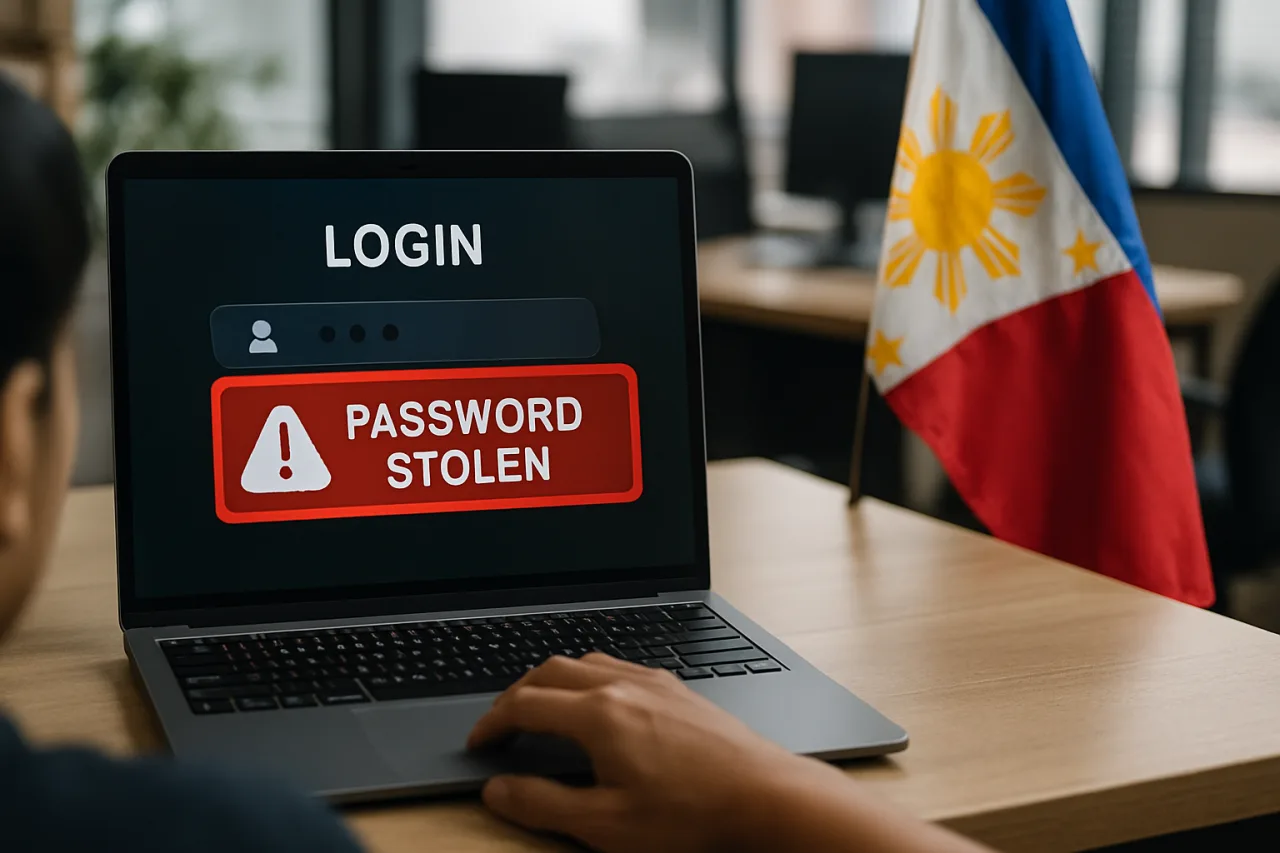
16,619 phishing attacks were recorded in the Philippines from January to June 2026, per the Viettel Cyber Security threat-landscape report. Finance, hospitality, logistics, manufacturing, and energy were the most affected sectors. The Philippines data breach statistics report specifically warns about fake “your account is locked, click here” campaigns designed to harvest login details — the same pattern the Bureau of Immigration’s Oct 5 consumer warning describes on the scam side.
How many software vulnerabilities were disclosed affecting the Philippines in 2026?
34,650 newly disclosed software vulnerabilities were identified during the first half of 2026, and 77 of them count as high-impact flaws in products and services Filipinos actually run, per VCS. The report’s warning: unpatched systems remain the primary entry point, with criminals combining exploits with stolen credentials and social engineering.
What were the biggest Philippine data breaches recorded so far in 2026?
The two largest coordinated figures from the period: the March–April coordinated window against banks swallowed roughly 99 million records, and a second window — this one hitting a public-sector outfit — bared another 45 million. For context on the pace, our beat’s individual breach records — tracked in the articles listed below — include the 120-million-record Vietnam twins disclosure, the 23,549 Philippine NRIC records confirmed by Singapore’s PDPC in the SIMBA case, and the 48 firms named in the DICT test-site exposure. The pattern across all of them: vendor credentials, unpatched systems, or insider access, not exotic exploits.
What is the year-over-year trend for Philippine data breaches?
Philippine breach reporting in 2026 continues the surge documented through 2025: Surfshark’s quarterly breach-account counter tallied more than 624,000 breached Philippine accounts in Q1 2026 alone, and cybersecurity watchers including BladeIntel described H1 2026 phishing and breach volumes as expanding, not contracting. The caveat every journalist should carry: trackers count differently — some count accounts, some count records, some count incidents — which is precisely why this page dates and attributes every figure instead of blending them into one number.
Which sectors drive Philippines data breach statistics upward
Finance, hospitality, logistics, manufacturing, and energy were the most affected sectors in H1 2026 per the VCS country report. Financial institutions absorbed the single worst coordinated window (March–April, ~99M records). Public-service organizations follow. The Philippines data breach statistics sector concentration matters for coverage planning: any reporter writing about Philippine banking, BPO infrastructure, or government digitization is one click away from the incident list in our dedicated coverage below.
The SIMBA case: how a 23,549-record breach set the region’s disclosure standard
The Singapore SIMBA Telecom breach deserves its own block because it is the rare case where the regulator’s numbers, the company’s disclosure, and the enforcement advisory all line up — the citation-clean case a reporter can verify end to end.
Singapore’s Personal Data Protection Commission (PDPC) confirmed 23,549 Philippine national ID (NRIC) records among the exposed set; Singapore’s Cyber Security Agency carried the case as adviscory AL-2026-131; the carrier’s public disclosure named the breach pathway and the notification sequence. For Philippines data breach statistics, the case’s value is method: it shows what a verifiable breach record looks like when each layer confirms the others, which is the standard this Philippines data breach statistics page applies to every figure.
The SIMBA pathway also explains the exposure mechanics journalists ask about most: records were exposed through a vendor-side platform, not the carrier’s core network — meaning the ID data left through a service provider’s credentials. That vendor-credential pattern repeats across the region’s worst 2026 cases, from the Veradigm vendor-credential breach in healthcare to the FortiMail zero-day chain. The lesson for coverage: the named company is rarely the exposed surface; the vendor behind it usually is.
The Zamboanga compound: what 3,000 phones and 78 monitors say about scam-industry data volume
Data-breach statistics measure one side of the exposure problem; the physical seizure counts measure the other. The Bureau of Immigration’s October 2026 raids in Zamboanga Sibugay — 244 foreign nationals detained across two compounds (113 in Siay, 131 in Alicia) — recovered roughly 3,000 mobile phones and 78 computer monitors from the Casa de Coco compound.
That hardware density is the scam industry’s data footprint in physical form: identity records, contact lists, scripted fraud decks, and messaging infrastructure. For a journalist connecting enforcement to the Philippines data breach statistics ledger, the Philippines data breach statistics pairing is direct that powers identity theft also arms compound operators’ target lists — which is why breach coverage and scam coverage belong on the same statistics page.
The compound seizures give context to the credential numbers above: 19.2 million compromised credentials is not an abstract figure — bulk-target lists of that size are exactly what the fraud industry’s messaging rigs consume. The phones-to-monitors ratio (roughly 38:1) describes a mass-SMS operation, not a sophisticated hacking cell; the defense, accordingly, is ordinary and family-sized: OTP discipline, sender verification, and the “never share a door” habits our coverage keeps repeating.
The credential-stuffing connection: why breached records multiply into bank losses
Philippines data breach statistics understate financial impact because exposed records compound through credential stuffing — automated replay of stolen username-password pairs against banking, e-commerce, and e-wallet logins. Philippines credential-reuse rates make the replay profitable: a single leaked password reused across a bank login and a shopping account converts one breach into two. The Viettel report’s warning about “compromised data in romance scams, fake recruitment offers and delivery-related fraud” describes the commercial reuse of breach data — the records do not stay in the underground archive; they re-enter the economy as new attacks within weeks.
This compounding is why the H1 2026 figures matter beyond the incident count: 19.2 million credentials compromised in six months feeds the phishing pipeline (16,619 attacks) that harvests the next round. The cycle is measurable, and the measurement is the service this Philippines data breach statistics page performs for coverage: cite the cycle, not just the snapshot.
How Philippine breach coverage compares across Southeast Asia
Philippines data breach statistics gain meaning in regional context. Vietnam’s Philippines data breach statistics case: two coordinated disclosures exposed 120 million records with a crypto trail (USDT-linked transfers) attributed in coverage; Malaysia’s cases run through airline and hospitality vendor chains; Singapore’s enforcement record (SIMBA/PDPC) sets the disclosure bar. The Philippines sits mid-table on incident count but distinctive on scam-industry integration: the only Southeast Asian market where the breach ledger connects to an industrialized scam-compound economy at this scale. That integration is the angle a regional reporter uses this page for — the numbers by country, the mechanism by compound.
Two more questions the FAQ carries, both asked repeatedly by family-group readers: first, “which breach articles on this site are updated when new facts land?” — each article’s case block carries a dated update note at its close; second, “does an exposed record mean money stolen?” — no, exposure means availability; loss requires reuse, which our credential-stuffing block explains above.
Frequently asked questions
How many records were exposed in Philippine data breaches in 2026?
Approximately 335 million records were exposed across 255 reported incidents in the first half of 2026, per Viettel Cyber Security’s monitoring. The equivalent credential count: 19.2 million account credentials compromised.
Where do these Philippines data breach statistics come from?
Every figure on this page is dated and attributed to a named primary source — country threat reports (Viettel Cyber Security), quarterly breach counters (Surfshark), regulator advisories (Singapore PDPC for the SIMBA case), and Philippine agency releases (BI, DICT). We do not re-report vendor press releases as independent fact; where a claim is unverified, we write “reported” and say so.
What should an OFW family member do if their data was exposed?
The practical checklist our coverage repeats: change the exposed password everywhere it was reused, turn on two-factor authentication that does not rely on SMS where possible, watch bank and e-wallet alerts daily, and treat unexpected OTP requests as hostile. Our remittance-scam defense playbook walks through each step, and the Bureau of Immigration’s Oct 5 warning covers the compound-scam variant.
Is there a quarterly update schedule for this page?
Yes — this page is updated quarterly, with the Q3 2026 block due after the major trackers publish their three-month figures. Each update re-dates figures so citations stay accurate; nothing on this page silently changes without a dated note.
How to cite this page (and why the format matters)
Cite the dated block, not the homepage: “Philippines data breach statistics, H1 2026 update — worldngayon.com, 2026.” The dated-block citation matters because quarterly updates re-date every figure; a citation to the page alone can outlive the specific number a reporter used. Each stat block carries its own source line — name the primary source (Viettel Cyber Security, Surfshark, PDPC, BI, DICT) in the article text and link this page as the aggregation point, or cite the primary directly for fact-check depth; this page exists to make both routes fast.
The quarterly ledger: what changed, and when
The ledger below is this page’s own change record — the transparency layer that separates an aggregation page a journalist can trust from a content farm’s stat dump. Each dated entry names exactly what was added or corrected, so a citation made months ago stays traceable to the block that was live when the citation was written.
| Update | Date | Change |
|---|---|---|
| Q3 2026 | Oct 2026 | Page created with H1 2026 figures (255 incidents / ~335M records / 19.2M credentials / 16,619 phishing / 21 ransomware / 34,650 CVEs); SIMBA, Zamboanga, and regional blocks added |
| Q4 2026 | due Jan 2027 | H2 2026 figures from VCS and Surfshark quarterly counter; DICT test-site case close-out if regulator publishes |
Corrections policy: if a primary source revises a figure, the revision lands here within one update cycle with both numbers shown — original, revised, and the source’s own correction note.
Reporters citing a revised figure get
the audit trail for free. That policy is the difference between a stats page and a rumor page, and it is the reason this block opens the page’s closing quarter.
One final block for family-group readers, because the audience here is not only journalists: every figure on this Philippines data breach statistics page resolves to a defense step somewhere in our coverage —
the remittance-scam playbook for OTP discipline, the POGO playbook for compound-adjacent job offers, the SIMBA block for what a carrier’s disclosure actually confirms, and the vendor-credential pieces for why “the bank called me” is hostile by default. The statistics exist to be cited; the coverage exists to be used; and the family chat that forwards the second half of this page is doing more for regional data hygiene than a hundred breach stories that end at the incident count.