Table of Contents
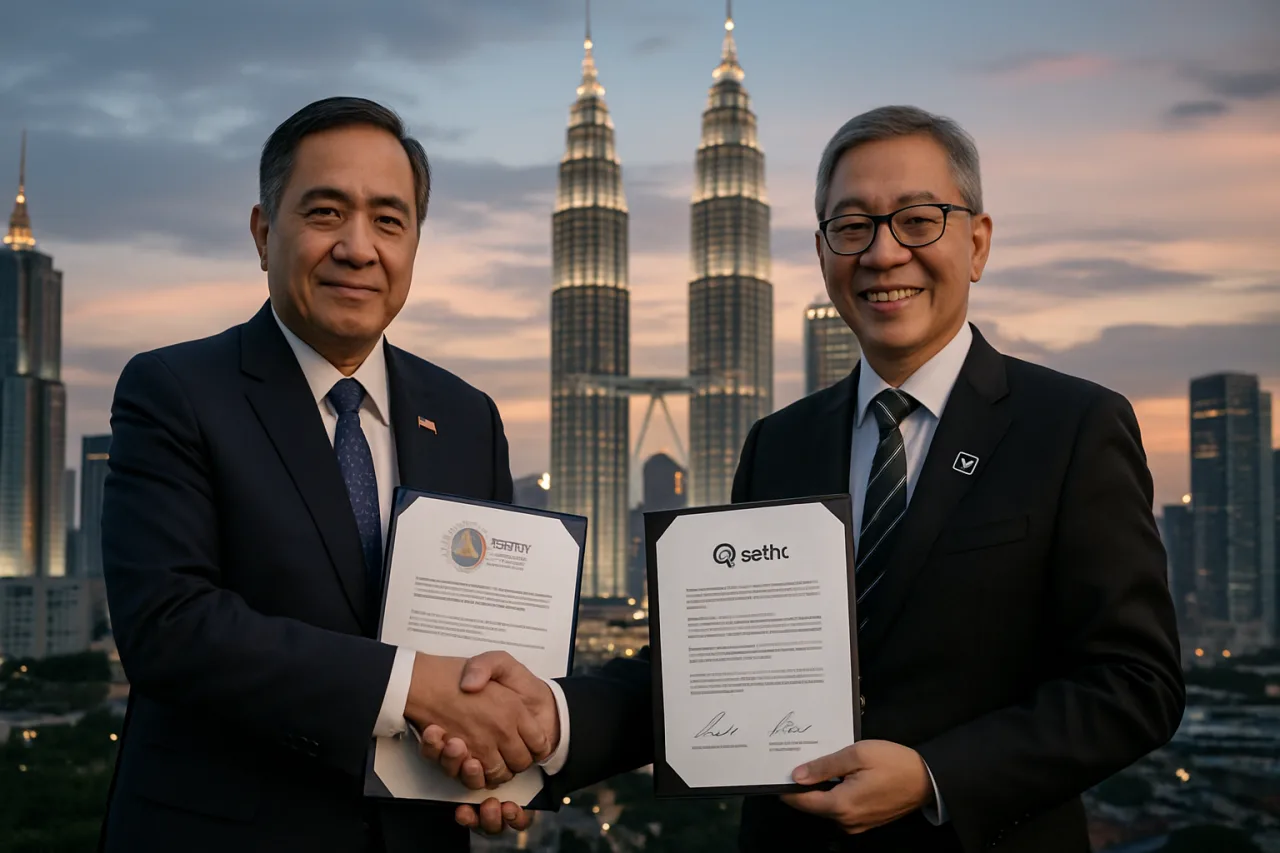
Philippine blockchain infrastructure took a decisive leap forward on July 7, 2026, when Malaysia’s Zetrix AI Berhad signed a memorandum of understanding with the Department of Information and Communications Technology (DICT) to build the Philippines’ national public blockchain platform — making the country only the second in the world to adopt Zetrix’s sovereign-grade protocol at the national level.
Key Takeaway
- 🇵🇭 DICT signed a landmark MOU with Malaysia’s Zetrix AI on July 7, 2026: The Philippine blockchain infrastructure will be built on the Zetrix Layer-1 protocol — the same blockchain platform that powers Malaysia’s national blockchain infrastructure, launched in April 2025. The Philippines becomes the second country to adopt Zetrix as its sovereign-grade blockchain foundation.
- 🔗 Cross-border digital ID interoperability is the headline use case: The MOU prioritizes blockchain applications that connect Malaysia’s and the Philippines’ national digital identity systems, enabling citizens of both countries to verify government-issued credentials across borders with cryptographic trust.
- 🏛️ Zetrix already works with five major Philippine government agencies: The Bureau of Internal Revenue (BIR), National Bureau of Investigation (NBI), Securities and Exchange Commission (SEC), Philippine Ports Authority (PPA), and Bureau of Fisheries and Aquatic Resources (BFAR) are existing Zetrix partners — giving the national rollout a near-decade operational head start.
- 🌐 The Philippines connects to China’s Xinghuo blockchain network through Zetrix: Zetrix operates the international supernode to China’s national Xinghuo Blockchain Infrastructure and Facility, positioning Philippine blockchain credentials for cross-border verification across multiple jurisdictions in Asia.
- 💼 The MOU covers credential issuance, trade facilitation, and national-importance applications: Digital issuance and verification of government credentials, trade document authentication, and blockchain infrastructure for applications of national importance are all in scope — with implementation subject to subsequent agreements.
The signing, formalized through a three-party MOU between Zetrix Philippines Inc., My Blockchain Infrastructure Sdn Bhd (MBI — a joint venture between Zetrix AI and Malaysia’s national R&D agency MIMOS Berhad), and DICT, represents the most significant Philippine blockchain infrastructure decision since the government began exploring distributed ledger technology for public services. For Filipino professionals in IT, cybersecurity, digital identity, and government technology, the agreement signals that the Philippines is moving from blockchain experimentation to blockchain standardization — and it is doing so with a partner that already operates a working national chain next door.
What the Zetrix-DICT MOU Actually Covers
The memorandum of understanding, signed on July 7, 2026, and publicly announced on July 8, establishes a framework for cooperation — not a finalized contract. This distinction matters. The MOU outlines intent and scope; the actual deployment, timelines, and financial terms will be determined through subsequent agreements and project development. No financial details of the collaboration have been disclosed.
What the MOU does establish is a clear set of priority use cases for the Philippine blockchain infrastructure:
1. Government Credential Issuance and Verification
The primary application is the digital issuance, verification, and authentication of government-issued credentials on the Zetrix blockchain. This means that documents issued by Philippine government agencies — tax clearances from the BIR, clearance certificates from the NBI, corporate registration records from the SEC, port documentation from the PPA, and fisheries permits from the BFAR — could eventually be issued as cryptographically verifiable digital credentials on-chain. Recipients could then prove the authenticity of these credentials to any third party — employers, foreign governments, financial institutions — without needing to contact the issuing agency directly.
DICT Secretary Henry R. Aguda framed the initiative in terms of trust portability: “The initiative is about making trust portable across systems and borders. Through this collaboration, we can make the verification of government-issued credentials more secure and efficient across systems. More importantly, it helps remove unnecessary friction so citizens can access services faster and with greater confidence wherever they are.”
2. Cross-Border Digital Identity Interoperability
The second priority — and arguably the most strategically significant — is cross-border interoperability between the national digital identity systems of Malaysia and the Philippines. The Philippines operates PhilSys, its national identification system administered by the Philippine Statistics Authority, which had issued over 6.6 million digital National IDs (ePhilID) in paper format as of mid-2026. Malaysia operates its own national digital identity framework integrated with the Malaysia Blockchain Infrastructure launched in April 2025.
If implemented, the Philippine blockchain would enable a Filipino citizen’s PhilSys-verified identity and government credentials to be cryptographically recognized and verified in Malaysia — and vice versa. This has direct implications for the estimated 800,000+ Filipinos living and working in Malaysia, who currently face document verification friction when accessing services, employment, and financial products abroad. For Filipino professionals who work across ASEAN, blockchain-based cross-border identity verification could reduce weeks-long authentication processes to seconds.
3. Trade Facilitation and National-Importance Applications
The third pillar of the MOU covers blockchain infrastructure for trade facilitation — applications like customs clearance processing, digital trade documentation, and supply chain verification. Zetrix’s existing deployment in Malaysia already includes customs clearance processing among its blockchain-based applications, along with digital identity verification, digital voting, and stablecoin initiatives. The Philippine collaboration is expected to initially focus on applications similar to those already deployed on the platform.
The MOU also references “applications regarded as being of national importance” — a broad category that could encompass everything from electoral integrity systems to land registry tokenization to government procurement transparency. The specific applications in this category will be defined through subsequent project agreements.
Why Zetrix? Understanding the Platform Behind the Philippine Blockchain
Zetrix is not a new entrant to the Philippine government technology landscape. The company, through its Philippine operations, has been working with Philippine government agencies for nearly a decade as a digital government service enabler. This existing relationship base — spanning the BIR, NBI, SEC, PPA, and BFAR — gave Zetrix a substantial operational advantage when DICT evaluated potential blockchain infrastructure partners.
Beyond the Philippine footprint, Zetrix brings three critical credentials to the Philippine blockchain initiative:
First, a proven national deployment. Zetrix serves as the foundational chain for Malaysia’s national blockchain infrastructure, which was launched in April 2025. This means the protocol has already been tested at sovereign scale — handling government credentials, identity verification, and cross-border use cases for a neighboring ASEAN nation with similar regulatory and demographic complexities. The Philippines is not being used as a beta tester; it is adopting a platform that has already gone through national-scale deployment next door.
Second, connection to China’s blockchain backbone. Zetrix operates the international supernode to China’s Xinghuo Blockchain Infrastructure and Facility (Xinghuo BIF) — China’s national blockchain infrastructure. This positions the Zetrix network, and by extension the Philippine blockchain built on it, to facilitate verification services across multiple jurisdictions in Asia. In a region where China remains the Philippines’ largest trading partner, the ability to cryptographically verify trade documents and credentials across the Zetrix-Xinghuo bridge has significant commercial and diplomatic implications.
Third, a Layer-1 public blockchain architecture. Zetrix is a Layer-1 public blockchain, meaning it is a base-layer protocol — not an application built on top of another chain like Ethereum or Solana. For a national government, this matters. It means the Philippines would not be dependent on a foreign base-layer protocol whose governance, upgrade roadmap, and fee structure are controlled by an external community. The Philippine blockchain would have its own sovereign instance of the protocol, with governance aligned to Philippine national interests.
The Zetrix blockchain was launched in April 2022 and has since been deployed across digital identity verification, customs clearance processing, digital voting, and stablecoin initiatives. The platform’s parent company, Zetrix AI Berhad, is a publicly listed Malaysian entity, providing a level of corporate accountability and transparency that unlisted blockchain projects cannot match.
The Malaysia Connection: ASEAN Blockchain Integration Takes Shape
The Zetrix-DICT MOU is not just a bilateral technology agreement — it is a building block in a broader ASEAN digital integration strategy. The three signatories to the MOU reflect this: Zetrix Philippines Inc. represents the local operating entity, My Blockchain Infrastructure Sdn Bhd (MBI) represents the Malaysian national interest as a Zetrix-MIMOS joint venture, and DICT represents the Philippine government. The structure ensures that both national governments have direct stakes in the infrastructure’s governance.
For the Philippine blockchain initiative, the Malaysia connection provides three advantages that a standalone deployment could not achieve:
Shared infrastructure economics. Building a sovereign blockchain from scratch — protocol development, node infrastructure, security auditing, developer tooling — is expensive and time-consuming. By adopting Zetrix, the Philippines inherits a proven protocol, existing developer ecosystem, and shared infrastructure with Malaysia, reducing both cost and time to deployment.
Immediate cross-border use cases. A national blockchain deployed in isolation provides domestic value but limited international utility. By deploying on the same protocol as Malaysia, the Philippine blockchain immediately has a cross-border interoperability partner — enabling the digital ID verification use case that is the headline application of the MOU. This is a model other ASEAN nations could replicate, creating a regional blockchain interoperability zone.
Regional digital economy alignment. ASEAN targets a digital economy exceeding $1 trillion by 2030. Cross-border digital identity, trade document verification, and credential portability are foundational to that goal. The Philippines and Malaysia, through Zetrix, are building the infrastructure layer that could enable other ASEAN members to plug in. For Filipino professionals working across the region — and there are millions — a blockchain-verified credential system could eventually mean that a PhilSys-authenticated professional license, university degree, or tax clearance is recognized cryptographically in Kuala Lumpur, Singapore, Jakarta, and beyond.
This regional dimension connects directly to the broader Philippine digital economy, which reached ₱2.74 trillion in Gross Value Added in 2025 — 9.8% of GDP. National blockchain infrastructure is the trust layer that digital economy growth depends on: without verifiable credentials, secure identity, and tamper-proof records, the digital economy’s expansion hits a trust ceiling. The DICT-Zetrix agreement is, in effect, an investment in the trust infrastructure that the next phase of Philippine digital economic growth requires.
What This Means for Filipino Professionals
The Philippine blockchain initiative has direct implications across multiple professional domains — and understanding these implications now, at the MOU stage, positions Filipino professionals to anticipate the skills, opportunities, and risks that will emerge as implementation proceeds.
For IT Professionals and Developers
A national blockchain deployment creates demand for blockchain developers, smart contract auditors, node operators, and blockchain integration specialists. If the Philippines follows the Malaysian model, the government will need technical professionals who understand the Zetrix protocol, can build applications on the Layer-1 chain, and can integrate blockchain-based credential verification into existing government IT systems. The existing AI and technology talent gap in the Philippines means that professionals who develop blockchain skills now will enter a market with significant unmet demand. Certifications in blockchain architecture, smart contract development, and cryptographic security will become increasingly valuable as the implementation timeline advances.
For Cybersecurity Professionals
National blockchain infrastructure is, by definition, critical infrastructure. It will require cybersecurity professionals who understand blockchain-specific threats — 51% attacks, smart contract vulnerabilities, private key management, oracle manipulation — alongside traditional security disciplines. The Philippines already faces significant cybersecurity challenges, with 100% of organizations experiencing supply chain breaches and a rapidly growing ransomware threat landscape. Adding a national blockchain layer to this environment means that cybersecurity readiness must scale in parallel. For cybersecurity professionals, the Zetrix deployment creates opportunities in blockchain security auditing, government SOC operations focused on blockchain infrastructure, and the emerging field of cross-border credential verification security.
For Government and Public Sector Professionals
The agencies already working with Zetrix — BIR, NBI, SEC, PPA, BFAR — will be the first to integrate blockchain-based credential issuance. Professionals in these agencies, and in DICT itself, will need to develop expertise in blockchain-based government service delivery. This includes understanding how on-chain credentials differ from traditional digital documents, how verification workflows change when a third party can independently verify a credential without contacting the issuer, and how to manage the transition from legacy systems to blockchain-verified systems without disrupting service delivery. The DICT’s broader digital transformation agenda, including PhilSys integration and cross-border digital ID, provides the strategic context for this work.
For Business Professionals and Entrepreneurs
Trade facilitation is a stated MOU priority. Filipino businesses engaged in cross-border trade — particularly with Malaysia and China — should watch for blockchain-based trade documentation and customs clearance applications that could reduce processing times and verification costs. Entrepreneurs should anticipate a new market for blockchain-based value-added services built on the national chain: credential verification APIs, identity-based authentication services, supply chain tracking applications, and compliance automation tools. The Philippine blockchain will create a platform layer, and platforms create ecosystems.
The Challenges: What Could Slow the Philippine Blockchain Rollout
A memorandum of understanding is a starting point, not a finished product. Several factors will determine whether the Philippine blockchain initiative moves from MOU to meaningful deployment.
MOU-to-implementation gap. The MOU explicitly states that further implementation is “subject to subsequent agreements and project development.” Government blockchain initiatives globally have a mixed track record of moving from MOU to production. The Philippines will need to negotiate specific project agreements, define technical specifications, establish governance frameworks, and secure budget allocations — each of which can introduce delays.
PhilSys integration complexity. The cross-border digital ID interoperability use case depends on PhilSys being sufficiently mature for blockchain integration. While PhilSys has made significant progress, with millions of IDs issued and digital formats rolling out, the system has also faced criticism over delays, data quality issues, and enrollment bottlenecks. Integrating PhilSys with a blockchain layer — and with Malaysia’s national ID system — adds technical and governance complexity on top of an already challenging national ID rollout.
Regulatory and legal framework. The Philippines does not yet have a comprehensive blockchain-specific legal framework. Questions about the legal status of on-chain credentials, data privacy implications of storing government credentials on a public blockchain, the regulatory jurisdiction over a blockchain operated jointly with a Malaysian entity, and the intellectual property arrangements between DICT, Zetrix Philippines, and MBI will need to be resolved. The Bangko Sentral ng Pilipinas (BSP) and the National Privacy Commission (NPC) will both have regulatory roles to play.
Geopolitical considerations. The Zetrix connection to China’s Xinghuo blockchain network introduces a geopolitical dimension. While cross-border verification capability with China is commercially valuable, it also means that the Philippine blockchain infrastructure will have a technical bridge to a Chinese national blockchain system. In the context of ongoing US-China strategic competition and Philippine-American defense ties, this may attract scrutiny from national security stakeholders. How DICT and the broader Philippine government navigate this dimension will be worth watching.
Public trust and adoption. Blockchain remains poorly understood by the general public, and “blockchain” as a term still carries associations with cryptocurrency speculation and scams in many minds. For the Philippine blockchain initiative to achieve its goals, the government will need to communicate clearly that this is infrastructure for credential verification and identity — not cryptocurrency — and that citizens’ data is protected through cryptographic methods that are more secure, not less, than traditional databases.
How the Philippine Blockchain Compares Regionally
The Philippines is not the first ASEAN country to pursue national blockchain infrastructure, but the Zetrix partnership places it in a specific regional context. Understanding how the Philippine blockchain compares to regional peers helps clarify the strategic positioning.
| Country | National Blockchain Initiative | Status (2026) | Blockchain Protocol |
|---|---|---|---|
| Malaysia | Malaysia Blockchain Infrastructure (MBI) | Operational (launched April 2025) | Zetrix Layer-1 |
| Philippines | DICT-Zetrix national blockchain | MOU signed July 2026; implementation pending | Zetrix Layer-1 (planned) |
| Singapore | Open Government Data + blockchain pilots | Project-based; no single national chain | Multiple (Ethereum, Quorum, others) |
| Indonesia | National blockchain strategy under development | Policy stage; no national deployment | To be determined |
| Thailand | Blockchain for government services (pilot stage) | Limited pilots; no national infrastructure | Multiple |
The Philippines and Malaysia, through their shared Zetrix foundation, are creating something that no other ASEAN pair has yet achieved: two national blockchain infrastructures built on the same protocol, designed for interoperability from the ground up. If other ASEAN nations adopt the Zetrix protocol — or if interoperability bridges are built to other national chains — the Philippines-Malaysia axis could become the foundation of an ASEAN-wide blockchain interoperability zone.
The Road Ahead: What to Watch
For Filipino professionals tracking the Philippine blockchain initiative, several milestones will indicate whether the MOU is translating into real deployment:
Watch for project agreements. The MOU is a framework; specific project agreements will define actual applications, timelines, and budgets. When DICT and Zetrix announce the first concrete project — likely a credential issuance pilot with one of the existing partner agencies (BIR, NBI, SEC, PPA, or BFAR) — that will signal the transition from intent to execution.
Watch for PhilSys integration announcements. Cross-border digital ID interoperability is the headline use case, but it depends on PhilSys being ready for blockchain integration. Any announcement of PhilSys-blockchain integration work — whether with Zetrix specifically or blockchain infrastructure more broadly — will be a leading indicator of progress.
Watch for regulatory developments. If the BSP, NPC, or Congress begins developing blockchain-specific regulatory frameworks — particularly around on-chain government credentials and cross-border data flows — it will signal that the government is building the legal infrastructure to support the technical infrastructure.
Watch for Malaysian milestones. Because the Philippine blockchain is being built on the same protocol as Malaysia’s MBI, Malaysia’s progress on its own blockchain applications — credential issuance, customs processing, digital voting — provides a roadmap for what the Philippines can expect. Malaysian milestones are Philippine previews.
Watch for developer ecosystem signals. A national blockchain needs developers. If Zetrix Philippines begins launching developer training programs, hackathons, or certification tracks in the Philippines, it will indicate that the platform layer is being prepared for application development — the stage where professional opportunities multiply.
FAQ: Philippine Blockchain and the Zetrix-DICT MOU
What is the Philippine blockchain MOU with Malaysia’s Zetrix?
The memorandum of understanding, signed on July 7, 2026, between Zetrix Philippines Inc., My Blockchain Infrastructure Sdn Bhd, and the Philippine Department of Information and Communications Technology (DICT), establishes Zetrix’s Layer-1 public blockchain as the underlying protocol for the Philippines’ planned national public blockchain infrastructure. The agreement covers government credential issuance and verification, cross-border digital ID interoperability between Malaysia and the Philippines, and trade facilitation applications.
Is the Philippine blockchain the same as cryptocurrency?
No. The Philippine blockchain initiative is infrastructure for government credential verification, digital identity, and trade documentation — not cryptocurrency. Zetrix does have stablecoin initiatives on its platform, but the DICT MOU focuses on credential portability and identity interoperability. Blockchain is the underlying technology; cryptocurrency is one application of it. The national blockchain initiative uses the trust and verification properties of blockchain, not its token-economics features.
Which Philippine government agencies already work with Zetrix?
Zetrix has operated in the Philippines for nearly a decade and counts five major government agencies as existing partners: the Bureau of Internal Revenue (BIR), National Bureau of Investigation (NBI), Securities and Exchange Commission (SEC), Philippine Ports Authority (PPA), and Bureau of Fisheries and Aquatic Resources (BFAR). The company also has agreements involving the Professional Regulation Commission, Bureau of the Treasury, and Land Bank of the Philippines. These existing relationships give the national blockchain rollout an operational head start.
How will cross-border digital ID verification work between Malaysia and the Philippines?
Under the MOU, the Philippine blockchain infrastructure will be built on the same Zetrix protocol as Malaysia’s national blockchain. This means that government-issued credentials and identity attestations created on the Philippine chain can be cryptographically verified on the Malaysian chain — and vice versa — without either country needing to directly access the other’s databases. A Filipino professional presenting a BIR-issued tax clearance in Malaysia could have it verified on-chain in seconds, rather than through the current process of embassy authentication and manual verification.
What is Zetrix’s connection to China’s blockchain network?
Zetrix operates the international supernode to China’s Xinghuo Blockchain Infrastructure and Facility (Xinghuo BIF) — China’s national blockchain infrastructure. This means the Zetrix network can facilitate cross-border verification of digital credentials across multiple jurisdictions, including China. For the Philippine blockchain, this provides a technical bridge for verifying trade documents and credentials with the Philippines’ largest trading partner, though it also introduces geopolitical considerations that the government will need to navigate.
When will the Philippine blockchain be operational?
The MOU signed in July 2026 is a framework agreement, not a deployment contract. Actual implementation is subject to subsequent agreements and project development, and no timeline or financial details have been disclosed. Based on Malaysia’s experience — where MBI launched in April 2025 after earlier planning and development — a realistic expectation is that initial pilot applications could emerge within 12 to 24 months, with broader national deployment depending on project agreements, regulatory frameworks, and budget allocations.
What does the Philippine blockchain mean for Filipino professionals’ careers?
The national blockchain initiative creates demand for blockchain developers, smart contract auditors, cybersecurity professionals with blockchain expertise, government technology specialists, and entrepreneurs building applications on the national chain. Professionals who develop blockchain skills — particularly on the Zetrix protocol — will enter a market with significant unmet demand. The initiative also signals that blockchain is moving from experimental to operational in Philippine government technology, creating career opportunities in a sector that is transitioning from hype to infrastructure.
How does the Philippine blockchain compare to other ASEAN national blockchain initiatives?
The Philippines is the second country to adopt the Zetrix protocol nationally, after Malaysia. Other ASEAN nations — Singapore, Indonesia, Thailand — are pursuing blockchain in government through pilot projects and multiple protocols, rather than a single national infrastructure deployment. The Philippines-Malaysia Zetrix partnership is unique in ASEAN for having two national blockchain infrastructures built on the same protocol with designed interoperability, potentially creating the foundation for a regional blockchain interoperability zone.
What are the risks of the Philippine blockchain initiative?
Key risks include the gap between MOU and implementation (many government blockchain initiatives globally stall between intent and execution), PhilSys integration complexity (the cross-border ID use case depends on the national ID system being sufficiently mature), regulatory uncertainty (the Philippines lacks a comprehensive blockchain legal framework), geopolitical considerations (the Zetrix-Xinghuo connection to China’s blockchain network may attract national security scrutiny), and public trust (blockchain must be communicated as credential infrastructure, not cryptocurrency, to build citizen confidence).
The Bottom Line: Trust Infrastructure for a Digital Philippines
The Philippine blockchain initiative, through the DICT-Zetrix MOU, represents a strategic bet that national blockchain infrastructure is not optional but foundational for the next phase of Philippine digital transformation. The choice of Zetrix — a proven protocol with a working national deployment in Malaysia, existing relationships with five Philippine government agencies, and a bridge to China’s blockchain network — reflects a pragmatic approach: adopt what works, build on what exists, and connect to where the trade flows.
For Filipino professionals, the message is clear. Blockchain is transitioning from a speculative technology to national infrastructure in the Philippines. The skills, regulatory frameworks, and application ecosystems that will emerge over the next 12 to 24 months will define career opportunities, business models, and governance patterns for years to come. Those who understand the technology, the use cases, and the regional context now will be positioned to lead as the Philippine blockchain moves from memorandum to reality.
The Philippines is not building a blockchain. It is building trust infrastructure for a digital nation — and it is doing so with a partner that has already done it next door. Whether that partnership fulfills its potential will depend on execution, regulation, and political will. But the direction is set, and for Filipino professionals, the time to pay attention is now.
This article is based on reporting from TechNode Global and The Star Malaysia, along with Zetrix AI official statements and DICT Philippines public communications. The MOU was signed on July 7, 2026, and implementation details remain subject to subsequent agreements. Technical specifications and deployment timelines have not been publicly disclosed.
Financial Disclaimer: This article is for informational purposes only and does not constitute financial advice, investment recommendations, or an offer to buy or sell securities. References to blockchain technology, digital assets, or companies mentioned herein do not constitute endorsements or investment recommendations. Blockchain investments and technology stocks carry varying levels of risk, including total loss of capital. Past performance does not guarantee future results. Always consult a licensed financial advisor before making investment decisions.