Table of Contents
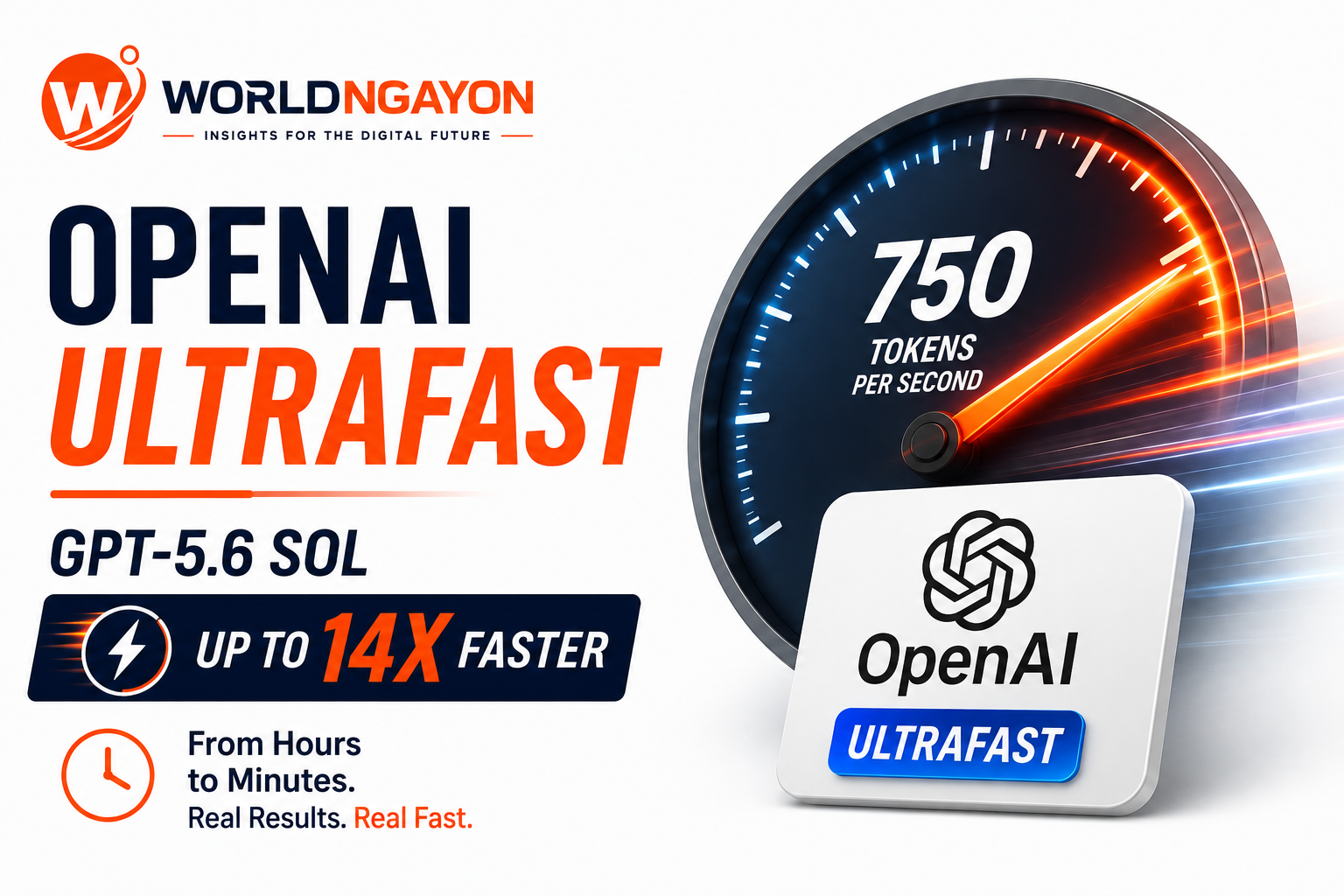
OpenAI Ultrafast is a new service tier that runs GPT-5.6 Sol up to 14 times faster than standard processing, generating up to 750 output tokens per second — and it is already cutting security investigations from two hours to fifteen minutes inside OpenAI’s own engineering teams.
Key Takeaway
- ⚡ 14x Speed Boost: OpenAI Ultrafast mode runs GPT-5.6 Sol up to 14 times faster than standard processing, delivering up to 750 output tokens per second through the OpenAI API
- 🤖 Powered by Cerebras: The speed gains come from a $10 billion partnership with Cerebras Systems, bringing ultra-low-latency inference to OpenAI’s most intelligent model
- 💼 Real-Time Enterprise Use Cases: OpenAI is testing Ultrafast across incident response, financial research, customer support, commerce, and live research — workflows where every second creates measurable value
- 🔬 Internal Results: OpenAI’s own security teams report that investigation workflows that once took one to two hours now complete in 10 to 15 minutes, sometimes approaching real time
- 📅 Limited Preview: Ultrafast is available to a select group of API customers as of August 13, 2026, with access expanding as Cerebras capacity grows
On August 13, 2026, OpenAI previewed Ultrafast, a new service tier that represents a fundamental shift in how enterprises access frontier AI intelligence. Until now, getting real-time speed from large language models meant choosing a smaller or more specialized model — sacrificing capability for velocity. OpenAI Ultrafast eliminates that trade-off. For the first time, a company’s most intelligent model runs at speeds that enable real-time interaction, not just batch processing.
The announcement comes at a moment when AI infrastructure spending has reached historic levels. In the first half of 2026 alone, global AI infrastructure investment exceeded $510 billion, as we reported in our AI World This Week coverage. OpenAI’s move to monetize inference speed — not just model capability — signals a maturing market where speed itself has become a competitive advantage. This is the same trend driving the broader AI infrastructure buildout we analyzed in our Philippine AI Infrastructure Master Plan guide.
What OpenAI Ultrafast Actually Delivers
The core technical claim is straightforward: GPT-5.6 Sol on Ultrafast mode runs up to 14 times faster than standard processing, generating up to 750 output tokens per second. To put that in perspective, a standard LLM generating 50-60 tokens per second takes roughly 30 seconds to produce a 1,500-word response. Ultrafast produces the same output in under 3 seconds.
The speed improvement comes from Cerebras Systems, the AI chip company that signed a ten-billion-dollar partnership with OpenAI earlier in 2026. Cerebras builds wafer-scale processors — entire chips etched on a single silicon wafer — that deliver dramatically higher throughput than conventional GPU-based inference. By running GPT-5.6 Sol on Cerebras hardware, OpenAI bypasses the bottleneck that has limited large model inference speed for years.
OpenAI already monetizes inference speed in tiers. Through the API, the company offers a “Fast Mode” that promises up to 2.5x speed with lower latency for GPT-5.6 Sol at roughly double the price. OpenAI Ultrafast adds a third, faster, and likely pricier tier. The pricing logic mirrors cloud providers like AWS, which have long charged more for the same service at higher performance levels. If speed becomes a bottleneck across industries, this tiered model gives OpenAI a direct cut of the revenue gains that faster inference creates.
The Five Workflows Where Ultrafast Changes the Game
OpenAI identified five enterprise workflows where an order-of-magnitude change in speed creates the most value. Each represents a category where the barrier was not model intelligence but model latency — the AI was smart enough, just not fast enough.
1. Incident Response and Reliability
When a critical system fails, engineers need to build an accurate picture while the system and the evidence are still changing. With Ultrafast, teams can analyze application logs, recent code changes, and engineer reports to identify the likely cause and help prepare a fix while the outage is still unfolding. Inside OpenAI, the impact is already measurable: security investigation workflows that once took one to two hours now complete in 10 to 15 minutes, sometimes approaching real time. Engineers use Ultrafast to investigate root causes, search systems in parallel, and stay in flow while coding.
2. Financial Research and Security
In financial markets, conditions change by the second. Ultrafast enables models to analyze market signals, assess transactions, and identify suspicious activity while conditions are still shifting — not after the opportunity or threat has passed. This is particularly relevant for fraud detection, where the window between detection and response determines whether a transaction is blocked or completed.
3. Customer Support and Voice AI
Voice AI has been constrained by latency. When a customer asks a complex question, a model that takes 30 seconds to respond creates an awkward silence that destroys the experience. Ultrafast resolves complex customer issues in real time without interrupting the conversation, even when finding the answer requires multiple steps or system queries. Podium, an early customer, reports that the speed “completely changes the call experience for the more complex work,” according to Courtland Lykins, Product Lead for Voice AI at Podium.
4. Commerce and Real-Time Personalization
In e-commerce, hesitation becomes an abandoned cart. Ultrafast can answer product questions, check inventory, personalize recommendations, and resolve checkout issues while the shopper is still deciding — before they navigate away. The speed means AI can intervene at the moment of decision, not after.
5. Live Research and Experimentation
Research workflows traditionally involved launching batch experiments overnight and reviewing results in the morning. Ultrafast compresses that loop into an interactive working session. Teams can test an idea, examine results, adjust their approach, and run another experiment without breaking their flow. As The Decoder reported, this turns overnight batch jobs into interactive work sessions where researchers iterate in real time.
What Early Customers Are Saying
OpenAI is testing Ultrafast with an initial group of companies across coding, commerce, financial research, support, and other interactive applications. The early feedback reveals a consistent pattern: speed does not just make products feel better — it changes what is realistically possible.
John Crepezzi from Jane Street, a quantitative trading firm, said: “The increase in speed brought by Cerebras is impressive. It enables different ways of using the models, and makes it practical for developers to work in a more focused and productive way alongside them.” For a firm like Jane Street, where milliseconds matter in trading decisions, the ability to run frontier AI analysis at near-real-time speeds opens entirely new categories of automated research.
Mitch Troyanovsky, Co-Founder at Basis, highlighted the combination of speed and intelligence: “Ultrafast allows us to create synchronous experiences for users that were previously limited by intelligence. Oftentimes the barrier to truly fast products is not just tokens per second, but also model intelligence, and Ultrafast combines both.”
Alex Wang from Rogo, a financial research platform, framed it most directly: “Speed doesn’t just make the product feel better. It changes what people can realistically use it for. Ultrafast makes complex financial research feel like a real-time interaction.”
Why OpenAI Ultrafast Matters for the AI Industry
The launch of OpenAI Ultrafast signals a strategic shift in how AI companies compete. The first wave of AI competition was about model capability — whose model scored highest on benchmarks. The second wave was about price — whose model delivered the most intelligence per dollar. The third wave, now beginning, is about speed — whose model delivers intelligence fast enough to embed in real-time workflows.
This matters because the enterprise use cases that generate the most value are also the most time-sensitive. A model that can analyze a security breach in 15 minutes instead of 2 hours is not just faster — it is fundamentally more useful, because the breach is still happening. A model that can personalize a shopping recommendation while the customer is still on the page is not just faster — it captures revenue that would otherwise be lost. Speed transforms AI from a background tool into a real-time collaborator.
For the broader AI ecosystem, this creates new pressure on competitors. Anthropic, Google, and Meta must now answer the speed question, not just the capability question. As we noted in our coverage of the Grok 4.6 launch and the broader AI model competition, the gap between leading models on benchmark performance has narrowed dramatically. Speed is the next frontier where differentiation will be won or lost. This also connects to the AI economic impact conversation we explored in our comprehensive analysis of AI’s P1.8 trillion opportunity for the Philippines — faster inference means faster adoption, which means faster economic transformation.
The Cerebras Partnership and Infrastructure Implications
Ultrafast would not be possible without the Cerebras partnership. Conventional GPU-based inference — even on NVIDIA’s most advanced H100 and B200 systems — faces fundamental limits on how fast a single model can generate tokens. Cerebras solves this with wafer-scale integration: instead of connecting multiple chips across a board, Cerebras etches an entire processor on a single silicon wafer, eliminating the inter-chip communication overhead that slows down traditional GPUs.
The $10 billion OpenAI-Cerebras deal, signed earlier in 2026, was one of the largest AI infrastructure partnerships of the year. It positioned Cerebras as a serious alternative to NVIDIA in the inference market — not by competing on raw training performance, but by dominating on inference speed. For AI professionals and infrastructure planners, this signals that the inference market is fragmenting: training will continue to run on NVIDIA GPUs, but latency-sensitive inference workloads may increasingly move to specialized hardware like Cerebras.
This fragmentation has implications for the entire AI supply chain. As we tracked in our AI World This Week series, the AI infrastructure investment cycle is the largest in technology history. But the hardware layer is diversifying — training chips, inference chips, and edge AI chips are becoming distinct markets with different leaders. Professionals who understand this fragmentation will be better positioned to make infrastructure decisions, whether they are building AI products or investing in AI companies.
What This Means for Professionals
For software developers, OpenAI Ultrafast opens new categories of real-time AI applications that were previously impossible. Voice assistants that handle complex queries without awkward pauses. Security tools that analyze threats while the attack is in progress. Research tools that enable interactive experimentation instead of overnight batch jobs. If you build AI-powered products, the constraint is no longer “is the model smart enough?” — it is “is the model fast enough?”
For cybersecurity professionals, the incident response use case is particularly significant. The ability to analyze logs, traces, and engineer reports in 15 minutes instead of 2 hours means security teams can respond to active threats in real time, not after the damage is done. This aligns with the broader trend we have tracked toward AI-augmented security operations, where AI handles the initial analysis and human engineers make the judgment calls.
For business leaders, the key question is not whether to adopt Ultrafast but when. The limited preview means most organizations will wait months for access. But the strategic planning should start now: which workflows in your organization are constrained by AI latency rather than AI capability? Those are the first candidates for Ultrafast migration when access expands.
Availability and Access
GPT-5.6 Sol on Ultrafast mode is available in a limited preview as of August 13, 2026, to a select group of API customers. OpenAI plans to expand access as Cerebras capacity grows. Businesses that require frontier intelligence at the highest speed can sign up for updates through OpenAI’s official form. The company has not yet announced pricing for the Ultrafast tier, but given that Fast Mode already costs roughly double the standard rate, Ultrafast is expected to command a significant premium.
Frequently Asked Questions About OpenAI Ultrafast
What is OpenAI Ultrafast mode?
OpenAI Ultrafast is a new service tier that runs GPT-5.6 Sol up to 14 times faster than standard processing, generating up to 750 output tokens per second. It is powered by Cerebras Systems and is designed for enterprise workflows where real-time AI interaction creates a competitive advantage.
How fast is 750 tokens per second?
At 750 output tokens per second, Ultrafast can produce approximately 1,500 words of output in under 3 seconds. Standard LLM inference typically generates 50-60 tokens per second, meaning the same output would take roughly 30 seconds. The 14x speedup means tasks that previously required minutes of waiting now complete in seconds.
What is Cerebras and why does it matter for OpenAI Ultrafast?
Cerebras Systems is an AI chip company that builds wafer-scale processors — entire chips etched on a single silicon wafer. This architecture eliminates the inter-chip communication overhead that limits conventional GPU-based inference. OpenAI signed a $10 billion partnership with Cerebras in 2026 to power Ultrafast mode, positioning Cerebras as a specialized alternative to NVIDIA for latency-sensitive inference workloads.
Which companies are already using OpenAI Ultrafast?
OpenAI is testing Ultrafast with an initial group including Jane Street (quantitative trading), Podium (voice AI), Basis (synchronous AI experiences), and Rogo (financial research). Early feedback indicates that the speed improvement changes what products can realistically do, not just how they feel.
How much will OpenAI Ultrafast cost?
OpenAI has not announced official pricing for the Ultrafast tier. For context, the existing Fast Mode tier costs roughly double the standard API rate for a 2.5x speed improvement. Ultrafast, delivering 14x speed, is expected to command a significantly higher premium. Pricing will likely be usage-based through the OpenAI API.
Can I access OpenAI Ultrafast through ChatGPT?
No. Ultrafast mode is currently available only through the OpenAI API, not through the ChatGPT consumer interface. It is designed for enterprise developers building products that require real-time AI inference. Access is limited to a select group of API customers during the preview period, with expansion planned as Cerebras capacity grows.
What are the best use cases for OpenAI Ultrafast?
OpenAI identifies five primary use cases: incident response and system reliability, financial research and fraud detection, customer support and voice AI, e-commerce personalization, and live research experimentation. The common thread is that all five require real-time AI responses where latency — not capability — is the binding constraint.
How does OpenAI Ultrafast compare to Fast Mode?
Fast Mode offers up to 2.5x speed improvement over standard processing at roughly double the price. Ultrafast offers up to 14x speed improvement, powered by Cerebras hardware. Ultrafast is the fastest tier in OpenAI’s three-tier inference hierarchy: Standard, Fast Mode, and Ultrafast. Each tier targets a different category of use case based on latency requirements.
Sources
OpenAI, “Previewing Ultrafast mode: GPT-5.6 Sol at up to 14X the speed,” August 13, 2026, openai.com/index/previewing-ultrafast | The Decoder, “GPT-5.6 Sol goes 14x faster as OpenAI launches Ultrafast mode powered by Cerebras,” August 2026 | TechDogs, “OpenAI Previews Ultrafast Mode For GPT-5.6 Sol,” August 14, 2026 | Cerebras Systems partnership details via The Decoder