Table of Contents
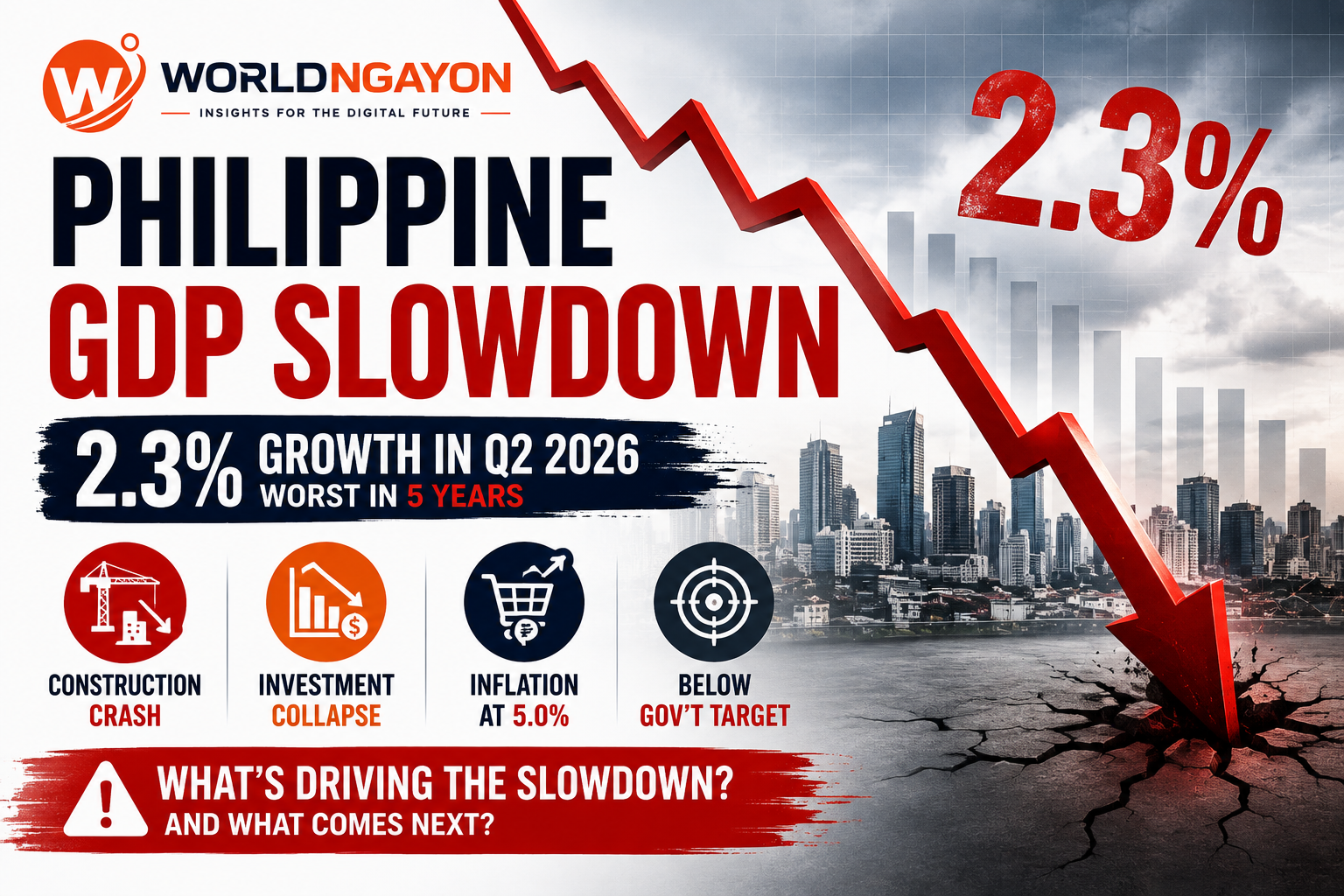
Philippine GDP slowdown hit 2.3% in Q2 2026 — the weakest annual growth rate in five years, driven by a construction collapse, shrinking investment, and an inflation rate running 67% above the government’s own target.
Key Takeaway
- 📉 2.3% Growth: The Philippine GDP slowdown marks the fourth consecutive quarter of deceleration — weakest since Q1 2021, below the 2.8% Reuters poll median
- 🏗️ Construction Crashed: Construction contracted 14.8% year-on-year, worsening from a 4.3% decline in Q1, as a corruption scandal curtailed public infrastructure spending
- 💸 Investment Collapse: Fixed investment shrank 9.2% — the fourth straight quarter of contraction, signaling deep erosion of investor confidence
- 🔥 Inflation 5.0%: Inflation averaged 5.0% in the first seven months of 2026, running well above the government’s 3.0% target and eroding household purchasing power
- 📊 Below Target: First-half growth of 2.6% falls well below the government’s revised 3.5%-4.5% full-year target, which was already cut from a higher range in June
The numbers tell one story. The trend beneath them tells another. A 2.3% GDP growth rate in a country that was supposed to be one of Asia’s brightest performers is not a temporary dip — it is a structural signal. The Philippine GDP slowdown reflects three forces converging simultaneously: a corruption scandal that froze public construction, an energy crisis driven by the Iran conflict that inflated import costs, and an inflation rate that has been running above target for seven straight months. None of these are cyclical. None will resolve themselves with a single rate cut.
What makes this moment particularly significant is that the slowdown is happening despite record OFW remittances and a global AI investment boom that should be lifting the Philippine economy. As we tracked in our OFW remittances analysis, remittance growth itself has slowed to its weakest pace in four years. And while global AI infrastructure spending exceeded $510 billion in H1 2026, as we reported in our AI economic impact Philippines guide, the Philippines has captured only a fraction of that investment. The gap between what the economy could be doing and what it is doing is widening.
Why the Philippine GDP Slowdown Is Happening Now
Three distinct forces are driving the deceleration, and understanding each is essential for any Filipino professional making career, business, or investment decisions in 2026.
The first force is the construction collapse. Construction contracted 14.8% year-on-year in Q2, a dramatic worsening from the 4.3% decline recorded in Q1. Economic Planning Secretary Arsenio Balisacan attributed this directly to a corruption scandal involving flood-control projects that broke in 2025. The scandal curtailed public spending and dented investor sentiment, particularly around infrastructure projects. When the government’s own integrity is questioned, private developers hesitate. The result: a sector that should be building roads, bridges, and data centers is instead contracting at double-digit rates.
The second force is the investment freeze. Fixed investment shrank 9.2% in Q2 — the fourth consecutive quarter of contraction. Four straight quarters of negative investment growth is not a blip. It is a pattern. Investors are not temporarily cautious; they are structurally repositioning. The Iran energy crisis, which affects the Philippines more than regional peers due to its heavier reliance on energy imports from the Middle East, has raised input costs across construction and manufacturing. Combined with one of the highest policy interest rates in ASEAN — the Bangko Sentral ng Pilipinas has raised rates by 25 basis points at each of its past two reviews — the cost of capital has become a barrier to new projects. This connects to the broader economic vulnerability we analyzed in our Philippine AI Infrastructure Master Plan coverage: without investment flowing into digital infrastructure, the AI economic opportunity remains theoretical.
The third force is inflation persistence. Inflation averaged 5.0% over the first seven months of 2026 — 67% above the government’s 3.0% target, according to data from the Philippine Statistics Authority. Household spending, which accounts for more than two-thirds of Philippine economic activity, grew only 2.8% in Q2, down from 3.0% in Q1. When inflation runs at 5% and wage growth lags, real purchasing power falls. Filipino households are spending more on the same goods and have less left for discretionary purchases. This is why the services sector, traditionally the economy’s growth engine, is sputtering.
What the Numbers Reveal — and What They Miss
The headline 2.3% figure is alarming, but the composition of the growth tells a more nuanced story. Not every sector is contracting. Government consumption rose 8.3% in Q2, up from 4.8% in Q1 — a sign that fiscal authorities are trying to compensate for private sector weakness. Exports of goods and services grew 12.2%, up from 7.8% in Q1, suggesting that external demand for Philippine products and services remains strong despite the global uncertainty.
But here is what the headline numbers miss: the Philippine GDP slowdown is disproportionately hitting the sectors that employ the most Filipinos. Construction employs millions of skilled and semi-skilled workers. When construction contracts 14.8%, those workers face reduced hours, project cancellations, or layoffs. The IT-BPM sector, which we analyzed in our Philippine Digital Workforce guide, is simultaneously facing AI-driven task automation that could reduce employment projections from 2.5 million to as low as 1.85 million by 2028. The convergence of a construction slump and an AI-driven services transformation means Filipino workers are being squeezed from two directions simultaneously.
Focus Economics noted that the Q2 reading was the weakest since Q1 2021 and fell short of market expectations of a modest acceleration. The seasonally adjusted quarter-on-quarter growth was just 0.6%, down from 0.9% in the prior quarter. This means the economy is not just growing slowly — it is decelerating. The gap between the current trajectory and the government’s own targets is widening, not narrowing. The Reuters report confirmed that construction contracted 14.8% while investment shrank 9.2%, marking the fourth straight quarter of investment contraction in the Philippine GDP slowdown.
The Second-Order Effect on Filipino Professionals
For Filipino professionals, the Philippine GDP slowdown translates into three immediate consequences. First, wage growth will remain suppressed. When GDP grows at 2.3% and inflation runs at 5.0%, real wages are falling. A professional earning ₱50,000 per month is effectively earning less than they did a year ago, because the cost of food, fuel, and housing has risen faster than their salary. This is not theoretical — it is showing up in household spending data.
Second, career opportunities in construction, infrastructure, and related sectors will remain constrained until the corruption scandal is fully resolved and public spending resumes. The government says it expects infrastructure spending to pick up in Q3 as work begins on recently approved projects. But after four straight quarters of investment contraction, the credibility of that forecast depends on whether investors believe the scandal is truly behind the government.
Third, the BSP’s next policy review on August 27 becomes a critical decision point. The central bank faces a classic stagflation dilemma: cut rates to stimulate growth, and risk fueling further inflation; hold rates high, and risk deepening the investment freeze. The Reuters report noted that the weaker-than-expected growth data “will be considered at the central bank’s next policy review.” For professionals with mortgages, business loans, or investment decisions pending, the August 27 decision matters directly. This connects to the investment landscape we explored in our Philippine AI stocks investment guide — the macro environment shapes every investment thesis.
The Structural Problem Beneath the Cyclical Noise
Here is the deeper question that the GDP numbers raise but cannot answer: is the Philippine economy too dependent on household consumption and the services sector? Secretary Balisacan himself flagged this on August 17, 2026, when he urged a shift away from household consumption and services sector reliance as key growth drivers. This is a remarkable admission from the government’s own economic planning chief — an acknowledgment that the growth model that served the Philippines for the past decade may be reaching its limits.
The World Bank maintained its 2026 Philippine growth forecast at 3.7% in early August, with division director Zafer Mustafaoglu noting that growth is set to decelerate “on the back of weak investment, constrained consumption and sustainability.” The World Bank’s Philippine Economic Update highlighted that the country’s growth deceleration is part of a broader regional trend, but the Philippine GDP slowdown is more severe than peers due to the corruption scandal’s impact on construction. Pantheon Economics cut its 2026 growth forecast to 2.8%. The government’s own revised target of 3.5%-4.5% already represents a significant downgrade from earlier projections. The 2027-2030 target of 5%-6% growth assumes a structural turnaround that the current data does not yet support.
The structural argument is this: an economy that relies on household consumption for two-thirds of its activity, and where that consumption is being eroded by inflation, cannot sustain growth without a meaningful increase in investment and productivity. The AI transformation offers one path to productivity gains — but only if infrastructure investment flows into digital capacity, as we outlined in our AI economic impact analysis. The construction freeze offers another path — but only if the corruption scandal is resolved and investor confidence returns.
What Comes Next
The government’s own statements suggest cautious optimism. Balisacan said recent indicators “give us reason for cautious optimism that the economy may already be entering the early stages of recovery,” pointing to improving business confidence surveys and expected infrastructure spending pickup in Q3. But after four consecutive quarters of investment contraction, optimism requires evidence that has not yet appeared in the data.
For Filipino professionals, the practical implications are clear. First, do not assume the economy will rebound to 6% growth in 2027 — plan career and financial decisions around a 3-4% growth environment. Second, prioritize sectors that are growing despite the slowdown: exports grew 12.2%, government consumption rose 8.3%, and the AI infrastructure buildout continues globally regardless of Philippine domestic conditions. Third, monitor the BSP’s August 27 rate decision closely — it will signal whether the central bank prioritizes inflation fighting or growth support. Fourth, invest in skills that are resilient to both the construction slump and the AI services transformation, as we detailed in our AI agents workforce guide.
The Philippine GDP slowdown is not a crisis. But it is a warning. An economy growing at 2.3% with 5% inflation and four straight quarters of investment contraction is an economy that needs structural change, not just cyclical patience. The question is whether that change comes from policy reform, infrastructure investment, or the AI productivity wave — or whether it comes at all.
Frequently Asked Questions About the Philippine GDP Slowdown
What was the Philippine GDP growth rate in Q2 2026?
The Philippine GDP slowdown brought growth to 2.3% year-on-year in Q2 2026, down from 2.8% in Q1. This was the weakest annual growth rate since Q1 2021 and fell below the Reuters poll median forecast of 2.8%.
Why did the Philippine GDP slow down in 2026?
Three main forces drove the Philippine GDP slowdown: a corruption scandal involving flood-control projects that curtailed public construction spending, the Iran energy crisis that raised import costs, and persistent inflation averaging 5.0% — well above the government’s 3.0% target — which eroded household purchasing power.
How much did construction contract in Q2 2026?
Construction contracted 14.8% year-on-year in Q2 2026, worsening from a 4.3% decline in Q1. This was the most significant drag on GDP, reflecting the freeze in public infrastructure spending following the corruption scandal.
What is the Philippine government’s revised GDP growth target for 2026?
The government revised its 2026 GDP growth target to 3.5%-4.5% in June, down from a higher previous range. First-half growth of 2.6% falls well below this revised target. The 2027-2030 target is set at 5%-6%.
How does inflation affect the Philippine GDP slowdown?
Inflation averaged 5.0% in the first seven months of 2026, 67% above the government’s 3.0% target. Elevated inflation eroded household purchasing power, causing consumption growth to slow to 2.8% in Q2 from 3.0% in Q1. Since household spending accounts for over two-thirds of Philippine GDP, this directly drags growth.
What is the BSP doing about the economic slowdown?
The Bangko Sentral ng Pilipinas has raised its policy rate by 25 basis points at each of its past two reviews to combat inflation. The weaker-than-expected Q2 GDP data will be considered at the next policy review on August 27, 2026, as the central bank balances the need to support growth against inflation concerns.
Is the Philippine economy in recession?
No. The Philippine GDP slowdown represents decelerating growth, not a recession. The economy is still growing at 2.3% year-on-year. However, four consecutive quarters of investment contraction and construction declines signal a significant structural weakness that requires policy attention.
How does the GDP slowdown affect OFW remittances?
OFW remittance growth has slowed to its weakest pace in four years, as we reported in our separate remittances analysis. While remittances remain a crucial economic stabilizer, the combination of a domestic slowdown and weaker remittance growth compounds the economic pressure on Filipino households.
Sources: Philippine Statistics Authority, “GDP Grows by 2.3 Percent in the Second Quarter of 2026,” August 7, 2026 | Reuters, “Philippine economy posts slowest growth in five years in second quarter,” August 7, 2026 | Focus Economics, “Philippines: Economic growth slows in the second quarter of 2026,” August 7, 2026 | World Bank, August 3, 2026 | Inquirer Business, August 17, 2026
This article is for informational purposes only and does not constitute financial or investment advice. Readers should consult a licensed financial advisor before making investment decisions based on economic data.