Table of Contents
Key Takeaway
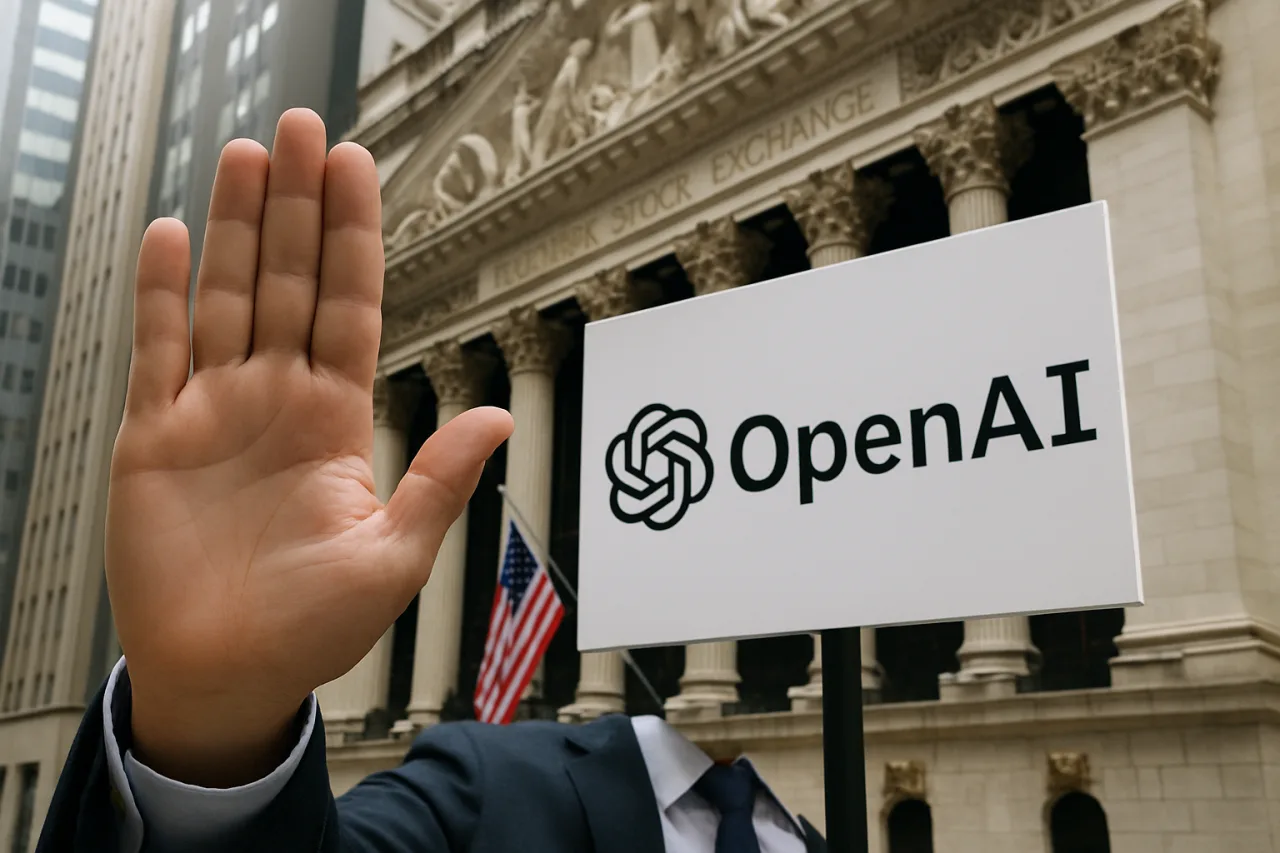
- 🏦 The OpenAI IPO is off the table for 2026: Sam Altman told Fortune over the weekend that going public now would be “an ill-advised moment,” citing safety work — the first time a market-bound giant has named AI safety as the reason to stay private.
- 💬 The quote that moved markets: “I actually think that, given everything happening with safety, right now would be an ill-advised moment to go public, and we don’t feel pressure on that.” Asked about 2027: “I would say not 2026.”
- ⚖️ The contrast is the story: while OpenAI pauses, Anthropic is marketing its IPO in mid-October and plans to list days before the November midterms — two rival labs now running opposite playbooks in the same week.
- 🤝 A slowdown pact may be forming: Altman also hinted that leading AI companies are close to an agreement to slow development and coordinate on safety — one day after Dario Amodei’s public essay urging the industry to “slow the pace.”
- 🇵🇭 Why Filipinos should care: the world’s most valuable private company just told investors that trust, not liquidity, is the scarce asset — a signal every Filipino founder and AI professional should read before building on the hype cycle.
The OpenAI IPO question just got its answer: the most valuable startup on Earth told Wall Street to wait. In a Fortune interview published Saturday, Sam Altman confirmed there will be no OpenAI IPO in 2026 — and for the first time in the modern market era, a company at the center of a trillion-dollar land rush named safety, not valuation, as the reason. The decision lands one day after Dario Amodei urged the industry to slow down, and one weekend before Anthropic’s own listing timetable hit the financial wires. This analysis unpacks what Altman actually said, why the timing matters, and what the diverging strategies of the two leading AI labs mean for investors, professionals, and the region building on top of their models.
What Altman Actually Said — and What He Did Not
The facts first. Speaking to Fortune in an interview published Saturday, Altman said: “I actually think that, given everything happening with safety, right now would be an ill-advised moment to go public, and we don’t feel pressure on that.” Pushed on whether an offering would slip to 2027, he did not commit — but he was unambiguous about this year: “I would say not 2026.” He added that the company has “significant work ahead” on safety and alignment, and on how governments and industry can work together. As Reuters reported, he also suggested that OpenAI and other leading AI companies may be close to announcing an agreement to slow AI development and coordinate on safety risks.
Read the statement carefully and two things stand out. First, the reasoning is not financial: no revenue shortfall, no down round, no regulatory cloud — an “ill-advised moment” is a statement about exposure. A public company files quarterly, answers to analysts, and narrates every safety incident in 13-week increments. Altman is declining that accountability loop while the alignment problem is unsolved, and he is saying so out loud. Second, “we don’t feel pressure” is a sentence only a company with private capital on tap can say — OpenAI’s compute commitments are measured in hundreds of billions, and its investors have accepted illiquidity as the price of frontier access. The Guardian’s coverage framed the decision against the industry’s own dire warnings; the framing matters, because it turns a capital-markets story into a governance story.
Two Labs, Two Playbooks: The Anthropic Divergence
The same week produced the counter-move. Anthropic is expected to begin marketing its IPO in mid-October at the earliest and complete the listing days before the U.S. midterm elections in November — with Morgan Stanley, Goldman Sachs, JPMorgan and Citi on the ticket, a $15 billion revolving credit facility in finalization, and reports suggesting a potential $2 trillion valuation on quarterly revenue that passed $11.5 billion in August. One lab is choosing the safety of privacy; the other is choosing the discipline of public markets while the election calendar narrows the window. There is no contradiction in both strategies being rational — but there is a fork being built, and every AI company watching will inherit one road or the other.
The deeper signal is the coordination layer. Amodei’s essay urging the industry to “slow the pace” of capability gains, Altman’s public agreement with its sentiment, and now a possible joint pact on pacing — the competitive logic of 2024-25 (“we must win because they will not pause”) is giving way to a mutually-assured-restraint logic that would have sounded absurd a year ago. For the market, an OpenAI-led agreement among frontier labs to slow down does three things at once: it reduces the odds of a catastrophic incident, it stabilizes the capex arms race that is straining balance sheets across the industry, and it quietly locks out new entrants who cannot afford to slow down — a dynamic our Gartner 40% cancellation analysis shows already separates disciplined builders from the rest. Our coverage of the Altman-Musk backing for Amodei’s essay traced how quickly that consensus formed; the IPO decision shows it now shapes capital strategy, not just press releases.
What the OpenAI IPO Delay Means for Investors and Builders
For investors: the AI trade just got more interesting. With OpenAI private through 2026 and Anthropic listing days before midterms, public-market exposure to the frontier runs through Anthropic’s ticker, the supplier chain (chips, power, data centers), and the application layer. The scarcity of direct exposure is itself a pricing force — secondary-market marks for OpenAI shares will harden while the primary market waits. Watch the prospectus dates: if Anthropic prices in late October, the entire AI complex will trade against that benchmark within the hour.
For builders and professionals: the delay is a calendar gift. Every enterprise that planned an AI-vendor selection “after the IPO clarity” now knows clarity is a year away — choose on capability and reliability now, not on market signals. And for the region: Southeast Asia’s AI adoption runs on the labs’ models through APIs, which means the pacing pact, if it happens, arrives in your product roadmap as slower model generations, not fewer features. Build for durability. Our AI World This Week brief on the slowdown maps which products the shift touches first.
For founders in the Philippines: there is a third lesson hiding in the quote. Altman can refuse Wall Street because OpenAI’s capital structure tolerates it — that is the same “own your runtime” logic we keep applying at personal and SMB scale. When your business model depends on someone else’s pricing power, their calendar becomes your calendar. The founders who internalize that this decade will be the ones still standing in the next one.
The Governance Math Behind Staying Private
To evaluate the OpenAI IPO decision on its merits, price what a listing would actually cost the lab. A public OpenAI would inherit the standard disclosure machinery: quarterly reports parsing revenue against a compute bill measured in tens of billions, material-incident disclosure obligations that would turn every alignment failure into a shareholder question, and a market narrative that re-prices the entire AI sector on each earnings call. The company’s structure — a capped-profit history, a foundation holding control, and a board that answers to the mission rather than to the float — exists precisely because its architects doubted that quarterly capitalism and frontier safety work could share a calendar. Altman’s “ill-advised moment” is that doubt, spoken into a microphone.
The counterargument deserves its hearing. Public markets manufacture accountability, and accountability is not the enemy of safety — it is how outsiders verify that “significant work on safety” is real rather than rhetorical. A listed OpenAI would publish audited numbers on its safety research spend; a private one asks for trust. Anthropic’s counter-bet is that verified trust compounds faster than unverified patience, and its $11.5 billion quarter gives it the standing to make that bet. Which governance model ages better is not a philosophical question — it is the empirical question the next eighteen months will answer, as one lab files prospectuses and the other files progress reports nobody can audit.
For the market mechanics, mark the calendar: Anthropic’s roadshow in mid-October, pricing in late October, listing days before the November 3 midterms. Every asset connected to the AI buildout — chipmakers, power providers, data-center REITs, and the application layer — will reprice against that print. The OpenAI IPO, when it comes, will land in a market that has already learned what a frontier-lab listing does to valuation math, and the private-market marks in between will tell you what sophisticated money believes before the prospectus says a word.
WorldNgayon Analysis: Strip the finance and this is a trust story, and trust is the one asset the AI economy cannot print. The most valuable private company on Earth just told the most liquid market on Earth that it is not ready for the scrutiny — while its closest rival bets that scrutiny is exactly what wins the next decade. Both can be right: OpenAI is buying time to solve alignment, Anthropic is buying legitimacy to survive it. The rest of the industry, and everyone building on it — including every Filipino professional whose career now touches a model API — should watch which bet the market rewards first, because that reward will set the risk appetite for every AI company that follows.
Bottom Line: The OpenAI IPO delay is not a postponement — it is a position statement: safety before liquidity, alignment before the ticker, and 2026 is the year the frontier chose patience over the market clock.
The question to keep on your watchlist is refreshingly concrete: does Anthropic price its listing in late October, and does the pacing pact get announced first? The sequencing tells you which force — market discipline or coordination discipline — the frontier believes is scarcer. Either answer rewrites the 2027 IPO math for OpenAI, and both answers matter to anyone whose career, portfolio, or product roadmap touches a model API.
Frequently Asked Questions
Will OpenAI go public in 2026?
No. Sam Altman told Fortune on September 12, 2026 that an IPO this year would be “an ill-advised moment” given the state of AI safety work, and directly ruled out 2026: “I would say not 2026.” He did not commit to a 2027 timeline.
Why is OpenAI delaying its IPO?
Stated reason: safety. Altman said the company has significant work ahead on safety and alignment and on cooperation between governments and industry, and that going public now would be ill-advised. Analysts add a practical layer: public-company disclosure cycles would expose the lab’s safety incidents and capex burn to quarterly judgment while an industry-wide pacing agreement is being negotiated.
When is the Anthropic IPO?
Anthropic is expected to begin marketing in mid-October at the earliest and complete its listing days before the U.S. midterm elections in early November 2026, per Reuters. The prospectus is expected in late September; Morgan Stanley, Goldman Sachs, JPMorgan and Citi are among the banks on the deal.
Is OpenAI agreeing to slow down AI development?
Altman suggested leading AI companies may be close to announcing an agreement to slow AI development and address safety risks together. That follows Dario Amodei’s September 12 essay urging the industry to slow the pace of capability improvements — and Altman publicly agreed with its sentiment.
What does the OpenAI IPO delay mean for retail investors?
Direct exposure to OpenAI stays out of reach through 2026, so public-market AI exposure flows through Anthropic’s listing, semiconductor and data-center suppliers, and the application layer. Expect secondary-market OpenAI share marks to firm up, and expect the Anthropic pricing to become the benchmark the whole AI complex trades against.
Financial Disclaimer
This article is for general information and editorial analysis only and does not constitute financial, investment, or legal advice. Statements reflect public reporting as of September 14, 2026 and are subject to change; IPO timelines and valuations are not guarantees. Company mentions are not recommendations to buy or sell securities. Readers should conduct their own research and consult a licensed professional before making financial decisions. WorldNgayon.com publishes under Edmon Agron.