OFW Pass explained in one line: it is the OEC’s successor — the same Philippine overseas-employment exit clearance, renamed and digitalized, issued free to returning workers and, since November 2025, generated as a color-coded QR code inside the official eGovPH app. This guide walks the returning OFW through the whole system: what the OFW Pass is and which circular created it, who needs one (and the travelers who do not), the two routes — the digital OFW Travel Pass in eGovPH and the traditional OEC for new hires — the validity and reuse rules that decide when you generate a fresh one, your airport-day paperwork, the changed-employer case, the honest cost table, and the advisory numbers that stay current.
Key Takeaway
- 🎫 The rename: the OEC became the OFW Pass under DMW Department Circular No. 02, Series of 2023 — and the ₱100 processing fee for returning (Balik-Manggagawa) workers was removed.
- 📱 The digital form: the OFW Travel Pass — introduced for eligible returning workers by DMW Advisory No. 38, Series of 2025 — is generated inside the free eGovPH app as an SVG-backed, color-coded QR clearance.
- ⏱️ The validity split: Travel Pass = 90 days from issuance; the traditional OEC = commonly 60 days, one departure. Every departure needs a fresh or confirmed-valid clearance.
- 🧳 Who is exempt: tourists, students, permanent emigrants and business travelers do not need an OFW Pass — it exists only for workers departing to take up overseas employment.
- ✈️ The airport truth: the Pass is a Philippine exit clearance, not a visa — it never replaces your passport, work permit, or contract, and it carries the statutory travel-tax and terminal-fee exemptions.
What the OFW Pass is — and how it replaced the OEC
The OFW Pass is the Department of Migrant Workers’ current form of the Overseas Employment Certificate — the exit clearance Filipino workers have presented at Philippine airports for decades. Under DMW Department Circular No. 02, Series of 2023 — published through the Department of Migrant Workers, the OEC was formally renamed the OFW Pass, and the ₱100 processing fee for passes issued to returning workers — the Balik-Manggagawa class — was removed. The document’s legal function carried over unchanged: it certifies that the holder is departing under a Philippine-recognized overseas employment arrangement, cleared through the country’s documentation system, protected by the Republic Act No. 8042 framework (as amended by Republic Act No. 10022) and administered today by the DMW under Republic Act No. 11641 — the full OEC-to-OFW-Pass requirements guide by immigration counsel stays current as the system evolves.
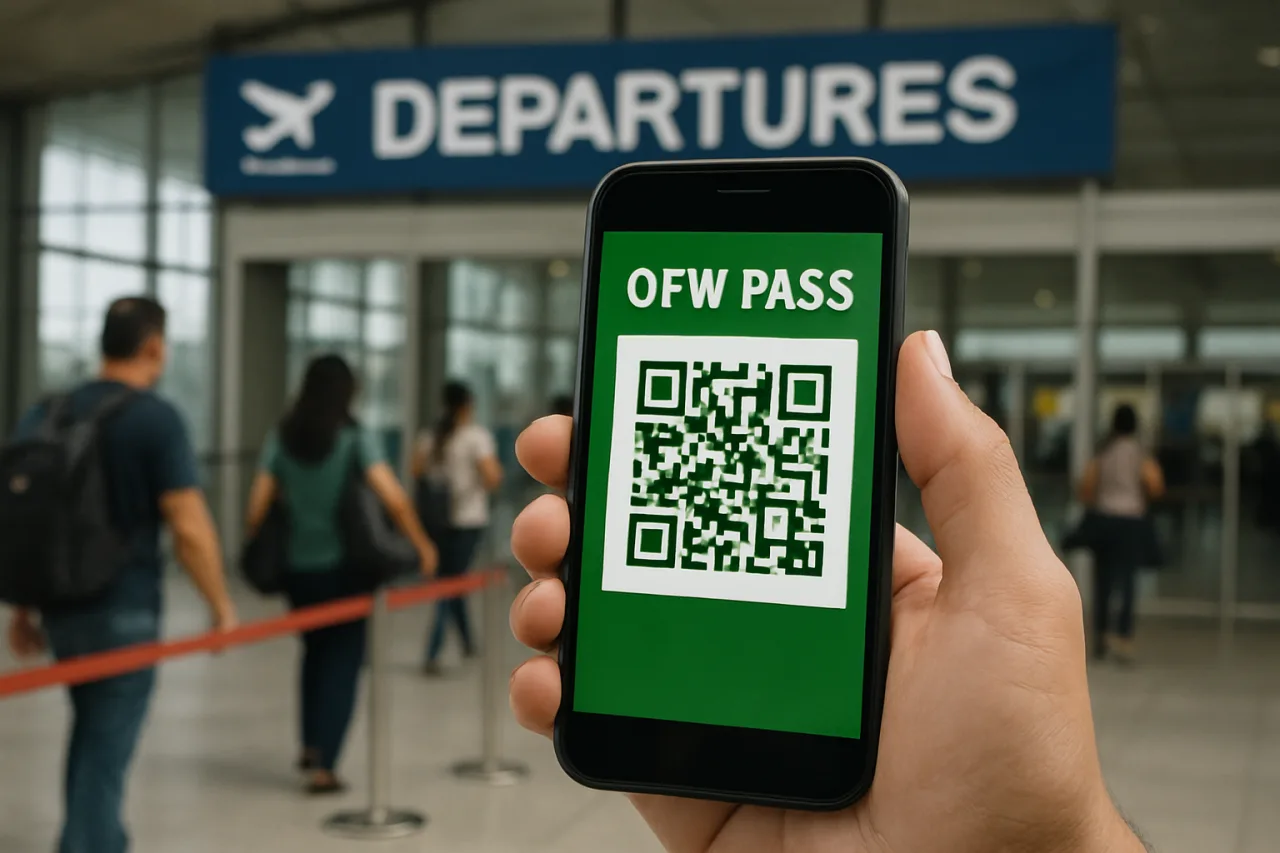
The digital transformation ran on two rails. First, the DMW Mobile App piloted the OFW Pass as a QR-code credential that immigration authorities can verify instantly — replacing the paper certificate’s queue era. Second, and now decisive for returning workers, DMW Advisory No. 38, Series of 2025 (November 2025) introduced the OFW Travel Pass inside the government’s eGovPH application: the returning worker generates the clearance digitally, and the pass renders as a color-coded QR code whose validity runs from the underlying employment record. The result in 2026: a returning worker’s exit clearance is typically an in-app QR code, generated free, presented at the Bureau of Immigration counter and to airline staff — no queues, no fee, no paper.
Who needs an OFW Pass — and who does not
The OFW Pass exists for one population: Filipinos departing the Philippines to take up overseas employment. Inside that population, the route depends on the hire’s shape: returning workers (Balik-Manggagawa) returning to the same employer and destination whose DMW record matches run the free digital route; new-hire land-based workers, direct hires, government-to-government hires, seafarers, and workers whose situations don’t match the digital pass’s coverage run the traditional processing route with appointment and verification steps. And critically for the immigration conversation families have at the airport: tourists, students, permanent emigrants, business travelers and family visitors do not need an OFW Pass or OEC at all — the clearance only applies when the departure is a work deployment. A grandmother visiting Toronto does not need a Pass; the domestic worker flying to Dubai does. Families who understand this distinction stop paying fixers for documents they never needed in the first place.
Route one: the OFW Travel Pass in eGovPH
The digital route for eligible returning workers runs entirely inside the eGovPH application — free, and system-generated. The steps per DMW’s advisory: download the eGovPH app from the App Store or Google Play; register and complete the identity verification the app requires; open the National Government Agencies section and select the Department of Migrant Workers tab; open the Balik-Manggagawa service; and let the system generate the OFW Travel Pass when your record qualifies. The system-generated issuance is the design point: the pass draws on the worker’s DMW employment record, so a matching record (same employer, same destination, active status) issues instantly, while a mismatched or incomplete record prompts the manual-verification paths described below. The pass’s validity runs 90 days from issuance, and the worker renews or voids it through the same system if plans change.
The Travel Pass’s eligibility boundary matters as much as its convenience: the rollout initially covers rehires and returning workers, including those holding OEC-exemption status. First-time workers — new hires through agencies, direct hires, name hires, government-to-government hires, seafarers — process through the traditional documentation stack, because their deployment begins a fresh record rather than extending an existing one.
Route two: the traditional OEC for new hires and special cases
The traditional OEC remains the workhorse clearance for the populations the digital pass does not yet cover: first-time land-based workers hired through licensed agencies; first-time direct or name hires; government-placement and government-to-government hires; sea-based workers and seafarers; and any worker whose situation falls outside the online exemption or Travel Pass coverage. Its requirements stack matches the classic pre-departure system: the verified employment contract (the OFW contract verification step covered fully in our country-map guide); the DMW e-registration account; the pre-employment orientation seminar certificate; the medical certificate from an accredited clinic; proof of OWWA membership; and for covered categories, the pre-departure orientation and insurance certificates. The OEC itself is commonly valid for sixty days and for one departure — generated at the DMW appointment, regional office, or One-Stop Processing Center, and still free at the counters where the fee removal applies.
The airport-day paperwork for this route adds the Bureau-of-Immigration layer: passport; valid work visa, entry visa, or work permit; the verified contract; the valid OEC — arrive early, because the verification-and-problem-solving desks at terminals assist delays, they do not substitute the process.
Validity and reuse: the rules that decide fresh generation
Two clocks govern the system, and both are short. The OFW Travel Pass carries 90 days from issuance. The traditional OEC commonly runs 60 days and clears a single departure. A pass already marked as used cannot be reused — the worker generates or confirms a valid clearance before each departure from Philippine territory for overseas employment. The practical pattern for the OFW on a home leave: generate the Travel Pass close to the return flight (days before, not weeks), keep the QR-code screenshot as backup for connectivity gaps, and treat the pass’s validity window as the departure window — a flight delay that outlives ninety days means a fresh, free generation in the app, which is why the free digital cycle is the quiet upgrade of this whole system: the old paid OEC’s sixty-day clock cost real money when schedules slipped; the new clock costs a screen tap.
Airport day: what the Pass replaces — and what it never did
The Pass is a Philippine overseas-employment clearance — and being precise about its boundaries prevents the counter mistakes that cost hours. It does NOT replace the passport, the work visa or work permit, the employment contract, a residence permit, the destination country’s entry requirements, or the airline’s travel documentation. It does one job: certify that this departure is a lawful, documented overseas employment departure — and with that certification come the statutory exemptions under Republic Act No. 8042: the OFW’s exemption from travel tax and airport terminal fees upon presenting the exit clearance. The digital pass carries the same standing as the paper it replaced; immigration officers verify the QR code against the system, which is faster than reading stamps. The honest boundary note: airline and immigration staff may still ask for the underlying employment proof — certificate, company ID, or recent payslip — so the worker carries the employment record alongside the clearance.
Changed employers mid-contract: the correction route
The worker who changed employers while abroad runs the correction chain before generating any pass: have the new contract verified by the MWO holding jurisdiction over the workplace (the fees and steps in our country-map guide); then book the DMW appointment that registers the new employment in the system; then generate the clearance that matches the updated record. Generating a pass against a stale record — the old employer’s data, the old contract’s terms — triggers the manual-review path, because the system-generated issuance reads the record, not the intention. Workers switching in the Gulf should also read our Saudi employer-switching guide for the destination-specific rules that ride above the documentation.
Costs: what is free — and what may still charge
The fee table has one big zero and a list of honest asterisks. Free: the OFW Pass itself for returning workers — the ₱100 processing fee was removed by Circular 02-2023; the OFW Travel Pass generation in eGovPH; the DMW Mobile App and eGovPH apps; the e-registration account. May still charge: the OFW contract verification steps (per-country fees, covered in our map); OWWA membership (USD 25 per two-year cycle — the card of our OFW ID guide); document translation, notarization, or courier services where the deployment requires them; insurance premiums for covered categories. The fixer economy dies at these numbers: everything that once justified a ₱100-plus-tip queue transaction is now a free app flow — and workers who know the list stop paying for it.
The wider ecosystem: for the ID card that completes the airport kit, see our OFW ID guide; for the scams this clearance system exists to fight, run the offer through our overseas-job verification ladder before any contract reaches processing.
FAQ
Is the OFW Pass the same as the OEC?
Yes — the OFW Pass is the OEC renamed under DMW Department Circular No. 02, Series of 2023, which also removed the ₱100 fee for returning workers. The traditional OEC continues for populations the digital route does not cover: new hires, direct hires, seafarers, and first-time workers.
How do I get the OFW Travel Pass in eGovPH?
Download the free eGovPH app, register and verify your identity, open the National Government Agencies section, select the Department of Migrant Workers tab, and open the Balik-Manggagawa service — the system generates the OFW Travel Pass as a QR code when your employment record qualifies. It is valid 90 days from issuance.
Who is eligible for the free OFW Pass?
Returning and rehired workers (Balik-Manggagawa) returning to the same employer and destination with matching DMW records, including workers with exemption status. New hires and other first-time workers process through the traditional OEC route with appointment and verification steps.
How long is the OFW Pass valid?
The OFW Travel Pass: 90 days from issuance. The traditional OEC: commonly 60 days and one departure. A used pass cannot be reused — generate or confirm a valid clearance before each departure from the Philippines for overseas employment.
Does the OFW Pass replace my visa or contract?
No. It is a Philippine exit clearance only — it never replaces the passport, work visa or permit, employment contract, residence permit, or destination-country entry requirements. It carries the statutory travel-tax and terminal-fee exemptions for the documented departure.
I changed employers abroad. Do I need a new OFW Pass process?
Yes: verify the new contract at the MWO with jurisdiction over your workplace, register the new employment through a DMW appointment, and generate the clearance from the updated record. A pass generated against a stale record triggers manual review — fix the record first.