Table of Contents
Key Takeaway
- 📊 The verified starting point — the BSP’s own survey: 94.8% of remittance-receiving families use the money for food and basic needs (the BSP’s Q3 Consumer Expectation Survey, the Inquirer’s Dec-11-2025 report) — the family budget’s first envelope is nutrition, and any split framework that ignores it is fiction.
- 💰 The money’s scale, from the BSP’s own data family: cash remittances hit USD 35.63B for 2025 (personal: USD 39.62B), with December 2025’s USD 3.52B the highest single month ever — 7.3% of GDP — every family’s budget sits inside these flows.
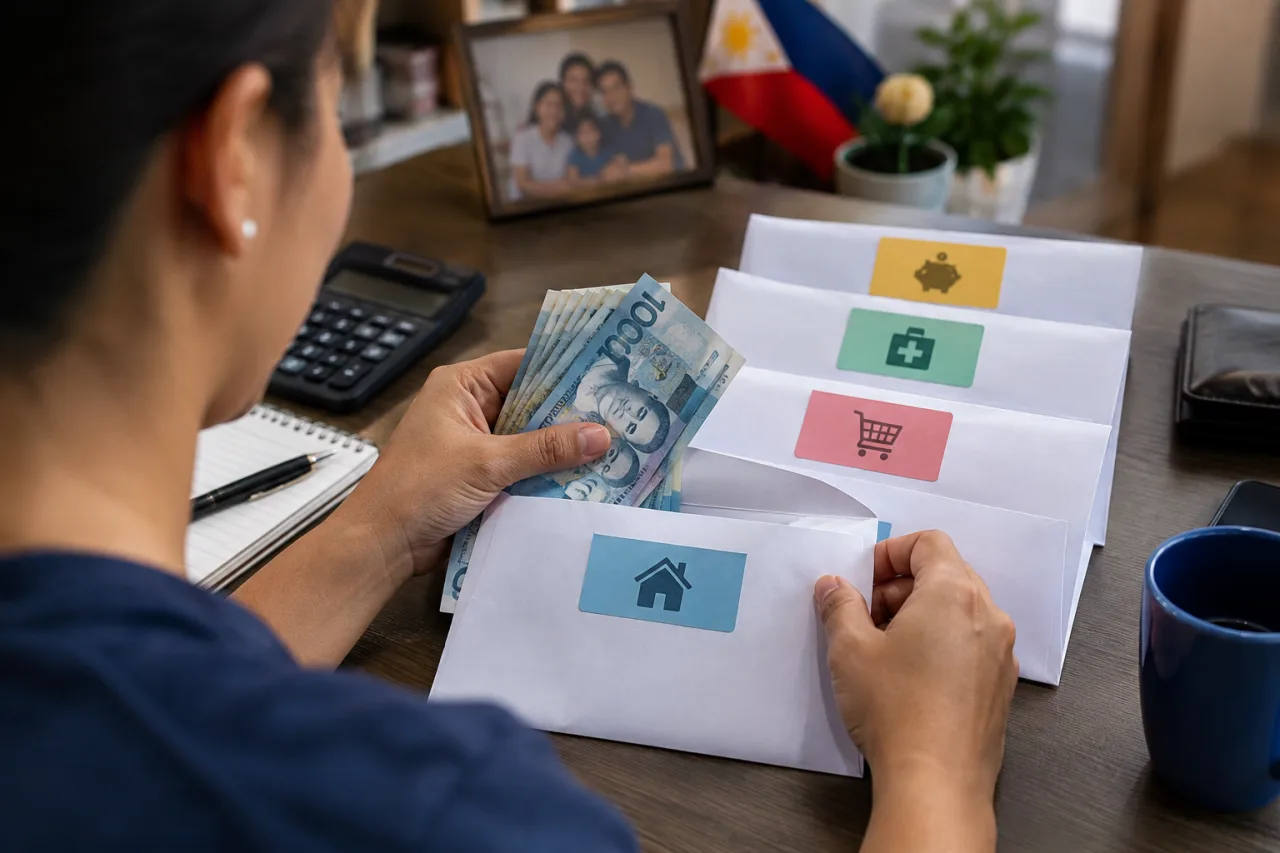
- ✉️ The OFW family budget’s four-envelope split (the framework this guide teaches, adapted to remittance reality): the living envelope (food, utilities, transport), the care envelope (the contributions, the health, the education), the future envelope (the savings ladder), and the boundary envelope (the buffer and the goal-ladder) — each with its own amount, named in writing.
- 🤝 The fights are a design problem, not a character problem: the money fights families report trace to unnamed envelopes and un-agreed percentages — the honest fix is the split written down, reviewed monthly on send-day, and honest about what the 94.8% reality means.
- 📱 The tools exist and are free: the wallet histories (the GCash/Maya transaction exports), a shared budget sheet, one tracker — the desk’s budgeting-apps guide carries the class; the split needs no paid subscription.
The OFW family budget is where remittances meet real life — and the verified data says the meeting is dominated by one envelope: the BSP’s own survey has 94.8% of families running the money into food and basic needs, inside a remittance flow that hit USD 39.62B personal in 2025. This piece is the OFW family budget’s split framework: the four-envelope method adapted to the send-day reality (the percentages the desk’s own classes set, not the roundups’ US-adapted 50/30/20), the tools that keep it honest, the money-talk mechanics that prevent the fights, and the boundary layer’s connection to the desk’s ₱1M blueprint — a framework piece, its arithmetic honest, its data verified, its advice marked as education.
The Verified Reality: What the Data Says Families Do
The BSP’s own expectation-survey class (the Inquirer’s dated report): 94.8% of the surveyed families direct remittances to food and basic needs — the survival-dominant reality the budget conversation must start from, not the idealized splits the roundups print. The flow’s own scale (the BSP-sourced dated report): cash remittances at USD 35.63B for 2025, the personal class at USD 39.62B, December’s USD 3.52B the record month, the share at 7.3% of GDP — a decade of growth behind every family’s table. The desk’s honest read: the four-envelope framework’s percentages must fit INSIDE the food-dominant reality — the framework’s honest design: the living envelope holds the majority in most OFW households (often 60-70% in the lower-income classes), and the framework’s job is to carve the care and the future envelopes from what remains, at families’ real sizes — not to shame the food dominance the data names.
The OFW Family Budget’s Four-Envelope Split: the Desk’s Framework
- Envelope one — the living class: food, utilities, house rent or amortization, transport, school-day costs — the 94.8% class; the framework’s rule: named first, funded first, and priced honestly (the family’s own month’s receipts, not guesses).
- Envelope two — the care class: the SSS/PhilHealth/Pag-IBIG contributions (the desk’s contributions guide), the health costs, the school fees above the daily class — the envelope the families most often forget until a hospital month arrives; the framework’s rule: pay it ON send-day, not at the emergency.
- Envelope three — the future class: the savings ladder — the MP2 classes (the desk’s MP2 guide), the time-deposit ladder (the desk’s TD guide), the automated investing (the desk’s own guide) — the framework’s rule: whatever the size, on send-day, before discretionary spends; the ₱1M blueprint’s ladder prices it.
- Envelope four — the boundary class: the emergency buffer + the family’s one goal (the house, the business seed, the retirement-adjacent classes) — the framework’s rule: the buffer sits in the high-rate savings class (the desk’s rates guide); the goal runs its own named account.
- The honest percentages: the desk’s framework sets no universal number — the family’s own receipts set the living envelope; the care envelope gets carved next (the contributions’ class is fixed by law-family), the future’s class starts at whatever honest size survives (even 5%), and the boundary’s class starts at zero with a named goal. The split’s honesty: a 5% future envelope that runs 24 straight months beats a 30% plan that dies on month three.
The OFW Family Budget’s Send-Day Ritual: How the Split Runs
- The send lands in the wallet or the account (the corridor rails, the desk’s guides price the lanes).
- The care envelope pays first — the contributions’ auto-debit classes or the manual payment on send-day; the framework’s own rule: the care envelope never waits for month-end.
- The future envelope moves second — the auto-invest schedule or the manual transfer to the ladder’s account; the automation classes run themselves once set.
- The living envelope’s own ledger: the monthly wallet-history review (the 30-day tracking-class the budgeting-tools guides teach) — the family sees the truth of the food dominance and adjusts honestly.
- The monthly money-talk (the framework’s own anti-fight ritual): on the same day each month, 20 minutes: the envelopes’ actuals vs the plan, ONE adjustment decision, and the next send’s split stated aloud — the OFW family budget’s fight-prevention is the ritual, not the percentages.
The Money-Talk Mechanics: Preventing the Fights the Data Implies
- Name the envelopes in writing — the unnamed money is the fight’s fuel; a one-page sheet (the desk’s own honest template: four lines + the percentages) beats every app.
- Split the autonomy: the framework’s honest class — the sender’s own personal allowance (the worker’s own envelope) + the household’s envelopes run separate; the “walang sarili” class is where resentment lives, and the allowance-line is the cheapest fix.
- Keep the boundary transparent: the future envelope’s balances visible to both generations — the family’s trust class; the honest note: the boundary envelope belongs to the family’s agreement, not to one person’s wallet.
- The corridor’s own honesty: the “recipient gets” test (the desk’s corridor guides) — the send’s real cost sits between the worker’s pay and the family’s envelopes; pricing it honestly ends the “the money shrank” argument’s confusion.
Three OFW Family Budget Scenarios at Work
The OFW family budget framework at three verified shapes, computed honestly at 2026’s cost classes. Scenario one — the Gulf single-earner, ₱40,000 monthly send: the living envelope at the ₱26,000 class (65%), care at ₱4,000 (the contributions + the HMO-class top-ups), future at ₱4,000 (the MP2’s ₱2,500-class + the ladder), boundary at ₱2,000 + the sender’s own ₱4,000 allowance — the fight-risk class: the boundary’s slow start, honest at 5%. Scenario two — the two-earner OFW-married pair, ₱70,000 combined: the living envelope ₱35,000, care ₱7,000, future ₱10,000 (the ₱1M blueprint’s ₱10K-tranche class runs the ladder), boundary ₱6,000 + allowances ₱12,000 — the honest note: the two-earner class runs the splits IN WRITING even more strictly, the silent-class failures multiply. Scenario three — the late-start returner (the 3-years-left class): the living ₱22,000, care ₱4,000, future ₱8,000-class (the time-deposit ladder + the MP2’s short-horizon classes), boundary ₱3,000 — the honest framing: the return-timeline compresses the future envelope’s classes; the ₱1M blueprint’s late-start re-scope prices it — the scenarios share one rule: the percentages are the receipt-set’s honest children, and the monthly talk is their parent.
Why the Envelope Language Fits: the Folk History
The honest history of the method’s own fit: families ran remittance budgets in notebooks long before the apps — the OFW’s own send-day notebook (the amounts sent, who received, what the month bought) is the class every OFW household above a certain age remembers; the envelope system itself is the folk method of every depression-era household worldwide — money physically named by its job before spending touched it. The digital-era’s honest change: the notebooks became wallet histories (the GCash/Maya exports the desk’s budgeting-tools guide carries), the envelopes became the accounts (the sub-accounts, the passbooks, the named pockets), and the percentage conversations moved to the send-day phone calls. The OFW family budget’s honest architecture: the folk method’s own shape survived every technology change — naming the money’s job before spending it. This piece’s four-envelope framework is that shape in modern rails; the family that ran a notebook can run it; the family that runs the wallet-export class does the same ledger with a better search bar.
What Would Change This Reading: the Invalidation Ledger
- A survey-cycle update: the 94.8% class is the Q3-2025 survey’s own figure — each BSP cycle re-prices the reality-class the framework starts from.
- A flow record: the USD-class remittance records — the BSP’s own releases re-price the scale monthly; the piece’s rows re-verify at each.
- The contribution classes: the rates and the schedules (the SSS/PhilHealth/Pag-IBIG families) — the agency pages re-verify each quarter.
- The family’s own change: a job-loss month, a return-home month — the framework’s own ledger re-runs; the envelope percentages re-price with the income’s shape.
What the Evidence Supports, by Reader Situation
Education desk, not an advisory service — decision inputs, never instructions.
- If the money disappears before month-end: the framework’s honest starting question: which envelope ate it — the 94.8% reality means the living class usually did, and the honest fix prices the living envelope exactly before carving the others.
- If the fights keep coming: the money-talk ritual (20 minutes, monthly, on send-day) is the verified-shape fix the data implies; the percentages matter less than the naming.
- If you’re the sender and the family: the four-envelope sheet runs in one sitting tonight; the contributions’ standing (the care envelope) is the piece’s first carve — the desk’s guides carry each rail.
FAQ
How should an OFW family split the monthly remittance?
The OFW family budget’s four-envelope framework: the living class first (the food/basic reality the BSP’s survey names — 94.8% of families run it there), then the care class (the contributions, the health), then the future class (the ladder), then the boundary class (the buffer + the goal). The percentages are the family’s own honest numbers, set on receipts, not on a roundup.
What does the BSP say about the OFW family budget?
The BSP’s Q3 Consumer Expectation Survey (the Inquirer’s Dec-11-2025 report): 94.8% of remittance-receiving families direct the money to food and basic needs — the dominant use the budget frameworks must start from.
How big are OFW remittances in 2026?
The BSP-sourced flow: cash remittances at USD 35.63B for 2025 (the personal class USD 39.62B), December’s USD 3.52B the record single month, about 7.3% of GDP — the flows grew every year since 2020 (a 39% rise over the decade).
What is the best tool for a family budget?
The desk’s honest class: a one-page written sheet + the wallet histories (the GCash/Maya exports) + one free tracker (the desk’s budgeting-apps guide) — the tool matters less than the naming and the monthly ritual.
How do we stop money fights in an OFW family?
The framework’s honest mechanics: name the envelopes in writing, split the worker’s own allowance line from the household’s envelopes, keep the balances transparent, run the 20-minute monthly talk on send-day, and price the send’s real cost with the “recipient gets” test — the fights trace to unnamed money more than to small money.
Should savings come before the family’s needs?
The framework’s honest answer: no — the living envelope funds first (the data’s own reality), the care envelope’s legal classes carve next, and the future envelope runs at whatever honest size survives — consistency beats size; the ₱1M blueprint prices the ladder’s order. The framework’s honest promise to the family: the OFW family budget’s four envelopes are names first and numbers second — and the family that fails the first month runs it again the next send-day, because the ledger’s honesty compounds faster than the percentages’ cleverness.
Financial Disclaimer
This article is for general information and education only. It is not financial, investment, legal or tax advice, and it does not prescribe any family’s budget or course of action. Survey figures, remittance records and contribution schedules change by cycle without notice; every figure was verified against the BSP-sourced dated reports and the cited guides as of November 2026 and must be re-confirmed before relying on it for any decision. The four-envelope framework is the desk’s editorial model, not a regulated recommendation. WorldNgayon is not affiliated with any agency or platform named; no content on this site should be acted upon without independent verification and, where appropriate, advice from licensed professionals.
- newsinfo.inquirer.net/2153866/bsp-data-ofw-remittances-go-to-food-bas… — the Inquirer’s Dec-11-2025 report
- blog.orbitremit.com/ofw-remittances-record-2025-aus-nz — the BSP-sourced dated report
External sources linked in this article, in order of first mention. Spotted an error or a broken link? Tell us.
Cite this pagePublished Nov 2, 2026
Agron, E. (2026, November 2). The OFW Family Budget 2026: How to Split a Monthly Send Without the Money Fights. WorldNgayon. https://worldngayon.com/ofw-family-budget-split/
Agron, Edmon. “The OFW Family Budget 2026: How to Split a Monthly Send Without the Money Fights.” WorldNgayon, 2 Nov. 2026, worldngayon.com/ofw-family-budget-split/.
Agron, Edmon. “The OFW Family Budget 2026: How to Split a Monthly Send Without the Money Fights.” WorldNgayon, November 2, 2026. https://worldngayon.com/ofw-family-budget-split/.
Agron, E. (2026) ‘The OFW Family Budget 2026: How to Split a Monthly Send Without the Money Fights’, WorldNgayon, 2 November. Available at: https://worldngayon.com/ofw-family-budget-split/.
E. Agron, “The OFW Family Budget 2026: How to Split a Monthly Send Without the Money Fights,” WorldNgayon, Nov. 2, 2026. [Online]. Available: https://worldngayon.com/ofw-family-budget-split/
@online{agron2026ofwfamily,
  author       = {Agron, Edmon},
  title        = {{The OFW Family Budget 2026: How to Split a Monthly Send Without the Money Fights}},
  year         = {2026},
  date         = {2026-11-02},
  organization = {WorldNgayon},
  url          = {https://worldngayon.com/ofw-family-budget-split/},
  urldate      = {}
}TY - ELEC AU - Agron, Edmon TI - The OFW Family Budget 2026: How to Split a Monthly Send Without the Money Fights T2 - WorldNgayon PY - 2026 DA - 2026/11/02/ UR - https://worldngayon.com/ofw-family-budget-split/ Y2 - ER -
Cite the version you read; the page may be updated. Zotero and Mendeley can also import this page directly.