Table of Contents
Key Takeaway
- 📉 The OFW deployment numbers fell off a cliff: the Department of Migrant Workers recorded 980,673 workers deployed from January to July 2026 — 34% fewer than the 1,486,756 sent out in the same months of 2025, as the Middle East war froze hiring.
- 💸 Yet the money keeps breaking records: cash remittances hit an all-time high of $35.63 billion in 2025, and the first half of 2026 grew another 2.4% to $17.15 billion. June 2026 alone was the strongest month of the year at $3.04 billion.
- 🧭 The paradox has a mechanical explanation: remittances track the stock of Filipinos already working abroad, while OFW deployment tracks the flow of new hires. The stock is still huge and still sending; the flow is choking.
- ⚠️ What to watch: Gulf alert levels, oil above $100, and peso policy. A prolonged hiring freeze eventually erodes the stock — and with it, the remittance cushion every OFW family depends on.
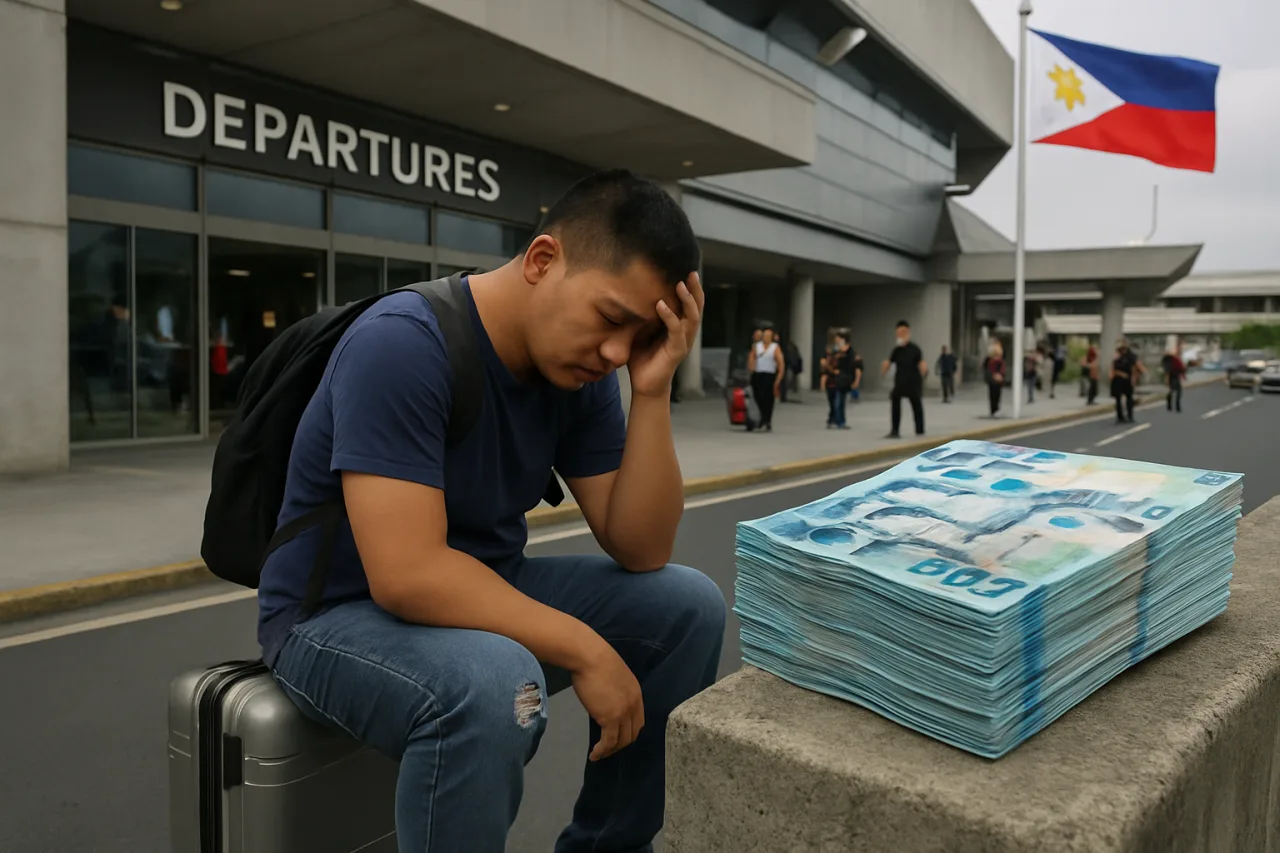
Fewer Filipinos are boarding planes for work abroad than at any point in the post-pandemic boom — and their families are receiving more money than at any point in history. Both statements are true at the same time, and together they describe the strange economy of 2026 for the millions of households that live off overseas work. The Department of Migrant Workers’ own figures show OFW deployment collapsing under the weight of the Middle East war, while Bangko Sentral ng Pilipinas data show remittances not just holding but compounding to fresh records. Understanding why those two lines refuse to move together — and what happens if they ever converge — is the money question for every Filipino professional with family abroad this year.
Related: EPS TOPIK Exam Guide: Eligibility, Registration and How Filipinos Pass
This is not a story about two statistics that happen to disagree. It is a story about timing: a shock to hiring today is a shock to remittances much later, and the gap between the two is where families, recruiters and policymakers are all living right now.
The Two Numbers That Don’t Agree
Start with the number that fell. Recruitment analyst Emmanuel Geslani, citing Department of Migrant Workers data on September 13, 2026, reported that 980,673 OFWs were deployed from January to July 2026 — down 34% from the 1,486,756 deployed over the same period in 2025. The first quarter was even uglier: deployment fell by roughly half in the opening months of the year after war broke out, as flights were cancelled and recruiters pulled job orders across the Gulf.
Then the number that rose. Cash remittances coursed through the banking system to a record $35.63 billion in 2025, up 3.3% from $34.49 billion in 2024, according to the Bangko Sentral ng Pilipinas. The momentum carried into 2026: January-to-June cash remittances reached $17.15 billion, up 2.4% year on year, with June’s $3.04 billion the highest monthly level of the first half. Include informal channels and in-kind transfers and personal remittances run close to $40 billion a year — a figure Migrant Workers Secretary Hans Leo Cacdac has described as roughly ₱4 to ₱5 trillion flowing into the Philippine economy annually.
A 34% collapse in new OFW deployments sitting beside record-breaking remittance growth is not a typo in one of the datasets. It is the signature of a specific kind of shock — one that stops the replacement of workers without stopping the work of the ones already there.
Why OFW Deployment Is Falling While the Money Keeps Flowing
The cleanest way to understand 2026 is the distinction economists have used through every previous Middle East crisis: deployment is a flow, OFW remittances ride a stock. Geoffrey Ducanes, the economist who has tracked conflict shocks to Filipino labor for years, put it plainly in March — remittances depend mainly on the stock of OFWs in the region rather than the flow, which is what deployment measures. Millions of Filipinos already hold contracts in Saudi Arabia, the UAE, Qatar and Kuwait. They keep working, keep getting paid, and keep sending money home. A war that closes the departure gates does not close the salary remittances of people already past them.
The flow, meanwhile, has been strangled by policy and logistics. Under the government’s alert-level system, an Alert Level 2 classification is already sufficient to ban the deployment of newly hired workers, and Iran carries a total deployment ban. When regional violence escalated, the DMW ordered recruitment agencies to suspend processing for several Middle East destinations, flights were cancelled, and — as Geslani noted — the wider economic activity that generates Gulf jobs in hospitality, transport, construction and events simply contracted. Secretary Cacdac has also described the phenomenon as countercyclical from the money side: precisely because conditions abroad are hardest, OFWs send more home, both to support relatives and to hedge their own uncertainty.
There is a third factor that has nothing to do with war: the direction of new hiring. The fastest-growing employers of Filipino professionals are no longer in the Gulf at all. The Philippines is now the world’s number two hub for global capability centers, and the hiring that is growing — healthcare in Japan, care work in Korea, hospitality in Europe — is diversifying away from the region where the fighting is. So the deployment slowdown is partly a Middle East freeze and partly a structural rotation in where the world wants Filipino labor.
What the Divergence Means for OFW Families
For households, the paradox lands very differently depending on which side of the departure gate you are on.
If someone in your family is already deployed: in the near term, your remittances are probably safe — and stronger in peso terms than ever. The peso’s slide to a record low near ₱63 means every dollar sent home converts into more pesos, one of the grim silver linings documented in our earlier coverage of the peso’s slide. History supports the resilience: in previous regional conflicts, remittances dipped briefly and recovered within months, because the workers stayed at their posts.
If you are a new applicant: the gate is narrower in 2026. Total deployment bans in the most affected countries, the processing suspensions for several Gulf destinations, and slower regional hiring mean fewer fresh contracts in the sector that historically absorbed the most first-time OFWs. First-time land-based hires — the ones who used to fill Gulf hotels, construction sites and clinics — are precisely the category alert levels freeze first. The practical advice from recruitment veterans this year has been consistent: verify agency licenses, track the DFA alert level for your destination before signing anything, and treat Middle East job orders promising quick deployment with suspicion until alert levels ease.
If you are planning the family budget: treat the remittance surge as a window, not a permanent state. The dollar’s strength will not last forever, and the stock of OFWs erodes slowly when hiring freezes persist — through contract expirations, repatriations and retirement that are no longer offset by new deployments. Finance Secretary Ralph Recto’s successor-facing planners are not the only ones who should be scenario-building; a family spending against a ₱5,000-stronger monthly conversion today should not anchor its school-fee plans to that same rate in 2027. Tools like the free OFW Toolkit can help families track remittance value and plan around the swings rather than around hope.
The Second-Order Effect on the Philippine Economy
Zoom out and the divergence gets more consequential. Remittances are roughly 8-9% of Philippine GDP and a pillar of the balance of payments; the BSP monitors the conflict’s risks to the flow, with Governor Eli Remolona noting that around 18% of remittances come from the conflict-affected region. As long as the stock holds, the external accounts hold. That is why the economy has been able to absorb a 34% deployment drop without a foreign-exchange crisis — the income stream is intact even as the pipeline that feeds it narrows.
But the lag effect is the risk to price into 2027. UnionBank chief economist Ruben Carlo Asuncion warned in July that remittance growth could be losing steam precisely because renewed US-Iran escalation threatens OFW employment and deployment in the Middle East. Goldman Sachs cut its 2026 growth forecast for the Philippines to 3.3% in August, citing inflation and slowing remittances. The arithmetic of attrition is unforgiving. Deployments in the first seven months of 2026 ran more than 500,000 below last year’s pace, and if the freeze holds for a full year the shortfall approaches a million contracts — a mid-sized Gulf labor market that never gets staffed. Each missing contract is not just one family’s missed paycheck; it is a future remittance stream that never starts. The stock of workers abroad has bought the economy a year of grace. If OFW deployment stays suppressed for another year, contract attrition starts eating the stock: every returning worker who is not replaced by a new hire is a remittance line that eventually goes quiet. The OFW deployment number today is the remittance number of twelve to eighteen months from now.
There is also a public-finance angle. The 2026 DMW budget grew 34% to ₱11.7 billion, a bet on reintegration and protection services that quietly assumes more returning workers, not fewer departures. A prolonged freeze makes that budget more important, not less — the state is financing the landing pad for a wave it did not cause.
What Would Turn the Tide
Three variables decide whether the deployment hole fills in 2027 or deepens. First, the DFA alert levels across the Gulf: every downgrade reopens a recruitment corridor, and the Gulf hosts the largest concentration of Filipino workers abroad. Second, the price of oil, which has climbed past $100 a barrel on the war’s supply disruptions — high oil both funds the regional economies that hire Filipinos and inflates the cost of deployment itself. Third, demand rotation: if global capability centers, Japan’s care-work program and European hospitality pipelines keep expanding, the sector mix of OFW deployment can rebalance away from the Gulf, restoring total OFW deployment numbers even if Middle East hiring never fully returns.
Watch the monthly DMW OFW deployment statistics and the BSP’s remittance releases side by side. The moment both lines move in the same direction — either both recovering or both rolling over — the paradox ends, and the story changes from “how is this possible” to “which way is it breaking.”
Frequently Asked Questions About OFW Deployment and Remittances
Why did OFW deployment drop in 2026?
The Middle East war triggered government deployment restrictions — including bans on newly hired workers under Alert Level 2 and a total ban for Iran — plus flight cancellations and shrinking Gulf job orders. DMW-cited data show deployments down 34% in January-July 2026 versus the same period in 2025, with the first quarter hit hardest.
Are OFW remittances still growing despite the war?
Yes. Cash remittances hit a record $35.63 billion in 2025 and grew 2.4% to $17.15 billion in the first half of 2026, with June the strongest month at $3.04 billion. Remittances track the millions of Filipinos already employed abroad, not the smaller flow of new hires, which is why they have stayed resilient.
What is the difference between cash and personal remittances?
Cash remittances are funds sent through formal banks and transfer channels; personal remittances add informal transfers and in-kind goods. Personal remittances run several billion dollars higher each year — close to $40 billion annually in 2025-2026 — which is why official statements sometimes cite different headline figures.
Which countries still hire the most OFWs?
The United States remains the largest source of remittances, followed by Singapore and Saudi Arabia among cash-sending countries. New hiring is shifting toward East Asia — Japan and Korea care-work programs — and away from the Gulf states most affected by the conflict.
Is it still safe to work in the Middle East?
It depends on the country and its current DFA alert level. Iran carries a total deployment ban; several destinations have restrictions on new hires. Check the alert level for your specific destination before signing any contract, and verify that your recruitment agency is DMW-licensed.
Will OFW hiring recover in 2027?
Recovery hinges on the DFA alert levels easing, oil prices stabilizing, and continued rotation of demand toward East Asia and Europe. Analysts expect the stock of deployed workers — and therefore remittances — to stay resilient through 2026, but a prolonged hiring freeze would slowly erode both into 2027.
Financial Disclaimer: This article is for informational and educational purposes only and does not constitute financial, investment or career advice. Readers should verify current government advisories and consult qualified professionals before making decisions based on deployment or remittance trends.